 |
 Packet lives!
 31 January 2011 | by
 I thought packet radio was all but dead. Yesterday I heard Richard MM1BHO mention that there was a packet node in Scotland on 70cm at the same location as the GB3LA repeater which is a monstrous signal here. I asked Richard to tell me the frequency so I could have a listen. I wasn’t optimistic about hearing anything as 70cm has always seemed a bit of a dead loss for me. I had to wait a while to hear anything, and when I did, I found the packet signal was 20dB over S9 which is the strongest signal I’ve ever heard on 70!
I then spent a couple of hours trying to sort out a way of receiving the packet. TrueTTY seemed like a good choice. It decoded the packets and displayed them on its screen. But I couldn’t find any software that would work with its virtual TNC.
I also tried AGW Packet Engine in sound card mode. That, too, decoded packets, so I got the AGW Terminal software as well. But I could not transmit. The software keyed the PTT when it was supposed to, but there was no audio modulation.
Finally I bit the bullet, shut down the APRS gateway and put the Kenwood D710 into packet mode. I then set up AGWPE to talk with the Kenwood’s TNC. That worked, and I was able to connect to the node whose call is GB7WD. I was wondering what to do next when Clive GM4FZH connected to me and I had my first chat over packet radio since the mid-1980s!

I’m afraid after all that time I have forgotten just about anything I knew about packet radio so I’m still pretty clueless as to what to do. I don’t know how to set up a mailbox, or even where to set one up. There seems to be a shortage of material on the interweb aimed at packet newbies (or oldies like me where the onset of Alzheimer’s has erased any memory of what we once knew!)
I think packet radio is something I will enjoy playing with again. I went back to AGWPE soundcard mode and found that the reason I was not getting any audio was because although the software says it uses the left channel which online references claim is the tip of the stereo jack, it was actually present on the ring. After resoldering the connector on the audio cable I was able to transmit packets as well as receive them, and G4ILO is now listening on the GB7WD frequency on the A side of my TM-D710 while my 2m APRS gateway is using the B side. There are just so many things to do in this hobby!

Julian Moss, G4ILO, is a regular contributor to AmateurRadio.com and writes from Cumbria, England. Contact him at [email protected].
CQ 160 CW
We got a dose of Mid-Atlantic winter weather last week—that once or twice a year event that is too much for the utilities and drivers to handle. Snow, sleet, freezing rain, and rain arrived on Wednesday. Power was out from 2030 LT to 0200 LT on Wednesday night/Thursday morning and then again from 1600 LT on Thursday to around 1100 LT on Friday. So, I didn’t get to operate NS this week on account of no power! I did think of going out to the car, but I was too wiped out and cold from the furnace blower being off. I just wanted to crawl under a big pile of blankets and sleep until the electricity came back on. As I have mentioned before, I grew up in an area with many Amish. A coworker many years ago was teasing me about finding an Amish girlfriend. I responded by asking him how an electrical engineer would fare in a society dedicated to not using electricity. He had to agree, although the Amish have rather ingenious mechanisms for harnessing electricity to do their work. But, as usual, I digress—we’re slightly dependent on electricity in ways we probably should not be!
I like contesting on 160 meters (1.8 MHz). When you call CQ, you are usually rewarded with blistering rate from loud stateside stations. When you’re tuning up and down the band, weak DX stations pop out from between said loud stateside stations. Now that I have something resembling a 160-meter antenna, I gave the CQ 160 CW contest a shot after some friends left on Saturday night. Another nice thing was that the station is working well enough (with the exception of the K9AY relays and possibly directivity) that I could just walk into the shack and operate.
So, that’s what I did… Only worked a handful of Europeans, but that’s not too surprising. They were loud here, even with 10 dB of attenuation in line to reduce IMD from really loud local stations. There were numerous other European stations that I could hear (on the TX antenna) but was unable to raise. But, in about four hours (three in the CQ 160 and one in the NAQP) of operating on Topband, I have only the hard states left for WAS from this QTH: ID, SD, ND, WY, AK, HI. I’m waiting for the LoTW confirmations to start showing up!
                    CQ 160-Meter Contest, CW

Call: K8GU
Operator(s): K8GU
Station: K8GU

Class: Single Op LP
QTH: MD
Operating Time (hrs): 3

Summary:
Total:  QSOs = 182  State/Prov = 48  Countries = 8  Total Score = 25,984

Club: Potomac Valley Radio Club
Ethan Miller, K8GU, is a regular contributor to AmateurRadio.com and writes from Maryland, USA. Contact him at [email protected].
ARRL January VHF Sweepstakes
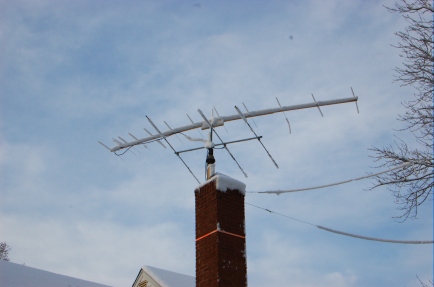
Last weekend (two weekends ago now), Sarah was out of town with friends from college, so I was free to meander in and out of the shack at will. Between making QSOs on 2 meters, I got a “modern” computer set up for SDR. More on this in the future. Was pleased to make some QSOs into New England with the “$200 VHF station” that consists of the TS-700S, Mirage B3016G amplifier, and homebrew FO12 antenna. Nevermind that the Pro-Set, Bencher, and Keyer cost at least that much again.
Still working on getting the other bands going. 50 MHz is very close, although with the recent sale of some extra gear, a K3 is almost within striking distance if I sold one the of the TS-930s. One of the locals has offered to lend me his FT-736R to get on 222 and 432 for now. So, I think I’ll try to finish up the 50-MHz transverter and pick up the ’736 while working on the antenna situation for those bands. I’m going to have to change the rotor/mast situation to do that. Not sure how that will go…I may just duplicate a “rover mast” and accept whatever sacrifice is introduced by stacking the beams too close together.
                    ARRL January VHF Sweepstakes

Call: K8GU
Operator(s): K8GU
Station: K8GU

Class: Single Op LP
QTH: FM19la
Operating Time (hrs):

Summary:
 Band  QSOs  Mults
-------------------
    6:
    2:  44     15
  222:
  432:
  903:
  1.2:
  2.3:
  3.4:
  5.7:
  10G:
  24G:
-------------------
Total:  44     15  Total Score = 660

Club: Potomac Valley Radio Club
Ethan Miller, K8GU, is a regular contributor to AmateurRadio.com and writes from Maryland, USA. Contact him at [email protected].
ICQ Podcast Series Four Episode Three – Magic 6m Band (30 January 2011)
Series Four Episode Three of the ICQ Amateur / Ham Radio Podcast. News Stories include:
- New Amateur Radio bill introduced in Congress
- Italian 145.800MHz repeater shuts down
- Radar intruders in Amateur bands
- Cadets’ using 5MHz WSPR clarified
- Contest University 2011
- FSTV beacon GB3CZ back to full power
- Mass SOTA/WAB activation planned
- Goonhilly rejoin deep space comms programme
- Celebrating 85 years of hospital radio
- D-Star active in Johannesburg
- Cell-phone to fly in space
Your feedback, upcoming events and Martin (M1MRB) discusses the 6m band.
Colin Butler, M6BOY, is the host of the ICQ Podcast, a weekly radio show about Amateur Radio. Contact him at [email protected].
ICQ Podcast Series Four Episode Three – Magic 6m Band (30 January 2011)
Series Four Episode Three of the ICQ Amateur / Ham Radio Podcast. News Stories include:
- New Amateur Radio bill introduced in Congress
- Italian 145.800MHz repeater shuts down
- Radar intruders in Amateur bands
- Cadets' using 5MHz WSPR clarified
- Contest University 2011
- FSTV beacon GB3CZ back to full power
- Mass SOTA/WAB activation planned
- Goonhilly rejoin deep space comms programme
- Celebrating 85 years of hospital radio
- D-Star active in Johannesburg
- Cell-phone to fly in space
Your feedback, upcoming events and Martin (M1MRB) discusses the 6m band.
Colin Butler, M6BOY, is the host of the ICQ Podcast, a weekly radio show about Amateur Radio. Contact him at [email protected].
Showing Brownies simple electronics

(Copyright V Steele)
Ginny, my wife, is a one of a group of leaders for a Brownie pack in a nearby village. Last week we showed the Brownies some simple electronics and they had some fun with a really simple circuit.
We had them put a number of LEDs onto a 3V button cell, rather like a LED throwies but without the magnet. Once they had an arrangement of three or four LEDs on a cell Ginny took photographs of them in a darkened room as they waved the LEDs around. Taking a photograph on a slow file speed setting (ISO 80) and over a relatively long period (15 s) the Brownies created some great art by ‘painting with light’. As well as the example above, a small selection is shown below.
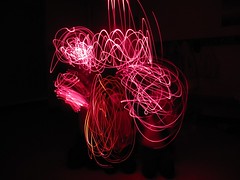

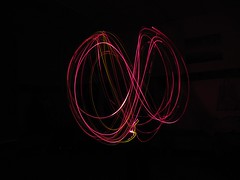
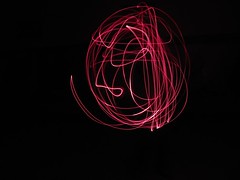
(All photographs copyright V Steele)
There was about 22 or so Brownies and we had them work on an LED ‘circuit’ in pairs. They really enjoyed the fun of arranging the LEDs and working out which way around to place them. However, I think they had the most fun with the ‘drawing with light’.
While some were involved with the photography I showed others the fun that could be had with electronics and how circuits could make things work. To do that I showed them how I could not light up an ultra-bright LED with a used 1.5V battery on its own. But, when I used a few components, connected into a Joule thief circuit, then the LED would light up brightly with the 1.5V battery. I also had some plastic optical fibre too and they had fun watching light bending around corners.
We kept the exercise simple and very visual and they all seemed to enjoy it.
If you want to make your own Joule thief you may find the Make magazine podcast below interesting and useful to watch.


Alan Steele, VA3STL, is a regular contributor to AmateurRadio.com and writes from Ottawa, Ontario. Contact him at [email protected].
Resonant Frequency Video Edition 1 (short Intro to Linux for Radio Operators)
This is a short introduction to Linux for Amateur Radio Operators showing a few things that are available for Amateur Radio.
Russ Woodman, K5TUX, co-hosts the Linux in the Ham Shack podcast which is available for download in both MP3 and OGG audio format. Contact him at [email protected].
 Ham Radio Deluxe |
 W5SWL Electronics |
 Ham Radio Prep |
 KB3IFH QSL Cards  Hip Ham Shirts  HamRadioAuctions HamRadioAuctions Reliance Antennas Reliance Antennas Enigma Shop Enigma Shop |  morseDX  Ni4L Antennas  R&L Electronics R&L Electronics antennas.us antennas.us QRV QRV |
- Matt W1MST, Managing Editor
