 |
 Boosting the VX-8GR on APRS
 10 March 2011 | by
 A few weeks ago I did an analysis of the audio levels of different APRS radios and lamented the low level of the audio transmitted by the Yaesu VX-8GR. An Italian ham wrote to me enclosing a copy of a document he obtained from Yaesu showing how to increase the transmit deviation. I decided to give it a try. You can find a copy of this document in the Files section of the VX-8R Yahoo group, but I will describe the process here.
Note that performing this adjustment will increase the transmit deviation on speech as well. There is no way to increase the packet deviation independently. Note too that while you are in the alignment menu it is possible to change other settings as well by accident. This may be undesirable, especially if you don’t have the test equipment to realign the radio properly, so be careful and perform the adjustment at your own risk! Finally, note that these instructions will work only for the VX-8GR. There are instructions for accessing the alignment menu of the VX-8R on the web. They don’t work for the GR and these instructions don’t work for the R. I have no idea if any of the instructions work with the DR.
To avoid entering the alignment menu accidentally, Yaesu has made accessing it quite difficult. First you must enable the CW ID (main menu item 16) and program a password AH041M into it. The manual explains how to do this. You must then set the transceiver to single band mode on the A band, in VFO mode (not memory) on a frequency of 430.000MHz. Now switch the radio off.
Press and hold the HM/RV key and turn the VX-8GR back on. If all the above steps were carried out correctly the radio should start up in alignment mode showing the first alignment setting. Rotate the control knob clockwise a few clicks to select the MAX DEV adjustment, then press the V/M button to select it. A pointer symbol should appear to show that adjustment is selected.
The control knob now adjusts the deviation setting. Make a note of the original value in case you want to reset it, then turn it up to 254. Yes, I know this sounds like a CB “screwdrivers to the max” tweak but as you can see from the spectrograms below, even at that setting the packet deviation won’t quite match that of the Kenwood rigs. Press the V/M button again to exit the adjustment, then press HM/RV to exit the alignment menu. The radio will restart in normal operational mode. Don’t forget to clear the CW ID once you’re happy with the new setting.
The spectrograms below show the difference made by the adjustment, with the Kenwood TH-D72 shown as a reference.

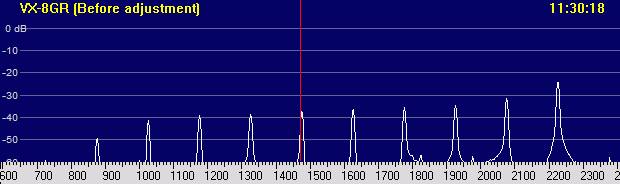

As you can see, the peak deviation of the high tone is now within 1dB of that of the Kenwood, though the Yaesu still has more low-frequency roll-off. Nevertheless, this is as good as it gets with the Yaesu. If you still can’t hit the digis you think you ought to, perhaps you’d be better off with a Kenwood.
As I said earlier, this deviation adjustment makes your audio louder as well. You, your local hams or your local repeaters might not like this. The VX-8GR has a “Half Deviation” menu option which will reduce the deviation back to approximately what it was before this adjustment, but it works across the whole radio and not per band, so you can’t have the wider deviation only on the APRS band.
It is interesting to note that in the Yaesu alignment document the deviation alignment is performed at 435MHz. I found that the deviation on 70cm is higher than it is on 2m. This appears to be a consequence of the way the radio is designed, as there are not independent deviation adjustments for the two bands. But this does explain to an extent why the deviation on 145MHz is lower than it should be.
Where I live, 70cm is completely dead and 2m is quiet so we can operate using 25kHz channel standards with no problems. Therefore I have not found this adjustment to cause any adverse effects and it certainly has improved the reach of my APRS packet beacons. Your mileage may vary.

Julian Moss, G4ILO, is a regular contributor to AmateurRadio.com and writes from Cumbria, England. Contact him at [email protected].
Handiham World for 9 March 2011
Welcome to Handiham World!

A couple of months ago my local radio club decided to bring back their monthly newsletter. The newsletter had been absent as a club communications tool for a few years, although there was a well-maintained website with frequent updates by multiple contributors. At least part of the reason the newsletter is returning to our club is that I suggested at one of the club meetings that it do so and that I would help to edit the new publication. So far, so good! There are two of us sharing editorial duties and several club members have stepped up to the plate and contributed columns and stories so that no one person is responsible for doing all of the work each month. Working together as a team allows the newsletter crew to turn out a good product that is an asset to the club.
But why is a newsletter still important in this age of constantly-available information that bombards us from every direction?
It’s hard to put one’s finger on exactly why people prefer one news and information source over another one. The obvious preference for a traditional means of reading the club news, a print newsletter format that has been successful for years, perhaps decades, is one consideration. If your club is anything like mine, there are going to be several club members who do not have computers and who feel left out without a monthly newsletter that they can actually hold in their hands and perhaps even mark or take notes on with a pencil. Although individual stories from a club website can be printed up for members who do not use computers, it really isn’t even close to the same thing as an official club newsletter that pulls together all of the information in one single publication. Then there will be the other club members who have and use computers but who still prefer the traditional print format. Even some people with advanced technical skills find a print newsletter more compelling and relaxing to read, especially if they sit in front of a computer screen all day long at the workplace. A print newsletter can also be passed on to another family member or a friend. A physical newsletter is not quite as easy to forget about as a web link that someone might give to you. A print newsletter can be read without any device or Internet access.
The last time I checked my calendar, it was 2011. With our feet firmly planted in the 21st century, even a print newsletter for your radio club must have a digital online edition. The reasons for this are pretty obvious; there will be people who prefer to read everything online. It is important that the club serve the newsletter up for these people on the website because doing so will save printing and mailing costs, probably for the majority of club members. In fact, our club seldom mails anything out these days, much less newsletters. It makes more sense to produce the newsletter in PDF, place it on the website as a download, and allow club members who want to read a print newsletter to go ahead and download and print the publication for themselves and for their friends. Several printed copies will be available to distribute at club meetings to members without computers. A few newsletters will be available to mail out to club members who are out of State for the winter or who are unable to get to a club meeting because of health or transportation issues. Furthermore, the PDF version necessarily contains embedded text that can be read by blind members who use screen reading technology.
So the club newsletter of 2011 is different from the club newsletter of 1991 or 2001. The differences are obvious even to club members who read the print edition. The layout and color photos wouldn’t be possible without modern software like Microsoft Publisher. The content itself is available 24/7 on the club website for club members to explore months or years after it was first published. Articles are searchable by computer. Content is accessible to blind computer users. Before all of this new technology came along, club newsletters were pretty basic-looking monochrome publications that were sometimes done on mimeograph machines. There is no doubt that the 21st century amateur radio club newsletter can be a pretty impressive looking publication!
However, the newsletter still serves the same basic purpose of communicating to club members in a way that it always has. Monthly meeting announcements and notes, things that are happening in the lives of radio club members, amateur radio news of broader importance to everyone, club calendars, regular columns by club members or officers, minutes from the previous month’s meeting, and all of the other timely news collected in a single place each month make up the traditional content of a typical monthly issue. The newsletter is fundamentally different from a website in that it represents information that has been collected, edited, arranged, and presented in a very specific way at a specific point in time by editors. The monthly publication, once posted on the website, is the official newsletter for that month. This may be seen as hopelessly outdated by some people who cannot understand why anyone would want to look at a news source that isn’t constantly updated, but on the other hand may be seen as a huge asset by others who don’t care to devote the time and attention to a club website where information overload can lead to missing important stories that might not be near the top of the pile of information.
One of the problems club websites have is simply that they must compete with hundreds of other websites for our attention every day every month every year every hour. Although at the time dropping a regular monthly newsletter seemed like a good idea, having the newsletter as a single point of collected information each month now seems like it is a little bit too important to give up just yet. That is the reason that I volunteered to help edit my club’s newsletter. Yes, it is another thing to do in my already busy life, but I know that I have the ability and desire to help my radio club in this activity and I realize that making a radio club a successful endeavor is something that requires all of us to roll up our sleeves and pitch in. I would like you to think about how you are helping your local radio club to be the best possible organization it can be. You may not be able or interested in editing a club newsletter, but you may have time to write an article or a monthly column about one of your amateur radio interests. You may have time to write an occasional column, perhaps promoting Handihams or the Handiham nets to your local club via the club newsletter or website. If you are simply not a writer, there are still plenty of other opportunities to participate in your club’s activities. Although showing up for meetings is important, your radio club will be better off and you will have more fun if you sometimes raise your hand to volunteer to help put together the club’s field day activities or the club picnic. Monthly meetings are generally divided into the business part of the meeting and some kind of club program. If you have a special interest in amateur radio and would like to put on a program for your club, I’d be willing to bet just about anything that you would be welcomed with open arms. Most clubs are eager to find presenters for the club program, instructors for their licensing classes, and volunteer examiners for their VE teams.
I guess my point is that you can’t be afraid to step forward and do something for your local radio club, whether it is working on the newsletter or some other club project or on the air activity like the net or the repeater. Every active organization will have volunteer opportunities. I hope you will step up to the plate. You will have more fun and your club will be the better for it!
Patrick Tice, WA0TDA
Handiham System Manager
[email protected]

FCC issues three accessibility-related NPRMs – Handiham members might want to comment!

Washington, D.C. – As part of its ongoing efforts to implement the “Twenty-First Century Communications and Video Accessibility Act of 2010” (CVAA), the Federal Communications Commission issued three Notices of Proposed Rulemaking (NPRMs). The CVAA is considered the most significant piece of accessibility legislation since the passage of the Americans with Disabilities Act in 1990.

Pat Tice, WA0TDA, is the manager of HANDI-HAM and a regular contributor to AmateurRadio.com. Contact him at [email protected].
Sign of things to come?
I finally got caught up with things so I could find time to experience the HF band conditions everyone has been talking about. I put the K3 on 10m WSPR while I was doing my computer jobs. I missed some chances of being heard because the WSPR rig control doesn’t switch the K3 into DATA mode and in SSB mode only the microphone is live not the line input. My apologies if the sound of typing affected anyone’s WSPR reception! After spotting the error and correcting it I was received by five VK stations, which is quite pleasing for 20 watts to an attic dipole!
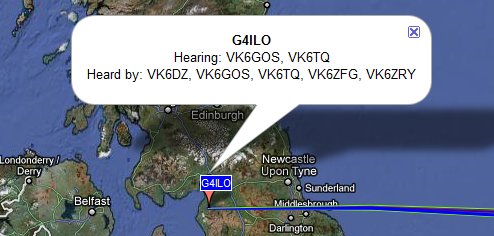
When I was finished with the computer I had a listen around the 10m band. There wasn’t as much happening as the WSPR results would suggest so I tried 12m, where some PSK31 was heard. After making one contact there (ER1RY, Moldova) I went back to 10m and saw some faint traces. I worked several Russians and heard but didn’t work three South African stations. I was also spotted from Madagascar by someone on the PSK Reporter site. That would have been a nice contact! I checked the SSB end from time to time but only heard a handful of signals too weak to work.
Ten metres is one of my favourite bands so it is great to see some signs of life. But I fear that improved propagation is going to bring problems for digital mode enthusiasts. As Paul, PC4T complains in his latest blog post, when you get good propagation people operate wherever they can within the band plan so the weak signal modes get trampled over by the wide, loud modes.
Unfortunately there is no “gentleman’s agreement” that says PSK has exclusive use of 14.070 – 14.072 or that only JT65A can be used from 14.076 to 14.078. Here in Europe, even the band plan separating CW, digital and voice modes is only a gentleman’s agreement. The frequencies mentioned above, like the QRP frequencies and others, are just “watering holes” that benefit people who operate those modes but can be ignored by others with no fear of any official penalty.
There has been an explosion in the use of digital modes over the last few years as more hams connect their computers to their radios and discover sound card software. The effect of this has mainly been that you could often find PSK31 activity when nothing else could be heard. Poor conditions have prevented the bands from getting too overcrowded.
But with better propagation people are going to be fighting for space. PSK is going to need to spread beyond its usual 2kHz on the most popular bands, as will JT65A. The “modes du jour” most of which offer no significant benefit over those that already exist will cause confusion by operating on top of one another. And the outmoded, inefficient RTTY, for which no technical justification for its continued use exists, will stomp over everything running the legal limit just as it always has, only this time more people are going to have their contacts spoiled and get angry about it.
It’s going to be a fun few years!

Julian Moss, G4ILO, is a regular contributor to AmateurRadio.com and writes from Cumbria, England. Contact him at [email protected].
Good Design
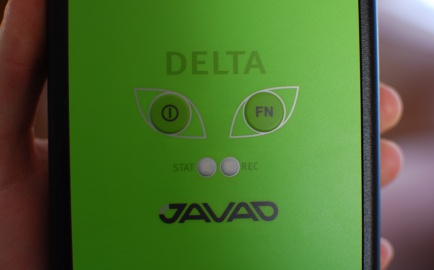
Good design by Javad, just like the arrow hidden between the ‘E’ and ‘x’ in FedEx.
Ethan Miller, K8GU, is a regular contributor to AmateurRadio.com and writes from Maryland, USA. Contact him at [email protected].
March 144/432MHz contest and a special mention to IS0BSR
Last weekend was busy, but I managed a few minutes on Sunday morning to listen to 144/432MHz and make a few QSOs during the contest. I had forgotten that it was a European co-ordinated contest, so there was plenty of activity from all over EU and conditions were quite good.
My best QSOs were F5OOM/P in JN38 and DF5GZ/P in JN47 on 144MHz. F1ISM was the best DX on 432MHz from JN09. But around 0800z, I was tuning up and down the band and I heard a great meteor burst from IS0BSR – I called him but sadly the burst wasn’t long enough!
However, this evening, I e-mailled Marco, IS0BSR to let him know that I heard him and he sent me a link to this great video of his contest activity from the weekend! Fascinating to see the station that allowed me to hear his 144MHz signals all the way from Sardinia!

Tim Kirby, G4VXE, is a regular contributor to AmateurRadio.com and writes from Oxfordshire, England. Contact him at [email protected].
Look out, Yaesu
Chinese-made VHF and UHF hand-held radios are no longer the novelty they were a few years ago when I discovered the Jingtong JT-208 and got one to try. They are no longer the shoddily made bits of junk the Jingtong was, either. Some Chinese makes like Wouxun are now directly imported into the UK and USA so unadventurous buyers don’t have to take chances on eBay. But there are better bargains and more choices to be had if you use the auction site. When I saw a smartly styled compact VHF handheld radio transceiver 136-174MHz being sold for only £40 it looked like just the job for keeping downstairs to monitor my Echolink node and acting as a backup radio for WOTA activations so I decided to order one. Shipping from Hong Kong took one week.
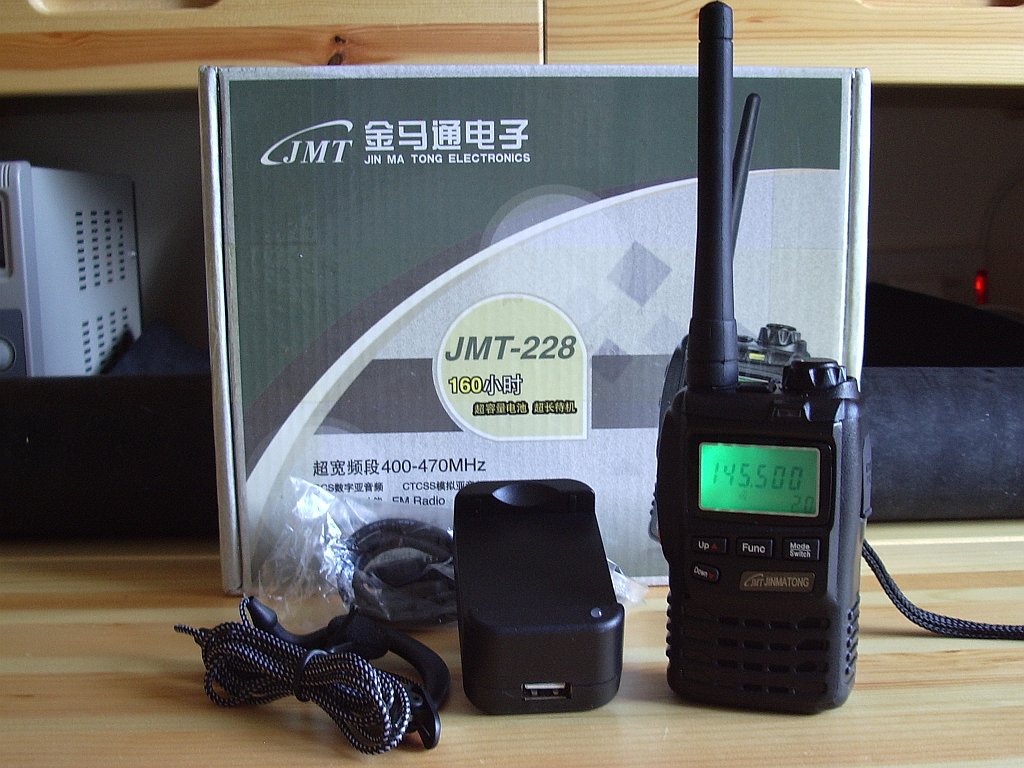
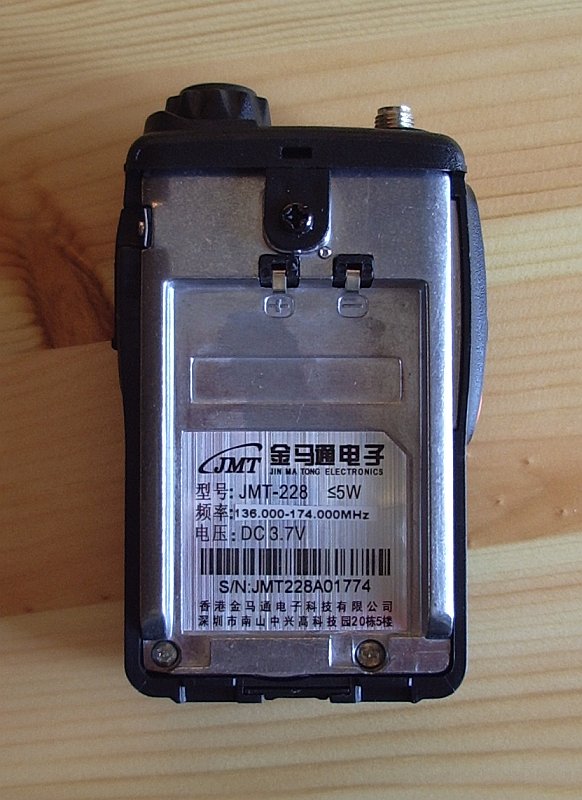 The radio is a model JMT-228 and is made made by Jin Ma Tong Electronics, which is not a company Google has much information about. Whilst tearing off the wrapping I experienced a heart-sinking feeling as the box was revealed together with the description “400-470MHz.” I was afraid the seller had sent the wrong model! Inspection of the manual revealed the radio comes in VHF and UHF versions, and when I looked at the back of the radio the label showed “136.000-174.000MHz.” What a relief!
Together with the radio and manual, the box contains a short helical antenna, a metal belt clip, a carrying strap, a 1500mAhH 3.7V Li-Ion battery pack similar to those used in mobile phones and digital cameras, a 100 – 240V AC charger with fold-out US-style mains plug, a USB cable (presumably used only for charging as there is no mention in the manual of programming software) and a hands-free style speaker microphone terminated in a 2.5mm stereo jack.
Here is an “unboxing” video (not made by me) from YouTube:
The JMT-228 is very light (the manual amusingly gives the weight as 200kg including the battery!) and looks rather similar to the early Yaesu VX models. It’s a bit smaller than the compact VX-8GR as you can see from the photograph below. The build quality seems very good. The radio is built on a die cast chassis as you can see when you put in the battery. It doesn’t have quite the same solid feel as a Yaesu but the light weight is a bonus. The belt clip is metal but a bit flimsy and it is fixed to the radio using one screw. There is no retaining lug (although the clip has a hole for one) so unless you tighten the screw so hard you risk stripping the threads it could rotate allowing the radio to fall off the belt.
The glass in front of the display is actually plastic which scratches rather easily – there are a couple of dings in it already that I don’t remember doing. A small thing perhaps and forgiveable at the price but something many hams won’t think about as we take the high quality of ham radio products for granted.

No claims are made that the radio is waterproof. Indeed, the manual warns: “Never expose the transceiver to rain, wet areas or any liquids, or it may be damaged. However, the speaker/mic and USB/charger sockets have stout rubber covers and another page in the manual states: “The transceiver is not fully water-resistant while using the speaker/microphone” which implies that it could be. The JMT-228 certainly doesn’t look any less waterproof than the Yaesu VX-8GR so it could probably withstand the odd rain shower, but don’t quote me on that as I haven’t tried getting it wet just to see what happens.
The manual is in Chinese and English. The English part is well written for a Chinese radio, though the most important part, describing the “Auxiliary Fuctions” (sic) is squashed into two pages and less well written so you need to do some guesswork to determine some of the functions. RC sets the CTS or DCS tones for receive, TC sets them for transmit. TOT sets a time-out timer. OFFS sets the direction of offset for repeater use, a different menu OST sets the amount of the offset.
There are 99 memories and they store the offset and tone settings in force at the time of programming. It took only a few minutes to enter in the 2m simplex channels, the three local repeaters and my Echolink node settings. Memory mode is clearly the way to use this radio on the amateur bands as it does not have automatic repeater shift as found on dedicated ham radios.
There is a scan mode, which simply scans all the memories. There is also an FM Radio mode that lets you listen to Band 2 FM radio frequencies. The sound quality isn’t the greatest for listening to Classic FM or BBC Radio 3, but it’s usable.
The antenna socket is an SMA type. Surprisingly for a Chinese made radio it is an SMA female, the same as that used on radios from Yaesu, Icom and Kenwood, so you can use the same SMA-M accessory antennas you could use on those radios. I can even use my SMA to BNC adapters! The supplied antenna is 4 inches long, presumably a helical whip, and fairly broadband with the best match, a 1.6:1 SWR, at 156 MHz. This isn’t going to be optimum (tests I have carried out in the past have showed that a noticeable benefit is gained by tuning short helical antennas to match the frequency of use) but it is no worse than the antennas supplied with Kenwood handhelds and only to be expected in a radio designed to operate over such a wide band.
The receiver sensitivity seems on a par with other handheld radios I own. Output power is claimed to be less than or equal to 5W. Frankly, I would not expect to get 5W out of a radio powered by a 3.7V battery pack. If you did, it would get very hot very quickly and the battery would soon run out. I measured the output power at 3W which I think is very good for a radio of this size. I had no trouble opening the GB3LA repeater more than 50 miles away using a 7 inch long helical (but not with the supplied antenna.)
There is no low power setting, which is a bit of a disappointment and will not help battery conservation. On receive, however, the radio seems to run forever, helped no doubt by a quite severe power saver mode. This does not appear to be user configurable nor can it be disabled so you could not use this radio to receive packet or APRS.
The modulation using the internal microphone is OK, but a bit on the low side. Using the included speaker/mic it is a bit better. Note that although this speaker/mic is similar to a hands-free mobile phone kit, the JMT-228 transceiver does not have VOX, so it is necessary to key the transmitter by pressing the button on the back of the mic. Here are some audio recordings of the JMT-228, with a couple of other hand-held radios for comparison purposes.
- JMT-228 using internal microphone
- JMT-228 using provided external speaker-mic
- Old Trio/Kenwood TH-205E with internal mic
- Motorola GP300 with internal mic
As you can hear, the audio level is similar to the Motorola GP300, another radio designed for use on the professional high bands. Amateur band radios tend to have a higher modulation similar to the TH-205E.
When using the speaker/mic I found that the transceiver tended to lock in transmit – presumably due to RF getting into the speaker/mic cable which is right next to the antenna. This is a bit of an annoyance, which could possibly be cured using a really small snap-on ferrite if I had one.
Despite a few niggles I think the Jin Ma Tong JMT-228 transceiver is a nice little radio and would be a good buy for anyone wanting an inexpensive and compact transceiver for use in the amateur 2m band. I think the Chinese are going to own the market for basic single or dual band handhelds very shortly and people will only buy from the specialist manufacturers if they need specialist functionality such as APRS, wide band scanning, a short wave receiver or even, dare I say it, D-Star.

Julian Moss, G4ILO, is a regular contributor to AmateurRadio.com and writes from Cumbria, England. Contact him at [email protected].
Out of touch
Olga and I returned yesterday from a long weekend in Birmingham. That sounds like one of those joke competition prizes doesn’t it? “First prize, a week’s holiday in Birmingham, second prize two weeks!” But that would be unfair to Britain’s second largest city. It was the first time either of us had visited it and I wasn’t sure what to expect, but we liked it a lot. It is clean, modern and prosperous and there are entertainments and amusements to suit all tastes.
We went to a ballet at the Hippodrome Theatre, a concert at the Symphony Hall, visited the National Sea Life Centre, the Botanical Gardens, Winterbourne House and Gardens and the art gallery and museum. But on Saturday night the place was heaving with squealing teenage girls wearing clothes so skimpy, despite the near freezing temperatures, that I was concerned for their health. They were there for a concert by someone called Justin Bieber, whom we had never heard of, but who is apparently the current teenage heart-throb.
I didn’t take a ham radio. I looked at the APRS map for Birmingham and it appeared to be a bit of an RF desert. The only repeater near enough the centre to be accessible using a handheld was D-Star. So I decided to save a bit of weight and space in my suitcase and give the hobby a break.
I switched off my mobile when we went into the theatre on Friday evening (to avoid the embarrassment of it ringing during the performance) and didn’t switch it on again until Monday when we were preparing to leave. That wasn’t a deliberate intention to be incommunicado so much as absent mindedness. I didn’t miss it, so it never crossed my mind to switch it back on. Having grown up in a house that didn’t have a home phone, and having only been persuaded a few years ago that a mobile would be useful “just for emergencies”, it has never concerned me that when I am away from home I am out of touch.
But it seems to me that many people can’t bear to be disconnected for half an hour, never mind a weekend. On the bus, on the train, walking along the street, even in the theatre during the interval people were staring at the tiny screens held in front of their face. There is a TV advert – I think it’s for the iPad – in which, apparently without irony, people are shown clustered round a screen while a fabulous view or famous building goes unnoticed in the background. In the Birmingham Botanical Gardens one woman appeared engrossed in interacting with her Blackberry whenever we saw her, ignoring the plants. Do these people ever switch off? If you are constantly connected, receiving a continual stream of information which you must absorb or respond to, when do you get time to think, to dream, to appreciate the real world around you?
Technology was supposed to be our slave, helping us to do things more easily. But it seems to have become a drug. The technology itself is amazing, but for me the most important feature is the ability to switch it off.

Julian Moss, G4ILO, is a regular contributor to AmateurRadio.com and writes from Cumbria, England. Contact him at [email protected].
 Ham Radio Deluxe |
 W5SWL Electronics |
 Ham Radio Prep |
 KB3IFH QSL Cards  Hip Ham Shirts  HamRadioAuctions HamRadioAuctions Reliance Antennas Reliance Antennas Enigma Shop Enigma Shop |  morseDX  Ni4L Antennas  R&L Electronics R&L Electronics antennas.us antennas.us QRV QRV |
- Matt W1MST, Managing Editor
