 |
 Out of touch
 8 March 2011 | by
 Olga and I returned yesterday from a long weekend in Birmingham. That sounds like one of those joke competition prizes doesn’t it? “First prize, a week’s holiday in Birmingham, second prize two weeks!” But that would be unfair to Britain’s second largest city. It was the first time either of us had visited it and I wasn’t sure what to expect, but we liked it a lot. It is clean, modern and prosperous and there are entertainments and amusements to suit all tastes.
We went to a ballet at the Hippodrome Theatre, a concert at the Symphony Hall, visited the National Sea Life Centre, the Botanical Gardens, Winterbourne House and Gardens and the art gallery and museum. But on Saturday night the place was heaving with squealing teenage girls wearing clothes so skimpy, despite the near freezing temperatures, that I was concerned for their health. They were there for a concert by someone called Justin Bieber, whom we had never heard of, but who is apparently the current teenage heart-throb.
I didn’t take a ham radio. I looked at the APRS map for Birmingham and it appeared to be a bit of an RF desert. The only repeater near enough the centre to be accessible using a handheld was D-Star. So I decided to save a bit of weight and space in my suitcase and give the hobby a break.
I switched off my mobile when we went into the theatre on Friday evening (to avoid the embarrassment of it ringing during the performance) and didn’t switch it on again until Monday when we were preparing to leave. That wasn’t a deliberate intention to be incommunicado so much as absent mindedness. I didn’t miss it, so it never crossed my mind to switch it back on. Having grown up in a house that didn’t have a home phone, and having only been persuaded a few years ago that a mobile would be useful “just for emergencies”, it has never concerned me that when I am away from home I am out of touch.
But it seems to me that many people can’t bear to be disconnected for half an hour, never mind a weekend. On the bus, on the train, walking along the street, even in the theatre during the interval people were staring at the tiny screens held in front of their face. There is a TV advert – I think it’s for the iPad – in which, apparently without irony, people are shown clustered round a screen while a fabulous view or famous building goes unnoticed in the background. In the Birmingham Botanical Gardens one woman appeared engrossed in interacting with her Blackberry whenever we saw her, ignoring the plants. Do these people ever switch off? If you are constantly connected, receiving a continual stream of information which you must absorb or respond to, when do you get time to think, to dream, to appreciate the real world around you?
Technology was supposed to be our slave, helping us to do things more easily. But it seems to have become a drug. The technology itself is amazing, but for me the most important feature is the ability to switch it off.

Julian Moss, G4ILO, is a regular contributor to AmateurRadio.com and writes from Cumbria, England. Contact him at [email protected].
More “Cheap Yagi” construction notes: push nuts
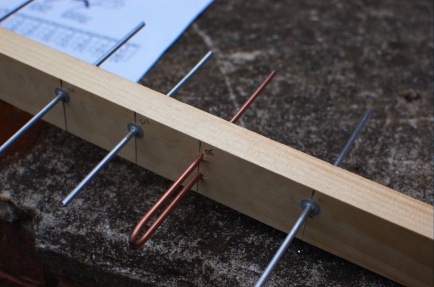
As I have mentioned in previous posts, I am a fan of the WA5VJB “Cheap Yagis” as described by W0FMS. One of the construction techniques W0FMS describes is the use of a “push nut” to secure elements to the boom. I bought some push nuts from McMaster last week. Since Mom and Dad were in town over the weekend, I took the opportunity brainstorm with Dad about methods and mechanisms for installing the push nuts. McMaster would have happily sold me a tool for $60, but as usual, I was feeling thrifty.
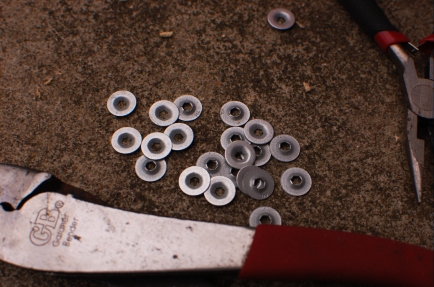
And, this is what a push nut is. They come in various sizes. These are for 1/8-inch shafts (McMaster part number 94807A024).
Here is a jig with an oversized (3/16-inch hole) for installing push nuts:
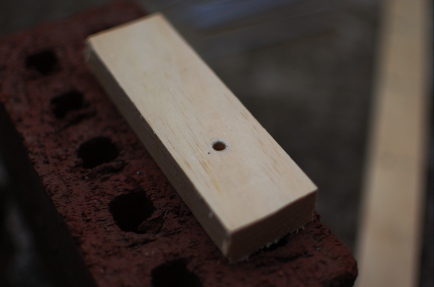
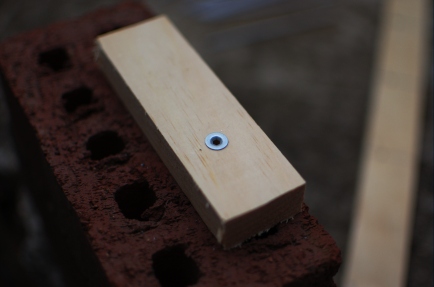
With a push nut fitted:
Dad demonstrates operation of the jig (why yes, those are tower sections in the background):
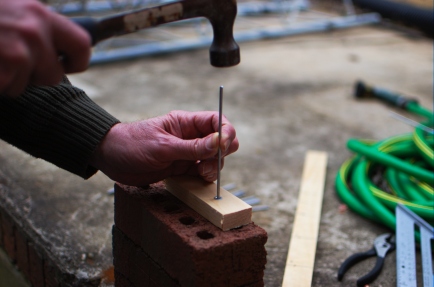
Demonstrating how to do the other side, notice that the installed (top) push nut works as a positive stop:
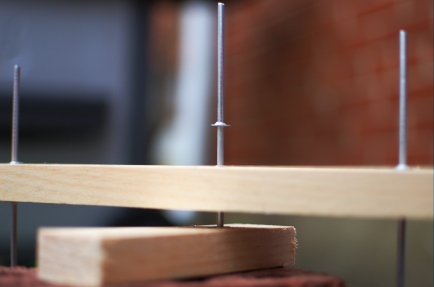
And, a (nearly) finished 10-element Yagi for 903 MHz:
Ethan Miller, K8GU, is a regular contributor to AmateurRadio.com and writes from Maryland, USA. Contact him at [email protected].
Triple Play / LoTW status
Happily, Sarah returned from Texas last night. You don’t always know how much you miss your spouse until they’re not around. But, she (and the baby—we’re expecting in July—very excited) is (are) home again!
She also brought the Trusted QSL-containing MacBook home safely and I uploaded my RTTY log to LoTW. Got a whole bunch of matches! So, the Triple Play award from the Maryland QTH is indeed coming along nicely: CW 50/50 – PH 34/50 – DG 29/50. Lots of easy ones still needed. Also have 31/50 states on 160 (lacking easy confs like VA, for instance?!). It’s also amusing to have more states on 2 meters than 15 meters. I guess I should spend some time on the high bands. 
Ethan Miller, K8GU, is a regular contributor to AmateurRadio.com and writes from Maryland, USA. Contact him at [email protected].
VHF/UHF Tropo
With the high pressure over the last couple of days, conditions have been good on VHF/UHF. The only chance I’ve had to operate has been whilst I’ve been mobile, but there have still been interesting things to hear.
Listening on 145.650 last night as I was driving home, I could hear ON0WV weakly but clearly. This morning, the Bedford repeater, GB3BF was easily audible in Oxfordshire on 145.7875. I gather that there was good activity on SSB last night on 144MHz with DK1CO (JO63) and a number of Dutch stations being worked.

Tim Kirby, G4VXE, is a regular contributor to AmateurRadio.com and writes from Oxfordshire, England. Contact him at [email protected].
Albrecht AE2990AFS – 24/28MHz portable
Thanks to Julian, G4ILO for drawing my attention to the Albrecht AE2990AFS portable rig on his blog.
As Julian describes, the rig is actually a multimode, multistandard CB rig, but it can be very readily converted for amateur bands use.
With solar activity starting to improve, it seems, 24 and 28MHz should become much more interesting and full of possibilities. Of course, low power and simple antennas will not always get through, but as conditions improve, so will your chances.
I was part of the team that operated from the Comoros islands as D68C back in 2001 and for many of the operators, one of the memorable QSOs that we had was with a portable station in California who was using a handheld 28MHz radio at a bus stop! And one solar cycle before that, I remember listening to mobile stations driving around Tokyo, Japan whilst I was using converted CB rig with a 28MHz vertical in the loft.
As I’ve already got an FT817 it would be hard to justify spending money on the Albrecht, but it certainly looks like a lot of fun and I can imagine them becoming popular.

Tim Kirby, G4VXE, is a regular contributor to AmateurRadio.com and writes from Oxfordshire, England. Contact him at [email protected].
Knott entirely as planned
Yesterday was one of those clear, blue, sunny, still, cold days that make you think it would be a criminal waste to stay inside. I decided to try another Wainwrights On The Air activation using my WOTA Pole, which had been rebuilt since Sunday’s disaster. My intention this time was to visit the summit of Knott, LDW-082, followed by nearby Great Calva, LDW-095. I took the VX-8GR for APRS but this time I also took the Motorola GP-300 to use for the activation which I hoped would avoid the receiver overload problems experienced with the Yaesu.
The weather may have been bright, but I was not. Sometimes I seem to get periods of a few days when although physically I may be awake, mentally I am not. Fortunately I hadn’t driven far before I realized I had not put walking boots in the car, so a complete disaster was averted. That wasn’t the only silly mistake I was to make, though.
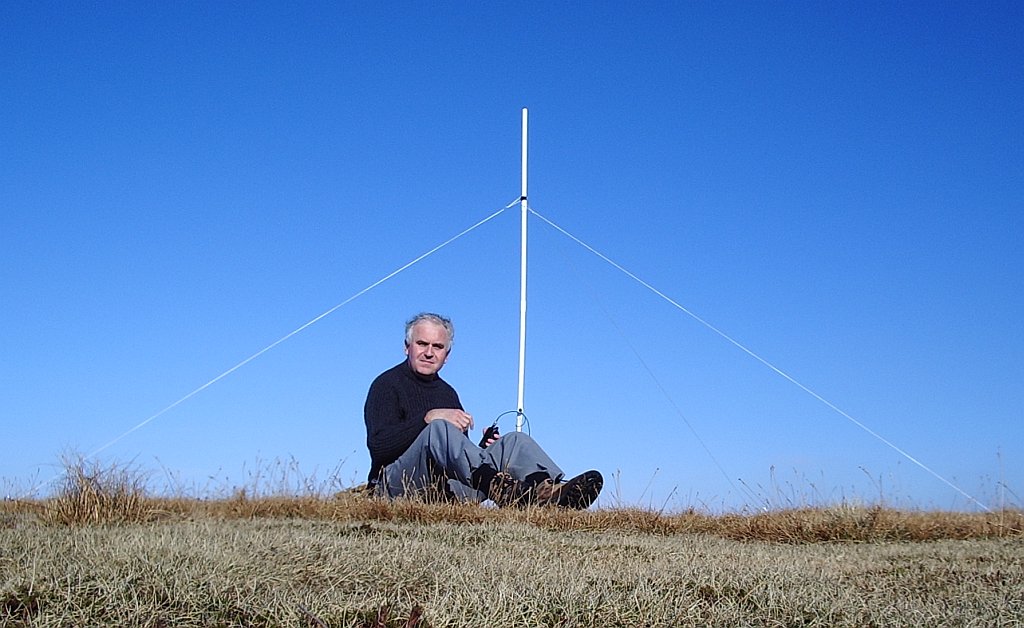
I parked at the head of Mosedale and started walking up the Cumbria Way path. I approached the structure you can see from the starting point, which turned out to be a large garden shed! The path seemed to be taking me near to High Pike so I thought I would make that my destination and visit Knott on the way back.
As I approached the “shed” I heard people making contacts with another hilltopper, Gordon G0EWN/P on Grey Knotts. I took the VX-8GR from the rucksack and made several calls using the helical whip as he completed each contact but he always replied to someone else. After ten minutes of standing around I decided to shoulder the rucksack again and continue climbing while holding the radio. I called several times when Gordon listened for “any more calls” but he was not hearing me. I don’t know why that was – another case of a radio front end being overloaded by high signal levels on the fell-top perhaps?
I reached a grassy summit topped by a tiny cairn and checked my position and realized that I was further from High Pike than I thought. I also then realized that I didn’t have my walking stick! I must have left it by the “shed” when I stopped to try to work Gordon! I turned round and went back. I retrieved my stick, but having wasted half an hour I decided to abandon High Pike and carry on to Knott instead.
I arrived at Knott still in sunshine with clear blue sky, the distant summits slowly disappearing in the haze. Although it was calm enough to try using the WOTA Pole supported in my rucksack I decided to use the guying kit from the MFD that I’d brought with me in case of windy conditions to avoid the trouble I’d had on Sunday. That cost the antenna some height, but on the plus side it allowed me to operate sitting down which I was glad of as I’d been climbing for over 2 hours by this point. Whilst I ate my lunch I connected the VX-8GR to the WOTA Pole and it was picking up APRS packet bursts from as far afield as Norway and Holland. VHF conditions were obviously up.
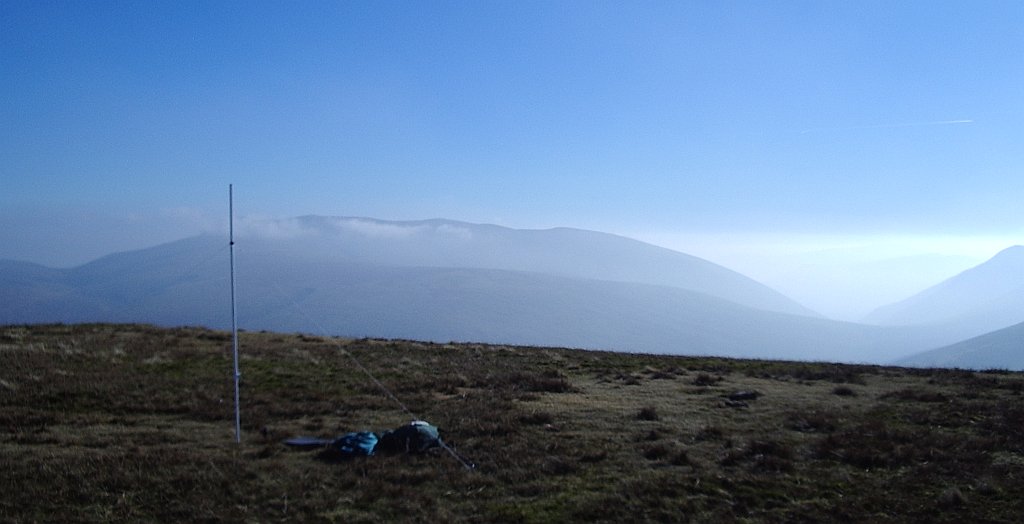
When I finished my lunch I connected the GP-300 to the antenna. This was when I discovered I’d brought the wrong speaker-mic. One of the hazards of owning too many hand-held rados I suppose! It was not a major problem of course, as I could use the radio without it. I made several contacts from the summit of Knott the most distant of which was G6ODU in Ormskirk, Lancashire, not a bad haul from the North Lakes.
The wind was so calm my Olympus voice recorder logging device was able to make a high fidelity recording of the activation. In case anyone is interested to hear what it sounds like at the sharp end of a WOTA activation here is a recording of about 8 minutes of activity. The loud, punchy audio from the Motorola GP-300 really helps so you can hear both sides of the contact equally well. Some of the quality has been lost compressing it down to an MP3 file of reasonable length but it’s still almost like being there!
I would have liked to stay on the hill longer to see what else I could work, or even move on to Great Calva to activate that, but a thick bank of mist was approaching and I didn’t want to be up there in mist. There are few clear paths on these infrequently walked grassy summits and without any landmarks to aim for it would be easy to get lost. Even though the visibility was clear I still went the wrong way off the fell and hit the Mosedale to Skiddaw House path much closer to Skiddaw House than to Mosedale. That cost me an extra 3km or so of walking to reach the car, by which time the mist had arrived and the sky was a grey murk.
This was long walk for only one summit activated. I could have made more if I’d had my wits about me and things had gone according to plan. But on a day like this it’s good to be out however many summits you activate!

Julian Moss, G4ILO, is a regular contributor to AmateurRadio.com and writes from Cumbria, England. Contact him at [email protected].
LHS Show Notes #057
Introduction:
- Hacker Public Radio promo.
Announcements:
- Check out the Mid-America GNU/Linux Networkers Conference (MAGNet Con) website for the latest news and registration information. (Note: the event has been postponed until 2012.)
- Take a look at the LHS website for some new screencasts.
Topics:
- Richard and Russ talk about the origins of the LHS podcast name. See Linux on the Desktop podcast.
- Richard talks about how to build a Delta loop antenna, and using a piece of 75 ohm coax to act as a matching transformer between the antenna and the 50 ohm feed line. He also describes velocity factor for coaxial cable. Here’s an illustration of a 20m Delta loop similar to what Richard describes.
- Just for fun: Fab’s Crap Alert
- linSmith, in the Debian repositories, is a program for plotting Smith Charts, and more.
- Richard then talks about Henry Allen W5TYD, formerly K5BUG, of Texas BugCatcher antenna fame, and the inductors he wound around Plexiglas forms. (Henry ceased production of his antennas in 2009 and has retired. -Ed.)
- Russ uses an Alpha Delta DX-CC multiband dipole, in preference to a G5RV dipole.
- Other antennas mentioned:
- Barker Williamson
- Resonant dipole antennas
- 135′ doublet (I use a 4:1 balun and an LDG autotuner. -Bill)
- Impedance of transmission lines: 50 ohms for communications coaxial cable, 75 ohms for cable TV coaxial cable, 300 ohms for the old TV twinlead, 450 ohms for window line, and typically 600 ohms for ladder line.
- Richard explains Standing Wave Ratio (SWR).
- Richard relates an Field Day story from several years ago… Commodore-64 running packet radio on the tailgate of a truck in 100-degree heat, and burning up the C-64.
Feedback:
- Audio feedback from Frasier K. thanking our hosts for the podcast. He’s currently studying for his ham license via HamTestOnline, and learned about Linux from the podcast. He’s now running Ubuntu 10.10 on his laptop and rockbox on his iPod. He’d like some sort of automatic calendar reminder service to alert him when a new episode will be recorded. Thanks, Frasier, and we’ll look into that.
- Mitch, KC2MBN, says that he enjoys the podcast. He’s now an Extra class licensee, but is new to Linux. He recently tried dual-booting Windows 7 with Pinguy OS and reports some troubles, and asks for some recommendations for a distro. Thanks, Mitch. If you have a spare machine, it would be better to run Linux on that rather than going to the trouble and risk of dual-booting. You might try actual Ubuntu, Debian or Linux Mint. Crunchbang Linux is also easy to install, as is PCLinuxOS.
Contact Info:
- Contact Richard at [email protected], Russ at [email protected], or both at the same time at [email protected].
- Listen to the live stream every other Tuesday at 8:00pm Central time. Check the LHS web site for dates.
- Leave us a voice mail at 417-200-4811, or record an introduction to the podcast.
- Sign up for the LHS mailing list.
- Sign up for the MAGNetcon mailing list.
- LHS merchandise is available at the SHOP! link on Web site. Check out the Badgerwear or buy one of the other LHS-branded items at PrintFection.com/lhs or Cafe Press. Thanks!
- Thanks to Dave from Gamma Leonis for the theme music.
Music:
- “Bad Boy (For You)” by Rebolt from the album “Made in Spite EP” courtesy of Jamendo.
- “Daylight” by Singleton from the album “The High Seas” courtesy of Jamendo.
Russ Woodman, K5TUX, co-hosts the Linux in the Ham Shack podcast which is available for download in both MP3 and OGG audio format. Contact him at [email protected].
 Ham Radio Deluxe |
 W5SWL Electronics |
 Ham Radio Prep |
 KB3IFH QSL Cards  Hip Ham Shirts  HamRadioAuctions HamRadioAuctions Reliance Antennas Reliance Antennas Enigma Shop Enigma Shop |  morseDX  Ni4L Antennas  R&L Electronics R&L Electronics antennas.us antennas.us QRV QRV |
- Matt W1MST, Managing Editor
