 |
 How To Save VHF and UHF Bands in the New World of Wireless
 28 March 2011 | by
 Here in the US, proposed legislation HR 607 recently made headlines as the latest amateur radio band threat, with a bid to reallocate the 70 cm band in the next ten years. ARRL is opposing the legislation on the basis that it would reallocate currently non-commercial spectrum to commercial interests.
On the surface ARRL’s claim is valid. But eventually this approach is going to fall on deaf ears at the FCC and in Congress. Commercial interests holding bands is not inherently evil. But in this current “pro-business” climate, the value of resources are increasing being judged more by revenue potential than benefits to a subset of citizens. Sadly, the “bang-to-buck” ratio that the FCC is getting by continuing to allow amateur radio to use this prime real estate band is abysmal. While the 70 cm band does have numerous repeaters across the US, it seems that in many areas the band is just dead or serves as a life support system for 2m repeater links or cross band repeaters that would otherwise be dead if it weren’t for 2 meters. Even worse, the 2 meter repeaters being linked are often dead as well, other than weekly ARES/RACES nets and the occasional kerchunker.
Since amateur radio can’t generate revenue from spectrum, the default benefit of amateur radio having the spectrum is public service. But when public service is used as a justification for keeping a band allocated to amateur radio, that argument can be easily turned around against amateur radio in the situation of 440 and HR 607. If the band is used for true public service in amateur radio perhaps only one or two times per year per one hundred square miles, and a competing use such as a mobile network in which the general public and public safety agencies can use it continually and use every last hertz, the amateur radio public service argument falls apart. The public overwhelming gets more service from the band in the hands of mobile wireless carriers than amateur radio.
What’s the solution? While mobile wireless networks are spectrum hogs, such technologies today can squeeze 2 or 3 bits per spectrum hertz of data transmission with complex modulation techniques, extensive frequency reuse, and “smart” antennas. Amateur radio needs to upgrade its technology to squeeze more information into the spectrum and use it to transmit information of value. Amateur radio needs to give up on classic single-carrier FM analog repeaters as a mainstay of VHF and UHF communications and migrate to wideband spread-spectrum digital modes and repeaters that carry both voice and data. To some extent this needs to mimic mobile wireless networks, but in an affordable lower tech and “open software” manner. Initially D-STAR comes to mind, but it’s like climbing a tree to get to the moon. It’s still a narrowband mode that can carry only a meager amount of data and lacks the complexity needed in its protocol for technological growth.
The new technology needs to be paired with a decentralized and open messaging system that connects with the Internet and is inter-operable directly with existing messaging standards. This would enable the creation of a true resilient 21st century messaging network, one that would come closer to having the capacity and speed necessary to provide public service benefits in the event of a disaster that would cripple mobile wireless and landline networks.
ARRL and other organizations worldwide need to develop a plan for such a technology and network, get support from manufacturers for low cost hardware, and build a development community around it. There needs to be a road map to show regulatory agencies where we’re going, not where we have been. This is what will save our valuable bands in the new world of wireless.
Stealth operation
One of the problems with operating in the evening is that on most HF bands even a few watts of RF is enough to turn on the neighbours’ security lights. So there is an extra incentive to work QRP. This evening I tried JT65A at 2W on 30m, then moved to 20m with 5W. This map shows where my QRP signals were received.
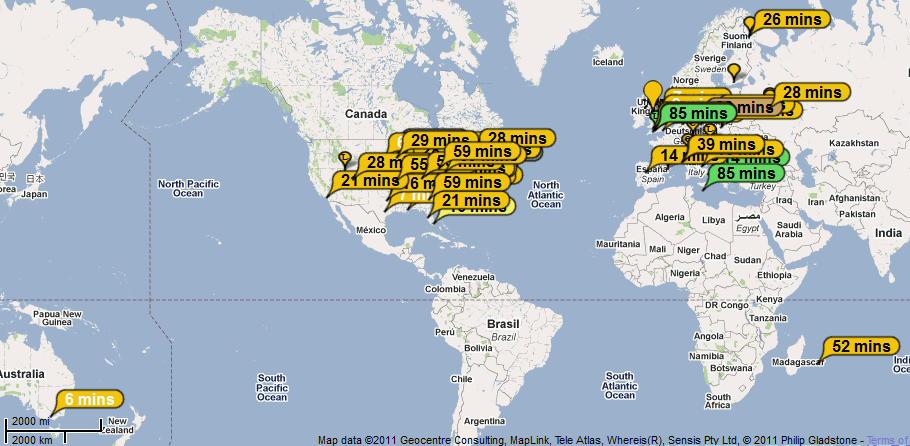
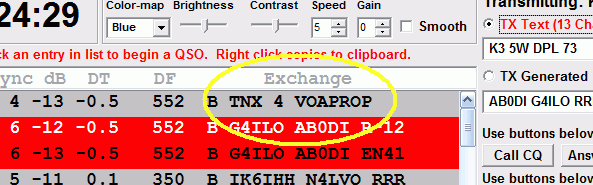
The antenna on 20m was the multiband attic dipole. Stations worked included K3AXR (FM28), KF4NX (EM83), AB0DI (EN41), VA3WLD (FN03) and KD2A (FN13). By the way, whoever said JT65A is not a chat mode!

Julian Moss, G4ILO, is a regular contributor to AmateurRadio.com and writes from Cumbria, England. Contact him at [email protected].
RSGB news
The Board of the RSGB has today released the following announcement:
Peter Kirby, RSGB General Manager, has left the Society’s employment after the discovery of financial irregularities on his part.
For the time being, RSGB Director Don Beattie, G3BJ, will act as General Manager.
At this difficult time for the Society can I ask that everyone supports Don in his role. He may be contacted at Don.Beattie at rsgb.org.uk or 01234 832 701/07802 922 219.
Dave Wilson
President
28 March 2011
Further comment from me would be inappropriate until we know the nature of the financial irregularities. But to say the news comes as a shock would be an understatement. I have been an RSGB member for nearly 40 years, barring a few years in the 1990s when I was inactive in the hobby. The Society will never please everybody and it has done a few things I don’t agree with but I think all things considered it does a pretty good job. I hope it will survive this crisis.

Julian Moss, G4ILO, is a regular contributor to AmateurRadio.com and writes from Cumbria, England. Contact him at [email protected].
What the RSGB needs now…a personal view
I normally try to steer this blog away from ham radio politics. In my opinion, too much time is spent on politicing rather than advancing the hobby. And in a way, I suppose, that’s what this blog post is about.The RSGB website today carries a statement that the General Manager, Peter Kirby (who, incidentally is no relation of mine…) has ‘left the Society’s employment after the discovery of financial irregularities on his part’.More than that, I do not know.Peter had a difficult job to do, one which I would not wish to attempt. But it seems to me that with Peter’s departure, there is the opportunity for the RSGB to be run by someone who has a vision of amateur radio in the 21st century. It would be good to see the society taking a lead with inspiring people to take part in amateur radio. There is much new and good in the hobby and many new ways (blogging, social media just to pluck a couple out of the air…) to inspire and engage people. Under Peter’s stewardship, it seemed to me that the society was stuck in a 1970s (maybe) time warp – of headmasterly toned communication with similar 1970 styled communication methods being employed.The RSGB needs, desperately, to freshen their image! I know many people, deeply involved with the RSGB that read this blog – people that can communicate their passion. These people are just the one’s who should be writing the society’s blogs, tweets, Facebook updates – as well as the GB2RS audio and video podcasts/YouTube videos.My wife Julie just popped in to ask what I was blogging about. I told her. As she put it – financial irregularities in the UK’s National Radio Society? It hardly paints a positive view of the hobby, does it.Along with my hopes for a more visionary approach to the hobby, it is good to see that Don Beattie, G3BJ has assumed (for the time being) the role of RSGB’s General Manager. A safer pair of managerial hands I cannot imagine, belonging to a REAL radio amateur.Today represents a REAL opportunity for the RSGB.

Tim Kirby, G4VXE, is a regular contributor to AmateurRadio.com and writes from Oxfordshire, England. Contact him at [email protected].
What the RSGB needs now…a personal view
I normally try to steer this blog away from ham radio politics. In my opinion, too much time is spent on politicing rather than advancing the hobby. And in a way, I suppose, that’s what this blog post is about.The RSGB website today carries a statement that the General Manager, Peter Kirby (who, incidentally is no relation of mine…) has ‘left the Society’s employment after the discovery of financial irregularities on his part’.More than that, I do not know.Peter had a difficult job to do, one which I would not wish to attempt. But it seems to me that with Peter’s departure, there is the opportunity for the RSGB to be run by someone who has a vision of amateur radio in the 21st century. It would be good to see the society taking a lead with inspiring people to take part in amateur radio. There is much new and good in the hobby and many new ways (blogging, social media just to pluck a couple out of the air…) to inspire and engage people. Under Peter’s stewardship, it seemed to me that the society was stuck in a 1970s (maybe) time warp – of headmasterly toned communication with similar 1970 styled communication methods being employed.The RSGB needs, desperately, to freshen their image! I know many people, deeply involved with the RSGB that read this blog – people that can communicate their passion. These people are just the one’s who should be writing the society’s blogs, tweets, Facebook updates – as well as the GB2RS audio and video podcasts/YouTube videos.My wife Julie just popped in to ask what I was blogging about. I told her. As she put it – financial irregularities in the UK’s National Radio Society? It hardly paints a positive view of the hobby, does it.Along with my hopes for a more visionary approach to the hobby, it is good to see that Don Beattie, G3BJ has assumed (for the time being) the role of RSGB’s General Manager. A safer pair of managerial hands I cannot imagine, belonging to a REAL radio amateur.Today represents a REAL opportunity for the RSGB.
Tim Kirby, G4VXE, is a regular contributor to AmateurRadio.com and writes from Oxfordshire, England. Contact him at [email protected].
Win a Buddistick™ Deluxe Package!

AmateurRadio.com & Buddipole Antennas have teamed up to give away a Buddistick™ Deluxe Package to a very lucky ham!
(a 175 USD value!)
Matt Thomas, W1MST, is the managing editor of AmateurRadio.com. Contact him at [email protected].
Fresh from the Radio Artisan Lab: Yaesu Rotator Computer Interface / Controller
I have completed the Arduino-based rotator computer interface and controller project or at least gotten the code and functionality stable and to the point where I’m satisfied with it. The unit emulates the Yaesu controller command set and works with Ham Radio Deluxe. I’ve tested the unit with a Yaesu G-1000DXA rotator. While the code has AZ/EL rotator support, I do not have an AZ/EL rotator to fully test the elevation functionality yet. This summer I hope to assemble a satellite antenna setup complete with an AZ/EL rotator using this interface.

If anyone is able to test with an AZ/EL rotator, or if anyone wants to attempt to interface this to another brand rotator, please let me know as I would be glad to develop the code.


 Ham Radio Deluxe |
 W5SWL Electronics |
 Ham Radio Prep |
 KB3IFH QSL Cards  Hip Ham Shirts  HamRadioAuctions HamRadioAuctions Reliance Antennas Reliance Antennas Enigma Shop Enigma Shop |  morseDX  Ni4L Antennas  R&L Electronics R&L Electronics antennas.us antennas.us QRV QRV |
- Matt W1MST, Managing Editor
