 |
 Mapping the grid squares you’ve worked on VHF/UHF
 13 April 2011 | by
 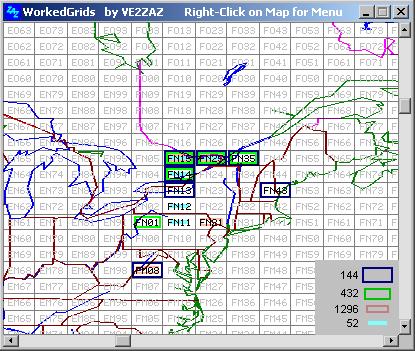 I was playing around in the RSGB’s 432MHz activity contest last night (enjoyable but no-one terribly distant worked) when I saw a tweet go by, from AI4RI, I think, asking if anyone knew any tools for mapping the grid squares that they’ve worked at VHF.I use the Winlog32 logging program, written by Colin, G0CUZ which has some grid mapping capability built in – although it does not overlay the squares onto a map.Another tweet from AI4RI quickly appeared saying that he’d found the WorkedGrids software from VE2ZAZ. I’d seen it mentioned before but not tried it. The software installed quickly and I was able to point it at an ADIF file that Winlog32 had created. If you have a logging program that keeps the log in plain text, ADIF or Cabrillo then you can use WorkedGrids to scan the file automatically and plot your grids on a map. Winlog32 keeps the log in an Access database so I had to create an ADIF export and point WorkedGrids at that.WorkedGrids setup allows you to select which bands you are interested in, I chose 50,70,144 and 432MHz, but you could just as easily select other bands. Having done that, a basic but effective map was displayed, showing the grid squares I’d worked on each band.I seem to remember that DX Atlas by Afreet Software – as used by the FSDXA’s 3B9C expedition some years ago has a similar capability.

Tim Kirby, G4VXE, is a regular contributor to AmateurRadio.com and writes from Oxfordshire, England. Contact him at [email protected].
Mapping the grid squares you’ve worked on VHF/UHF
I was playing around in the RSGB’s 432MHz activity contest last night (enjoyable but no-one terribly distant worked) when I saw a tweet go by, from AI4RI, I think, asking if anyone knew any tools for mapping the grid squares that they’ve worked at VHF.I use the Winlog32 logging program, written by Colin, G0CUZ which has some grid mapping capability built in – although it does not overlay the squares onto a map.Another tweet from AI4RI quickly appeared saying that he’d found the WorkedGrids software from VE2ZAZ. I’d seen it mentioned before but not tried it. The software installed quickly and I was able to point it at an ADIF file that Winlog32 had created. If you have a logging program that keeps the log in plain text, ADIF or Cabrillo then you can use WorkedGrids to scan the file automatically and plot your grids on a map. Winlog32 keeps the log in an Access database so I had to create an ADIF export and point WorkedGrids at that.WorkedGrids setup allows you to select which bands you are interested in, I chose 50,70,144 and 432MHz, but you could just as easily select other bands. Having done that, a basic but effective map was displayed, showing the grid squares I’d worked on each band.I seem to remember that DX Atlas by Afreet Software – as used by the FSDXA’s 3B9C expedition some years ago has a similar capability.
Tim Kirby, G4VXE, is a regular contributor to AmateurRadio.com and writes from Oxfordshire, England. Contact him at [email protected].
UK amateurs have the opportunity to use special callsigns to celebrate the Royal Wedding
UK radio amateurs have the opportunity to apply for a special callsign to mark the occasion of the forthcoming royal wedding.It’s all quite simple. G4VXE would become GR4VXE, GW5NF would become GR5NF, MM3JFM would become MR3JFM and so on. In order to do this, you need to apply, through the RSGB to OFCOM for a Notice of Variation (NoV). The only information you need to provide is your callsign and a contact e-mail address.The special callsigns can be used between 29th April and 9th May 2011.You can read about how to apply and the conditions of the variation hereI’ve applied, so it will be a bit of fun to use GR4VXE for a few days. Who knows, I may even fire up the HF transceiver…

Tim Kirby, G4VXE, is a regular contributor to AmateurRadio.com and writes from Oxfordshire, England. Contact him at [email protected].
UK amateurs have the opportunity to use special callsigns to celebrate the Royal Wedding
UK radio amateurs have the opportunity to apply for a special callsign to mark the occasion of the forthcoming royal wedding.It’s all quite simple. G4VXE would become GR4VXE, GW5NF would become GR5NF, MM3JFM would become MR3JFM and so on. In order to do this, you need to apply, through the RSGB to OFCOM for a Notice of Variation (NoV). The only information you need to provide is your callsign and a contact e-mail address.The special callsigns can be used between 29th April and 9th May 2011.You can read about how to apply and the conditions of the variation hereI’ve applied, so it will be a bit of fun to use GR4VXE for a few days. Who knows, I may even fire up the HF transceiver…
Tim Kirby, G4VXE, is a regular contributor to AmateurRadio.com and writes from Oxfordshire, England. Contact him at [email protected].
Wedding celebrations
The RSGB has negotiated with Ofcom to allow UK radio amateurs to use a special call to celebrate the wedding of H.R.H. Prince William and Catherine Middleton. The call may be used during a period of 11 days from the date of the wedding, 29 April 2011, until 9 May 2011. The call will use the letter “R” after the first letter of the call, replacing the regional designator for Scotland, Ireland, Wales etc. where used. So G4AAA would become GR4AAA, 2E0ABC would become 2R0ABC, GM3ZZZ would be GR3ZZZ and so on.
UK licensed amateurs wishing to use the special call must apply for a Notice of Variation (NoV) to their license. This NoV may only be applied for online using a simple online form and the NoV will be delivered by email. Who says that the RSGB is not progressive?
Personally I will be trying as much as possible to avoid all the ballyhoo over this wedding so I shan’t be applying, but I thought that the information may be of interest.

Julian Moss, G4ILO, is a regular contributor to AmateurRadio.com and writes from Cumbria, England. Contact him at [email protected].
India to Oman on 145Mhz FM
I love reading about VHF openings and operation in other parts of the world.I just found this fascinating post by OM Satheesh, VU2WSM regarding an opening from Oman to India on 145MHz.

Tim Kirby, G4VXE, is a regular contributor to AmateurRadio.com and writes from Oxfordshire, England. Contact him at [email protected].
India to Oman on 145Mhz FM
I love reading about VHF openings and operation in other parts of the world.I just found this fascinating post by OM Satheesh, VU2WSM regarding an opening from Oman to India on 145MHz.
Tim Kirby, G4VXE, is a regular contributor to AmateurRadio.com and writes from Oxfordshire, England. Contact him at [email protected].
 Ham Radio Deluxe |
 W5SWL Electronics |
 Ham Radio Prep |
 KB3IFH QSL Cards  Hip Ham Shirts  HamRadioAuctions HamRadioAuctions Reliance Antennas Reliance Antennas Enigma Shop Enigma Shop |  morseDX  Ni4L Antennas  R&L Electronics R&L Electronics antennas.us antennas.us QRV QRV |
- Matt W1MST, Managing Editor
