 |
 SoftRock v9.0 Lite+USB Xtall
 25 June 2011 | by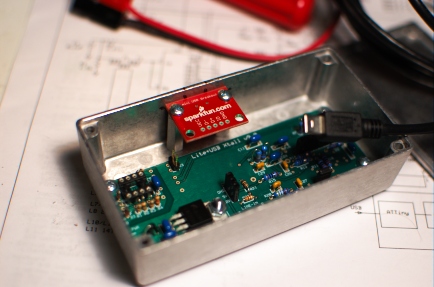
Brian, ND3F (aka N3IQ/R), gifted me a partially-complete SoftRock kit a few months ago on the condition that I put it on the air. I’m making some progress on that. I took this photograph to show the SparkFun USB break-out board installed in the Bud CU-124 enclosure. The whole thing is assembled now, but there is probably a solder bridge somewhere. This kit is going to be a lot of fun because it’s actually more flexible for experimenting than the present Ensemble II RX kit.
Ethan Miller, K8GU, is a regular contributor to AmateurRadio.com and writes from Maryland, USA. Contact him at [email protected].
Microwave updates
Apologies for the bad pun in the title. I was going to call it “Microwave progress” but could help myself when I thought of this one. Here are some notes from tinkering over the past few days.
1296 Mhz
After learning that the 1152-MHz LO power was -11 dBm, I inserted a MAR-3 MMIC on the 1296RSU transverter board. W1GHZ shows an MAR-6 on his board, but the ever-astute N3UM noticed that the P1dB for the MAR-6 is 1 dBm, which is well below the nominal 7 dBm level of the ADE-5 mixer. Unfortunately, the MAR-3 has about 12 dB of gain vs the MAR-6′s 20 dB. A little bit of skullin’ lead me to my stash of SGA-4586′s (suggested as an economical front end by W9SZ), which can do >20 dB gain with a P1dB point of 16 dBm or so. Perfect.
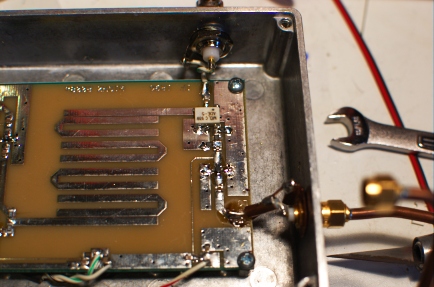
Unfortunately, with an 144-MHz IF drive of about 2 dBm, the 1296-MHz output was totally trashed with various mixing products. I spent about 20 minutes searching frantically for the 3-dB SMA attenuator I’d purchased at Dayton. But, I never found it—a sign that my organizational scheme has lost control or that I never actually bought the attenuator. Either are possible. So, I did the next logical thing—I added a Pi-network attenuator between the SGA-4586 “LO boost” MMIC and the ADE-5 mixer. If the Dremel tool didn’t make it’s inventor independently wealthy, it should have. The only SMD resistors that I had on-hand that were realistically appropriate (39.6 and 130 ohms) yielded about 6-7 dB of attenuation, so the effective gain of the SGA-4586/attenuator cascade was probably around 13-15 dB, yielding somewhere around 2-3 dBm of LO. Blech. That’s essentially the same as the MAR-3. The 1296-MHz output with 2 dBm of drive at 144 Mhz was about 2.5 dBm.
The data sheet for the ADE-5 suggests that the conversion loss increases as the LO drive level falls bellow 7 dBm (shocking!), but there are not enough data to show how precipitously it deteriorates. However, essentially 0.5 dB of overall power gain does not jibe with the amount of gain in the system, which should be closer to 20 dB. From this standpoint, perhaps the mixing products were due to IF overdrive instead of LO overdrive. In any event, about 3 dB (instead of 6 or 7 dB) of attenuation in the LO would be a good thing.
902/903 MHz
Fresh off my mixed success with the W1GHZ 1296RSU (which are neatly packaged in Hammond 1590BB-sized cast aluminum boxes), I wanted to give the 902/903 version (which is still loose boards) a try with the spectrum analyzer. So, I hooked up the 756LO board first. It made -5 dBm at 756 MHz. These numbers are more like what W1GHZ was promising. So, I put the MAR-3 mentioned above onto the 902/903 transverter board. With 2 dBm of 147-MHz drive, the output was a very clean 16 dBm on 903. Score! Must be livin’ right at least half the time. My last DigiKey order included a 1590BB for that transverter, but the 756LO board is a bit longer and I haven’t yet found a suitable case for it.
3456 MHz
Thought I was done? Me too.
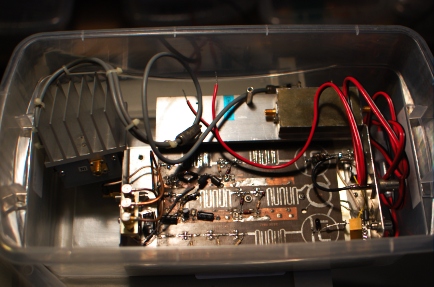
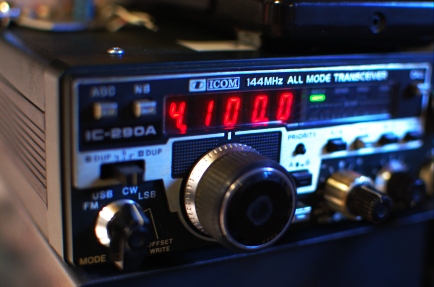
I admit it. I’m a sucker for this sort of thing. Fred, N1DPM, recently posted to VHFcontesting and the “Stanford” VHF lists that he was selling a bunch of spare microwave gear, including a first-generation DEMI 3456 transverter/LO and some amplifiers to get the output up to 4 watts. Cheap. He had some 2304 stuff, but ye old project fund is pretty much depleted since Dayton and I always try to keep a little bit in reserve for just this sort of opportunity. Anyhow, the transverter is set up for 10 watts of drive on 144 MHz. I gave it 250 mW (24 dBm) from my modified IC-290A (post to follow on this—not rocket science, just bypassed the PA) and the output came up at -9 dBm on 3456 MHz. Once I remove the attenuator from the input, I should be able to get it up to about 13 dBm. At least it seems to work on TX. Need an antenna to try RX because the K3UO beacons are not as close as W3APL.
Ethan Miller, K8GU, is a regular contributor to AmateurRadio.com and writes from Maryland, USA. Contact him at [email protected].
Yaesu FT-60: Speaker Mic Complaint
 Don’t get me wrong. I love my little Yaesu FT-60 dual-bander. Before this radio, I always owned Kenwood HTs and they were great. But I couldn’t pass up this little gem for under $200. Yes, it has a NiMH battery instead of lithium ion like those new Wouxuns. No, it doesn’t have cross-band repeat like some of those other HTs. But it’s reliable. It’s small. And it’s a great value.
Why am I complaining? I hate the speaker mic jack. Specifically, I hate that whenever I use my speaker mic it always starts to fall out of the jack a little bit. Not a big deal, right? Well, unfortunately as the plug starts to come out (and we’re talking just a millimeter or two), it keys the transmitter until you notice it. If you have a big mouth like I do, this can be a problem. Besides potential embarassment, you run the risk of interfering with other QSOs. And if you’re running EMCOMM, for which this radio is very popular, it could interfere with more important traffic than run-of-the-mill ragchewing.
This sort of thing never happened with my Kenwood rigs with their two-plug (3.5mm/2.5mm) connections versus Yaesu’s all-in-one single (3.5mm) stereo phone plug. It’s compact, yes. But it’s not as stable. And trying to jam everything into one plug creates problems like this.
Has anyone else noticed the same problem? If so, have you developed a fix for this wandering plug (short of a tight rubber band around the radio)?
Matt Thomas, W1MST, is the managing editor of AmateurRadio.com. Contact him at [email protected].
New version of WinDV v1.1.3 available
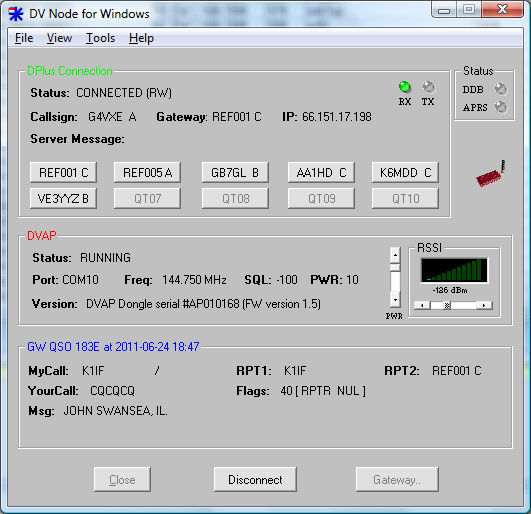
It was a nice surprise to have an e-mail last week from Fred, PA4YBR explaining that a new version of the WinDV DSTAR software is available for download.
I grabbed a copy and have been playing with it in conjunction with my DVAP Dongle. Like the previous version, v1.1.3 works well and has some useful new features. If you’ve got GPS on your rig, you can pass that into the network and have your location shown on http://aprs.fi and there’s also an interface to ircDDB which I have to admit, I’ve not explored yet.
I like the fact that WinDV allows you to set up connects from the software, rather than fiddling around setting callsigns on the (in my case) IC-E92. There’s more debugging information than in the current DVAP Tool as well.
WinDV works with DVAPs and Hotspots too. I definitely recommend you check it out – you can download it here

Tim Kirby, G4VXE, is a regular contributor to AmateurRadio.com and writes from Oxfordshire, England. Contact him at [email protected].
W1GHZ 1152-MHz LO measurements
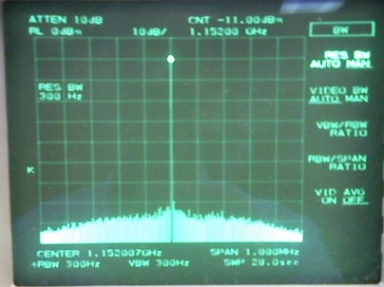
Through some reorganization at work in the past two months, I have suddenly gained ready access to a lab full of RF test equipment again. Two years is a long time to go without. Apologies for the cell-phone photograph of the screen.
I took the W1GHZ 1152-MHz LO board over to have a look at it during lunch. I’m seeing -11 dBm at 1152.007 MHz. I am a bit dubious of the last digit of the frequency (even at 300 Hz RBW) but I’m sure there’s a frequency counter around somewhere. Anyhow, I need to put a MMIC (or two) on the transverter board. That should be a nice evening project along with the W6PQL preamp kit that showed up today.
Ethan Miller, K8GU, is a regular contributor to AmateurRadio.com and writes from Maryland, USA. Contact him at [email protected].
Handiham World for 22 June 2011
Welcome to Handiham World!

One of the movies I remember enjoying was “The Perfect Storm”. A huge storm barreled up the Eastern United States seaboard and all the conditions aligned to turn it into a real disaster. Everything that could go wrong did go wrong.
This week seems a lot like that here in the ham shack. My main Windows computer suffered a failure and the Windows installation could not be repaired without a complete reinstallation. Although I regularly back everything up, reinstalling an operating system is still a huge and very disruptive process. Although you may have documents and the files you have created preserved, you have to reinstall all of your applications. That means all saved settings, passwords, usernames, the lot of it. So I am operating here on an old computer with limited resources. I cannot retrieve all of my old email and many contacts have disappeared. It is a huge mess and it will take a long time to get back to anything like an efficient office day.
But is it a perfect storm? Well, consider that yesterday I had to attend some staff training at our main office at Camp Courage. A thunderstorm had passed through several days before, knocking the W0ZSW remote base offline. That problem was fixed easily enough by restarting the rig control computer and setting the BIOS to always turn the machine on following a power failure. Turning to my main office computer, I found that it had been fried. So now my main office computer and my main home computer on which I produce all audio podcasts, do all audio editing, all my home email, the web publishing, and nearly everything else having to do with my computing life, all both down for the count.
Add to that the fact that we are into the busy season at camp and Courage Center, like other healthcare providers, is worried about an impending State government shutdown, and you can see that this is quite some storm!
So today’s e-letter will have to be shorter. I will do my best to catch up, but ask that emails and phone calls be kept to a minimum.
I know this is disappointing, so to cheer you up, we will hear a special presentation by Matt Arthur, KA0PQW, later on in the audio podcast version of this week’s e-letter. Matt sent me an audio lecture on sporadic-e propagation, and this is a perfect time of year to learn more about it and then look for some sporadic-e yourself!
Patrick Tice
[email protected]
Handiham Manager

Letters

Anne, K1STM, wrote to let us know that TIPSnet is in summer shut down mode and will return on September 13. The final TIPSnet for this past season was yesterday, June 21.
Editor’s note: I have lost a considerable amount of email. I am not sure when it will be recovered. If you have sent me something and it does not get acted upon, that is the reason. Please send only urgent email to [email protected] until further notice.
Troubleshooting 101: No column this week

Maybe if I ever figure out my computer problems, I’ll write about that, HI!
Send your ideas about troubleshooting for possible inclusion in this column to:

Pat Tice, WA0TDA, is the manager of HANDI-HAM and a regular contributor to AmateurRadio.com. Contact him at [email protected].
Power supplies – good info about them and one really neat project
 We’ve all seen the neat projects on the web where someone uses a power supply taken from an old PC. There is something simple about the project, yet so insanely useful and versatile.
I have not seen many that were as “polished” as the power supply project here. This is from the blog “TG’s Electronics Exploration”. The project is laid out in a way that will give you multiple power options as well as a digital readout. Most of the power supply projects I’ve seen are relatively simple hacks where the basic simple values of a PC power supply are used (5 volts, 12 volts, etc). This has many more options.
I really like how clean the layout is as well as the LCD’s. The other really neat thing about his – the work isn’t wasted if the power supply eventually dies on you. It is relatively easy to move all the electronics to a new supply.
The project page can be found at:
http://tgbuilds.wordpress.com/projects/diy-bench-supply/
The next website we will talk about comes from a sit I visit on a regular basis. Not ham radio, but plenty of electronics information and kits – ladyada.net. I used to run a hackerspace in my area. We did a few projects to get people soldering. One neat project was a “TV be-gone”. Simple device where you build it, put it in a container (I, of course, used an Altoids tin) and use it to turn off TV’s. Great when you’re somewhere where a TV is on, loud, and nobody is actually watching the thing and you can’t even carry a conversation with the guy next to you. Simple enough project.
This site goes into several questions I get from potential hams when I teach radio classes, including:
What is a power supply?
Why use a power supply?
What’s inside a power supply?
AC/DC theory.
A really neat primer geared towards those that may not understand anything about all those wall warts that are drawing tons of power when not used! I almost passed this up, as I know enough about power supplies to get me through what I need for my projects. I found it a neat article that allowed me to probably explain it easier to those that aren’t technically inclined.
Check it out at:
http://www.ladyada.net/learn/powersupply/index.html
Now, if you have any links to great projects or informative sites, please leave them below.
Jonathan Hardy, KB1KIX, is a regular contributor to AmateurRadio.com and writes from Connecticut, USA. Contact him at [email protected].
 Ham Radio Deluxe |
 W5SWL Electronics |
 Ham Radio Prep |
 KB3IFH QSL Cards  Hip Ham Shirts  HamRadioAuctions HamRadioAuctions Reliance Antennas Reliance Antennas Enigma Shop Enigma Shop |  morseDX  Ni4L Antennas  R&L Electronics R&L Electronics antennas.us antennas.us QRV QRV |
- Matt W1MST, Managing Editor
