 |
 Does Burt make some good points?
 27 June 2011 | by
 If you’ve never heard of Burt Fisher, K1OIK, then you’ve probably been living under a rock. Well, not quite. But the video above has garnered well over 90,000 views in the couple of years it has been online. In the world of Internet video, that’s fairly respectable. How does he do it? By making fun of just about every aspect of our beloved hobby, that’s how!
Many people will view the video and get upset. Or they’ll be offended. Or annoyed. Don’t worry, that’s just what Burt was hoping to accomplish! But there is something more to this video than just some jerk on the Internet with an axe to grind. More than trying to tick anyone off, I think he’s trying to get you to think. To turn a critical eye on what we do and why we do it. To self-evaluate and change the parts of Amateur Radio that don’t make sense or that are self-destructive. He makes some good points. Some may not like his condescending style, but do you know why he’s so annoying? He’s very often right.
Matt Thomas, W1MST, is the managing editor of AmateurRadio.com. Contact him at [email protected].
The G4VXE blog is five years old
I’ve just noticed that my first posting to this blog was on the 24 June 2006 – making the blog five years old.
What I have enjoyed about it is that I can write about anything that interests me in Amateur Radio be it a passing interest-du-jour or something more long standing.
It always fascinates me which posts get the most visits. The ones about setting up D-STAR have been popular – which I was pleased about. I was less pleased that a rare comment on RSGB politics was the best read post of all time on the blog! Why was I less pleased? Because this blog has always been about getting on and trying ‘stuff’ in Amateur Radio out – not paperwork and politics! So I guess if someone wants to write a blog on Amateur Radio politics, you’ll get great readership. But I won’t be writing it!
Thank you for reading the blog – if you’ve been reading since 2006 then my commiserations – but thank you!

Tim Kirby, G4VXE, is a regular contributor to AmateurRadio.com and writes from Oxfordshire, England. Contact him at [email protected].
How to get a coax cable through a cavity wall (or improper use of knitting equipment)
For a while I’d been wanting to reroute the coax from the Butternut HF6V to the shack. Where was it going before, I hear you ask? Well, the lounge actually… it’s a long story.
Got around to the job yesterday and put a new coax run in up the garden, secured it to the fence and neatly tacked it up along the side of the house. When we put the V2000 vertical up on the house the other day, we drilled another hole into the shack to take this coax.
However, I had a very frustrating half hour or so trying to get the coax through the hole (which it turned out was not quite straight) – the coax kept missing the hole at the other side of the cavity and curling around.
Julie seeing my exasperation suggested I had lunch whilst I worked out a plan. Over a prawn mayo sandwich I noticed a number 8 knitting needle sitting on her desk….
Once replete, I marched outside with the knitting needle, a knife and some insulation tape. I stripped back the outer of the coax and the screen, leaving the inner of the coax to the same length as the knitting needle. I then taped the end of the coax as tightly as possible to the sharp end of the knitting needle. And poked!
The needle and coax went through the hole first time. From the inside, I undid the insulation tape from the tip and pulled the coax through as far as it would go. Then I went outside and gently retracted the knitting needle (I really didn’t want the coax to follow it!).
Back inside and I was then able to pull the coax through into the shack fully! And hastily, I rinsed the knitting needle to ensure it was once again fit for knitting!
So, I can now play HF should I wish. Currently the Butternut vertical is connected to the Anytone AT-5555. More on that in a separate post.
If you don’t have a knitting needle handy, a straightened metal coathanger may serve the same purpose.

Tim Kirby, G4VXE, is a regular contributor to AmateurRadio.com and writes from Oxfordshire, England. Contact him at [email protected].
K8GU Field Day 2011
I had not been a big fan of Field Day for many years until last year. Although ARRL technically terms it “an operating event,” it has most of the features and flavor of a contest. But, the bands are crowded, there are a few more drunks and lids than your standard contest. Your local club thinks it’s a great idea to put up a tower and an ancient tribander, but they only do a half-witted job of it making a lot of work for something that could have been smoked by a doublet in the trees. Or, you show up at a random Field Day site, introduce yourself, and offer to operate CW—only to be handed a J-38 or a blank stare.
Last year was different. Sarah’s branch chief at work is a ham and she’s married to a ham. Somehow, it came up that I was a ham and soon we had an invitation to Field Day at her mother’s place near the water of the Chesapeake Bay on Maryland’s Eastern Shore. I was reluctant, but they assured me it would be OK. They have a tower trailer for a triband Yagi and trees for dipoles on the low bands and they operate 1A. It was fun. Sarah enjoyed herself, too, which is a welcome change for a ham radio event!
For a variety of reasons (namely the impending birth of our first child), we elected not to go to the Eastern Shore this year. After talking to a few guys at the PVRC/W3LPL open house last weekend who implored me to come to their operation (W3AO, the FD of epic proportions) instead, I decided I needed to do something. Since W3AO was making a run on the all-time Field Day high score record this year, I opted to make a game of running 1D and working W3AO (and their GOTA station, KE3Q) on every band and mode available. The goal was to not disrupt our weekend too much and to have fun, possibly contending for a plaque offered by PVRC for the most band/mode QSOs with W3AO/KE3Q.
Here’s how things shook out (yellow = QSO, blue = no QSO, red = no QSO possible with W3AO/KE3Q, hashed = no QSO possible with K8GU, but possible with W3AO):
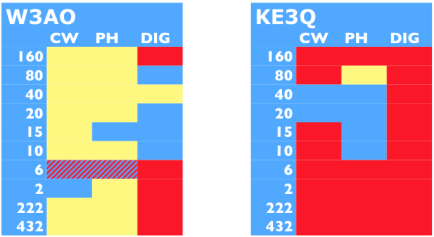
So, I did pretty well with W3AO, all things considered. I was not QRV on RTTY until Sunday morning (forgot that I did not set that up on the “new” PC yet). By that time, I missed the really good opportunities to work them on 20 and 80. I don’t know if I ever would have on 15 and 10. I did see them spotted on PSK31 (a mode I will never enjoy—one QSO was enough) on 15, but could not hear (erm, see) them here.
It was a bummer not to have 6 meters here and despite 3-4 requests, the 2-meter phone operator(s) refused to QSY to CW with me, even though one told me I was his first QSO in an hour! It did take almost 10 minutes for them to find a key to work me on 222 and 432 CW! Thanks for going the extra mile! I believe my total of 17 QSOs ties K3DI’s record, plus one more with KE3Q, for 18 total.
I worked KE3Q right away on 75 meters, but never heard them again. I did see QRS Skimmer spots for them on 40 and 20 CW in the middle of the night and at the very end of event, respectively. But, I do not believe they were QRV on CW on any other bands.
Having 6 meters and digital from the start probably could have increased my totals a bit. A satellite QSO or two would also have been good. But, I did not have it in me to get that set up in addition to building microwave gear and getting the baby’s room ready. Plus the 432-MHz amp I bought recently has been held hostage by the deadlock between Canada Post and their workers. So, I only have 10 watts on that band until that arrives, making the annual Field Day “Battle for Bandwidth on the Birds” that much more exciting with a small antenna oriented for terrestrial work.
It was a good time, although I think I’ll be itching to go out into the “field” again next year…thanks for the QSOs and the QSYs!
Ethan Miller, K8GU, is a regular contributor to AmateurRadio.com and writes from Maryland, USA. Contact him at [email protected].
SoftRock v9.0 Lite+USB Xtall
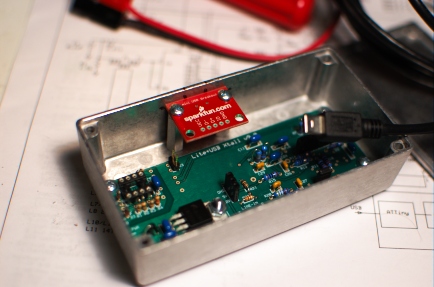
Brian, ND3F (aka N3IQ/R), gifted me a partially-complete SoftRock kit a few months ago on the condition that I put it on the air. I’m making some progress on that. I took this photograph to show the SparkFun USB break-out board installed in the Bud CU-124 enclosure. The whole thing is assembled now, but there is probably a solder bridge somewhere. This kit is going to be a lot of fun because it’s actually more flexible for experimenting than the present Ensemble II RX kit.
Ethan Miller, K8GU, is a regular contributor to AmateurRadio.com and writes from Maryland, USA. Contact him at [email protected].
Microwave updates
Apologies for the bad pun in the title. I was going to call it “Microwave progress” but could help myself when I thought of this one. Here are some notes from tinkering over the past few days.
1296 Mhz
After learning that the 1152-MHz LO power was -11 dBm, I inserted a MAR-3 MMIC on the 1296RSU transverter board. W1GHZ shows an MAR-6 on his board, but the ever-astute N3UM noticed that the P1dB for the MAR-6 is 1 dBm, which is well below the nominal 7 dBm level of the ADE-5 mixer. Unfortunately, the MAR-3 has about 12 dB of gain vs the MAR-6′s 20 dB. A little bit of skullin’ lead me to my stash of SGA-4586′s (suggested as an economical front end by W9SZ), which can do >20 dB gain with a P1dB point of 16 dBm or so. Perfect.
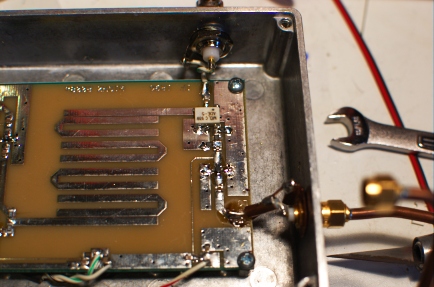
Unfortunately, with an 144-MHz IF drive of about 2 dBm, the 1296-MHz output was totally trashed with various mixing products. I spent about 20 minutes searching frantically for the 3-dB SMA attenuator I’d purchased at Dayton. But, I never found it—a sign that my organizational scheme has lost control or that I never actually bought the attenuator. Either are possible. So, I did the next logical thing—I added a Pi-network attenuator between the SGA-4586 “LO boost” MMIC and the ADE-5 mixer. If the Dremel tool didn’t make it’s inventor independently wealthy, it should have. The only SMD resistors that I had on-hand that were realistically appropriate (39.6 and 130 ohms) yielded about 6-7 dB of attenuation, so the effective gain of the SGA-4586/attenuator cascade was probably around 13-15 dB, yielding somewhere around 2-3 dBm of LO. Blech. That’s essentially the same as the MAR-3. The 1296-MHz output with 2 dBm of drive at 144 Mhz was about 2.5 dBm.
The data sheet for the ADE-5 suggests that the conversion loss increases as the LO drive level falls bellow 7 dBm (shocking!), but there are not enough data to show how precipitously it deteriorates. However, essentially 0.5 dB of overall power gain does not jibe with the amount of gain in the system, which should be closer to 20 dB. From this standpoint, perhaps the mixing products were due to IF overdrive instead of LO overdrive. In any event, about 3 dB (instead of 6 or 7 dB) of attenuation in the LO would be a good thing.
902/903 MHz
Fresh off my mixed success with the W1GHZ 1296RSU (which are neatly packaged in Hammond 1590BB-sized cast aluminum boxes), I wanted to give the 902/903 version (which is still loose boards) a try with the spectrum analyzer. So, I hooked up the 756LO board first. It made -5 dBm at 756 MHz. These numbers are more like what W1GHZ was promising. So, I put the MAR-3 mentioned above onto the 902/903 transverter board. With 2 dBm of 147-MHz drive, the output was a very clean 16 dBm on 903. Score! Must be livin’ right at least half the time. My last DigiKey order included a 1590BB for that transverter, but the 756LO board is a bit longer and I haven’t yet found a suitable case for it.
3456 MHz
Thought I was done? Me too.
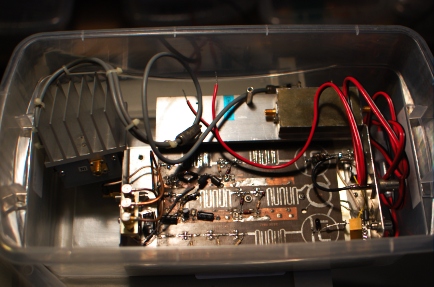
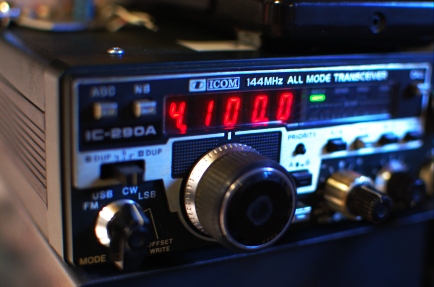
I admit it. I’m a sucker for this sort of thing. Fred, N1DPM, recently posted to VHFcontesting and the “Stanford” VHF lists that he was selling a bunch of spare microwave gear, including a first-generation DEMI 3456 transverter/LO and some amplifiers to get the output up to 4 watts. Cheap. He had some 2304 stuff, but ye old project fund is pretty much depleted since Dayton and I always try to keep a little bit in reserve for just this sort of opportunity. Anyhow, the transverter is set up for 10 watts of drive on 144 MHz. I gave it 250 mW (24 dBm) from my modified IC-290A (post to follow on this—not rocket science, just bypassed the PA) and the output came up at -9 dBm on 3456 MHz. Once I remove the attenuator from the input, I should be able to get it up to about 13 dBm. At least it seems to work on TX. Need an antenna to try RX because the K3UO beacons are not as close as W3APL.
Ethan Miller, K8GU, is a regular contributor to AmateurRadio.com and writes from Maryland, USA. Contact him at [email protected].
Yaesu FT-60: Speaker Mic Complaint
 Don’t get me wrong. I love my little Yaesu FT-60 dual-bander. Before this radio, I always owned Kenwood HTs and they were great. But I couldn’t pass up this little gem for under $200. Yes, it has a NiMH battery instead of lithium ion like those new Wouxuns. No, it doesn’t have cross-band repeat like some of those other HTs. But it’s reliable. It’s small. And it’s a great value.
Why am I complaining? I hate the speaker mic jack. Specifically, I hate that whenever I use my speaker mic it always starts to fall out of the jack a little bit. Not a big deal, right? Well, unfortunately as the plug starts to come out (and we’re talking just a millimeter or two), it keys the transmitter until you notice it. If you have a big mouth like I do, this can be a problem. Besides potential embarassment, you run the risk of interfering with other QSOs. And if you’re running EMCOMM, for which this radio is very popular, it could interfere with more important traffic than run-of-the-mill ragchewing.
This sort of thing never happened with my Kenwood rigs with their two-plug (3.5mm/2.5mm) connections versus Yaesu’s all-in-one single (3.5mm) stereo phone plug. It’s compact, yes. But it’s not as stable. And trying to jam everything into one plug creates problems like this.
Has anyone else noticed the same problem? If so, have you developed a fix for this wandering plug (short of a tight rubber band around the radio)?
Matt Thomas, W1MST, is the managing editor of AmateurRadio.com. Contact him at [email protected].
 Ham Radio Deluxe |
 W5SWL Electronics |
 Ham Radio Prep |
 KB3IFH QSL Cards  Hip Ham Shirts  HamRadioAuctions HamRadioAuctions Reliance Antennas Reliance Antennas Enigma Shop Enigma Shop |  morseDX  Ni4L Antennas  R&L Electronics R&L Electronics antennas.us antennas.us QRV QRV |
- Matt W1MST, Managing Editor
