 |
 Zero Bias: The Chinese Connection
 3 August 2011 | by
  I’m in the middle of reading a fascinating book, 1421: The Year China Discovered America, about Chinese voyages of discovery in the early 15th century. The author claims to have evidence that, among other things, the Chinese landed and established colonies in the Americas about 80 years before Columbus “discovered” the New World. I haven’t gotten far enough in yet to comment on that, but the first part of the book lays the groundwork by discussing medieval Chinese history and culture and explaining how China spread its influence and came to dominate foreign trade in Asia and Africa at the time.
Despite having the world’s largest army and navy, and having already invented gunpowder and developed firearms, this book’s author says it wasn’t China’s style to simply invade a place and take it over. Rather, the Chinese sent treasure ships full of the finest goods, not only to trade but to bestow as gifts on local rulers. Once trading relationships were established, these rulers were given every imaginable luxury and invited to major events in China—with the Chinese providing transportation and picking up the tab for everything.
Of course, all this came at a price. If the foreign rulers wanted to continue to benefit from China’s largesse, and if they wanted their highly profitable trade with China to continue and grow, then they had to pay tribute to China, both financially and by swearing allegiance to the Chinese emperor. The Chinese came to dominate the region, generally without firing a shot (even though they were the only ones at the time with guns). It would do us well here in the west to study more Chinese history.
I bring this up because, as many of you are aware, the past year has seen the introduction to the U.S. market of ham gear from China. The two major brands we have seen so far are Wouxun (pronounced OH-shin) and TYT (Quanzhou TYT Electronic Co.). The prices are very low and from all reports we’ve heard, the radios work well, too. At Ham-Com in Texas this past June, one dealer selling these new rigs wanted to be sure everyone in the hall knew how well they were doing, so the booth staff banged a big gong every time a ham bought one. Following a commercial tradition that is at least 700 years old, the Chinese are establishing themselves in the ham radio marketplace with quality goods at low prices that significantly undercut their competition.
Of course, their competition is acutely aware of this, especially the Japanese manufacturers who know from their own experience how effective this strategy can be. After all, it’s been just over 40 years since the first ad for a Japanese radio appeared in U.S. ham magazines. The Japanese manufacturers used a similar approach, offering quality goods at low prices that significantly undercut their competition, starting with low-cost VHFFM gear and then moving into higher-priced HF equipment as well.
Most of the “long-established” U.S. manufacturers (I put that in quotes because many of them had only been in business for about 40 years themselves at that point!) could not or would not respond effectively and eventually dropped out of the amateur market, giving the Japanese manufacturers market dominance for the past three decades. Now, the Chinese manufacturers appear to be adopting similar tactics, and the question becomes whether the Japanese manufacturers will learn from their own success and how (or if) they will adapt to meet this new challenge.
Ultimately, it will be up to you, the consumer, to decide which radios from which manufacturers give you the greatest value for your dollar. Other issues that may merit consideration by consumers include possible Chinese government subsidies to hold down prices on exported goods, and questions about working conditions and worker pay at Chinese factories (we know nothing about these specific companies, only that this is an issue in the broader topic of U.S.-China trade). And, of course, we the consumers should not forget that the U.S. amateur radio manufacturing industry has rebounded, with newer companies taking leadership positions in several areas of the ham marketplace. One thing is certain: radios from China will be a part of the ham radio landscape for many years to come, and the presence of these new “players” in the market will continue to be seen in magazines, on dealers’ shelves and at hamfests around America.
Dayton and Dallas
Speaking of hamfests, both Dayton and Dallas (Ham-Com) seemed to be down a little in attendance this year, but most dealers reported strong sales nonetheless. Getting to and from Dayton proved to be challenging this year—it took me 13 hours to get there from New Jersey, which wouldn’t have been too terrible if I was driving…but I was flying! And after the show, both Ad Manager Chip Margelli, K7JA, and Popular Communications and WorldRadio Online Editor Richard Fisher, KI6SN, got stranded overnight at different airports while trying to get home to California.
Ignoring all that, actually being at Dayton was its usual incredible experience. Yes, there was the sewer backup that shut down nearly all of the restrooms on Saturday afternoon and sent sewage seeping across parts of the flea market. But on the other hand, there was the unplanned and unannounced visit on Saturday morning by FCC Chairman Julius Genachowski and the usual controlled chaos at the CQ booth.
Working a booth at Dayton is a lot like running a pileup on a DXpedition. There’s a constant line of people waiting to “work” you; you can only “work” one at a time, and you have to hope all the others behave until you get to them (99% of the time, they do). But the people you get to meet are the best part. Attendees at Dayton truly cover the full spectrum of the ham radio hobby. All, of course, are just-plain-hams, having fun and chatting on a first-name basis … even though among those just plain hams were at least one Nobel laureate, two retired admirals, a former ambassador and at least one astronaut. It sure is a good thing we don’t have to QSL all those “eyeball” QSOs at the booth!
A couple of issue notes: Our coverage of ham radio’s response to the wicked spring weather across the U.S. continues this month with a detailed look at how SATERN (Salvation Army Team Emergency Radio Network) volunteers helped out in Joplin, Missouri after a massive tornado struck that city (p. 13); and Youth Editor Brittany Decker, KB1OGL, shares her experience with—and lessons learned from—a too-close-for-comfort encounter with lightning at her home in New Hampshire (“A Striking Story,” p. 38). Plus, of course, we have the SSB results of last year’s CQ World Wide DX Contest. Once again, this truly worldwide contest made its own propagation — nearly two dozen new records were set – and we received over 6500 logs, showing operation from 232 countries … including China.
73, W2VU
Rich Moseson, W2VU, is Editor of CQ magazine and Editorial Director of all CQ publications, including CQ VHF, Popular Communications and WorldRadio Online. Contact him at [email protected].
Watch ARISSat-1 Deploy on NASA TV [VIDEO]
It’s the big news of the week for Amateur Radio. ARISSat-1 will be deployed today from the International Space Station thanks to 2 Russian Cosmonauts. The satellite will have 4 Slow Scan TV cameras as well as a CW and BPSK beacon. According to what I have read you’ll be able to pick it up with just a simple hand held and a quarter wave whip antenna. I plan on testing that statement out myself.It’ll also have on board, a cross-band linear transponder for SSB/CW work. A little something for everyone. I’m thinking the SSTV is going to be what I am shooting for. AMSAT-NA has a special page setup with more information on how to receive signals from the satellite. Below is the live feed from NASA-TV. The Sat is being deployed at 14:00 UTC.
73.
Rich also writes a Tech blog and posts stories every Tuesday and Thursday on Q103, The Rock of Albany’s website, as well as Amateur Radio stories every Monday thru Friday here on AmiZed Studios.
Rich Gattie, KB2MOB, is a regular contributor to AmateurRadio.com and writes from New York, USA. Contact him at [email protected].
Join the discussion on Google+

Google+ is the latest entry in the social media web applications taking the world by storm. It’s been around for a little over a month and is gaining some attention. I believe it is still in beta form and you can only gain access to the service via an invite from another existing user. More about that in a minute.
Yes it might be possible that you have already hit your limit of the number of social media sites you will join and use. Like many hams, I tend to frequent Twitter and Facebook only. But Google+ is gaining more of my attention, especially over Facebook.
Facebook privacy concerns have always been something I’ve thought about. I know some folks just flat out will not join Facebook or they cancelled their accounts for this very reason. I tend to operate under the idea that I won’t say or talk about anything on Facebook that I would be afraid for my Mother or Grandmother to read. But with Facebook you really don’t have a lot of control with who you share what information with.
An example of this problem is I have a couple of different types of people who follow me on Facebook. I have hams (like you), family and old class mates. If I log onto Facebook and talk about how excited I was to work the STS-135 special event station, about half of my followers won’t or care to understand what I’m talking about.
Google+ changes all this. When you setup Google+ you add people you know or want to know better into circles. Think of them as a circle of friends. I’ve setup circles based on ham radio, geocaching, flight simulation, family and friends. When I decide to post something on Google+ I can decide which of my circles to direct that message to. This functionality helps prevent the information overload effect of broadcasting every thought to every person you follow.
There are other advantages to Google+ which I’ve not covered. I wanted to keep this blog posting short and sweet. If you are a ham and would like an invite to Google+, please contact me (my email address is on QRZ) and I’ll be more than happy to send you an invite and add you to my amateur radio circle.
Until next time…
73 de KD0BIK
Jerry Taylor, KD0BIK, is a regular contributor to AmateurRadio.com and writes from Colorado, USA. He is the host of the Practical Amateur Radio Podcast. Contact him at [email protected].
AF1 VS KX1 problem solved……
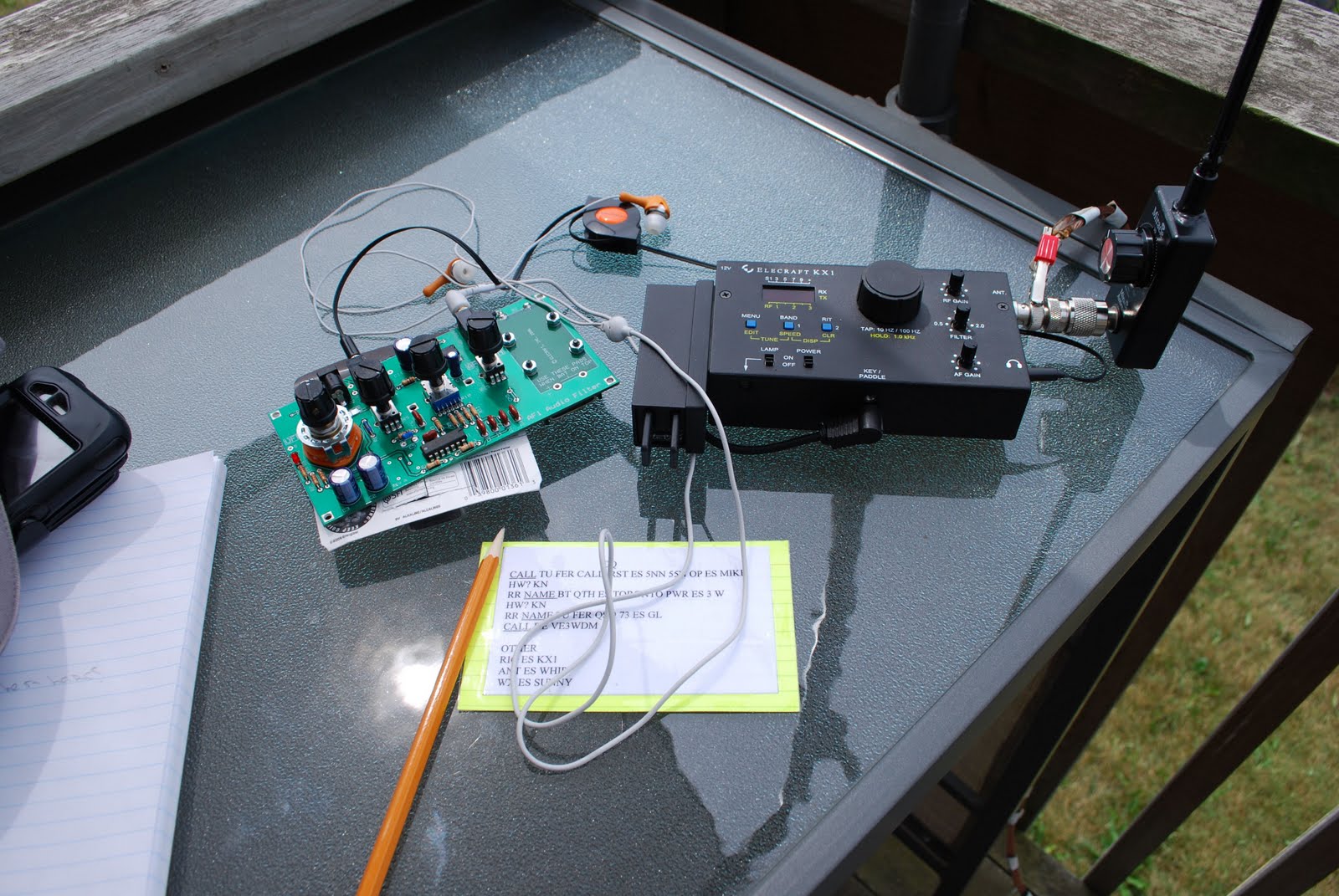 |
| The setup along with the cheat sheet |
AF in and out on the AF1" Not having any capacitors at the time I did have a counterpoise that I have used with the Miracle whip in the past. I stopped using it as I was able to get a decent SWR without it.....WRONG.......I really need to take antenna 101 the ARRL used to offer it but no more....that is another blog post....So I clipped on my counterpoise and all was well with the AF1. As well it improves the effeminacy of the Miracle whip I am told as well. So it was off to the back deck counterpoise in hand to give the KX1 and AF1 a workout to see how it preforms against the stock filter in the KX1. I had viewed some Youtube AF1 video's
and they seemed to be doing much better than mine. It's not that I am short of QRN as there are 500KV hydro lines right behind me!! With the counterpoise on I could hear my transmitted CW crystal clear. The AF1 filtering still did not seem to be all that great. It was only by chance that I noticed the filter on the KX1 was still set at about 300HZ. I backed it off all the way allowing the AF1 to do it's job, seems I was having the two filters in competition with each other. After this was done the AF1 was very very impressive and preformed like the Youtube video's I was watching in the past. At this point unfortunately I have no way of recording the KX1 with and without the AF1 filter so the blog world can hear the difference....those techno wiz bong skills I continue to work on.
 |
| Counterpoise alligator clipped |
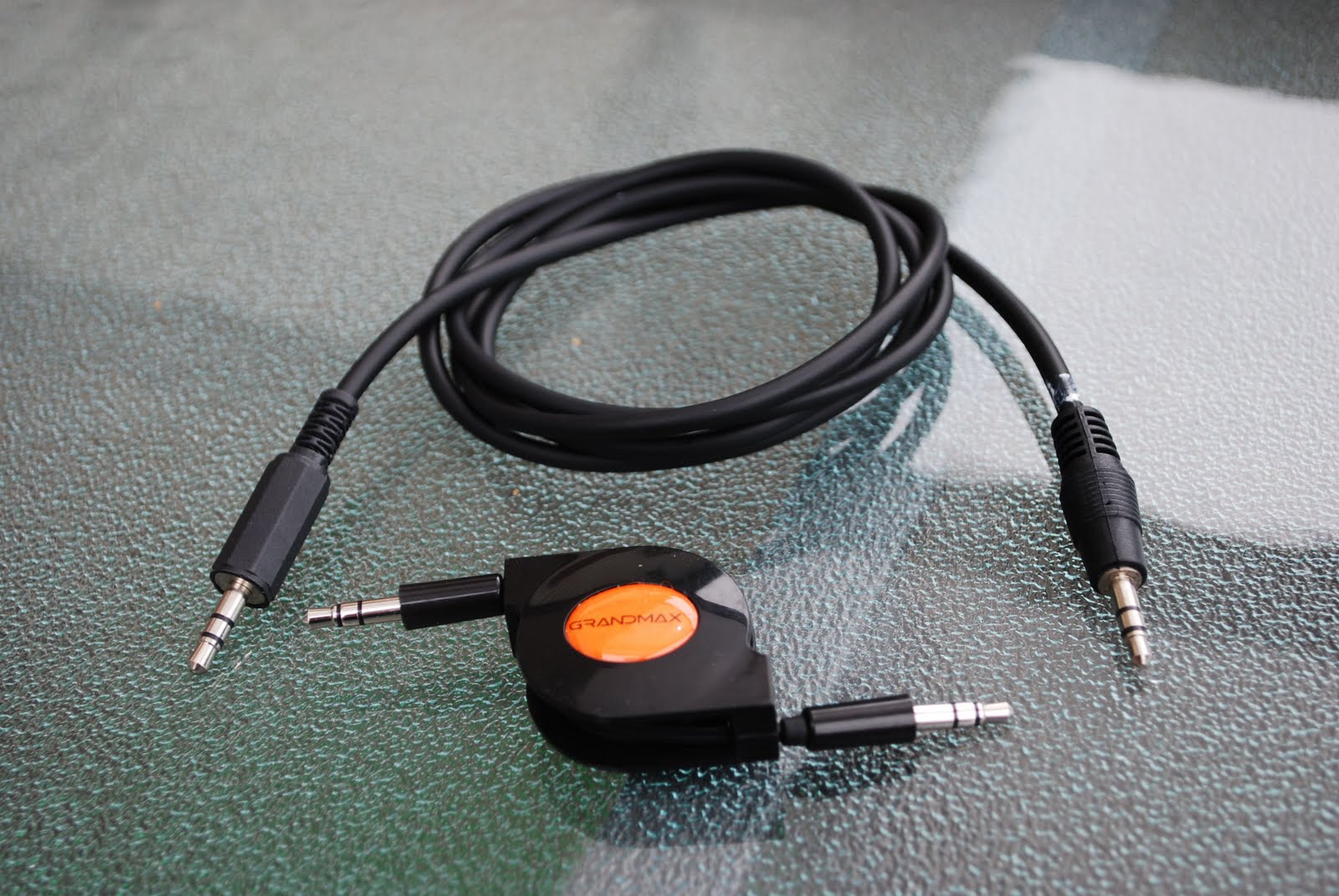 |
| With RF solved able to use roll up which is smaller |
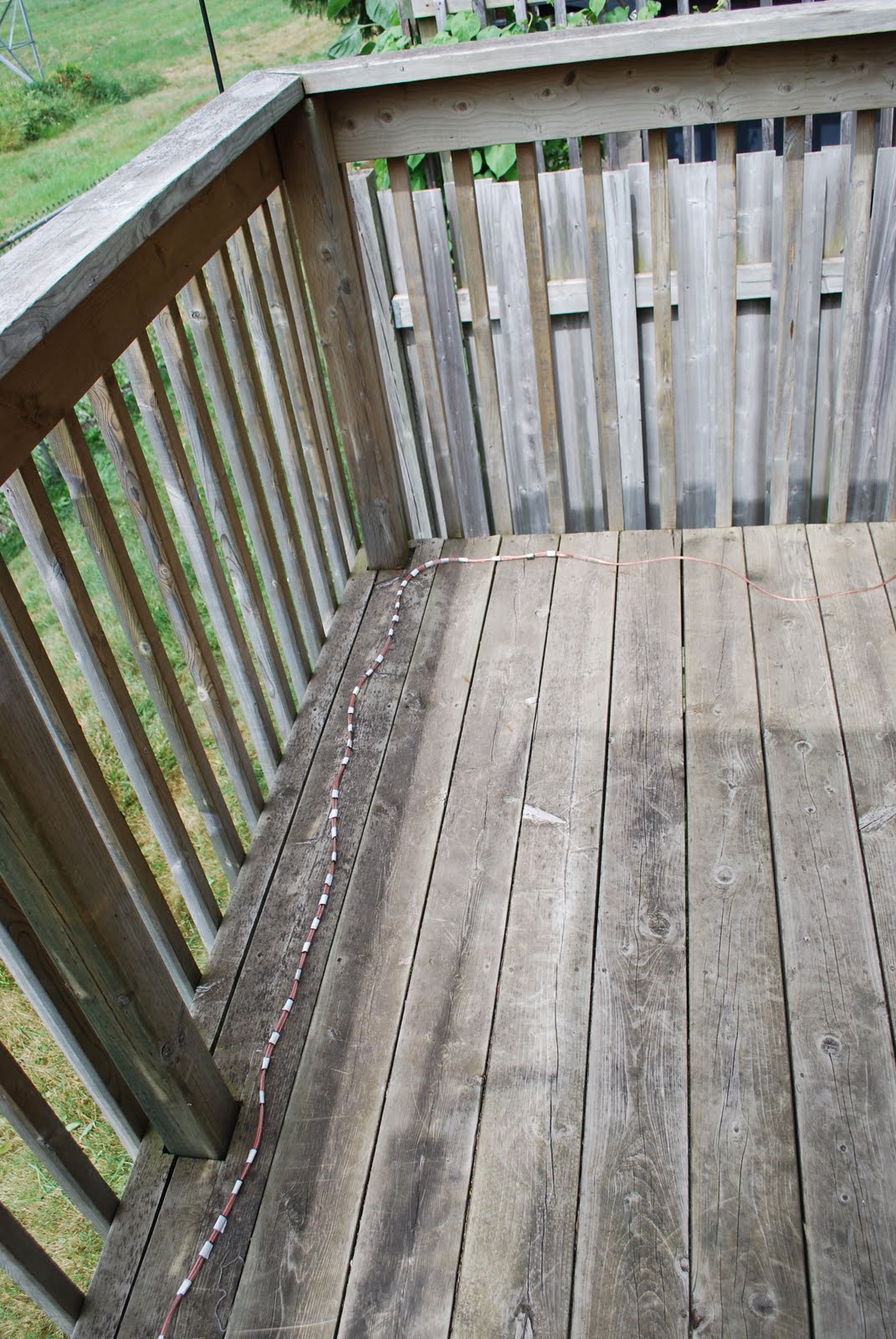 |
| Counterpoise |

Mike Weir, VE9KK, is a regular contributor to AmateurRadio.com and writes from New Brunswick, Canada. Contact him at [email protected].
Memorization is for Whimps! Learning the Extra Class
So I recently posted on Twitter that the formulas for the Extra class exam was kind of making me feel stupid because it’s been so long since I did any kind of serious math. I got a couple replies saying I didn’t need a calculator for the Extra Class test. Well, since they pull from a group of questions where all the questions and answers are known, yeah.That’s just raw memorization and reciting the answer on command. That’s not what I want to do. I want to understand the theory and use it in a practical purpose in my own projects. If someone else wants to pass the test to say “Yeah, I have an Extra Class”, then feel free. I believe that knowing this theory and being able to use it in a practical sense make someone a m0re rounded Ham and able to tackle new problems and take on more complex projects.
Now Yes, there are times when you just need a shortcut for the math. It makes it easier. So here are 2 videos that kind of show you what I mean. These make it a little easier for me to grasp the math behind the theory. If you’re studying like me, good luck!
73.
Rich also writes a Tech blog and posts stories every Tuesday and Thursday on Q103, The Rock of Albany’s website, as well as Amateur Radio stories every Monday thru Friday here on AmiZed Studios.
Rich Gattie, KB2MOB, is a regular contributor to AmateurRadio.com and writes from New York, USA. Contact him at [email protected].
K2 audio switchbox
My vision and steadiness of hand have improved to the point that I am able to build projects! Here is a picture of a switchbox I made for my Elecraft K2 a couple of days ago which allows me to switch the audio input source from the microphone to the computer sound card.
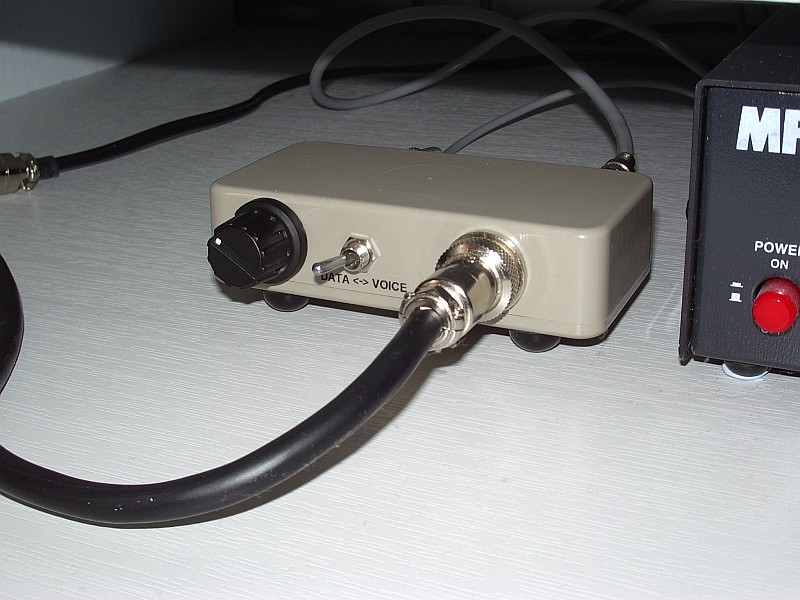
One of the niggling annoyances of the K2 is that it does not have separate inputs and outputs for voice and data modes. Most users carry out one of several published mods to obtain a fixed level audio output for the computer. Mine is tapped off the KAF2 filter module and runs to an RCA phono socket on the back panel. But for transmit most people just swap the mic lead and data lead over.
I used my K2 like that for years, though it wasn’t a great hassle mainly because I hardly ever used a microphone anyway. But I finally decided to come up with a better solution – hence the switchbox. It was easy to make and I thought it would be within my capabilities. Here is a picture of the internals.
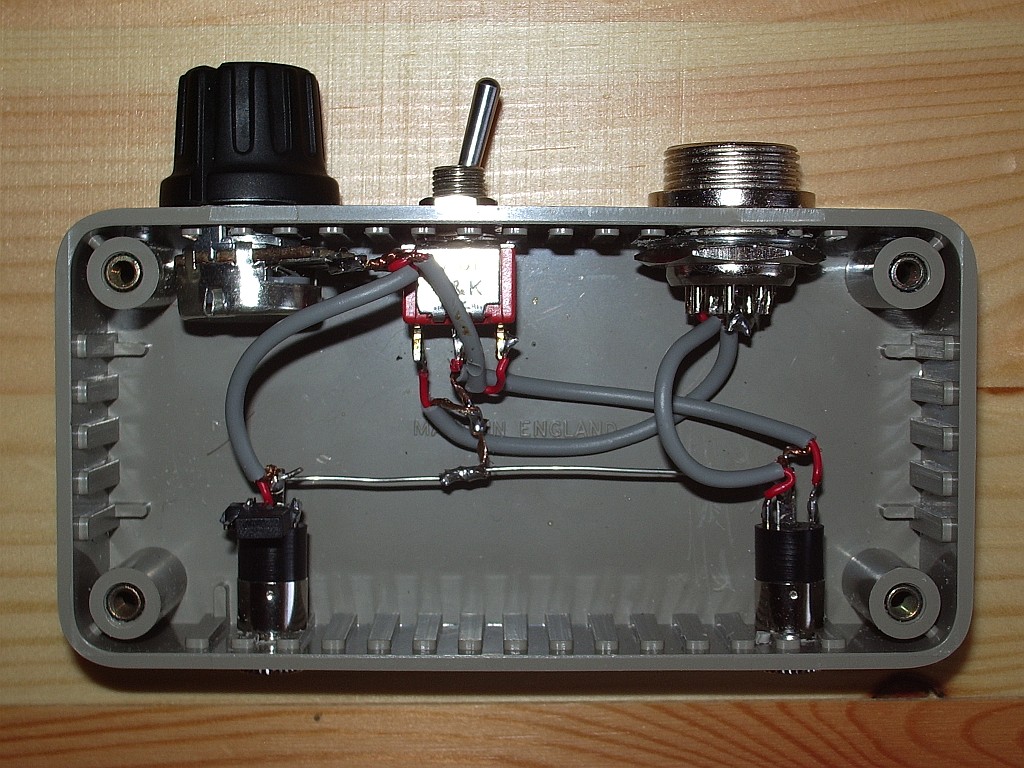
In one position of the front panel switch the microphone signal is switched straight through. In the other, the audio comes from the computer sound card headphone output via a potentiometer. Since taking that picture I added some resistance to the hot side of the pot so the control can be used over a greater range as the K2 mic input is very sensitive and needs some attenuation. As you can see, I don’t bother with isolating transformers. I’ve made dozens – well at least a handful – of computer/radio interfaces in my time and I have never, ever found the need for one. YMMV.
To celebrate the restoration of my constructional skills I have ordered a W5OLF WSPR beacon kit. John Harper, AE5X, recently reviewed it and wrote that it took him 50 minutes from starting to build to receiving his first spot. So I figured it shouldn’t be too difficult, though it will probably take me longer than 50 minutes. It would be nice to successfully complete a kit before I start undergoing the treatment that I expect will make me too tired to do all the stuff I am managing to do at the moment.

Julian Moss, G4ILO, is a regular contributor to AmateurRadio.com and writes from Cumbria, England. Contact him at [email protected].
You can count on WSPR
 |
| 10 meters |
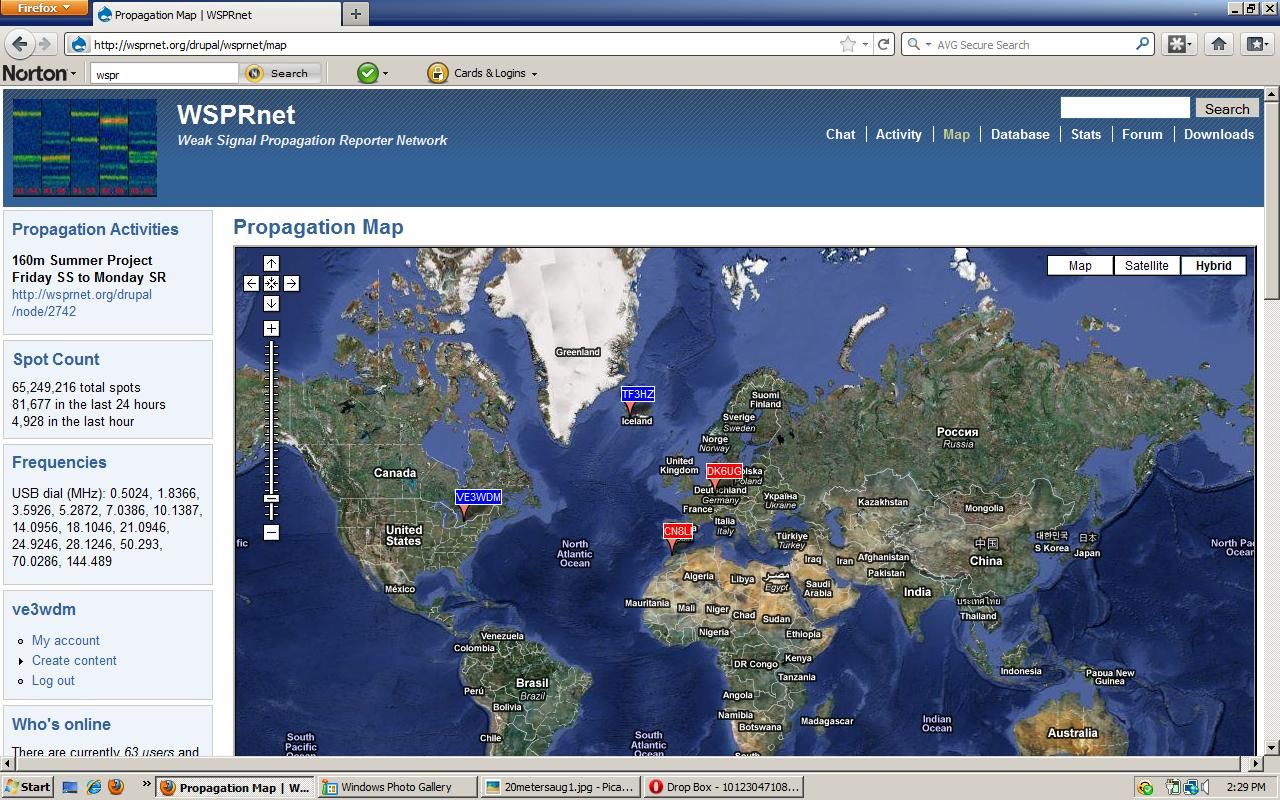 |
| 15 meters |
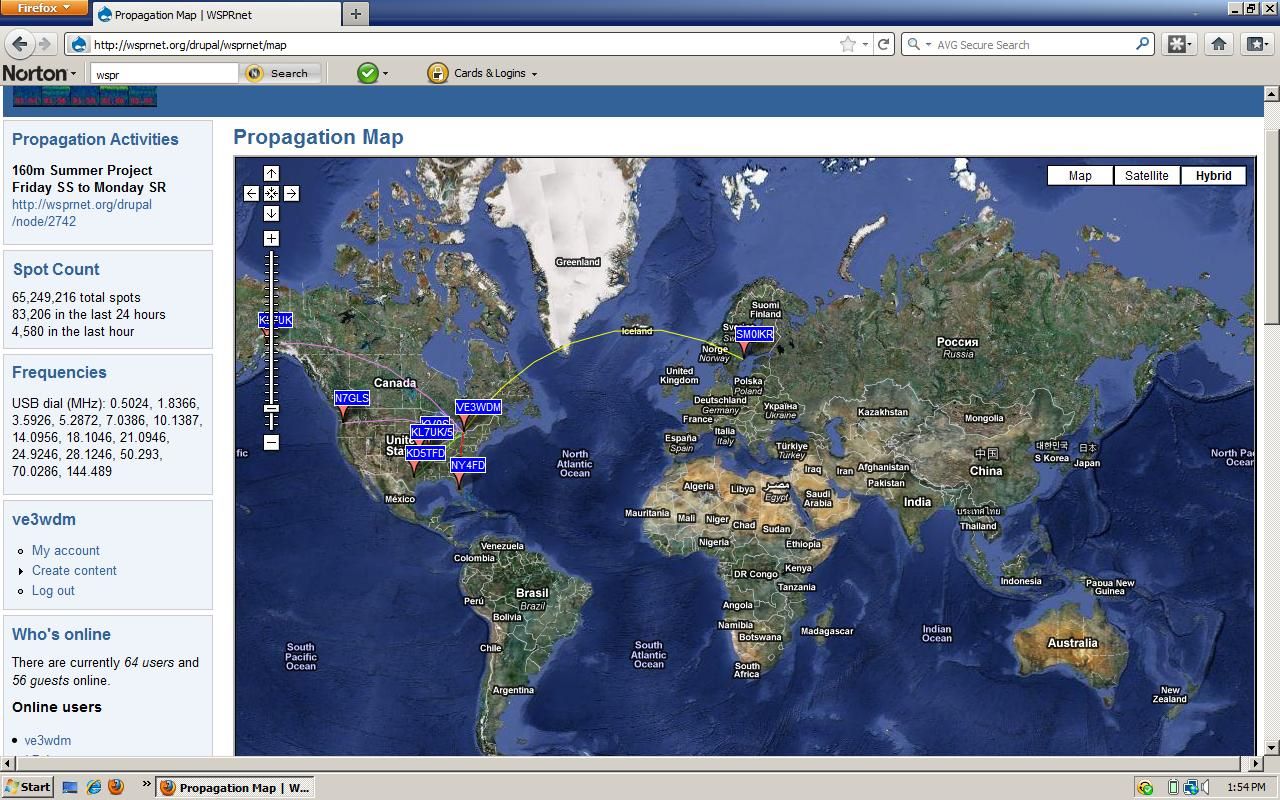 |
| 20 meters |

Mike Weir, VE9KK, is a regular contributor to AmateurRadio.com and writes from New Brunswick, Canada. Contact him at [email protected].
 Ham Radio Deluxe |
 W5SWL Electronics |
 Ham Radio Prep |
 KB3IFH QSL Cards  Hip Ham Shirts  HamRadioAuctions HamRadioAuctions Reliance Antennas Reliance Antennas Enigma Shop Enigma Shop |  morseDX  Ni4L Antennas  R&L Electronics R&L Electronics antennas.us antennas.us QRV QRV |
- Matt W1MST, Managing Editor
