 |
 Making QRP to QRP contacts…..
 3 January 2012 | by
  |
| VE1BA's shack |
I then called CQ on 14.060 and Mike N0ZH came back to me with a 559 signal. He gave the the same signal report. It was not long before Mike started to fade in and out and very hard to read. So my QSO to Missouri came to a fast end. For this QSO the K3 was at 1 watt with a better miles per watt at 694 miles. I did hear KF5HGL calling CQ I started returning his CQ at 500mW's and climbed all the way up to 5 watts and he was not able to copying me. So either conditions were changing or it was not time for me to make a QSO into New Mexico.
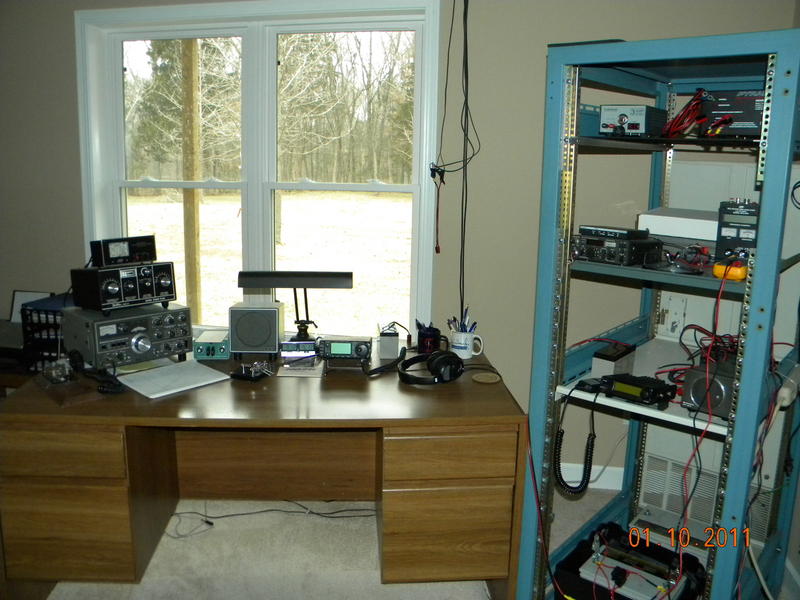 |
| N0ZH's shack |

Mike Weir, VE9KK, is a regular contributor to AmateurRadio.com and writes from New Brunswick, Canada. Contact him at [email protected].
More Summits On The Air (SOTA) Info
 I recently wrote about the Summits On The Air (SOTA) program gaining traction here in Colorado. Catching up on some of my podcast listening, I came across Jerry KD0BIK’s Practical Amateur Radio Podcast (PARP) on the topic of SOTA. It turns out that Jerry has gotten hooked on the SOTA program and has been out activating some of the Colorado peaks in December.
Operating a ham radio on top of a mountain during winter may seem like the act of a person with only one oar in the water (or shall we say one half of a dipole in the air?). But actually, we’ve had quite a few days of favorable weather that have been begging us to get outdoors in December. Still, I am on guard for an activation by Jerry in the middle of a blizzard, as he seems a bit smitten by this SOTA thing.
Episode 49 of PARP introduces the SOTA concept near the end of the episode, which is followed by a deeper SOTA discussion in Episode 50. These two episodes run about 25 minutes each, so take some time out to give them a listen.
73, Bob K0NR
Bob Witte, KØNR, is a regular contributor to AmateurRadio.com and writes from Colorado, USA. Contact him at [email protected].
A year in review…….
I have always been a QRP operator but for the first time I decided to drop my output power to less than 5 watts. By the end of 2011 the output had dropped to 500mW's or less with great success as well.
I took some time to look around the shack to notice how much "stuff" I had that was just taking up space. I then put up for sale items I was not using and made enough for some new toys.
I discovered WSPR and all that you can do with it.
I was able to upgrade the shack. The Elecraft K3 was upgraded with a second receiver and matching filters. Along with some added treats.
My main contest antenna was the Sidekick from High Sierra antennas. It was a great antenna that gave me coverage from 10m to 80m. The problem was it could only be outdoors when I was on the radio due to antenna restrictions. I tried the Sidekick in the attic along with my 20m dipole but it just did not work.
I sold the Sidekick and ordered the Alpha Delta DX-33 and installed it in the attic. I am now able to work 10m to 40m anytime I want and not worry about an outdoor antenna.
I found time to get some kits done and added to the shack.
I also had some Plasma TV interference so I purchased an MFJ-1026 and that fixed the problem it's a great unit.
I did more portable op's this year with my Elecraft KX1 and had a great time.
There was my trip of a life time to the UK and ham radio came along for the ride as well.
There was some wall paper added WAS awards, 1,000 miles per watt at 8,325 miles per watt. I then topped that record with 16,737 miles per watt.
Much more went on but these were the highlights here at VE3WDM!

Mike Weir, VE9KK, is a regular contributor to AmateurRadio.com and writes from New Brunswick, Canada. Contact him at [email protected].
HAPPY NEW YEAR


Mike Weir, VE9KK, is a regular contributor to AmateurRadio.com and writes from New Brunswick, Canada. Contact him at [email protected].
Yaesu Digital Voice
Yaesu has been in the news recently for the digital salvo they fired over the bow of the D-STAR ship. In theory I think this is a great move, and others are praising Yaesu’s announcement. My concerns with D-STAR’s proprietary AMBE vocoder algorithm and hardware, the essentially one vendor market for D-STAR equipment (Icom), and the relatively dated and unscalable D-STAR protocol are no secret to anyone who reads this blog regularly. But looking at the Yaesu digital voice whitepaper, it’s somewhat a half-baked initiative, in my opinion, where Yaesu has a new hammer and everything looks like a nail.
Most of the paper focuses on the modulation technique of D-STAR, GMSK, and pits it against Yaesu’s (errr….. Motorola’s) C4FM. While better RF and data throughput performance can be had with better modulation techniques, the big issue with D-STAR isn’t its modulation technique, it’s the layer two protocol. Yaesu doesn’t even mention its layer two protocol and network that would presumably be used, Wires II.
Yaesu’s case for C4FM superiority beyond it being used in commercial networks falls flat. In the paper there are specifications of selected D-STAR and C4FM radios compared, with some highlighted parameters. There’s also a graph comparing various modulation techinques, but the big takeaway is D-STAR has a rate of 4800 baud versus 9600 baud for C4FM. I’ve used the somewhat archiac term of baud rather than kpbs intentionally to illustrate just how lame the comparison is. Furthermore, while D-STAR is clearly in the crosshairs of Yaesu, there is no mention of D-STAR’s 128kbs data mode or how Yaesu’s solution beats that data rate.
All in all this whitepaper and initiative which some are praising appears to me to be a rather sophomoric effort, and one more concerned with selling retreaded commercial rigs in amateur radio. Aligning amateur standards with commercial ones isn’t a bad thing especially when secondhand commercial gear can be re-purposed for amateur use, but there needs to be other compelling reasons to adopt a commercial modulation technique. Even with the best layer one modulation technique, if the layer two protocol and the supporting network is badly designed the digital voice standard is doomed for failure. Yaesu needs to be making a case for its system by explaining the entire network, how it is open and non-proprietary, and how it will scale in the future. I hope Yaesu does successfully launch a competing digital voice solution, and I hope organizations like ARRL and RSGB get involved and insure that the standard is consistent with the spirit of amateur radio. Unfortunately to me this new initiative looks like another D-STAR in the making.
(D-STAR is a registered trademark of Icom Incorporated.)


DV Wars in 2012?
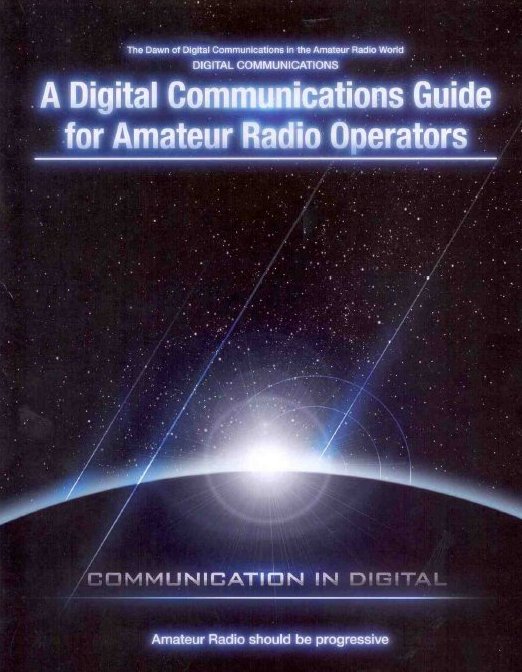
In 2012 Yaesu will introduce a range of digital voice radios to the amateur market. They have published a Digital Communications Guide for Amateur Radio Operators that describes their new system and answers some questions about it. Yaesu’s offering seems to be compatible with Motorola’s professional digital mobile radio system, which offers hams the possibility of a second source of compatible equipment on the surplus market – not that used professional Motorola radios have ever been cheap. But the Yaesu system will not be compatible with D-Star. No surprise there, then.
I have always believed it was a foolish move for ham radio organizations like our RSGB to allow themselves to be bamboozled by Icom into permitting the creation of a digital network that gave one supplier a monopoly. Repeater groups and their members who have made substantial investments in D-Star technology are not going to want to switch to a different digital mode that makes existing hardware obsolete. On the other hand, D-Star itself is becoming an outmoded technology in digital terms. Hams who have been sitting on the fence looking for an up to date alternative that doesn’t involve buying Icom are not going to plump for one system or the other while the future looks like being fragmented into rival factions. It will be like the video war between VHS and Betamax.
I think Yaesu’s announcement will kill the already lame duck of D-Star and ensure that analogue FM remains the dominant mode on the amateur VHF bands and up for years to come.

Julian Moss, G4ILO, is a regular contributor to AmateurRadio.com and writes from Cumbria, England. Contact him at [email protected].
ICQ Podcast S05 E01 – Powered SWR Meter Kit (01 January 2012)
Series Five Episode One of the ICQ Podcast has been released. News Stories include :-
- Amateur Radio Balloon crosses the Atlantic
- Radio Ham's invention seeing wide use
- EU threat to Amateur Radio kits
- 137kHz German signal received in Alaska
- Hams do their bit after disaster
- Australia to trial limited higher power
- Ofcom - 3400 MHz licence exemption
- Amateur radio operators to host kids day
- Beacon Maps and Beacon Spots
- Raspberry Pi moves towards production
Your feedback, Martin reviews a Power SWR Meter Kit.
Colin Butler, M6BOY, is the host of the ICQ Podcast, a weekly radio show about Amateur Radio. Contact him at [email protected].
 Ham Radio Deluxe |
 W5SWL Electronics |
 Ham Radio Prep |
 KB3IFH QSL Cards  Hip Ham Shirts  HamRadioAuctions HamRadioAuctions Reliance Antennas Reliance Antennas Enigma Shop Enigma Shop |  morseDX  Ni4L Antennas  R&L Electronics R&L Electronics antennas.us antennas.us QRV QRV |
- Matt W1MST, Managing Editor
