 |
 A Winter Trip to Greenland
 3 February 2012 | by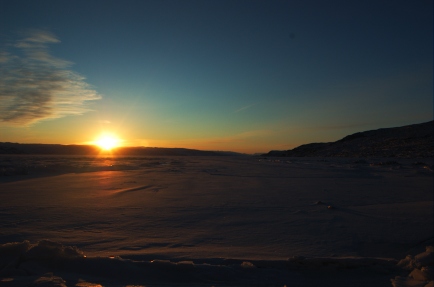
Last year, I managed to scrape together some equipment funds at work to buy a small spectrograph system for studying atmospheric light emissions (airglow and aurora). A co-worker secured the funds and contacts for us to install it at an observatory in Greenland. Because we need to make the measurements at night, and because the instrument was delivered in early December, we made immediate plans to go to Greenland as soon as possible. (Sarah is certainly laughing at this point because the plans were actually far from immediate and we bought our passage just over one week before departure.)
Greenland is only a short (4- to 6-hour) flight from the NE U.S., however the only route that operates in winter (and indeed the only commercial route) is on Air Greenland via Copenhagen, which operates four round-trip flights per week in winter. This turned getting there into a two-day affair of perverse travel arrangements totaling over 12,000 air miles to go about 4200 miles round-trip on the great circle. I met my co-worker, a United Airlines devotee (myself an American Airlines devotee), in Copenhagen and we flew to Kangerlussuaq (Sondrestrom) on Air Greenland.

One of the things that strikes you about Greenland as you approach Kangerlussuaq is how otherworldly and remote it is. Kangerlussuaq is the site of the former U.S. Sondrestrom Air Force Base, and one of two runways (the other is at Thule) on the island large enough to accommodate aircraft capable of flying to Greenland from abroad (this is a mild, although amusing exaggeration). Air Greenland has its hub there, shuttling passengers off to towns around Greenland on twin-engine turboprops like the Dash-8. It is, as our host explained, “…not your typical Greenland town. It is far inland at the end of the fjord and not on the coast. The only reason it exists is because of the airport.” Fuel and supplies are all brought in from outside. Like most current and former U.S. military installations worldwide, it is reliant on diesel fuel for its on-going existence. It’s sobering to be someplace that is totally unsustainable, although one might argue similarly of many U.S. cities, but I digress.
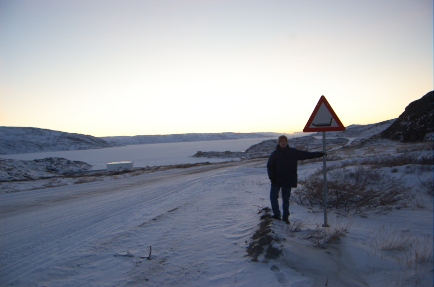
Kangerlussuaq is also near “the dog line,” north of which sled dogs are very common. Here is one of the two road hazard signs we saw while driving around…dogsled crossing:
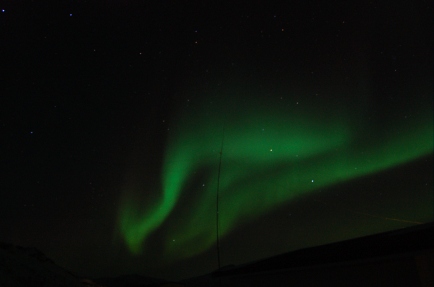
The instrument set up easily the first afternoon and we were able to collect some data with it that night. As we were setting the instrument up, we heard reports of an Earth-directed CME from the Sun and hoped for aurora over the next few days. We were not disappointed…
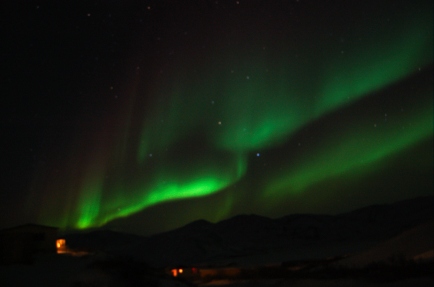
The second night, I stood “aurora watch” in the cold while my warm-blooded co-worker processed the previous night’s data. Soon, I saw some faint cloudy white sheets way down on the horizon and I ran back in to alert him and retrieve the camera tripod. This photograph was taken facing toward the east southeast.
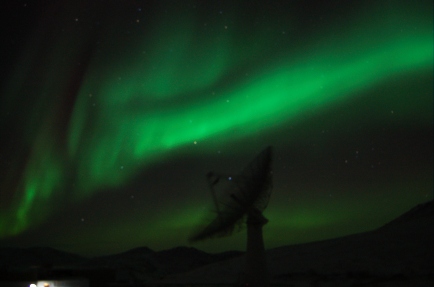
And, the 3.5-MW peak L-band incoherent scatter radar was running. The dish is blurred because it is moving.
And, here is a shot of my fan dipole strung up on the DK9SQ mast.
Speaking of radio, I did manage to make a few QSOs as OX/K8GU on 17 meters, but not as many as I would have liked. The combination of high absorption in the auroral oval (mostly to our south during our stay), little sunlight, a poor low-angle shot (required to avoid the auroral zone) to North America, short openings, and the fact that we were well-occupied with work for the four days we were there conspired to keep my contact count low. QSOs will go into LoTW soon—the certificate was issued yesterday. I have not yet designed a card, but there will be a special card. Thanks to those who did contact me.
Ethan Miller, K8GU, is a regular contributor to AmateurRadio.com and writes from Maryland, USA. Contact him at [email protected].
Hermes a step closer
Southgate ARC News ran a short piece on TAPR and appointing PCB manufacturers the other day. Reading onto this could be catastrophic but I can see that Hermes is getting closer. I’ve been following this for a little while know and bump into Kevin Wheatly, M0KHZ, the project leader every once in a while. I am really looking forward to this innovative piece of kit coming to the open market. Having seen a very early prototype a few years ago I would love to get one of my greasy paws on one of these. A high performance (HF) shack in a very small box! Hold onto your hats for Dayton then!
Alex Hill, G7KSE, is a regular contributor to AmateurRadio.com and writes from Cumbria, UK. Contact him at [email protected].
LHS Episode #074: The Great Hobo Migration
 2012 is rolling along nicely and Linux in the Ham Shack is rolling along with it, bringing you new ways to use your computer with amateur radio, and sometimes just technology for fun (and maybe profit). This time around, the guys break into politics — just slightly — and get a few grievances of their chests. In the middle segment, Richard and Russ discuss terminal emulation, something a radio amateur might need for accessing modems built into rigs or running packet TNCs. Finally, our intrepid co-hosts open up the mail bag and respond to listener feedback. If you would like to contribute feedback, please do so by sending us e-mail at [email protected] or calling in on our voice line at +1-909-547-7469.
73 de The LHS Guys
Russ Woodman, K5TUX, co-hosts the Linux in the Ham Shack podcast which is available for download in both MP3 and OGG audio format. Contact him at [email protected].
Ham Nation 33

Hosts: Gordon West (WB6NOA) and George Thomas (W5JDX)
Gordo talks about his adventures at Quartzfest, inspiration from Peggy Sue (K5PSG). Leo smokes a pickle, and more.
Guest: Cheryl Lasek (K9BIK)
Download or subscribe to this show at http://twit.tv/hn.
We invite you to read, add to, and amend our show notes at wiki.twit.tv.
Thanks to Joe Walsh who wrote and plays the Ham Nation theme.
Thanks to Cachefly for the bandwidth for this show.
Dr. Bob Heil, K9EID, is the founder of Heil Sound and host of TWiT.tv's Ham Nation which streams live each Tuesday at 6:00pm PT (9:00pm ET) at http://live.twit.tv. Contact him at [email protected].
Handiham World for 01 February 2012

Because the station will be staffed by real live humans (members of the Handiham affiliated Stillwater Amateur Radio Association, SARA), the Remote Base station W0ZSW will be off line for the duration of the contest. The W0EQO repeater will be active and connected to the Handiham Conference Server.
W0ZSW Remote Base service will be restored at 6:00 PM CST (2400 UTC) on Saturday, February 4, at the end of the contest. W0EQO Remote Base at Courage North will remain in service throughout the contest.
The SARA members are also going to help us assess equipment and clean and organize the Handiham station area and storage room. We will also check the station infrastructure and prepare some of our computer equipment with digital mode software for the upcoming Minnesota Radio Camp session in June.
We hope to hear you on the air!
For Handiham World, I’m…
Patrick Tice, WA0TDA
Handiham Manager

Pat Tice, WA0TDA, is the manager of HANDI-HAM and a regular contributor to AmateurRadio.com. Contact him at [email protected].
PE4BAS goes QRO!

You’re kiddin’ PE4BAS goes QRO. No, it can’t be. But a picture says more then a 1000 words! It has to be true. I just had the opportunity to buy this RM KL500 amplifier very cheap on the club evening last friday. I thought what the heck, I just like to experiment. This amp is rated 600W (!!) out with 30W SSB in. Well I don’t recommend that at all, as it will get very hot. At first I connected everything to my FT817 and did a 5W input, the amp was not going to TX, was it broken? So I was a little angry about that. I wrote one of the clubmembers to get the call from the amateur that had sold it so I could get in contact with him. Then it strikes me that there was a extra connection made on the back side. The electronic diagrams were delivered with it and from that I understood the internal VOX circuit was bridged. I just had to connect this connection to earth or neutral via PTT to get it on TX. After looking inside it was clear to me the extra BIAS mods found on the internet were already made in this amp. Anyway, just to be shure I connected a old CB radio with 3W instead of my expensive FT817. With the KL500 on the dummy it did already 100W out full power. But it took 30A of current already. I don’t want to test it any further as that was more then enough for me. I guess it does about +200W out with 10w in? Too much for my needs. So I will sell this one after I tidy it a little and make a proper connection for the large current supply. After that I will try to test it once more with 10W input and then sell it.

So I’ve been to the local radioclub last friday and collected my QSLs from the bureau. They have a special PE4BAS tab in the QSL trunk now, so they were easy to find. 2 QSLs were special to me. The one from ON2PCO as I remember him well. He was using 10W with a FD4 dipole inside the house and was surprised to work me on 80m in the PACC. And the QSL from JW/PA0ZH from Spitsbergen, Svalbard. I didn’t work them with EME but on 20m SSB. Although they were QRV with EME, I think they made a lot of operators very happy.

Today I listened for HK0NA once again. I guess luck is not with me as I could only hear a very weak sometimes readable signal on 15m. The rest of Europe seems to have very good propagation as he worked one after the other. Same for TO4M who was just readable on 10m, he worked a lot of Europe but after calling for half a hour I just gave up. I tried for a Brazilian station who was RS58 here, but even he didn’t hear me. Time to leave the radio then and do some other things. I hope propagation will be better with the PACC on……9 days to go.
Bas, PE4BAS, is a regular contributor to AmateurRadio.com and writes from Groningen, Netherlands. Contact him at [email protected].
A cheap LCD
A packet arrived from China this morning containing a 16×2 LCD module which I purchased for the absurd sum of £1.93 including shipping. That wouldn’t cover the postage from a UK supplier. I don’t know how the Chinese do it and make a profit.

I bought the module with the intention of using it to make a user interface for my Parallax Propeller beacon. Having ordered it I was not sure how to interface the LCD to the Propeller so I chickened out and ordered an LCD UI module from Gadget Gangster. This is rather more expensive (though still a reasonable $29.99) but it includes a 4-way + depress button for menu navigation, plus a separate red button. It plugs straight into the Gadget Gangster board. I reasoned that even with the hardware sorted the software would be enough of a challenge.
I have rather ambitious plans for this beacon. Perhaps over-ambitious. After reading Alex G7KSE’s blog post about his Arduino based MSF 60kHz receiver I’m interested in interfacing one of the inexpensive MSF receiver modules to the Propeller. I could use this to display an accurate clock and also to control the start of WSPR beacons. As I’m a bit of an accurate time nut and have two radio controlled clocks in the shack (and a radio controlled watch) it is really no trouble to press a button to start the beacon at the beginning of an even minute and then keep time from there. But that isn’t the point really, is it? What could be cooler than a shack clock that is also a WSPR beacon?
This microcontroller stuff is new to me and I have a lot to learn about it. One question I have is what do constructors who use Arduino boards or similar things like the Gadget Gangster do when they want to make a finished project? Do you just buy another development board to use for the next project, or are there simpler boards with just the microcontroller and its essential ancillary components which you use for the final version? I guess I’d still want the ability to update the software (firmware?) so there isn’t much of the Propeller Platform board that I wouldn’t be using.

Julian Moss, G4ILO, is a regular contributor to AmateurRadio.com and writes from Cumbria, England. Contact him at [email protected].
 Ham Radio Deluxe |
 W5SWL Electronics |
 Ham Radio Prep |
 KB3IFH QSL Cards  Hip Ham Shirts  HamRadioAuctions HamRadioAuctions Reliance Antennas Reliance Antennas Enigma Shop Enigma Shop |  morseDX  Ni4L Antennas  R&L Electronics R&L Electronics antennas.us antennas.us QRV QRV |
- Matt W1MST, Managing Editor
