 |
 First HF Opera QSO
 11 March 2012 | by
Yes. Opera now has a QSO mode. I had to update KComm to allow the Opera contact to be logged, so I thought I’d add ROS for good measure. You never know. 🙂
eQSL still won’t accept the mode “Opera” as it hasn’t yet been added to the ADIF specification. It remains to be seen whether the mode catches on. It’s an obvious rival to JT65A but the JT mode has a lot more users. Opera is not time-synchronous and allows a bit more free-text flexibility.
By the way, have any of you Blogger users noticed that you can’t insert GIF images into blog posts any more? When I try, I just get an empty box. I have to save all my images as JPG which is not a very efficient format for screenshots.

Julian Moss, G4ILO, is a regular contributor to AmateurRadio.com and writes from Cumbria, England. Contact him at [email protected].
Trip #4 to Lido Key, IOTA NA-034
In just over a week, I’ll be heading down to Florida to visit family, and, as I’ve done on previous trips, I plan to be operating from Lido Key, IOTA # NA-034 from March 21 to 23. My current plans are to be on the air during my local afternoon between around 1700 – 2200 GMT, on 14.260 or 21.260 (the standard IOTA frequencies), phone only. This is very much a “holiday style” operation, so those operating times may vary, and depending on band conditions, I might set up elsewhere.
For this trip, I’ll be taking my Buddipole and using it on top of the same 8-foot mast that I used last summer in Costa Rica. When I was in Costa Rica, I was able to bungee cord the mast to the railing of the balcony, but since I’m not sure that I’ll be able to do the same with the picnic tables at the park where I’m planning to operate, I figured out how to guy the mast using some lightweight tent stakes, some line, and some small carabiners that I picked up at a local outdoor store. The folks who sell the Buddipole do make a guying kit, but I thought it would be nice to see if I could make something myself.
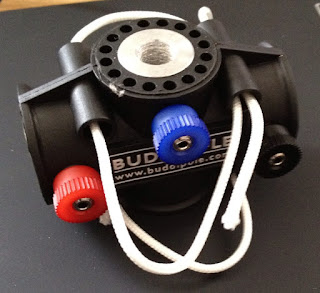
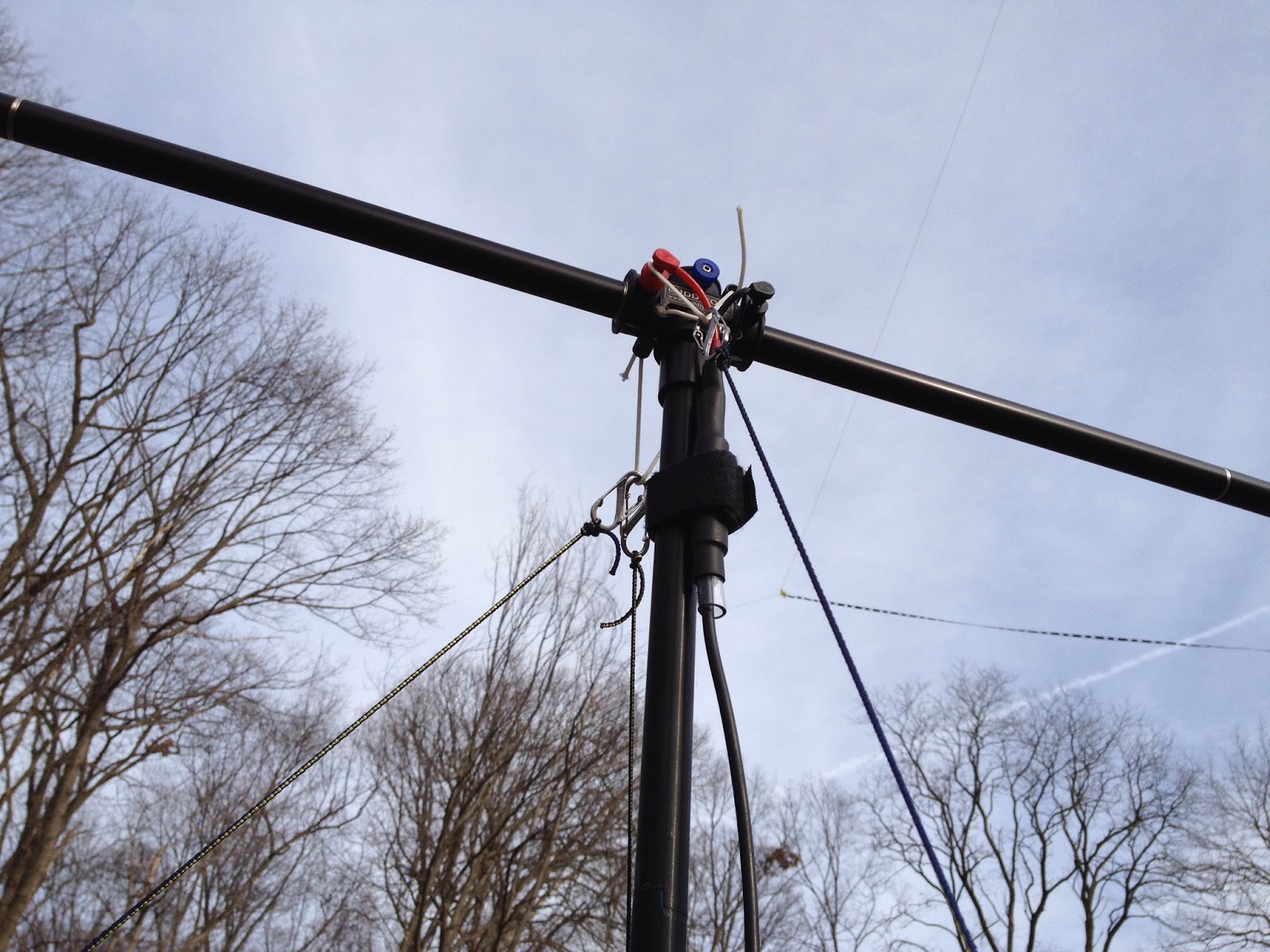
Because I learned the hard way that it’s pretty easy to break a whip if the antenna isn’t supported properly, I first made sure that I could connect the Versatee to the mast (without the arms or whips), attach the lines to that, then stand it up and tension the guys so that the mast seemed stable. I realized that I needed to keep the guy lines probably a bit closer than I would have liked to the mast or I wouldn’t be able to reach the hitch knots to adjust them. While I could have used adjustable knots to connect to the carabiners, in use those would be at the top of the mast and would be unreachable. As it turned out, it worked out pretty well the way I set it up. I had to first roughly estimate the 120 degree separation between the stakes around the mast, and I got lucky on my first try.
 After seeing that this seemed to be pretty stable once I put some tension on the guy lines, I took it down and screwed in the antenna arms, coils, and whips, though I left the whips fully collapsed. I raised it back up, tightened up the guys (actually I just had to tighten one guy because of the way I’d lowered things), and it still seemed pretty stable, so I lowered everything once again, extended the whips (I’d already connected the wander leads to the proper location on the coils) and raised everything up. (If you’re viewing this on my blog page, you can click on the pictures to see a bit more detail, which is particularly helpful for the one showing the antenna fully deployed).
I connected the feedline to my radio (I’d brought my Icom 706MkIIG and a small power supply outside) and the built-in SWR meter in the’706 showed good SWR over the phone portion of 15 meters. I tuned around to see if I could find a station to work and I came across was Pedro, EC8AUZ. We had a nice little chat and he told me that my setup was working well, which was all that I could ask for.
At only 8 feet above ground, I know that the pattern for the antenna is going to be distorted. As I was set up with the broad side of the antenna roughly aligned Northeast/Southwest, it was good to know that I could make a 3500 mile contact due east with that setup.
I still have a few things to do before leaving, but it looks like I should be all set as far as the antenna goes. I hope to work some of you while I’m in Florida. If you’re in the Sarasota area, drop me and email and maybe we can get together for a bit while I’m there.
PC power supplies for Amateur Radio equipment?
 I’ve noticed a few spirited discussions regarding modifying computer power supplies for use with Amateur Radio equipment. On the surface it seems as though they supply the perfect solution: Inexpensive, high current, regulated 12V DC supplies for a fraction of the cost of specialized amateur equipment. Is it really is as straight forward as lopping off a molex connector and replacing it with an Anderson Powerpole?
By design PC power supplies are designed to output a fairly well regulated 3.3V & 5V to the PC motherboard and 12V to the motherboard, fans and hard-drive motors. Modern units are typically rated anywhere from 75W to 1200W which should be a measurement of the output power available from all the 3.3, 5 and 12 volts. Since this isn’t a lab grade power supply you can expect marketing hyperbole has perhaps inflated the power output figures.
Back when my job was to build PCs I had an issue with a server not being able to start its complete complement of disk drives. When I opened the case I found a 300W desktop supply board had been used in place of the 800W board … sometimes you don’t even get what you pay for!
Before you convert your first PC power supply there are two issues that may, or may not, cause a problem depending on your unit.
The first is load regulation or the ability of the power supply to maintain its rated voltage under load. If the output voltage drops too far your rig will shutdown, distort or fail to provide its rated output power.
The second issue is due to the high frequency switching circuits used in switch mode supplies. Depending on the individual power supply there can be adequate to no filtering to prevent radio frequency interference being broadcast to your receiver. Toroids on the input and output lines can help to reduce interference.
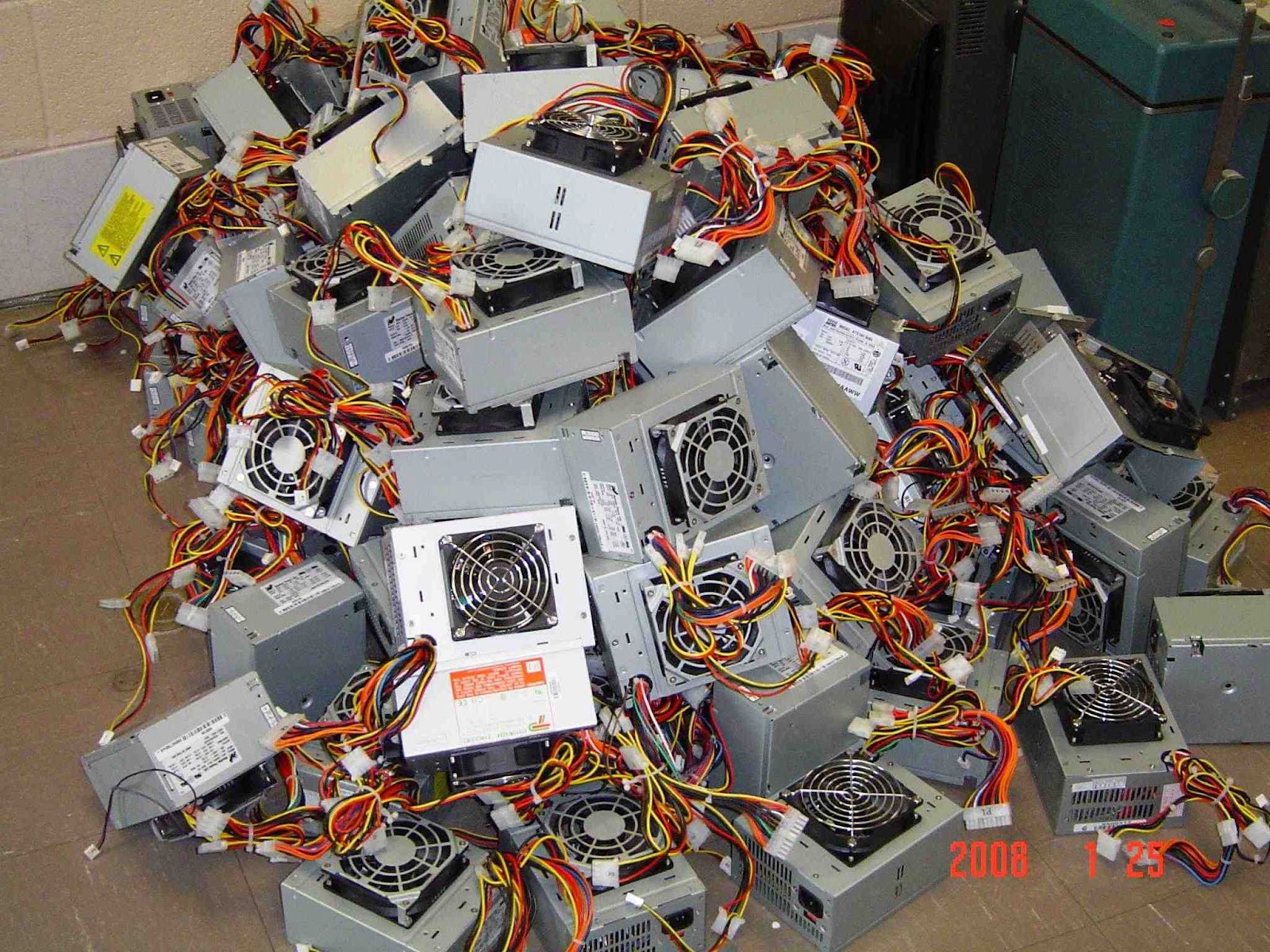 Because of construction differences between models and even between batch numbers for the same model you can never be certain how the power supply you purchase, or recycle, will perform. For the most part people’s experiences have been positive but I have heard of power supplies that were unusable because of RF interference or such poor load regulation that the 12V rail dropped to 11V under load.
Without a motherboard presenting a load and supplying the power-on signal there are a few changes that need to be made to the power supply. Modern power supplies will not enable the 12V output unless the power-on wire is grounded and a load should be placed on the 5V line to help with regulation. Additionally there is usually an adjustment that can be used to raise the voltage above 12V
The following links detail the steps required to convert a PC supply for use with amateur radio equipment. Whether this represents a good investment of your time will depend on your desire to do-it-yourself and the quality of the power supply you begin with. I’ve heard strong opinions either way but I’ll just say that, if luck favors you, you’ll save some money and learn a few new skills in this exercise.
Computer Power Supply Converted for Ham Use
CONVERTING COMPUTER POWER SUPPLIES (Advanced with theory)
Converting Computer Power Supplies to stabilized 13.8 V DC 20 A
Owen Morgan, KF5CZO, is a regular contributor to AmateurRadio.com and writes from Texas, USA. Contact him at [email protected].
ICQ Podcast S05 E06 – 21st Century Beacon – GB3VHF (11 March 2012)
Series Five Episode Six of the ICQ Podcast has been released. News Stories include :-
- Opera Beacon takes Route 66
- Australian Kilowatt
- Ofcom on 5 MHz NoV
- Discover amateur radio at Surrey Museum
- Special Event Station - VO1AA
- ARRL publishes new Guidelines for 60 meters
- BBC - A lifetime of shortwave
- Extension of UK 501 kHz to 504 kHz NoV's
- 'Twisted' waves could boost capacity of Wi-Fi and TV
- Raspberry Pi computer now on sale
Your feedback and GB3VHF – a beacon designed for the 21st Century.
Colin Butler, M6BOY, is the host of the ICQ Podcast, a weekly radio show about Amateur Radio. Contact him at [email protected].
ICQ Podcast S05 E06 – 21st Century Beacon – GB3VHF (11 March 2012)
Series Five Episode Six of the ICQ Podcast has been released. News Stories include :-
- Opera Beacon takes Route 66
- Australian Kilowatt
- Ofcom on 5 MHz NoV
- Discover amateur radio at Surrey Museum
- Special Event Station - VO1AA
- ARRL publishes new Guidelines for 60 meters
- BBC - A lifetime of shortwave
- Extension of UK 501 kHz to 504 kHz NoV's
- 'Twisted' waves could boost capacity of Wi-Fi and TV
- Raspberry Pi computer now on sale
Your feedback and GB3VHF – a beacon designed for the 21st Century.
Colin Butler, M6BOY, is the host of the ICQ Podcast, a weekly radio show about Amateur Radio. Contact him at [email protected].
Newsflash: Not Everyone Is Going to Be an Expert
You’ve probably run into this situation…some of the more experienced radio amateurs commenting about how so many of the newer hams are incompetent. “Yeah, they’ve dumbed down the FCC exam, so now anyone can get a license. Back when I got my license, I had to copy Morse Code in my head, design a triple-feedback-loop vacuum tube amplifier and recite the Gettysburg address backwards in front of an FCC examiner.”
A while back, I wrote about the time when a newbie on an email list asked a simple electronics question and got this reply: Not to pick on you, but is there any requirement these days to have a basic knowledge of electricity and/or radios to get a ham license?
Often this shows up as an elitist attitude of If you don’t pursue the hobby my way or at my level, then you are doing it wrong.
Since amateur radio consumes most, but not all, of my hobby time, it is easy to lose perspective on this. And, yes, I am sure I have complained about clueless newbies and LID operators from time to time.
It’s interesting to put the shoe on the other foot and think about activities that I pursue with much less time and intensity. In other words, think about activities where I am not that experienced and certainly not an expert.
For example, I enjoy fishing but I am really not that skilled at it. For me, fishing is just an excuse to sit next to a stream and enjoy the scenery. If I catch fish, that is a plus (but I always throw them back in anyway). When I encounter Real Fisherpersons, they are usually friendly and helpful, passing along a few tips on what they using for bait, etc. Sometimes I will encounter That Fly Fishing Guy that looks down his nose at any form of fishing that does not meet his high standard.
I also enjoy photography. I have a decent Canon DSLR camera with a few lenses and I manage to capture some reasonably good photos that way. (This probably has more to do with the quality of the camera than the photographer.) My interest is mostly to capture experiences and events in my life and create photos that I can use in my various writing activities. But I know a number of people that are infinitely more skilled than I am. They are generally very helpful and I usually manage to learn something from them. Come to think of it, I have not encountered very many condescending photographers — most of them have been very helpful. Maybe I have just been lucky.
Although it’s a cliche, Life is Too Short. There are so many things we can choose to do with our time and, really, so little time to do it. People must make choices about how deep they get into any activity, all while balancing family time and demands at work. It shouldn’t surprise us when some people choose to be part-time hams and don’t aspire to be the expert in all things radio.
And the final point is, if you think you have something to offer to the newbies, make sure you come across as helpful and make sure it looks like you are having fun. Being the Old School Grumpus will not attract people to your favorite activity. Having fun and inviting them in will!
73, Bob K0NR
Bob Witte, KØNR, is a regular contributor to AmateurRadio.com and writes from Colorado, USA. Contact him at [email protected].
Mentoring……….who me!!!!!

are looking for in ham radio....strictly VHF/UHF, upgrade to HF and are they interested in code? The meeting to find all this out will be this weekend over coffee. In the mean time I have been on the Internet looking up what is now involved for one getting their Amateur radio license here in Canada! I found out that it sure has changed and in a very good way. It seems to me at first glance anyway that the study materials exhibit a more practical aspect of the hobby. Sure the regulations are still a part of the exam but there is more on antennas, propagation and even setting up a station. I can see for me this is going to be a learning experience as well. I will have the opportunity to brush up on my theory and who knows learn some new "stuff" about antennas, feed lines, radio equipment, the regulations and the theory! Wish me luck..........

Mike Weir, VE9KK, is a regular contributor to AmateurRadio.com and writes from New Brunswick, Canada. Contact him at [email protected].
 Ham Radio Deluxe |
 W5SWL Electronics |
 Ham Radio Prep |
 KB3IFH QSL Cards  Hip Ham Shirts  HamRadioAuctions HamRadioAuctions Reliance Antennas Reliance Antennas Enigma Shop Enigma Shop |  morseDX  Ni4L Antennas  R&L Electronics R&L Electronics antennas.us antennas.us QRV QRV |
- Matt W1MST, Managing Editor
