 |
 The Baofeng UV-5R has arrived
 18 April 2012 | by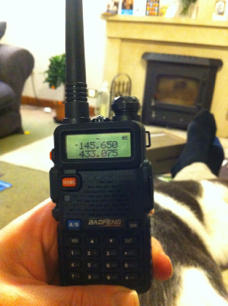
Haven’t had a QSO with it yet, but the UV-5R has arrived. Nicely built and looks promising.
Programming the memories manually is, um, interesting. I can program most things but I’ve ordered a programming cable.
The VHF side seems to work better than the UV-3R. I’ve successfully blipped up GB3WH on 2m and GB3TD, GB3DI, GB3UK on 70cms.
Charger looks ok, though I preferred the USB capability on the UV-3R plus. No sign of an earpiece/mike as supplied with the UV-3R which I found useful. I will try the UV-3R earpiece/mike – I’m guessing that will work fine.
More soon as I have time to play.

Tim Kirby, G4VXE, is a regular contributor to AmateurRadio.com and writes from Oxfordshire, England. Contact him at [email protected].
Handiham World for 18 April 2012
Welcome to Handiham World.
You can do it!
Today, just as we did last week, we are going to begin with Troubleshooting 101 as part of our initiative to help new ham radio operators (and even some of us older ones) learn how to do some basic troubleshooting for ourselves. Yes, it can be tempting to ask someone else to do things for us. This can become a bad habit when it keeps us from learning new things, especially things that we could – with a bit of practice – learn to do for ourselves. Knowing these basic things can serve us well in the future when no help is available. This next simple exercise is one that we will be practicing at this summer’s Radio Camp. You can do it yourself once you learn a few basics.
Troubleshooting 101
Help! My HF radio is dead!
One of the things we grow used to is turning on the radio and hearing stations, even if they happen to be weak or off frequency. We quickly learn, as new operators, how to tune around and adjust the VFO to hear stations clearly. Sometimes we turn the radio on first thing in the morning and hear nothing but static from far-off thunderstorms, but that is nothing new. We know that we can tune across the band and find some really strong stations.
But this morning is different. You turn the transceiver on, but there is nothing – no sound at all, at least any that is loud enough to detect without headphones. What could be wrong?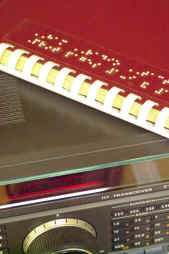
Well, the best thing to do is to follow the advice in “The Hitchhiker’s Guide to the Galaxy” and don’t panic. Many of our Handiham members are blind, so we will include some troubleshooting steps for them. We are going to check off everything without making assumptions. Some of our readers will think that this stuff is obvious, but in the grand scheme of things we must allow for a wide range in the knowledge and experience of amateur radio operators. Some will be familiar with the “dead radio” problem and others will be experiencing it for the first time. Let’s cover all the bases.
- Yes, I know this is obvious, but did the radio really turn on when you flipped the switch? Did the radio make a telltale sound when switched on? Even if I could not see the lighted display of my IC-7200, when it is powered up I hear a click as a relay energizes in the connected autotuner and my computer makes a connected sound to tell me that a USB device is now on line. Keying the PTT in SSB mode and not talking should trip the transmit relay without sending any RF, so you can hear the click of the relay. Have you checked the power supply switch?
- Make sure that you have not left headphones plugged into the PHONES jack. Doing so on most radios will mute the speaker.
- Check the AF gain (volume) control. Maybe you turned it all the way down the last time you used the radio. Don’t laugh – I often do this if I am in the radio room and get a phone call or start listening to something else. Turn up the volume and if you can hear stations, you have solved the problem.
- Check the RF gain control. Sometimes this gets turned down by accident, or perhaps you turned it down in a previous session because you were dealing with a very strong signal. Turn it back up and try tuning around again. Incidentally, I often find that users of the Handiham remote base stations leave the RF gain turned down on the TS-480 radios. No wonder the bands seem dead!
- Okay, so now we have power to the radio, the RF and AF gains are adjusted, and there is still no sound. Many radios have squelch controls, and this little feature can cause all but the very strongest signals to be completely muted. Perversely, this control is sometimes a concentric one that shares the same spot as the volume control. It is easy to misadjust, by which I mean setting it to anything but completely off! With the volume turned up to mid-range turn the squelch all the way down. Note that you don’t want the volume cranked up to max when you do this, as the sound may be startlingly loud!
- Don’t forget the other adjustments your radio may have to tailor the sound. Filter settings and pass band tuning might be set incorrectly. If they have detents, return them to “normal”.
- Still nothing at all? Retrace your steps to make sure there is power to the radio. Check the power supply and connection to the radio. Check the fuses and breakers at the station equipment and at your home’s breaker box. Make sure everything is connected as usual.
- Assuming that you do actually have power and that the radio is powered on, you could have a problem with the radio itself. Sometimes oxidation occurs on the mechanical connection in the headphone jack. Push a headphone plug in and out to clear it. Don’t forget to listen via the headphones to eliminate the unlikely possibility that the speaker coil has opened. If any of this resolves the condition, you are good to go. If not, take further steps to have the radio checked. Ask for help from your local radio club before assuming that the radio has failed. There are probably club members who are experienced with that radio and who can help you determine what is wrong and whether it needs service.
- Let’s say that you do actually hear a gentle hiss from the radio but that you can’t tune in any stations. Check to see if you have locked the main tuning dial by mistake. If the tuning is locked, you can twirl the dial all day long and the frequency will not change!
- Now you have tuned across the band and there are no signals. Try another band and check again. Still nothing? Check to make sure that the antenna’s feedline is connected. If you have an antenna switch, make sure that it is in the correct position. Don’t forget the radio’s antenna selector if your transceiver has one!
- Try WWV on 5 and 10 MHz. Both put out awesomely strong signals. If you hear a weak or warbling signal, conditions may be poor.
- Next, tune your radio to a local commercial AM radio frequency. You may not be used to doing this, so be aware that to direct enter such a frequency you may need to key in something like
zero dot eight three via the direct entry on your keypad to get “830” on the AM radio dial as I do here for local station WCCO. Of course you will choose your own local station if you don’t live here in the Twin Cities. If you can hear a local AM station it is likely that the radio is fine and that HF sky wave band conditions are just extremely poor. By tuning the local commercial AM station, you can hear a ground wave signal that does not depend on sky wave propagation. - If the local commercial station comes in fine, try checking the SWR on your antenna system. If that passes muster, it is likely that your station is intact and functioning normally and that HF band conditions are just really, really poor following a solar event. If the SWR is terrible, perhaps the feedline or antenna have failed. That is a separate troubleshooting issue.
- If the HF conditions are indeed so bad that you cannot hear sky wave stations, you can confirm this by checking various solar weather and propagation websites. It is generally a matter of waiting a few days for conditions to return to normal. When I was a young lad and had only recently gotten my General license, I ran into just this situation. I even went out side to check to see if my antenna was still up in the air! It was the first time I had experienced what amounted to a radio blackout of sky wave propagation caused by a solar event. Today we can confirm our suspicions about solar weather via the Internet, but back then it was a very puzzling thing. Eventually I did learn more about solar weather and HF propagation so that the next solar storm did not catch me by surprise and make me think my antenna had fallen down!
Email me at [email protected] with your questions & comments.
Patrick Tice
Handiham Manager

Pat Tice, WA0TDA, is the manager of HANDI-HAM and a regular contributor to AmateurRadio.com. Contact him at [email protected].
Ham Nation 44

http://dts.podtrac.com/redirect.mp4/twit.cachefly.net/video/hn/hn0044/hn0044_h264b_864x480_500.mp4
http://dts.podtrac.com/redirect.mp4/twit.cachefly.net/video/hn/hn0044/hn0044_h264b_640x368_256.mp4
http://www.podtrac.com/pts/redirect.mp3/twit.cachefly.net/hn0044.mp3
Hosts: Bob Heil (K9EID) and George Thomas (W5JDX) and Leo Laporte (W6TWT)
The Ham Nation invades NAB Show 2012 in Las Vegas.
Guests: Kirk Harnack (AE5DW), Tim Schwieger and Charles Wooten
Download or subscribe to this show at http://twit.tv/hn.
We invite you to read, add to, and amend our show notes at wiki.twit.tv.
Thanks to Joe Walsh who wrote and plays the Ham Nation theme.
Thanks to Cachefly for the bandwidth for this show.
Running time: 47:42
Dr. Bob Heil, K9EID, is the founder of Heil Sound and host of TWiT.tv's Ham Nation which streams live each Tuesday at 6:00pm PT (9:00pm ET) at http://live.twit.tv. Contact him at [email protected].
Win a Rigger HT Stand
AmateurRadio.com is offering a free prize drawing!
With the help of our very generous sponsor,
Gary, N5BI in Macon, Georgia,
we’re giving away
The Rigger
All licensed hams in the U.S. are eligible to enter
Shipping to the US is included.
Matt Thomas, W1MST, is the managing editor of AmateurRadio.com. Contact him at [email protected].
QRP To The Field + SOTA = Contest
 Here’s a great opportunity for both chasers and activators. The QRP To The Field (QRPTTF) is an annual QRP CW contest taking place on Saturday, 28 April. This year the organizers of QRPTTF have joined forces with the Summits On The Air program. The theme for the 2012 event is “Get High on QRP”.
As I previously stated, this is a great opportunity for both chasers and activators. While this is a CW contest, I also feel this is a great opportunity even for non-CW enthusiasts to still activate and chase. You can read more about the specifics of the contest, including the rules below. Keep in mind that while QRPTTF rules state “any old hill or lump of dirt”, SOTA rules will apply if claiming for activation or chase points through the SOTA program.
I have this on my calendar and will try very hard to activate a Colorado SOTA summit for a portion of the contest period. Stay tuned for more info.
Until next time,
73 de KDØBIK
QRP TO THE FIELD (QRPTTF)
“Get High on QRP”
SATURDAY, APRIL 28, 2012
1500Z April 28 thru 0300Z April 29
East Coast Time: 1100 – 2300 EDT (UTC –4 hrs)
Mid-west Time: 1000 – 2200 CDT (UTC –5 hrs)
Mountain Time: 0900 – 2100 MDT (UTC –6 hrs)
Left Coast Time: 0800 – 2000 PDT (UTC –7 hrs)
QRPTTF is an annual event to encourage QRPers to operate portable “from the field,” and of course, have fun. This year, we are joining forces with others who also like to operate from the field – Summits On The Air, or SOTA. This will not change the QRPTTF event – just gives us all more stations to work.
SOTA stations operate from designated summits for points and awards. Out of necessity, most are QRPers. This year some SOTA stations will activate summits for their purposes, AND to participate in QRPTTF. For QRPTTF stations, you work fellow TTF stations or SOTA stations … they all go in the log and add to the score. Plus, each SOTA station worked will count as an SPC – like working a DX station – boosting your multiplier.
Therefore, the theme this year is to “get high with QRP” and operate from a hill. Any old hill or lump of dirt near your QTH, or as high as you want to go. Even a SOTA summit if you feel so inclined. To find the designated SOTA summits near you, go here: http://www.sotawatch.org/summits.php and look under your call area. Not all states have SOTA summits.
NOTE: You do not have to operate from a SOTA summit to participate in QRPTTF. Again, any old nearby hill.
Exchange:
QRPTTF Station: RST SPC Name example: 599 OH Jake
SOTA Station: RST SPC SOTA ID example: 599 CO W0/FR-004
SOTA ID = call area plus summit ID; example W0/FR-004 (Pike’s Peak, CO)
Scoring:
Per band: Number of QSOs times SPCs times SOTA stations worked
ADD scores for each band for QSO points
Total Score: QSO points TIMES Multiplier
Multipliers:
x1 home station
x2 TTF hill field station
x3 SOTA summit location
Jerry Taylor, KD0BIK, is a regular contributor to AmateurRadio.com and writes from Colorado, USA. He is the host of the Practical Amateur Radio Podcast. Contact him at [email protected].
The shack has a ceiling
The progress of my new basement ham shack has taken another turn towards completion with the recent work completed on Saturday, 14 April. If you recall, on 12 March (over a month ago) I blogged about the accomplishment of having the walls completed. I had every intention of taking a weekend off and getting started on the ceiling prior to the end of March.
Best laid plans…blah blah blah. The weather in Colorado is I guess much like anywhere else. Wait 5 minutes and it is guaranteed to change. The immediate weekend after the walls went up was supposed to be nice. However, it ended up windy/cooler and we delayed the outside painting project by one weekend. This delay sort of shifted everything else on the schedule. So we ended up doing the outdoors projects on the weekend of 24 March. I did the sheet metal work for the AC/Heat duct work on 31 March. Then on Saturday, 7 April I spent the day giving a presentation on summits on the air followed by a SOTA activation.
As I had discussed, I rented a drywall lift and picked it up on Friday evening just before 8 PM. This would allow me to get started early on Saturday without the need of running to the rental store. I set my alarm as if it were a normal work day. I allowed myself time for coffee and even some HF radio time. With this being the 100th Anniversary of the sinking of the Titanic, I really wanted to work a couple of the special event stations commemorating the event. I worked K3MGY and W4S and decided it was time to go to work.
While the drywall lift was a bit awkward in some of the tight places of the basement, it really saved the day. Essentially you just place a 4×8 sheet of drywall on the lift and crank it into position. Then screw it into position, lower the lift and finish adding screws. Then repeat, repeat, repeat, repeat until all done.
It was our goal to complete the ceiling in one day. It’s not that we couldn’t afford to rent the drywall lift for another 24 hours, it was simply the desire to just get the work done in one day. The last piece of drywall was securely fastened on the ceiling at just before 6:30 PM. This left me enough time to shower and return the lift with time to spare.
The below three pictures were taken showing progress from the same vantage point (or very close). We started on the walls the weekend of 25 February and finished the ceiling on 14 April. While this sets no drywall hanging speed records and I’d go broke if I were a professional drywall installer (which I’m not and never want to be after this experience) all work has been done by my wife and I.


Of course, now begins the messy phase of the project. Over the next week or two, we plan to start the taping, mudding and sanding. Like anything else, if you don’t regularly do this type of work there is a learning curve and as you progress you get a little better and a little faster. I’m not sure when it will get completed. I guess I’ll just say that we’ll get it done, when we get it done. We have a tremendous amount of work to still complete.
Oh….I did receive notice on Friday, 13 April to expect my Elecraft KX3 to ship sometime the week of 16 April – 20 April. I’m sure I will have a strong desire to take it on top of a Colorado summit for SOTA in the next couple of weeks.
Final comment. Each corner we turn in the overall progress, I do see the end result and it makes me extremely proud to be doing this work myself. I’m not sure of the exact date I’ll officially move into the new space. At this point my goal is to be 100% complete and moved into the new space prior to the Colorado QSO Party which will take place the first weekend in September. It truly is my desire to operate in my State’s QSO party from inside the new space.
Until next time…
73 de KDØBIK
Jerry Taylor, KD0BIK, is a regular contributor to AmateurRadio.com and writes from Colorado, USA. He is the host of the Practical Amateur Radio Podcast. Contact him at [email protected].
Wish I was there!!
72 de Larry W2LJ
QRP – When you care to send the very least!

Larry Makoski, W2LJ, is a regular contributor to AmateurRadio.com and writes from New Jersey, USA. Contact him at [email protected].
 Ham Radio Deluxe |
 W5SWL Electronics |
 Ham Radio Prep |
 KB3IFH QSL Cards  Hip Ham Shirts  HamRadioAuctions HamRadioAuctions Reliance Antennas Reliance Antennas Enigma Shop Enigma Shop |  morseDX  Ni4L Antennas  R&L Electronics R&L Electronics antennas.us antennas.us QRV QRV |
- Matt W1MST, Managing Editor
