 |
 Hustler 4BTV base cover.
 25 October 2022 | by
 |
| Lower section before balun install. |
Autumn is here along with the leaves all over the lawn, once or twice a week I take the lawn mower out with the grass catcher on and vacuum the lawn of leaves. Doing this got me thinking of winter and my Hustler 4BTV antenna regarding the snow. I did some internet searches and some left the base alone while others covered it. The conscience was that snow does not bother the vertical with regards to performance but I was concerned about the connections and isolation balun.
I decided to make a box to cover the base section of the antenna but one that could easily come off in case of a storm and I had to lower the antenna. I wanted something simple, that would stand up to the weather and remove without issue. I came up with a cover made of wood and only 4 deck screws had to be removed to remove the box cover from the antenna for storage. The top also has 4 deck screws it can be removed for access to the antenna if it has to be taken down due to high winter winds.
I also made the box with room on the side as I knew I would be adding the choke balun to the mix. It's going to be painted white to mix in with the snow when it comes and I will keep on top of shovelling the snow on and around it just in case the antenna has to come down due to windy weather.
As said before to remove the box ultimately all that has to be done is 4 deck screws removed and the side cover and half of the top cover comes off and the box can be removed and stored for the summer. In case of poor winter weather, 2 deck screws are removed and half of the top cover is removed and the antenna base is exposed.
 |
| Room for the Balun |
 |
| Completed box to be painted |
The final picture shows 1/2 of the top cover removed and the lower screw clamp is exposed and can be loosened for the antenna to be removed. The cover goes back in place.

Read the rest of this post
Mike Weir, VE9KK, is a regular contributor to AmateurRadio.com and writes from New Brunswick, Canada. Contact him at [email protected].
Ham Radio Gamification
 Setting operating goals has been useful for me in ham radio. They often provided a reason or incentive for me to get on the air and make some contacts. I followed the typical award sequence of Worked All States (WAS), Worked All Continents (WAC), DX Century Club (DXCC), and so forth. I wrote about it here: Pursue Radio Operating Goals.
Gamification
Over time, I’ve come to realize that some amateur radio activities include the elements of gamification. Gamification is a hot topic in user interface design, online learning, and other computer-based systems. The basic idea is to incorporate gaming techniques into activities to increase user engagement. From Wikipedia:
Gamification techniques are intended to leverage people’s natural desires for socializing, learning, mastery, competition, achievement, status, self-expression, altruism, or closure, or simply their response to the framing of a situation as game or play.
Gamification commonly uses these elements (also from Wikipedia):
Game design elements are the basic building blocks of gamification applications. Among these typical game design elements, are points, badges, leader-boards, performance graphs, meaningful stories, avatars, and teammates.
This article discusses some of the principles involved and Dennis/AD6DM wrote this piece on the topic: The Gamification of Ham Radio.
Summits On The Air
I first became aware of this topic after I became involved in Summits On The Air (SOTA). Before SOTA was a thing, I was often found on the top of some summit making radio contacts. So when SOTA was established in Colorado (W0C), I thought “this is interesting but I am already doing it.” It did strike my fancy enough that I started submitting logs into the SOTA database. Oh, guess what, many of my mountaintop operations were the first activation for SOTA. How about that? I am the first. I win. I have bragging rights, or something.
Soon I was accumulating SOTA activator and chaser points. My first objective was to qualify for the 100-point activator certificate. (SOTA has many certificates and awards.) Achieving 100 points took me about 15 activations, so it is not too difficult but does represent an accomplishment. It did not take very long to do this and soon I was focused on 1000 points for the coveted Mountain Goat award. That goal took several years to complete, but I got it done. I decided to only use the VHF/UHF bands for the Mountain Goat award, so that was my little personal twist on that accomplishment.
We can clearly see that the SOTA program has these elements of gamification: points, badges (certificates/awards), and leaderboards. For me, the leaderboard is the Activator Role of Honour, with the Colorado (W0C) Association selected:
 At the moment, I am #12 on the list. I do not aspire to be at the top of the list but I do want to be on the list, somewhere above the 1000 mark. I also like to see how my fellow W0C SOTA activators have been doing. For example, it has been fun to watch Szymon/WV0X go from zero activator points to over 1800 in a short period of time. Also, Gary/W0MNA and Martha/W0ERI are a couple from Kansas (no SOTA summits in the state) that have both made it to Mountain Goat. Not an easy accomplishment. It is cool to see that we have 19 Mountain Goats in the association and more on their way. Pretty good!
SOTA does not specifically have any teams formed as part of the program but the camaraderie of W0C is essentially a team. We share information about various summits and encourage each other when new goals are achieved. Sometimes groups of activators get together for a joint activation. (Most areas that have significant SOTA activity also have this community/team effect.)
Parks On The Air
Recently, I have become involved with Parks On The Air (POTA), which also has gamification built into it. POTA has the advantage of parks being virtually everywhere. (Unlike SOTA summits, Kansas has parks to activate.) As Joyce/K0JJW and I have traveled around the country, POTA has been a satisfying activity to include in our plans.
POTA has many different award schemes, too many to mention here. I pulled up my awards page to see what I have qualified for:
 The objective I have set for POTA is to activate all the parks in Colorado. I want to visit them anyway, so this is a good opportunity to blend ham radio with our travel plans. There are 187 POTA parks in Colorado, so this is going to take a while to complete.
Implications
Gamification can be used to make ham radio activity more fun and to more fully engage the participants. Traditional radio contesting is clearly a competition and has the elements of keeping score, having leaderboards (after the contest) and having teammates. However, most contests provide painfully slow feedback. The official results may not be posted until 6 months later. (The 3830 Scores website was created to bypass this delay by sharing scores immediately.) Contesting is obviously a game, so where’s the gamification?
Perhaps your radio club (or just your group of ham friends) can use gamification to have fun. You could leverage programs like SOTA and POTA to create a club activity. Pursue a club goal (activate 50 parks or summits this year), a friendly competition, whatever. POTA lets you activate with a club call while still providing credit for the operator, so that opens up some possibilities.
If you are getting stale in your ham radio operating, perhaps one of these gamified programs would be good motivation for you. It could be SOTA or POTA (both include chasing, so you can do it from home), or maybe some other program out there.
Those are my thoughts. What do you think?
73 Bob K0NR
The post Ham Radio Gamification appeared first on The KØNR Radio Site.
Bob Witte, KØNR, is a regular contributor to AmateurRadio.com and writes from Colorado, USA. Contact him at [email protected].
ICQ Podcast Episode 388 – News from the Hamfest
In this episode, we join Martin Butler M1MRB, Chris Howard (M0TCH), Martin Rothwell (M0SGL), Frank Howell (K4FMH), Bill Barnes (WC3B) and Leslie Butterfields (G0CIB) to discuss the latest Amateur / Ham Radio news. Colin Butler (M6BOY) rounds up the news in brief and in the episode's feature News from the Hamfest.
We would like to thank our monthly and annual subscription donors for keeping the podcast advert free. To donate, please visit - http://www.icqpodcast.com/donate
- San Angelo Amateur Radio Club Celebrates 100 Years
- Meters or MHz?
- December YOTA Month
- Tech Exam Cheat Sheet
- Call for Instructors
- Ham Radio Auction Supports ARRL Programs Underway
- ICOM Withdraw Android Apps
Colin Butler, M6BOY, is the host of the ICQ Podcast, a weekly radio show about Amateur Radio. Contact him at [email protected].
Amateur Radio Weekly – Issue 258

US opts to not rebuild Arecibo telescope
The agency issued a solicitation for the creation of a $5 million education center at the site.
Yahoo!
Ham TV to return to the ISS
AMSAT announced the Ham TV unit for the ISS is repaired and on the way to Houston for testing.
AMSAT
Take a long hard look at our community
Im distressed to report that, yet another amateur has been bullied out of our community.
VK6FLAB
Ghosts in the Air Glow
An ionospheric transmission art project using the HAARP Ionospheric Research Instrument transmitting NBTV and SSTV.
Ghosts in the Air Glow
ARRL to offer training for club officers
Webinars will offer training for the skills needed to build and run a successful club.
KB6NU
Make your own solder flux
Lets make a healthier soldering flux using only natural ingredients.
hackaday.io
Log 10 meter CW beacon activity
Some beacon ops will request QSL card reports the old school way via mail.
The SWLing Post
How to build aluminum antennas
Next to wires, antennas made of aluminum tubing and rod are the most common type of amateur radio antenna construction.
OnAllBands
Anatomy of Blockstream Satellite
Blockstream Satellite is a service that broadcasts the Bitcoin blockchain and some additional related data from GEO satellites.
Daniel Estévez
1956 Philips 353A Bakelite vacuum tube radio restoration
The 353A is a reasonably complex mains-powered seven-tube superheterodyne radio receiver.
Adams Vintage Computer Restorations
Crusty leaking battery cells
What has happened here and how can I fix it?
Hack A Day
Video
Internet Archives Digital Library of Amateur Radio & Communications
The Internet Archive is preserving more than 100 years of Amateur Radio knowledge and is looking for your donations of media.
Archive.org
Dollar Store Permeability Tuned Oscillators
Experimenting with PTOs following Farhans use of one in his new Daylight Again transceiver.
SolderSmoke
Arborist throwing line for hanging antennas
How to use an arborist throw line to hang antennas in trees high enough to work properly.
K0PIR
|
|
|
|
|
*some classifieds may contain affiliate links
Get Amateur Radio Weekly in your inbox.
Sign-up here
Amateur Radio Weekly is curated by Cale Mooth K4HCK. Sign up free to receive ham radio's most relevant news, projects, technology and events by e-mail each week at http://www.hamweekly.com.
Time to add a balun.

When I moved to the East coast from Ontario at the new QTH I purchased and installed an EndFed antenna and it worked great for me. It was a huge step up from the condo balcony mag loop antenna. The EndFed is a compromise-type antenna and does come with some issues. The main issue is (if you don't use a counterpoise) the coax shield is used as the counterpoise. This can cause some issues and an isolation balun is needed in the shack. I purchased a quality isolation balun from balun designs to take care of the feed line issues. In time I did install a counterpoise but it's not that effective when your Endfed goes from 10m-80m.
I still had some RFI issues in the shack that ferrites did an excellent job in looking after. I still had some off-and-on issues with our electronic washing machine, the motion sensor light on the shed and some Google home devices. I then moved from the EndFed to a vertical antenna the Hustler 4BTV antenna. In the manual for the 4BTV, it is advised if you have any RFI issues due to the coax radiating RF place an isolation balun at the antenna. It seemed as time passed I was issue free. 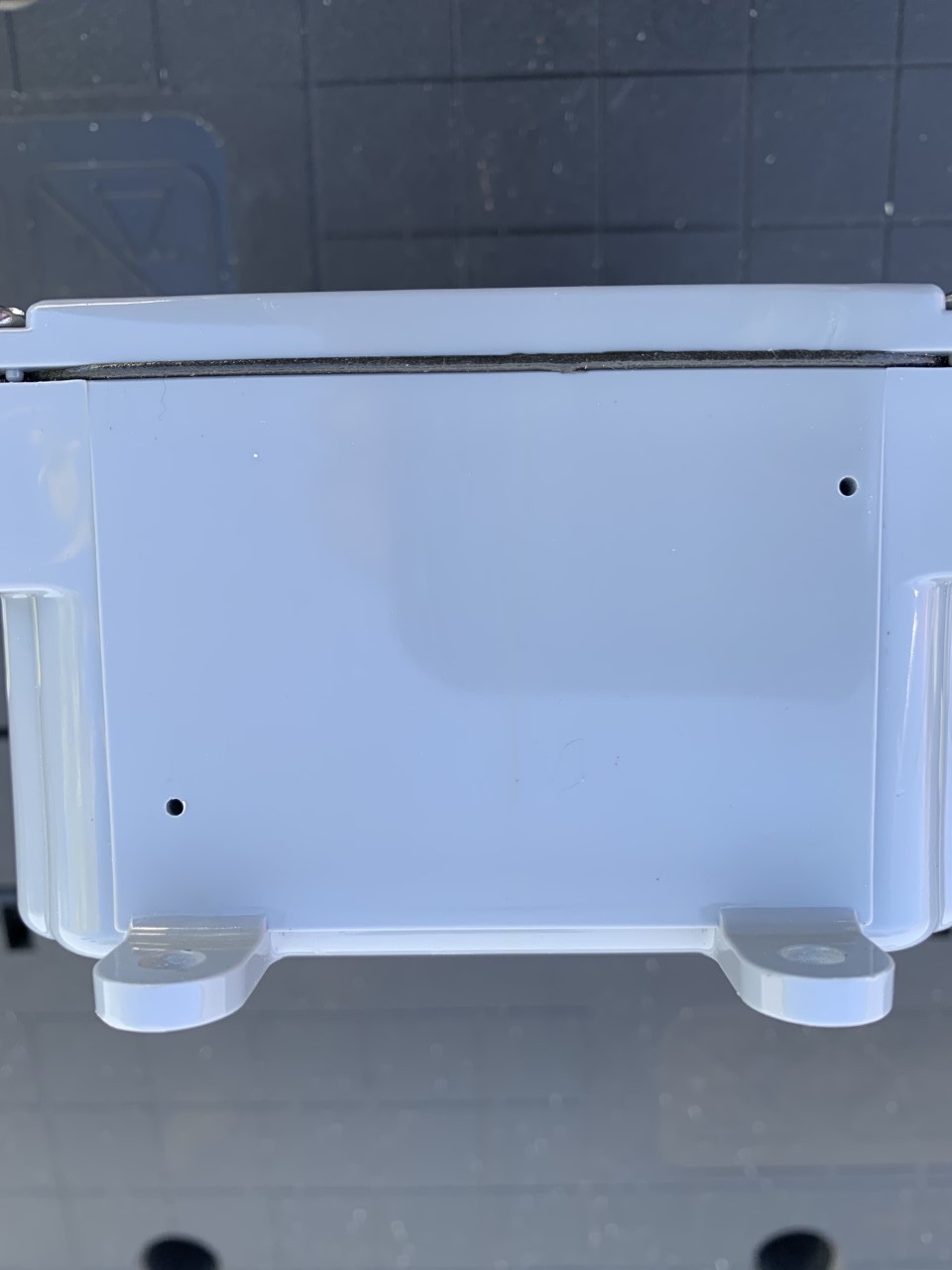
Drainage holes 1/16th
Now and then I started to notice while operating my Icom 7610 in CW mode I would have my N1MM contest program lock up. There was no rhyme or reason as to when this happened, what power level and what band I was on. I could make it through a CWops mini-test of an hour with no issues. The next CWops mini contest I had nothing but issues. I also noticed when using my VPN on the PC I would have the VPN disconnect and then reconnect messages coming up as I transmitted. I was reading online when coax radiates RF it can be very hit-and-miss as to when it happens and what is affected each time. This sounded like the issue I was having and I decided to place the isolation balun at the base of the 4BTV vertical.
Once the isolation balun was installed I am RF free and have been for over a month now. My electronic washing machine, N1MM logger and VPN connection have no problems. 
Waterproof connections
I had to take into consideration some precautions when putting the isolation balun outdoors. It was recommended to drill 2 1/16 holes in the bottom so any condensation would not build up inside. Also around all PL-259 connections, I waterproofed them with self-amalgamating tape.
Mike Weir, VE9KK, is a regular contributor to AmateurRadio.com and writes from New Brunswick, Canada. Contact him at [email protected].
LHS Episode #485: QSLing Deep Dive

Hello and welcome to Episode 485 of Linux in the Ham Shack. In this episode, the hosts discuss the art and science of sending and receiving QSL cards, either physically or digitally. There are several methods and it can be something of a chore to navigate. We hope you enjoy this episode and have a great week.
73 de The LHS Crew
Russ Woodman, K5TUX, co-hosts the Linux in the Ham Shack podcast which is available for download in both MP3 and OGG audio format. Contact him at [email protected].
Contest Winner
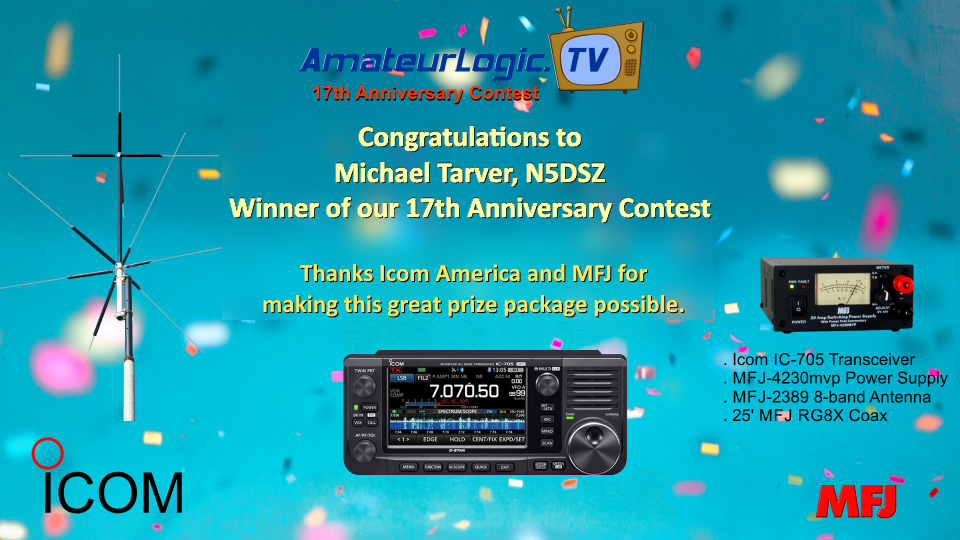
Congratulations to Michael Tarver, N5DSZ.
He’s the winner of our 17th Anniversary Contest.
And a big thanks Icom America and MFJ for making this possible.
George Thomas, W5JDX, is co-host of AmateurLogic.TV, an original amateur radio video program hosted by George Thomas (W5JDX), Tommy Martin (N5ZNO), Peter Berrett (VK3PB), and Emile Diodene (KE5QKR). Contact him at [email protected].
 Ham Radio Deluxe |
 W5SWL Electronics |
 Ham Radio Prep |
 KB3IFH QSL Cards  Hip Ham Shirts  HamRadioAuctions HamRadioAuctions Reliance Antennas Reliance Antennas Enigma Shop Enigma Shop |  morseDX  Ni4L Antennas  R&L Electronics R&L Electronics antennas.us antennas.us Ears to Our World Ears to Our World |
- Matt W1MST, Managing Editor
