 |
 YMC ARES Training Net Begins!
 12 June 2012 | by
 Last night at 8:00 P.M. I held our first Yellow Medicine County ARES Training Net. The plan is to do this every Monday night at 8:00 P.M. and to cover a specific learning objective each time. Dean Herzberg, NYØI, graciously agreed to let us use his 2 meter repeater in Milan for this.
Rather than trying to re-invent the wheel, I’m trying to mimic the Arizona Emergency Net. They have been doing some excellent work, and you can listen to recordings of their training nets online (click here for their archives).
Yesterday’s topic was “Tactical Call Signs.” After explaining the concept of tactical call signs, I assigned one to each operator, asking him to acknowledge it. Then I put the operators through a little exercise. I explained that I would call each one of them with his tactical call sign, and after he replied with his tactical call sign, I would ask him a question. When he answered the question, he was to conclude with his FCC call sign. This is standard format; signing with the FCC call sign tells net control that the operator considers the exchange complete. Here’s an example:
Net control: “EOC-1″
EOC-1: “EOC-1″
Net control: “EOC-1, what is your favorite mode?”
EOC-1: “My favorite mode is FM. NØJXI”
The stations who checked in did a great job. The whole net took only about 15 minutes; I tried to make it short, sweet, and to the point, and since we didn’t have many check-ins it didn’t last long.
All hams within range of the repeater are welcome to participate in this net, whether or not they are in Yellow Medicine County and whether or not they have registered with ARES. I do hope that this will draw some hams into ARES, though. Now that we have something like this going, it’s time to beat the bushes by sending out letters to local hams inviting them to take part.


Todd Mitchell, NØIP, is a regular contributor to AmateurRadio.com and writes from Minnesota, USA. He can be contacted at [email protected].
Please stand by…
 Have you ever had one of those days? Something that I refer to as The Shidas Touch. Wherein everything you touch turns to feces. I successfully managed to break my iPhone, Dell laptop, and a Garmin Nuvi 250 all in the course of about 12 hours. None of my radio equipment seems to have been affected by the condition, with my Icom dual-bander actually seeming to repair itself recently. The iPhone was an easy fix. Just a tethered reboot did the trick. I seem to always go one step too far when playing with things on my jailbroken Sprint iPhone 4. The Garmin was actually already broken, but I did manage to break it further. The person who borrowed this from my YL must have been trying to delete his history from the thing before he returned it, and managed to delete all of the maps in the process. Some research, and a few trial-and-errors brought the device back, and now is actually working better than before, but in the process I was pretty sure I had bricked the thing, and shoved it aside in favor of salvaging part of a good night’s sleep. The Dell, however, is a sad story.
I bring this up, because it is this same Dell laptop that was the processing muscle behind my testing of the Soft66LC4 that was sent to me to evaluate. In a fit of kindness, I was attempting to clone a USB flash drive that I use for radio programming, and accidentally hosed the partition structure of the Dell’s hard drive. How, you ask? Well, let’s just say that if you ever use a wonderful little program called Drive Image XML, don’t do it with any major distractions competing for your attention. It’s very easy to click the wrong thing, and BOOM!
I have managed to back up the damaged partition so that I can restore any settings in all of my radio software on there, but it is not rebuild-able at this point. I did manage to get it working for a little while using a program I like called TestDisk, but then when I tried to rebuild the Linux partition that I had also lost (along with some of Jill’s files), it killed all of the progress I had made earlier.
So, it’s done. Time to reload. So, for anyone who was waiting for more info on the Soft66LC4, We are experiencing operator difficulties. Please stand by. Good thing I didn’t try to work on the car that day!
–Neil W2NDG
Neil Goldstein, W2NDG, is a regular contributor to AmateurRadio.com and writes from New York, USA. Contact him at [email protected].
LHS Episode #084: GNU Radio
 The 84th installment of your most favoritest podcast is now in the wild. As you may have noticed, we make a lot of assumptions about our listeners on this show; for example: You all love us. We have a good show in store for you today, including antennas made from electric fencing, a question about whether GPL software can be profitable, and most importantly a look at software defined radio and the GNU Radio project. Towards the end we address some feedback, solve a technical problem in Italian and try to stage an intervention for one of our more peculiar fans. ALL THIS WEEK on Linux in the Ham Shack!
Russ Woodman, K5TUX, co-hosts the Linux in the Ham Shack podcast which is available for download in both MP3 and OGG audio format. Contact him at [email protected].
Stuff
Sometimes, the most satisfying QSOs don’t seem to relate to distance. I had a really nice rag chew tonight with John N3WT on 40 Meters. The band was in real good shape, with hardly any background QRN. John is only two states away, in Maryland; but yet he gifted me with one of the nicest chats I’ve had since the one with Terry W9UX last week. He was using his K1, and I was on (of course) my KX3. We were both pumping 599 five Watt signals into the aether.
The discussion ranged from things Elecraft to things Flex Radio, antennas and radio problems. Our conversation lasted but a half hour; but it will be one that I will remember for a while to come. When the CW just flows from your fingers and the copy is armchair, a QSO can be a thing of beauty.
I’ve also migrated back from Ham Radio Deluxe to N3FJP’s AC log. Since Simon Brown sold the rights, and HRD will no longer be a free offering, it’s probably just a matter of time until the free version will no longer be supported. I paid for AC Log years back, so I may as well use what I have already paid for. And seriously, with HRD, I was only using the logging portion anyhow, so it’s not like I’m losing a lot of features that I never used anyway. AC Log loads faster, since it’s a much simpler program – so it’s almost ready to go as soon as I am. Good thing I never threw away the e-mail with my registration number!
I was contemplating looking at the DX Lab suite of programs for a second time, but again, I think we’re looking at more than I need for my purposes. All those bells and whistles are extremely nice; but if I don’t plan on using them, what’s the sense? I don’t want to say that I would never be, but right now I’m just a dial twiddlin’ kind of guy. I don’t envision being the kind of contesting guy who truly needs the ability to click a mouse and have the radio instantly jump to a frequency that’s on a computer screen. To borrow a line from Seinfeld – “Not that there’s anything wrong with that”. But it’s just not my speed.
This coming Saturday is the Raritan Valley Radio Club’s annual hamfest. Like last year, I will probably be on parking lot duty. It will be a long day, with arrival time set at about 5:00 AM. Watching the 10:00 PM news for the long range forecast is so far calling for a partly cloudy, but dry Saturday with highs in the mid to upper 70s.
Oh well, time to hit the sack. I have to go downstairs and pop a couple Advil first. I am feeling some minor aches and pains from all the yard work that I did this weekend. Don’t want to be up all night with a twitchy back.
72 de Larry W2LJ
QRP – When you care to send the very least!

Larry Makoski, W2LJ, is a regular contributor to AmateurRadio.com and writes from New Jersey, USA. Contact him at [email protected].
Results and a Few Thoughts On the June VHF Contest
As hoped, I had a great weekend working the ARRL June VHF QSO Party (AKA the June VHF Contest). Band conditions were not as good as last year but we had some very good sporadic-e propagation on 50 MHz.
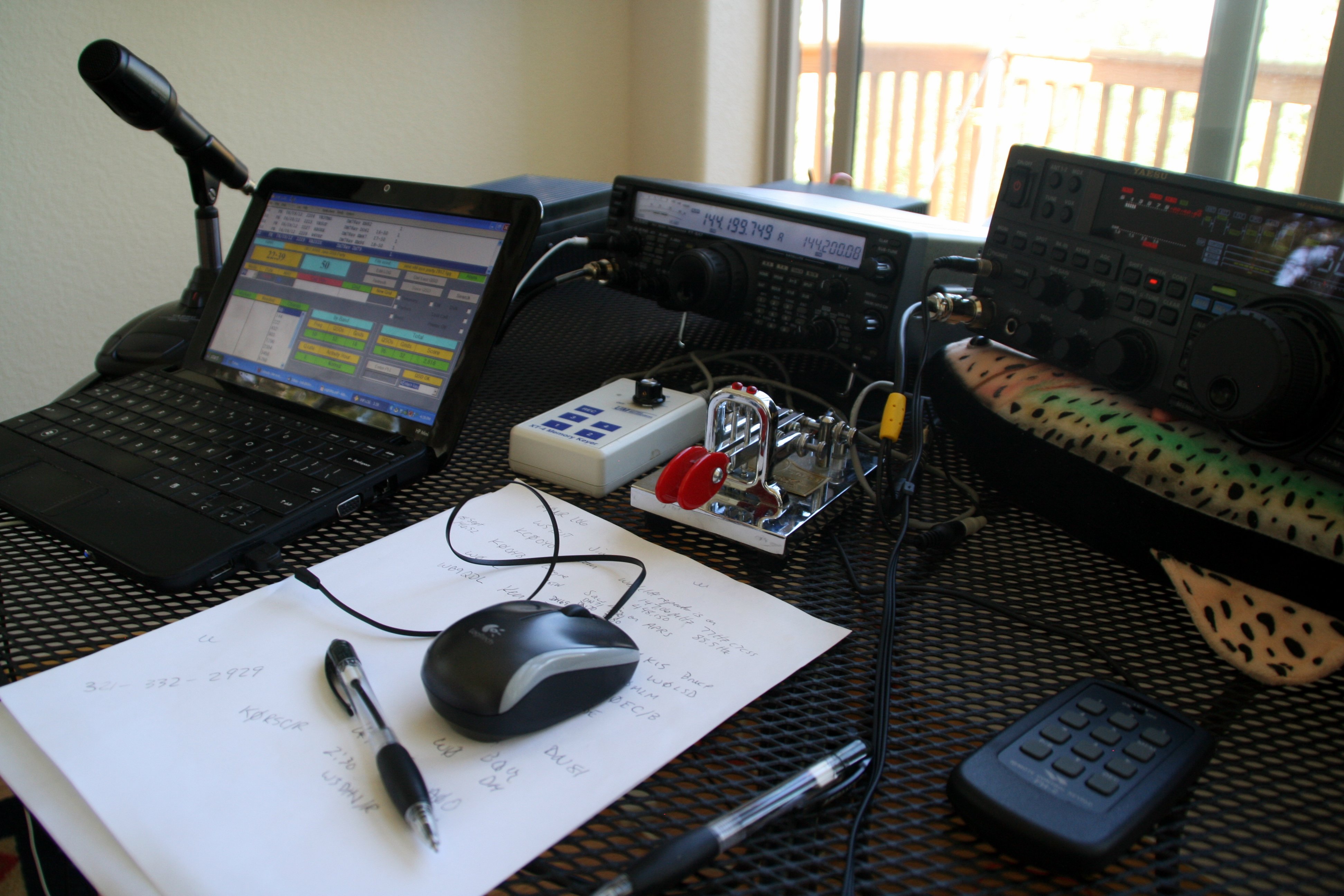
I operated from the cabin “portable style” in DM78av, near Trout Creek Pass. It was a two band effort (50 MHz, 144 MHz) but I did make a few Qs on 440 FM. Everything worked pretty well except my portable mast struggled with the high winds we experienced.
I kept my Yaesu FT-847 on 2 Meters the entire time, using its 50 Watt output to drive a 180W Mirage amplifier to a 2M9SSB yagi antenna. My FT-950 was put to work on 6 Meters, with its 100 Watt output driving a 6M5HP Yagi.
The contest started out slow with just a few local contacts on 2 Meters. About 3 hours into the contest, 6 Meters started to percolate and I heard east coast and midwest stations popping up. Soon, the sporadic-e was in high gear and I was working stations at a decent clip. Later in the day, the band swung around and I worked quite a few stations in pretty much every part of the USA. Sunday started out in the morning with a few contacts to the south, including XE2X in grid EL06. Later the band flipped over to the east coast, then hovered over the midwest. Later in the day, the VE stations from Canada were pounding in and it seemed they were having a blast working many different states.
    Band       QSOs X pt =  QSO pts.  X   Grids   =     Points
    ---------------------------------------------------------------
    50         398    1      398           126           50148
    144        38     1      38            13            494
    432        3      2      6             3             18
    ---------------------------------------------------------------
    TOTALS     439           442           142           62764
Note the CW keyer and paddles in the picture. I am not a great CW op but I end up making a few CW contacts “when the going gets tough” during VHF contests. Not shown in the photo is the Heil Pro Set headset with HC-4 microphone element and optional PTT foot switch. I have really come to appreciate how effective and efficient this headset is for contesting. I’ll also give a shout-out for the VHFLOG contest software by W3KM. I’ve tried a number of logging programs and really like this one for VHF contests.
73, Bob K0NR
Bob Witte, KØNR, is a regular contributor to AmateurRadio.com and writes from Colorado, USA. Contact him at [email protected].
Sunday evening DX on 50MHz
When I made my 70MHz posting last night, I expected that was it for the day. Around 2130 local time, I popped up to the shack to have a listen to 50MHz and was surprised to hear some signals from UW2ZM and an LZ. Neither was particularly strong, although I thought it was unusual to hear them at that time. I’d have liked to work UW2ZM as he’s in KN58, but he was pretty weak.
Just before turning in for the night (we had a 04.30 alarm set this morning), I checked 50MHz again and CW was buzzing! Lots of I, SM coming in. But to my enormous surprise, I could hear a number of US stations taking part in their VHF contest. The first station I heard was NN1N, who astonished me by coming straight back to a very tentative call. The other stations I heard had big pileups and I didn’t get involved, but it was particularly good to hear the Mt Greylock Expeditionary Force, W2SZ coming through. There was a very loud K1 who had an enormous pileup.
No doubt for those with a bigger aerial than a vertical, there was some really great DX to be had, but I was quite satisfied with my transatlantic QSO.

Tim Kirby, G4VXE, is a regular contributor to AmateurRadio.com and writes from Oxfordshire, England. Contact him at [email protected].
6m WSPR
On 10th June DX Sherlock showed that a big Sporadic E opening was in progress. The red lines showing contact paths stopped tantalizingly short of north-west Cumbria, unfortunately.
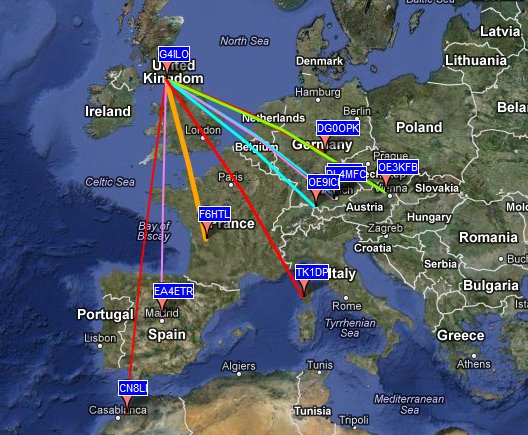
I listened on 10m but I didn’t hear the S9+ signals such an opening would suggest so I thought I would do some WSPR on 10m, moving to 6m if the 10m signals suggested the skip would be short enough. They eventually did, as DX Sherlock indicated the lift was getting stronger. I moved to 6m, running 5W to the attic multi-band dipole, and eventually spotted or was spotted by stations as far afield as Austria, Spain and Morocco.

During the peak of the opening I broke off from WSPR to tune the bands and make a few contacts. On 10m I worked TM210VH – a special call commemorating 210 years since the birth of Victor Hugo. I made contacts into Italy, Switzerland and France on 6m as well.
Seeing some massively strong signals now on 10m WSPR so time to check out 6m I think!

Julian Moss, G4ILO, is a regular contributor to AmateurRadio.com and writes from Cumbria, England. Contact him at [email protected].
 Ham Radio Deluxe |
 W5SWL Electronics |
 Ham Radio Prep |
 KB3IFH QSL Cards  Hip Ham Shirts  HamRadioAuctions HamRadioAuctions Reliance Antennas Reliance Antennas Enigma Shop Enigma Shop |  morseDX  Ni4L Antennas  R&L Electronics R&L Electronics antennas.us antennas.us QRV QRV |
- Matt W1MST, Managing Editor
