 |
 Colorado 14er Event – Now With SOTA!
 7 July 2012 | by
  Amateur Radio operators from around Colorado will be climbing many of Colorado’s 14,000-foot mountains to set up amateur radio stations in an effort to communicate with other radio amateurs across the state and around the world. The prime operating hours on August 5th are from approximately 9 AM to noon local time (1500 to 1800 UTC), but activity may occur at other times during the day.
New this year: Summits On the Air (SOTA) activity, which adds 1700 additional potential summits! If you aren’t up to climbing a 14er, there are many other summits to choose from (with a wide range of difficulty). See the W0 SOTA web page for details.
Radio operators that plan to activate a summit should register their name and intended peak at the ham14er Yahoo! group. To subscribe to the event mailing list, visit the yahoo groups site at . Also, be sure to check out the event information at 14er.org
Frequencies used during the event
Activity can occur on any amateur band including HF and VHF. The 2M FM band plan uses a “calling frequency and move up” approach. The 2M FM calling frequency is 147.42 MHz. At the beginning of the event, operators should try calling on 147.42 MHz. As activity increases on that frequency, operators should move up the frequency using the standard channel spacing used in Colorado (15 kHz). Don’t just hang out on 147.42 MHz…move up! The next standard simplex frequency up from 147.42 MHz is 147.435 MHz, followed by 147.45, 147.465, 147.480, 147.495, 147.51, 147.525, 147.54, 147.555, 147.57 MHz.
Don’t just hang out on 147.42 MHz…move up and share the band.
| Frequency (MHz) | Comments |
| 147.42 | Primary 2M FM Frequency, then up in 15 kHz steps |
| 223.5 | Primary 222 MHz FM frequency |
| 446.000 | Primary 70 cm FM frequency |
| 446.025 | Alternate 70 cm FM frequency |
| 52.525 | Primary 6M FM frequency |
| 1294.5 | Primary 1.2 GHz FM frequency |
| 144.200 | 2M SSB calling frequency |
| 50.125 | 6M SSB calling frequency |
| 14.060 | 20M CW Frequency |
| 21.060 | 15M CW Frequency |
| 28.060 | 10M CW Frequency |
| 14.260 | 20M SSB Frequency |
| 18.1575 | 17M SSB Frequency |
| 21.330 | 15M SSB Frequency |
| 28.350 | 10M SSB Frequency |
| Other Bands/Modes | Standard calling frequencies and/or band plans apply. |
Warning: Climbing mountains is inherently a dangerous activity.
Do not attempt this without proper training, equipment and preparation.
Sponsored by The Colorado 14er Event Task Force
Bob Witte, KØNR, is a regular contributor to AmateurRadio.com and writes from Colorado, USA. Contact him at [email protected].
Where did I find those other 60 hours a week?
So I finally pulled the plug on the day job six weeks ago. For the first time since I was 18 years old, I don’t have a regular pay check coming in. Unless you count that Social Security thing, which is hardly enough to call a “paycheck.” I had big plans for all the new spare time I was going to have in retirement, including actually getting on the air more, seeking out long, rambling ragchews, working more PSK31 and RTTY, doing some QRP, maybe even building a kit or two and trying out an antenna idea I’ve been contemplating. Contemplating for a dozen years.
Truth is, I only retired from one of my several jobs. For some reason, I quit the only one that actually paid me a regular wage, which automatically brings my sanity into question. But like a gas occupying a vacuum, the other things I do quickly expanded to take up all my available time, including what the day job once took. I have no idea how I was able to work those sixty hours a week at the old vocation!
Some of you may be aware that I am a writer, too, and just published my 24th book. I’ve also finally gotten around to putting one of my novels–my second book, published way back in 1997–up on Amazon.com as an eBook. (I hope it finds a bigger audience this time because it is near to my heart, the story of a young man who falls in love with the magic of radio, goes on to a career in broadcasting as a deejay, and eventually his best friend, who just happens to be a ham, saves his bacon…using a trick many of you will recognize. It’s titled WIZARD OF THE WIND and, yes, there is a lot of me in that story!)
I’m also finishing up an amateur radio book, one that has been in the works for a while, too. It will include some of the articles and short stories I’ve put up on eHam.net and more. I want it to not only entice those who develop an interest in ham radio to go ahead and take the plunge but to also encourage those already in the hobby to explore other aspects and become true evangelists for it.
When I was writing WIZARD OF THE WIND, I actually took a weekend job at an oldies radio station for a year, working a weekend deejay shift, just to get that old feeling back. It really helped me put it into words as I worked on the novel. Maybe now is the time that I should be getting on the ham bands more, broadening my own horizons so I can capture the magic of the hobby as I work on the new book.
I think I just talked myself into getting off this blog and seeing what the DX clusters are saying. Or watching the waterfall for a bit on 20M PSK31. Time’s wasting!
Don Keith N4KC
(A blog about rapid technological change and its
effect on society, media, and ham radio)
Don Keith, N4KC, is a regular contributor to AmateurRadio.com and writes from Alabama, USA. Contact him at [email protected].
Solar storms VS QRPp
K3MM in M.D. 21dB
WZ7I in P.A. 18dB
K1TTT in M.A. 11dB
KB9AMG in W.I. 9dB
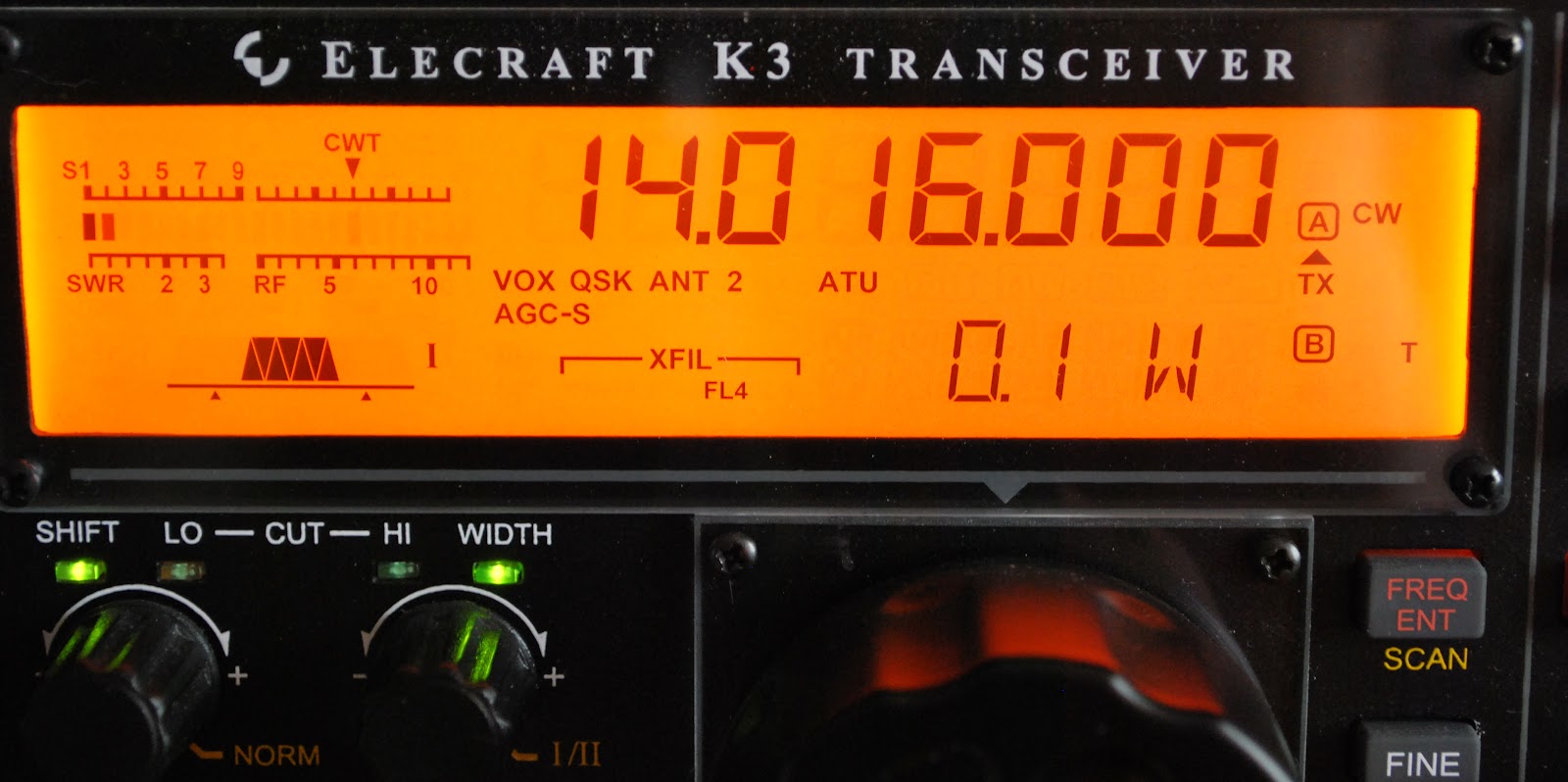
Most of the time I would be heard in Europe but with conditions the way they are the U.S. seems to be my DX destination for the time being. I fired up the K3 along with DxLabs. Right off the bat I saw lots of spots for Europe but was not able to hear them on this side of the pond. I then heard an S5 signal from SM5EPO from Sweden. I knew conditions were not that great and after all the RBN confirmed that on 20m's it was the U.S only.........So I dropped the K3's power to 100mW's Heee Heee Heee and gave it a go. SM5EPO came back to me and with a few repeats the contact was complete at 39,111 miles per watt. In the past when conditions were good and I was making QRPp contacts and logging the miles per watt I wanted to see how I would do if conditions were not ideal.

Mike Weir, VE9KK, is a regular contributor to AmateurRadio.com and writes from New Brunswick, Canada. Contact him at [email protected].
Zero Ohm Resistors
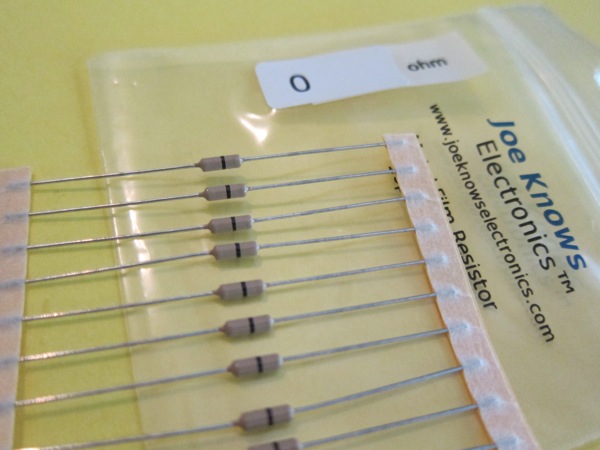
Mark Frauenfelder innocently (or cleverly) asks the question “What are zero ohm resistors for?” on BoingBoing. The fun really starts in the comments section, with replies such as “They’re a novelty gift for electronic engineers.”
Take a look at the article here.
Yes, zero ohm resistors really do exist. Think of them as jumpers on a PC board.
73, Bob K0NR
Bob Witte, KØNR, is a regular contributor to AmateurRadio.com and writes from Colorado, USA. Contact him at [email protected].
Wish lists
I freely admit that I am more of an operatin’ kind of guy and not a techno-wizzy type Ham. I got my KX3, put it together, marvel at its abilities and am on the air with it, a lot. And excuse my language, but I am enjoying the hell out of it.
I look at the KX3 e-mail reflector and I’m seeing all these “wish list” posts, with guys wanting this and that added to the next firmware edition. I shake my head, cause obviously these guys are all light years ahead of me as Amateur Radio operators. I’m pretty content with the radio as it is. About the only thing that I would like to see changed, if I could, is how the power level changes. When I twist the power level knob, I see the output power change in 0.2V steps. In other words we go from 5.0V to 4.8V, completely skipping 4.9V. I guess I would like to see that curve smooth out to be a tad more linear.
But that’s it. No requests for the sun, moon and stars. Heck, half the things these guys are asking for, I can’t even figure out! As advanced as this radio is, I remain a humble dial twiddler. I actually managed to hook the radio up to my netbook and got rig control software to do its thing.
I remained unimpressed.
Perhaps, if I was a contester or big gun DXer, I would appreciate that kind of thing more. Me, I’m just a ham and egger. I appreciate the radio, it’s features and the genius behind it – courtesy of Eric, Wayne and the KX3 development team. And no doubt, I’ll keep downloading future versions of firmware and will keep the radio as up to date as possible. But the more esoteric stuff, I will leave to those light years ahead of me. I’ll be content to go along for the ride.
72 de Larry W2LJ
QRP – When you care to send the very least!

Larry Makoski, W2LJ, is a regular contributor to AmateurRadio.com and writes from New Jersey, USA. Contact him at [email protected].
Fox hunt fun.
Wowsers!
Both 20 Meter foxes worked within the first 10 minutes of the hunt. That doesn’t occur very often, but when it does it’s gratifying. The K3 (and the KX3) really makes it easy with those dual VFO knobs. Hit split, listen on VFO A, dial up the transmit frequency with the VFO B knob and got to town. No more hitting the A/B button and trying to deal with tuning two separate VFOs with one knob. Probably a minor thing when you consider it, but oh so convenient!
The Maxpedition padded pouch arrived today and it is perfect! Fits the KX3 just fine and will protect it from anything else that’s in the knapsack. Not that there’s really that much in there, but I still worry about something jouncing around and doing damage. I had the K1 in a “Tupperware” container all those years and it stayed looking mint. I am sure this padded pouch will do the same for the KX3.
KX3
Antenna wire
Small SLA battery (and small gel cel charger – going to charge off the grid this year)
Lithium Ion battery
Paddles
Earbuds
Autek antenna analyzer (to make setting up the Buddistick easier).
Pad and misc supplies
Wrist rocket
Still, that’s enough to carry along when we go to Lake George later this summer – and for the Flight of the Bumblebees and the Skeeter Hunt as well.
The SLA battery is being taken as a back up only. If the Lithium Ion performs admirably and gives me a decent amount of radio time between charges, the SLA will stay home in the future. That would certainly lighten things up.
72 de Larry W2LJ
QRP – When you care to send the very least!

Larry Makoski, W2LJ, is a regular contributor to AmateurRadio.com and writes from New Jersey, USA. Contact him at [email protected].
First results with the £13 SDR
The digital TV card arrived yesterday and of course, I couldn’t resist getting it going straight away. I followed Richard, G4WFR’s instructions and all went very well. There was a slight issue getting the USB driver installed with ZADIG.EXE. The problem wasn’t the program but no doubt my VISTA laptop! Anyway, after an initial failure to install the driver, I rebooted the laptop, tried again and it all worked well.
The first experiments have just been using an internal antenna. However, I’ve been able to receive a number of Band II FM stations, some in stereo, my own transmissions on 70, 144 and 432MHz on a variety of modes as well as some aircraft on AM around 120MHz and weather stations in the 433MHz band.
What I need to do is to pop into Maplins, hopefully tomorrow lunchtime and grab some plugs to make up an adapter, so I can plug the various external antennas into the receiver. I’m hoping we’ll see some good results.

Tim Kirby, G4VXE, is a regular contributor to AmateurRadio.com and writes from Oxfordshire, England. Contact him at [email protected].
 Ham Radio Deluxe |
 W5SWL Electronics |
 Ham Radio Prep |
 KB3IFH QSL Cards  Hip Ham Shirts  HamRadioAuctions HamRadioAuctions Reliance Antennas Reliance Antennas Enigma Shop Enigma Shop |  morseDX  Ni4L Antennas  R&L Electronics R&L Electronics antennas.us antennas.us QRV QRV |
- Matt W1MST, Managing Editor
