 |
 Two years of blogging…………
 4 September 2012 | by

How is the flow of the blog?
Are there topics you enjoy more than others in the blog?
How is the setup of the blog sit with you?
Finally any other input you would like to add don't hold back let me know!

Mike Weir, VE9KK, is a regular contributor to AmateurRadio.com and writes from New Brunswick, Canada. Contact him at [email protected].
Noisy Designer Lamp
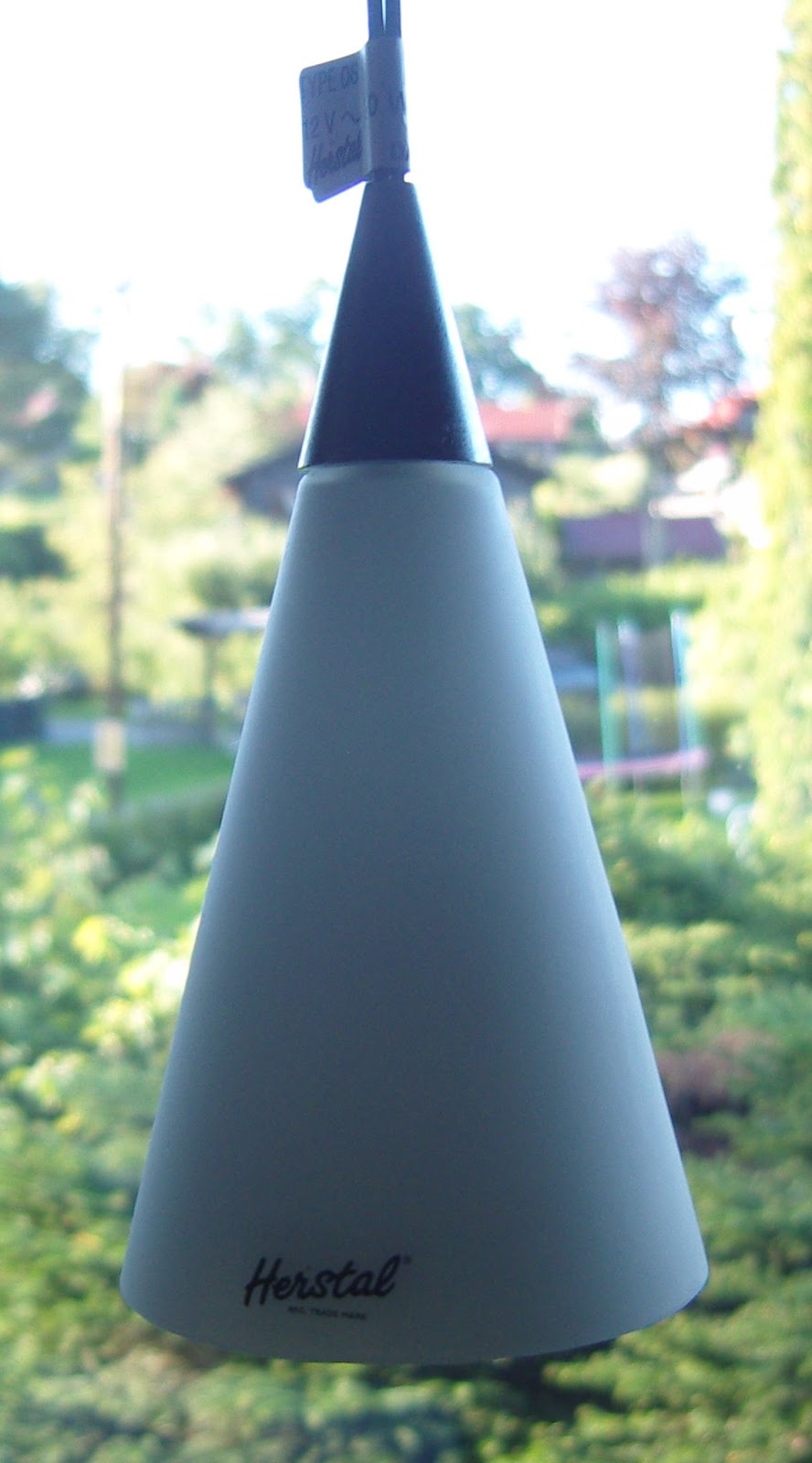 |
| Herstal pendant lamp, type 06 |
Some years ago I had this annoying noise that made listening for weak signals on several of the shortwave radio bands virtually impossible. In the end I was finally able to track down the noise source: Our beautiful Danish Herstal designer lamps in the kitchen. Actually it wasn’t the lamps themselves, but the dimmable switch mode power supply that came with them.
After some years of always having to remember to turn them off, in the end I just replaced the original noisy dimmer with a fixed voltage, noiseless, electronic transformer and inserted lower wattage 12 V light bulbs in the two lamps.
The original dimmer came in its own nice conical designer housing and inside one finds a more ordinary plastic housing. And of course it is marked with the CE mark, thus indicating that it should be fine with respect to noise. But as I kept opening it up, I finally found the printed circuit board. Interestingly, there are several components which have just been bypassed with wires. The most important one must be the one to the left of the center hole. Here two wires have replaced a component connected more or less directly to the 230 V AC input.
I believe this is a common mode filter. These filters hardly serve any purpose when it comes to the function of the dimmer. But they are vital for ensuring that the dimmer does not radiate noise on the power line, and probably also for achieving the CE mark.
 |
| Press for larger image |
I think the manufacturer, Herstal, may have cut some corners here in order to save cost. They seem to have fallen for the temptation to remove this filter component after it initially had been designed in.
Who at Herstal who made that decision, I can only speculate about. But since the filter initially was there, I think that it was someone other than the design engineers.
Sverre Holm, LA3ZA, is a regular contributor to AmateurRadio.com and writes from Norway. Contact him at [email protected].
2012 Challenge – QSO A Day Challenge Update
With all the excitement of moving into the new basement ham shack and operating in the Colorado QSO Party, I almost forgot to write this update blog posting on my 2012 Challenge to have at least one QSO per day. I’m pleased to say that my QSO a Day challenge continues.
As I have stated in previous blog entries. My own version of a QSO a Day challenge has helped me be more active on the bands and as a result has produced many positive results.
My DXCC count grew by three in the month of August with the addition of Puerto Rico, South Africa and Bolivia. My DXCC count currently stands at 70 with approx. 65 confirmed. Also, I’ve not missed a month in 2012 of adding at least one new DXCC to my count. Hopefully this streak will continue throughout the rest of the year.
The total QSO count for August is a bit low with only logging 81 Q’s. But so much of my free time during the month was devoted to getting the new ham shack ready for equipment. The balance of effort for this milestone versus the lack of Q’s in my opinion balances out. One other way of looking at this stat. During both the 2009 and 2010 calendar years, my total QSO count for each year was less than 81. But this isn’t about how many Q’s I can rack up in a month or a year. It’s about quality over quantity.
A few other noteworthy items for August 2012. I operated the PSK63 mode for the very first time and worked the London 2012 Summer Olympics Special Event station 2O12L. I also successfully worked W9IMS in August which was their third and final special event station in support of the Indy Motor Speedway events. I’m looking forward to receiving the certificate for working all three race events in the same calendar year.
Finally, I worked several 2m FM contacts in August in support of the annual Colorado 14’er event. These contacts also increased my total SOTA chaser points to over 100.
I can’t remember if I shared the website I use to create the ADIF to Google map I display each month. This web-tool is made possible by David Levine, K2DSL. Thank you David!

The QSO breakdown for August is as follows:
Mode
Number QSO’s
JT65
68
SSB
3
PSK31
5
PSK63
1
2m FM
4
Additional notes of interest:
DX Stations Worked in August – 13
New DX Entities in August – 3
Total QSO’s for 2012 – 937
Total consecutive QSO days – 244
Days left in 2012 – 122
Until next time…
73 de KD0BIK
Jerry Taylor, KD0BIK, is a regular contributor to AmateurRadio.com and writes from Colorado, USA. He is the host of the Practical Amateur Radio Podcast. Contact him at [email protected].
Lighter yagi’s
Over the summer I managed to ‘do’ 2 out of the 5 available 2m Backpacker contests. These to me are a great opportunity for me to get out on the fells and enjoy a longer spell on a summit with a nice qrp rig and some simple gear. The trouble with contesting is that inevitably you want to do better. So what’s the likely areas for improvement. Well there’s the rig, coax and antenna.
The rig is an ft817 and its not going anywhere fast. I sold once once then instantly regretted it. So it’s not going to be changed in a hurry. Yes it has its problems but frankly it just works and is relatively light so its a keeper.
Coax…Hmm work in progress. RG213 is too heavy, Ecoflex just isn’t flexy enough for summit packing. I’m yet to find the ‘perfect coax’. I’m leaning towards a trial with some Messi & Paoloni Ultraflex 7 as I like Mini 8 as a size but am looking for perfection here kids. This just means a reduction in losses to something as low as reasonably practicable as the saying goes
Antenna. Well I do like my now obsolete Sotabeams SB270 ( A 3 element yagi that lives inside its own plastic boom). Its light and doesn’t get thrown about too much in the wind and has lasted years. Trouble is it’s looking a bit knackered now and 3 elements is a bit short. I bought a 5 element LFA off innovantennas years ago and was really disappointed with the build quality. The elements just weren’t secure enough and it was way too heavy. Too heavy for a UKAC /p so no good for a summit. But it is well designed and the elements are quite light.
So the plan is to change the coax. I’ll do that over the winter. In the mean time I’ve taken a few grams off the yagi.
The boom was very substantial 32mm2 2mm thick Aluminium (note spelling you stupid browser ;-)). The boom weighs in at 1150g as is.Swapping this for 20mm2 1mm thick boom I’m down to 560g. Roughly half the weight. Element clamps have been swapped for the G1YBB method of IML mouldings plates and cheapo pipe clamps

You can see the immediate difference in size. The original beam is clearly made for sticking up at home then forgetting about it, ignoring the defects with this particular one.
Now with the elements added. They simply snap in to the pipe clamps and are held in place without any bother.

We’ll see how easy it is to carry up the Old Man of Coniston next year but at 1240g it is nearly 500g lighter than the original with the same RF performance.
I bought 2 pieces of aluminium and have a larger 2m and 70cm DK7ZB yagi that needs the same treatment (I went the other way this time, it was too light and flimsy) that I’ll give a run out during the Christmas Cumulative content
Alex Hill, G7KSE, is a regular contributor to AmateurRadio.com and writes from Cumbria, UK. Contact him at [email protected].
Not a QRP posting – and a new 144MHz antenna on the way
At the weekend it was the Region 1 144MHz contest and as always I tuned around to see what I could hear. I worked a few Gs as well as ON/PA/F stations all around 300-400km distant.
On Sunday morning, I tuned around quickly and heard a weak French station. It turned out to be F5OAU/P who, I could see from the last time I worked him was in JN27. I turned the beam down that way and called him running my usual 50W. No reply – which was fair enough – he was quite weak.
I decided to fire up the 4CX350A amplifier, now correctly wired up (see earlier post!) and see if I could raise him. I called him on SSB and though he could hear me, he was obviously struggling. Switched to CW and suddenly he could copy me quite easily. Excellent – a distance of just under 700km, We exchanged details and I was just sending him 73s on the key when….
…it all went quiet! Had a relay stuck? No.
Bypassed the amp and connected the antenna straight into the back of the rig – no sign of any stations or GB3VHF. Ah. Tried another rig. Same.
Oh dear.
I’d thought that my trusty 5el yagi on the roof was rated at 500W, but apparently not! I was running about 300W, which would have probably been ok on SSB, but I suspect on CW, was a little too much. I’m guessing there’s a capacitor in the gamma match, or rather, there was a capacitor in the gamma match.
Unfortunately, getting the antenna off the mast isn’t that straightforward, but Justin G4TSH has kindly volunteered to come and help (I am not a fan of ladders, sadly).
The exciting thing, however, is that a new antenna is on the way; a 6el LFA yagi from the team at Innovantennas – I have been talking to Justin G0KSC for a while and it nice to be able to give one of his designs a try out – I’m really looking forward to it. I’m particularly interested that Justin’s designs are claimed to be low noise and I have been plagued by some quite low-level but troublesome noise, a particular pain with weak signals and low level meteor bursts – so we’ll see how it goes.

Tim Kirby, G4VXE, is a regular contributor to AmateurRadio.com and writes from Oxfordshire, England. Contact him at [email protected].
It’s official now!
 It is now official: I have a fixed amateur radio station in Taiwan. Very interesting that the licence shows both my name and call, which wasn’t the case in the past.
Yesterday another gruelling teaching semester has started. Like so many I need to put extra effort and energy in my work just to be able to keep the job I have. Apart from that, I need to work on my physical well-being also (being 45 and all), so I have joined my kids in their Taekwondo class. It is going to be busy and tiring for the next half year. The little time I have to myself I’m going to spend in the shack, not behind the computer. So, I’m going to be quiet for while, not writing anything except for the occasional entry in the diary on my own web site. But who knows, maybe we will meet on air before I return here. 73 from Taiwan.
Hans "Fong" van den Boogert, BX2ABT, is a regular contributor to AmateurRadio.com and writes from Taiwan. Contact him at [email protected].
A Great SOTA Weekend
 For the long Labor Day weekend, Joyce (K0JJW) and I headed to the cabin in the mountains. My main objective was to work the Colorado QSO Party. See previous post.
When in the mountains, I try to remember to monitor 146.52 MHz. You never know who might show up on that frequency…some of the locals chatting, a mobile station passing through, people camping or…a SOTA (Summits On The Air) station.
Sure enough, on Saturday, I heard Eric (W0ECE) calling from the summit of Mount Evans on 146.52 MHz. Joyce and I gave him a SOTA contact (and I got a new county for the CO QSO Party). Then, on Sunday morning, we heard Dave (KI6YMZ) calling from the summit of Mount Shavano, also on 146.52 MHz. We were mobile at the time and both of us worked Dave to give him two contacts. Then on Monday morning, again listening to 146.52 MHz, we heard Bob (AD6QF) on Quandary Peak. We handed out two more contacts.
Sometime on Monday morning, we started thinking of doing a hike. That led to the idea of hiking up Kaufman Ridge North (W0/SP-085), a SOTA peak about 2 miles from our cabin. It had not been activated before, so that seemed like a good idea.
Except for the fact that I did not bring along any of my SOTA gear. (Note to self: whenever you are in the mountains, take along the SOTA gear.) I scrounged around the cabin and found a dualband HT with fully charged battery. Unfortunately, the only antenna was the rubber duck. (The World’s Most Convenient Crummy Antenna.)
Oh, what the heck, we gave it a try anyway. It was an easy climb to the summit. I got out the HT and called on 146.52 MHz. I quickly got a reply from Ben (KD0ELP) and Mark (KE0P). A little more calling and I raised Jerry (N0VXE) in Salida, CO. To get the minimum four contacts, I tried calling on two of the local repeaters and found Dave (K0HTX) who QSY’d to 446.00 MHz for a simplex contact with me. That made it an official SOTA activation, so we headed down the mountain.
A good weekend for SOTA activity. Keep listening on 146.52 MHz.
73, Bob K0NR
Bob Witte, KØNR, is a regular contributor to AmateurRadio.com and writes from Colorado, USA. Contact him at [email protected].
 Ham Radio Deluxe |
 W5SWL Electronics |
 Ham Radio Prep |
 KB3IFH QSL Cards  Hip Ham Shirts  HamRadioAuctions HamRadioAuctions Reliance Antennas Reliance Antennas Enigma Shop Enigma Shop |  morseDX  Ni4L Antennas  R&L Electronics R&L Electronics antennas.us antennas.us QRV QRV |
- Matt W1MST, Managing Editor
