 |
 Ham Nation 63
 6 September 2012 | by
http://dts.podtrac.com/redirect.mp4/twit.cachefly.net/video/hn/hn0063/hn0063_h264m_1280x720_1872.mp4
http://dts.podtrac.com/redirect.mp4/twit.cachefly.net/video/hn/hn0063/hn0063_h264m_864x480_500.mp4
http://dts.podtrac.com/redirect.mp4/twit.cachefly.net/video/hn/hn0063/hn0063_h264b_640x368_256.mp4
http://www.podtrac.com/pts/redirect.mp3/twit.cachefly.net/hn0063.mp3
Hosts: Don Wilbanks (AE5DW), Gordon West (WB6NOA), George Thomas (W5JDX)
Bob’s phased 75 meter dipoles, video of hurricane Isaac, George starts building a shortwave radio, and the Icom contest.
Guests: Cheryl Lasek (K9BIK)
Download or subscribe to this show at http://twit.tv/hn.
Submit your own video to Ham Nation! See the Video Guidelines, http://www.frozen-in-time.com/guide/
We invite you to read, add to, and amend our show notes at wiki.twit.tv.
Thanks to Joe Walsh who wrote and plays the Ham Nation theme.
Thanks to Cachefly for the bandwidth for this show.
Dr. Bob Heil, K9EID, is the founder of Heil Sound and host of TWiT.tv's Ham Nation which streams live each Tuesday at 6:00pm PT (9:00pm ET) at http://live.twit.tv. Contact him at [email protected].
Icom launches a new handy
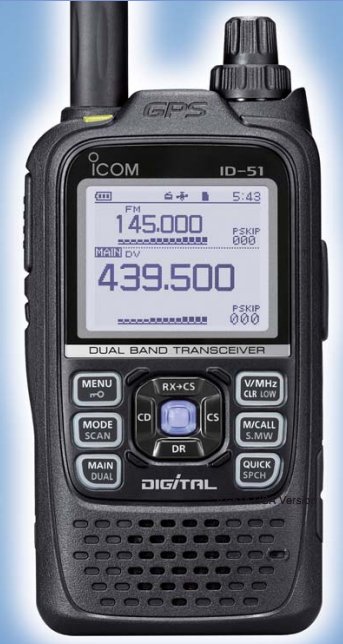 |
| Icom ID-51 |
Icom has demonstrated a prototype of its latest dual-band handheld transceiver – the ID-51A. (The European version will be the ID-51E.)
Covering 2m and 70cm, the ID-51 can also receive FM broadcasts and AM short wave radio. It supports D-Star (of course) as well as FM mode, and boasts a large 128×104 pixels display, the largest yet seen on an amateur radio handheld rig.
Like its smaller sibling the UHF-only ID-31, the ID-51A/E has a built-in GPS which can be used for track logging to a micro-SD card. The storage card can also be used to record incoming and outgoing voice traffic. Very useful – not!
Disappointingly though not unexpectedly, this new Icom does not support APRS, though it presumably supports D-Star’s rather lame version, D-PRS.
The ID-51 is being billed as the most technically advanced handheld, though it looks like you will be paying a lot for features – like the GPS and short wave receiver – for which most hams will have little use. I doubt that the large display – never mind the GPS – will do much to extend battery life, though Icom will offer an extended battery pack (at the usual inflated Icom prices no doubt.) However it is nice to see a manufacturer breaking the mould for HT user interfaces which have changed little for the last 20 years.

Julian Moss, G4ILO, is a regular contributor to AmateurRadio.com and writes from Cumbria, England. Contact him at [email protected].
Show Notes #089
Introduction:
- The 10th Annual Ohio LinuxFest will be held September 28-30, 2012, at the Greater Columbus Convention Center in downtown Columbus, Ohio.
- Another riveting episode even though Richard has been attempting unassisted human flight. (We’re all worried about the consequences should he succeed.)
- Our special guest tonight is Rob Hawkins from the mintCast.
Announcements:
- If you’re a subscriber to LHS, you can access the Etherpad, download episodes without music, and you’ll soon have the option of episodes in .flac format.
- Remember the Black Sparrow Media app for iPhones, iPads and Android devices. It’s free! With it, you can listen to all of the podcasts in the Black Sparrow Media group.
- Please consider donating to the podcast! Click the Donate link.
- Check out the KF8GR Linux Ham Home Page. Even though it hasn’t been updated in several years, much of the information is still relevant.
- Richards suggests a Linux/Amateur Radio “best on the web” award. Your web site should have at least one page devoted to Linux or Linux and Ham Radio. Send your nominations to [email protected]. If accepted, the LHS hosts will provide an award graphic for your website, and a link to your site from LHS.
- Richard also found this TechNewsWorld article “Why Ham Radio Is Still Handy”.
Topics:
- Interview with Rob Hawkins of the mintCast podcast.
- Rob describes his move from Ontario, Canada to Houston, TX, and drops this bombshell: “Texas is nothing like Ontario!” Rob is an engineer by training. His first computer encounter was an IBM 370 mainframe and Fortran at the University of Waterloo, Ontario. His first personal computer was a Radio Shack Color Computer and his first Linux exposure was with Slackware and several dozen floppy disks. He’s been using Linux Mint since version 8.
- Rob goes on to describe how he came to the mintCast.
- Our hosts and Rob then move on to various technology topics:
- The current state of Linux Mint.
- UEFI – Unified Extensible Firmware Interface.
- Software patents.
- Windows 8 and possible opportunities for Linux.
Contact Info:
- Contact Richard at [email protected], Russ at [email protected], or both at the same time at [email protected].
- Listen to the live stream every other Tuesday at 8:00pm Central time. Check the LHS web site for dates.
- Leave us a voice mail at 1-909-LHS-SHOW (1-909-547-7469), or record an introduction to the podcast.
- Sign up for the LHS mailing list.
- Sign up for the MAGNetcon mailing list.
- LHS merchandise is available at the Merch link on Web site. Check out the Badgerwear or buy one of the other LHS-branded items at PrintFection.com/lhs or Cafe Press. Thanks!
- Thanks to Dave from Gamma Leonis for the theme music.
Music:
- “The Napalm Theory” by Ophyra, from the album Post Mortem, courtesy of Jamendo.
- “Velvet Embracer” by Diablo Swing Orchestra, from the album The Butcher’s Ballroom, courtesy of Jamendo.
Russ Woodman, K5TUX, co-hosts the Linux in the Ham Shack podcast which is available for download in both MP3 and OGG audio format. Contact him at [email protected].
Handiham World for 05 September 2012
Pat Tice, WA0TDA, is the manager of HANDI-HAM and a regular contributor to AmateurRadio.com. Contact him at [email protected].
Tuning up an NA-666
The Nagoya VHF/UHF antennas made in China and available from sellers like 409Shop are popular and cheap, but I think they leave a lot to be desired in the quality control department.
 A couple of years ago I bought a Nagoya NA-666 with a regular male SMA connector for use with my Kenwood and Yaesu rigs. I was impressed with the performance of this antenna, and with the fact that it achieved a true 1:1 SWR at bang on 145MHz.
So when I ordered another antenna of the same model but with a BNC connector to work with all my HTs (which have now all been fitted, where needed, with SMA to BNC adapters) I was surprised to find that its performance was a disappointment.
I am well aware of the existence of fake antennas on eBay and have bought more than my fair share of them, but this looked to all intents and purposes to be a genuine Nagoya (silver on black label on the base and a serial numbered Nagoya hologram on the pack.) It had been purchased from 409Shop, a reputable seller. However, when tested on my RigExpert AA-200 antenna analyzer the nice sharp SWR curve dipped to a minimum at 135MHz – 10MHz too low. The SWR at 145MHz was off the scale. Ho hum.
As any ham knows, if an antenna tunes too low in frequency the solution is to cut bits off. After a bit of a struggle the rubber end cap came off and I gingerly pruned about a tenth of an inch . The antenna analyzer showed the minimum SWR point had moved up 1MHz. So I carried on with the cycle of cut, test, cut, test until I had achieved a much more reasonable SWR at 145MHz.
 |
| Final SWR curve of the shortened antenna |
As I approached 145MHz the antenna was now quite noticeably shorter and I was concerned that I may have passed the point at which the improvement due to a better match was counteracted by the reduced size of the radiating element. I may have passed that point but it is very difficult to make reliable and repeatable field strength measurements. Therefore I didn’t make the final cut which would have brought the SWR (shown above) to 1.0:1 at exactly 145MHz.
Field strength measurements and on-air tests led me to the conclusion that the 7-inch shortened NA-666 performed 2-3dB better than my 8.5 inch long NA-701. It beat all the stock rubber ducks by another 2 or 3 dB. The only antennas that outperformed it were a quarter wave telescopic (19 in long) an even longer Nagoya NA-767, a nicely made but unbranded “RH-770” and a “Diamond” RH-205 5/8 wave telescopic, all of which are really too long and cumbersome to use with a small radio like the Baofeng.
Using the shortened NA-666 I have had solid simplex contacts with 5 and 9 reports over distances of several miles and can even access a repeater 50 miles away from inside the shack. So I’m pretty pleased with the result.

Julian Moss, G4ILO, is a regular contributor to AmateurRadio.com and writes from Cumbria, England. Contact him at [email protected].
Ham Radio Action Next Weekend – Sept 8/9
 There are three excellent ham radio activities going on this coming weekend. Check these out and see if there is an activity that catches your interest. This is written for people in Colorado but items #1 and #3 are North American wide.
- ARRL September VHF QSO Party – noon MDT on Saturday until 9 PM MDT on Sunday http://www.arrl.org/september-vhf
- Colorado FM Sprint – a mini version of the September VHF QSO Party,
using FM only on these bands: 146 MHz, 222 MHz and 440 MHz
Saturday from noon to 7 PM MDT
http://www.qsl.net/k0yb/Colorado_FM_Sprint.html
Suggested frequencies: 146.58, 146.55, 223.5, 446.000, 446.100 MHz FM simplex - North American Summits On The Air (SOTA) Weekend
SOTA activations all over North America
http://na-sota.org/NASOTA_Weekend.html
Go here to see announced summit activations: http://www.sotawatch.org/
VHF contacts are usually on 146.52 MHz
(Note: this frequency is NOT allowed for contacts in the
Sept VHF QSO Party and Colorado FM Sprint)
HF contacts are on frequencies listed on sotawatch.org
Wow, lots of stuff to choose from!
At the very least, I’d suggest getting on the air Saturday afternoon to see if you can work some of the VHF contest stations. They are likely to be some mountaintop SOTA stations active at that time, too. Some of these folks may try to work the VHF contests AND do the SOTA thing on the same expedition.
73, Bob K0NR
Bob Witte, KØNR, is a regular contributor to AmateurRadio.com and writes from Colorado, USA. Contact him at [email protected].
The Birthplace of the Wind

I recently had the good fortune (Sarah and some Alaskan friends might question the use of the adjective “good”) to spend about 10 days on the Aleutian island of Adak for work. In the midst of preparing for the trip, I learned that my fellow travelers Kevin, KJ4OAP, and Nathaniel, W2NAF, were planning to bring ham gear. Of course, I was as well, so we ended up with quite the merry bunch of hams on Adak. I don’t collect IOTAs, but I know it’s popular. So, I checked out Adak Island in the IOTA directory—NA-039, Andreanof Group. Fewer than 20% had claimed it, so it’s not super-rare, but not super-common, either. I was assured by at least one friend that we would be very popular, especially in Europe.
One of the first things you notice about Adak when you get off the plane is the wind. In fact, the locals call Adak “the Birthplace of the Wind.” It’s actually quite poetic considering that the winds are so strong that you don’t leave furniture outside and that the houses shudder with typical gusts. I experienced 75-mph gusts and 60-mph sustained winds during my short visit alone.
Adak is probably best known as the forward base from which the U.S. conducted its counteroffensive against the Japanese invasion of Attu and Siska during World War II. It also played an important role during the Cold War and although the military left some 10 years ago, it retains much of the infrastructure including heavy machinery, a port, and a large airport. The population shrank rapidly from a peak of just over 6000 in the 1990s to around 150 today. Just before the military (principally Navy) pulled out, they were in the process of building new base housing. The housing was completed nevertheless and so there are literally dozens if not a hundred homes that have never been occupied! Some of the others have been converted into a small hotel (this is where we stayed).
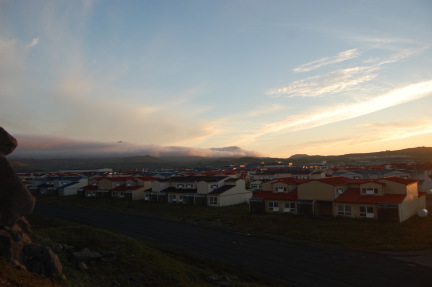
The economy is heavily dependent on fishing and fish canning right now. However, the locals are excited about the possibility of becoming a logistics hub for oil and gas work in the Bering Sea. In fact, the aircraft I came out on (An Alaska Airlines 737-400) had an unprecedented 60+ passengers on it because executives from an oil company were coming to check the place out.
Alaska Airlines operates “regular” flights twice per week.
Due to a fiction of time zones, Adak is only one hour behind Anchorage, despite being some 27 degrees west. So, sunrise and sunset are both very late in local time. It is also very far south, about the same latitude as Vancouver. Although I arrived at 6:30 pm, it was still light out for almost another four hours. So, I quickly put up the vertical on 20 meters just before sunset.
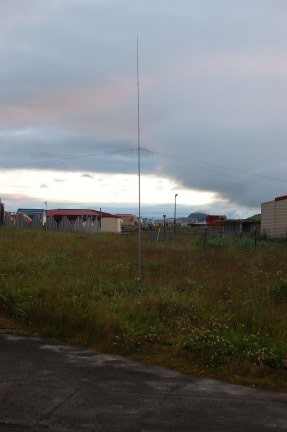
While we were putting up the vertical, Nathaniel met Jeff, KL2HD, who happened to have flown in on the same flight as us and who also happened to have his office and station across the street from my apartment. Neat. He works for U.S. Fish and Wildlife Service and they have field sites throughout the Aleutians. They use HF to communicate with their camps. So, he just plugs into a well-installed folded dipole to do his hamming. Have you ever seen a folded dipole installed between two (yes, two) Rohn 45 towers? Intense. Wind.
Due to our work schedule (8-10 hours per day plus meals), I often did not manage to get on until 0500 UT at the earliest, and sometimes even later. But, when I did, I was greeted with a roaring pileup of the “deserving.” This elicited a little bit of mail from my East Coast friends about getting on the air earlier. It turns out, however, that for most of the trip, 20 and 17 meters were open to the entire U.S. until 0630 UT. Both the skimmers and the QSOs bear this out.
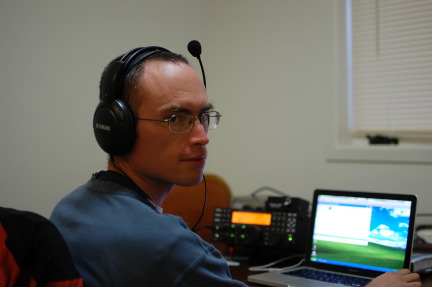
Why yes, I did get a new radio to replace the FT-840. More on this in the future.
It was pretty apparent that I had a lot of callers who couldn’t (for a variety of reasons) copy me. European friends reported a total lidfest on their end the first night I was on the air, although I learned a lot about pileup control on this trip. I have great respect for the “real” DXpeditioners who do this from the rarest locations. This was tremendous fun, though, and I enjoyed working each and every one. Thank you for calling!
There was one night on 17 meters that I CQed dead air for almost a half hour, making just two QSOs with stateside stations. And like a switch, the Europeans came in over the pole. It was incredible: I made 300 QSOs in 2.5 hours that night…mostly Europeans and Japanese.
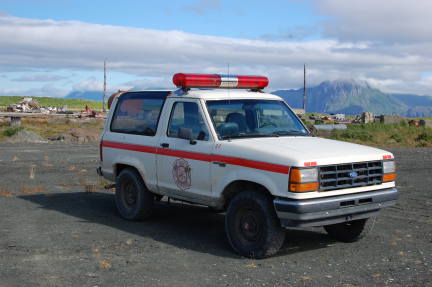
Oh, one more photo…this is one of our rental vehicles on Adak. No, your ARES group cannot buy it. The siren and lights don’t work anyway.
So, I got home on Monday and Sarah is amused by the amount of fan mail (QSL cards) the trip generated. Speaking of QSLing, the log has been uploaded to LoTW and has already generated about a 25% return rate. If you worked KL7/K8GU, you can get a nice photo card by sending an SASE or SAE+green stamp to my callbook address. I also use the bureau. To this point, Kevin and Nathaniel and I have been planning to share a card. They are still there for another week (so, if you missed me, you still have a chance for NA-039) and then we will figure out a card and order them. So, it will be a few weeks until cards can go out.
Ethan Miller, K8GU, is a regular contributor to AmateurRadio.com and writes from Maryland, USA. Contact him at [email protected].
 Ham Radio Deluxe |
 W5SWL Electronics |
 Ham Radio Prep |
 KB3IFH QSL Cards  Hip Ham Shirts  HamRadioAuctions HamRadioAuctions Reliance Antennas Reliance Antennas Enigma Shop Enigma Shop |  morseDX  Ni4L Antennas  R&L Electronics R&L Electronics antennas.us antennas.us QRV QRV |
- Matt W1MST, Managing Editor
