 |
 Beautiful Autumn Day
 23 September 2012 | by
 The weather was sunny, and mild – not hot. A gorgeous Autumn day with crisp, blues skies and big, puffy white clouds. We spent the early afternoon picking apples at a nearby “pick your own” orchard. We got some great looking Red and Golden Delicious, Winesap, Jonathan and Macintosh apples. Probably about 15 pounds of apples all told. Great snacks for a person (yours truly) who has sworn off junk food in an effort to drop some poundage.
After returning home, I spent some time on the radio and worked some DX as the bands were open. 20,17, 15 and 12 Meters were active and I even heard some stations on 10 Meters, too. I managed to snare the following:
PA6XX on 15 Meters
PA3FQA on 12 Meters
S57DX on 17 Meters
EA8DO on 12 Meters.
I heard a ZL1 station on 10 Meters; but from listening, it was apparent he was running QRO and was only about 569/579 here and there was quite a pileup. Getting him in the log would have been nice, and I gave a few tries; but decided that hanging around too long was not going to bear fruit. As the song says, “You’ve got know when to hold ’em and when to fold ’em.” And sometimes you do “just know” when it’s not going to work, and sometimes perseverance also means “not today; but some other time”.
I also worked two stateside stations. One was Terry WA0ITP, on 20 Meters, who was working portable from Pioneer Ridge County Park near Ottumwa, Iowa. Terry self posted onto QRPSPOTS and sure enough, I was able to get into his log. That was fun, as I consider Terry to be one of the better known QRPers and it’s always a delight to work a QRP “celebrity”.
QRPSPOTS is (if you’re not already familiar) a QRP Spotting site, sponsored by the Four States QRP Group.. QRPers who are going portable will often spot themselves in advance of their outing in order to let everyone know that they are active in the field. There are a lot of spots posted for SOTA activities and many QRPers will spot juicy DX that they have been able to work with low power. Nothing like spreadin’ the wealth, man! QRPSPOTS is a boon to QRPers and many thanks to the Four States QRP Group for the service they make available to us.
The other QSO was after dinner with Adam N0SSS who answered my CQ on 20 Meters. Adam is a younger Ham (relatively speaking) at 32 years of age and only 4 years as a Ham. But I have a feeling that Adam will go a long ways in the QRP world. He was using his KX1 at 2 Watts with a Moxon antenna that he built himself this summer. When he turned the antenna so that I was in his sites, his signal went from 559 to 599+. We had a very enjoyable chat that lasted for over a half an hour. I sure hope we run into each other again sometime.
72 de Larry W2LJ
QRP – When you care to send the very least!

Larry Makoski, W2LJ, is a regular contributor to AmateurRadio.com and writes from New Jersey, USA. Contact him at [email protected].
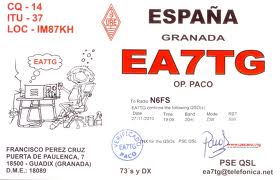
The magic of 10 meters………….
 |
| Almost broke my all time QRPp record with this one |
anymore..
 |
| 500mW contact |
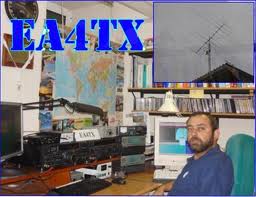
was no new DXCC's for me to be had but lots of DX. It was 2pm in the afternoon local time and that was very odd for 10 meters to be this active but heck who is arguing. It seems I had a direct line to Spain, sure there was Germany and other European countries but they had huge pileup's waiting for a contact. It seemed to workout that I would fall upon Spanish stations calling CQ and it would work out that they were just waiting for me to come back to them. I made four contacts with as little power as possible. Since I worked stations with the minimum power it tends to drag out contacts as I start with 100mW"s or less and work my way up from there.
 |
| 500mW contact. |
Mike Weir, VE9KK, is a regular contributor to AmateurRadio.com and writes from New Brunswick, Canada. Contact him at [email protected].
VHF SOTA Activation (W0/ SP-081)
It was another great day for Summits On The Air (SOTA) activity. I hiked up to Kaufman Ridge HP (W0/SP-081) with Joyce K0JJW to do the first SOTA activation of that summit. This summit is just south of Kaufman Ridge North (W0/SP-085) mentioned in this post.
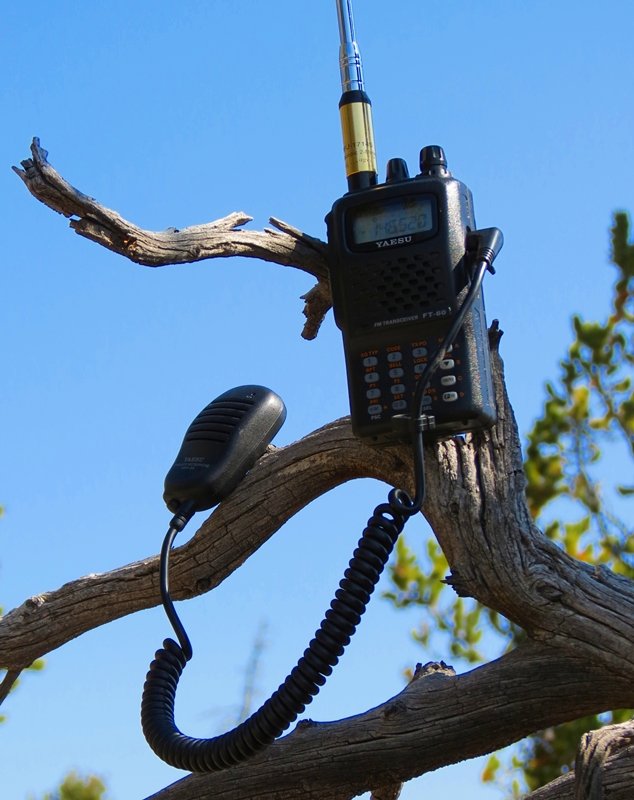
Unlike some of my previous SOTA activations, I actually kind of sort of planned this one. I had my Yaesu FT-60 HT with a decent omni antenna for 2 Meters (the MFJ-1714). I also took along the VX-8GR handheld for use as an APRS station. Note the innovative In The Tree mounting scheme for the FT-60:
On the way up, I heard Steve WG0AT on the summit of Mount Rosa (W0/FR-034) calling on 146.52 MHz. I gave a quick call to Steve to let him know I was hearing him but that I was not at the summit yet. About 20 minutes later, I was on top and worked Steve and his hiking partner Frank K0JQZ, for a summit-to-summit contact.
A call on 146.52 MHz got a reply from John N0EVH who was operating mobile. Then I worked Bill KD0PFF who was driving up a 4WD road to Red Cone Peak. Later, I worked his 4WD partner Stan KD0PFC. Fred WA0SIK, a regular in the various VHF contests, came up on five two to give me another contact. Then I got a call from Dave K0HTX who spends many weekends over on the other side of South Park. Finally, I caught Randy KN0TPC and Jeremy KD0MWT on 147.555 MHz, near Divide at a Boy Scout Camporee.
It was really cool to catch all these folks out having fun in the mountains. It was a glorious fall day and the aspen trees were at their peak fall color.
73, Bob K0NR
Bob Witte, KØNR, is a regular contributor to AmateurRadio.com and writes from Colorado, USA. Contact him at [email protected].
ICQ Podcast S05 E20 – Operating Aboard (23 September 2012)
Series Five Episode Twenty of the ICQ Podcast has been released. News Stories include :-
- Amateur Radio Astronomy
- Two commercial operations evicted from amateur bands
- Icom UK releases Amateur Radio IP Software
- Banbury Canal Day
- California QSO Party
- 3D2C DXpedition to Conway Reef
- End of an era for MKARS at Bletchley Park
- First Thames Amateur Radio Group Meeting
Listener mailbag and Martin (M1MRB) discusses operating aboard
Colin Butler, M6BOY, is the host of the ICQ Podcast, a weekly radio show about Amateur Radio. Contact him at [email protected].
Derventio
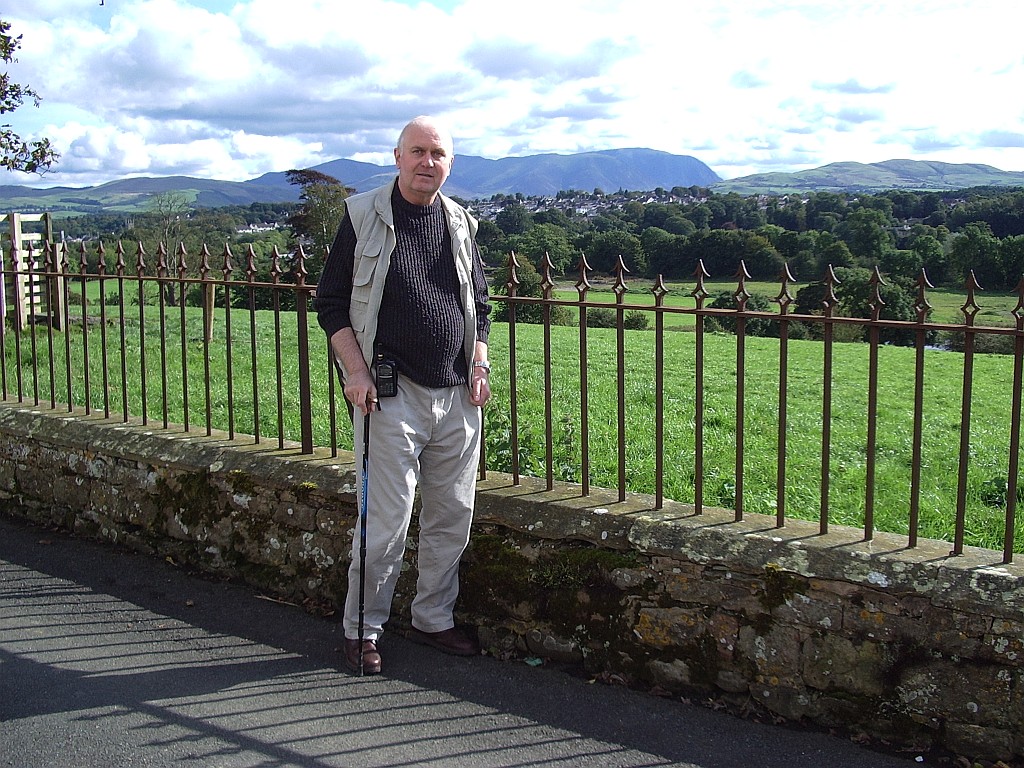
I have been itching to try venturing further afield and thought we might go down to the river Derwent at Papcastle. I carried the Kenwood TH-D72 on my belt to track the walk using APRS and see how far we got. When we reached the path down to the river we saw a paper sign saying “Derventio.” Olga thought – wisely with hindsight – that it would not be a good idea to walk down to the river as we would then have to climb back up again. We walked a bit further along the road and looked down towards the river where we could see substantial excavations were taking place. This looks like being a major archeological site. One day when I’m just a bit fitter we will go down and take a closer look.
We continued our walk with a loop through the village of Papcastle, then returned home the way we had come. On the way I heard and worked Richard G1JTD portable on the summit of Great Calva, and Liz M6EPW on my local SOTA summit of Watch Hill. That will undoubtedly be the first summit I will attempt but at the moment it is still too far – about 3 miles from our front door.
I was pretty tired and very sweaty by the time we got back to Cockermouth but I resisted Olga’s suggestion that we finish the excursion by taxi. Although what we had done was an easy walk by normal standards this was my most ambitious outing since finishing my treatment.

When we got home I could see that our track had been perfectly recorded by APRS. I was happy with that – and with the two contacts I made. I had only been using one of those stubby antennas about 5 cm long which are a couple of dB down on a rubber duck.
I saved the track as a GPX file and then produced a report using one of the online GPX report generators. According to the report we had walked exactly 4 kilometres. 1.5km of this had been climbing for a total ascent of 87m. To me it felt as if I had just climbed Scafell Pike!

Julian Moss, G4ILO, is a regular contributor to AmateurRadio.com and writes from Cumbria, England. Contact him at [email protected].
A cheaper approach to Virtual Radar using the microADSB dongle
For quite sometime, I have been intrigued by the whole ADS-B Virtual Radar thing. As you know, if you’ve read this blog for a while, I love maps and plotting objects on them. I love planes too and whenever I look up and see a plane I always wonder where it has come from and where it is going to. Not to mention the propagation angle. ADS-B (Virtual Radar) operates at 1090MHz, so how interesting to have a set of beacon sources operating at around 1GHz and to be able to monitor propagation to and from them.
How to achieve it? Until recently, the only way to do it appeared to see some very interesting, if expensive units such as the SBS-3 Virtual Radar devices. These look great, well put together but seemed a lot of money for something that would probably not be a core part of the station here.
Dave G4FRE had told me of his experiments of using Ubuntu and the RTLSDR dongle to monitor ADS-B which looked effective and interesting. I did not really want to get into the whole Linux thing. I’ve nothing against Linux, but I spend my days looking into the technicalities of computer systems and though it is something that fascinates me it is not something I want to reproduce at home! I might give it a go in the future though. Dave has had some good results with his Ubuntu box and RTLSDR which does sound worth experimenting with.
However, talking to Mark VK3PI on Twitter he mentioned that he had got a lower cost ADS-B receiver which was showing good results.Mark had obtained a USB dongle from Miro LZ2RR called the microADSB The cost was modest compared to other solutions, so I placed an order.
The microADSB arrived on Thursday and I wasted no time getting it going. The package consists of the dongle itself, a CDROM of software, a USB cable from the dongle to the PC and a small magmount antenna terminated with an SMA that connects to the dongle.
Software installation was straightforward. On plugging the dongle in, I was prompted for the drivers which installed happily off the CD. The software that comes with the dongle is adsbScope. All I had to do to get it working was to select the virtual COM port that the dongle had attached to and then connect ADSB Scope to the dongle.
I was doing this at around 10pm at night with a few less planes flying, but I moved the antenna close to the window of the lounge on the ground floor and was soon seeing points plotted from the planes at surprising distances from home. Having got it all setup, I transported the laptop and the dongle upstairs to the shack, which has an easterly facing window and set it up. Range seems to be regularly 50-60 miles with occasional greater distances.
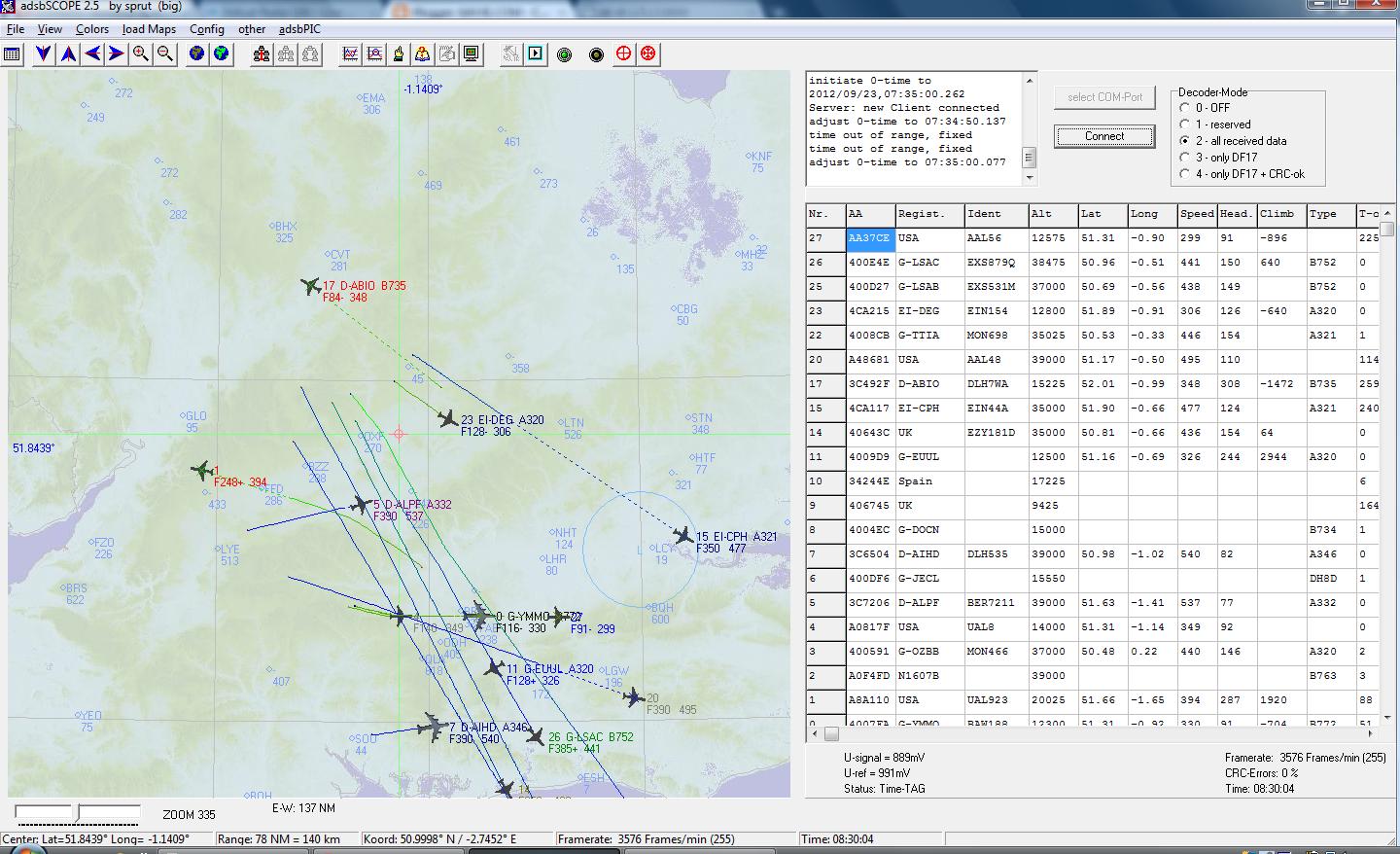
adsbScope allowed me to plot planes easily and it shows, where possible, the country of registration and the flight number, However, this didn’t entirely satisfy my curiosity about where the planes were flying to and from.
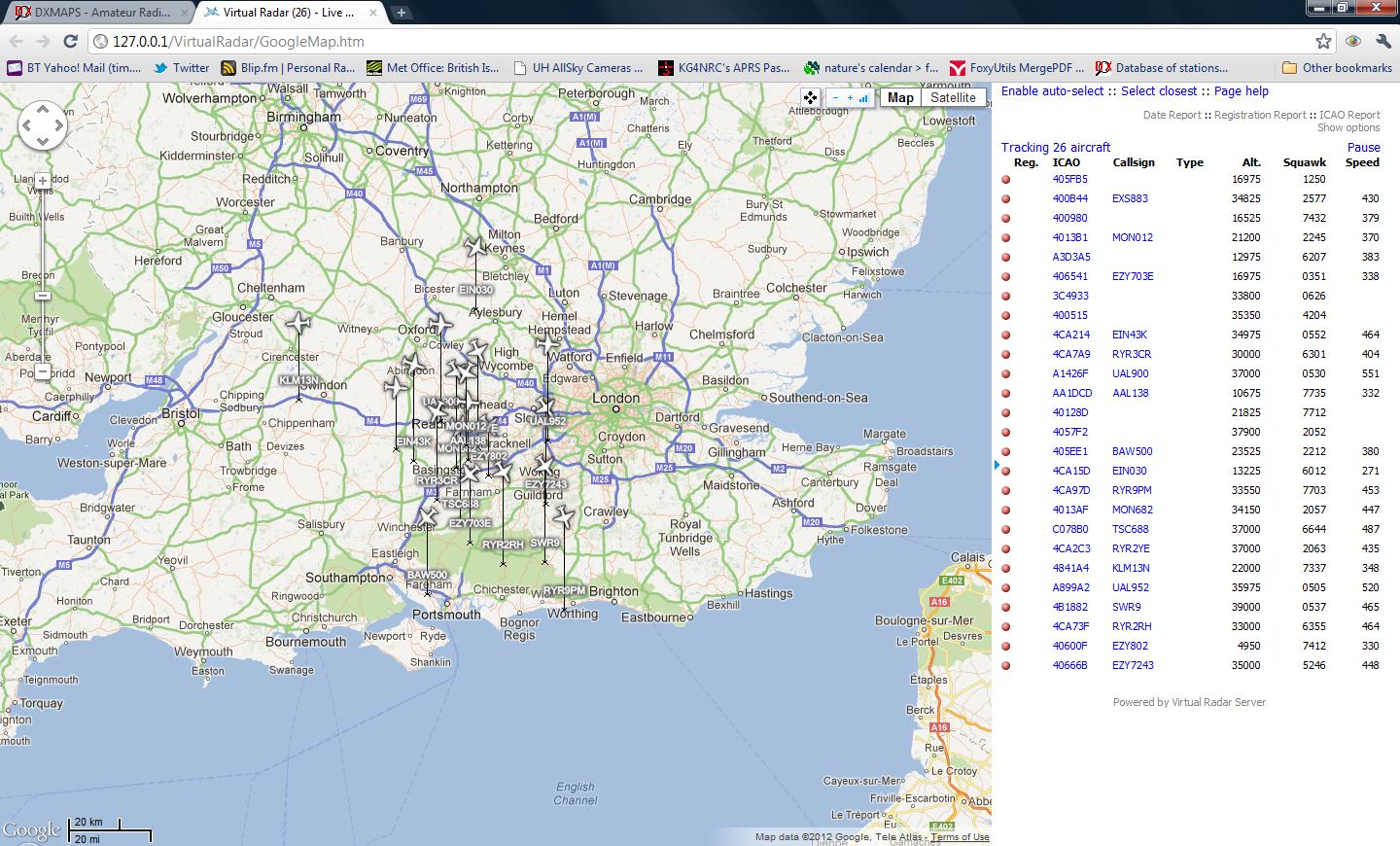
I had noticed an application called Virtual Radar server which runs as a webserver on your PC and picks up the data from adsbscope and augments it with information from a routes database and plots the planes on a nice Google map. I had to start adsbScope’s server functionality which Virtual Radar Server was able to read. Virtual Radar Server expects an SBS type installation, so I had to install a plugin called Database Writer which reproduced the basestation.sqb file/database which the SBS software seems to work on. I enabled the plugin and then allowed it to create the database file and granted it permissions to update it.
That did the trick! I was then able to browse to the URL which the Virtual Radar server provided on the local machine to see the planes plotted, along with the route information. I’m finding that so far, if I just want to get a sense of what propagation is like, I stick with adsbScope as that tells me all I need to know, but if I want a bit more information abut the flights, then I start up Virtual Radar Server.

Tim Kirby, G4VXE, is a regular contributor to AmateurRadio.com and writes from Oxfordshire, England. Contact him at [email protected].
Oopsy!
Forgot a score. And it affects the Top Ten – mea culpa, mea culpa. mea maxima culpa!
My apologies to Pete W1PNS who came in with a score of 4620 – so let me rephrase this …..
The Top 11 Finishers
W1PNS – 4620 points
Golly gee, and Pete went to so much trouble to post niceness about the Skeeter Hunt on his blog and I went and left him out – truly and purely accidentally with no malice a forethought.
Thanks, Pete, for being so understanding. I’ll get the hang of this yet, I promise!
72 de Larry W2LJ
QRP – When you care to send the very least!

Larry Makoski, W2LJ, is a regular contributor to AmateurRadio.com and writes from New Jersey, USA. Contact him at [email protected].
 Ham Radio Deluxe |
 W5SWL Electronics |
 Ham Radio Prep |
 KB3IFH QSL Cards  Hip Ham Shirts  HamRadioAuctions HamRadioAuctions Reliance Antennas Reliance Antennas Enigma Shop Enigma Shop |  morseDX  Ni4L Antennas  R&L Electronics R&L Electronics antennas.us antennas.us QRV QRV |
- Matt W1MST, Managing Editor
