 |
 Classic Straight Key CW
 18 April 2013 | by
 http://www.youtube.com/watch?v=nVkLr0GyJPI
Test Questions;
What is a glass arm?
How long should you be able to send using proper form?
How far apart should the contacts be?
What are the working parts of the body when sending CW?
Mike Crownover, AD5A, is a regular contributor to AmateurRadio.com and writes from Texas, USA. Contact him at [email protected].
Checking Out A Baofeng UV-5RA
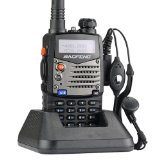 In the Winter 2013 issue of CQ VHF magazine, I wrote about some of the VHF/UHF handheld radios available from China. In that article, I reported on the measured performance of a few of the Wouxun and Baofeng transceivers. One of the Baofeng UV-5R radios that I tested showed harmonic distortion that was a bit high on the 2 Meter band, around -40 dBc.
I recently got my hands on a Baofeng UV-5RA, which is a newer version of the same radio (firmware BFB297), so I wanted to check its performance. Like the two UV-5R models I checked, the power output, transmit frequency and receiver sensitivity were all quite solid on both bands. I was more interested in the harmonic distortion present in the transmit signal.
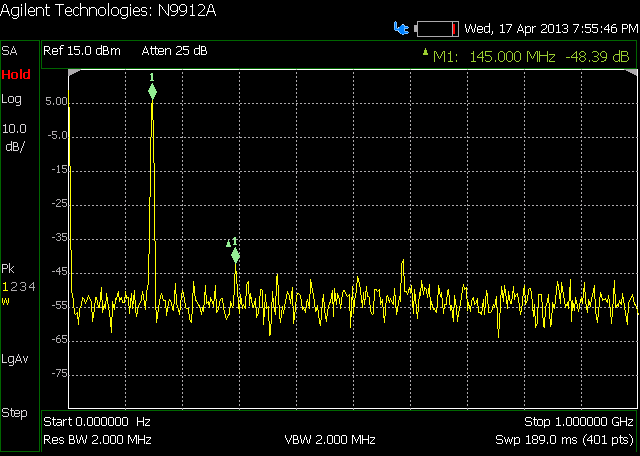
On the 2 Meter band, the 2nd harmonic measured -48.4 dB relative to the fundamental which is pretty good. Similar to the other radios I measured, the performance in the 70 cm band is a lot better (-56.1 dB).
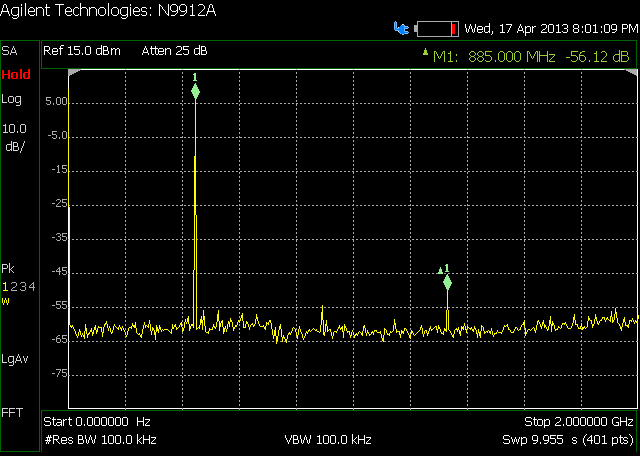
This radio has significantly better harmonic distortion than the older UV-5R radio. Of course, this is just a single sample, so performance of other radios may be different.
73, Bob K0NR
Bob Witte, KØNR, is a regular contributor to AmateurRadio.com and writes from Colorado, USA. Contact him at [email protected].
NJQRP Skeeter Hunt for 2013
Official announcement to come out in a few weeks. The date is confirmed, though – Sunday August 11th, so save the date!
New for 2013:
New theme for this year with bonus points.
SSB will be a category this year for folks who prefer that mode.
Extra points to be awarded for any WAE (Worked All Europe) contacts made, as it runs the same day and a few Skeeters and Hunters actually made DX contacts last year.
Stay tuned – more to come!
72 de Larry W2LJ
QRP – When you care to send the very least!
Larry Makoski, W2LJ, is a regular contributor to AmateurRadio.com and writes from New Jersey, USA. Contact him at [email protected].
Handiham World for 17 April 2013
Pat Tice, WA0TDA, is the manager of HANDI-HAM and a regular contributor to AmateurRadio.com. Contact him at [email protected].
Simply Amazing
This is my 35th year as an Amateur Radio operator, and my 10th year as a dedicated QRPer. I think the best thing about this hobby is that it just doesn’t get old. Maybe I’m the exception, rather than the rule, but my latest QSOs give me as much enjoyment and fill me with as much wonder as that very first one.
Tonight, I worked EW8DJ, Alex in Belarus on 30 Meters. Listening on 20 Meters for a bit, I heard RW6FS and LZ1QI and I hesitated to work them, as we QSOed so very recently. Sometimes I feel like they’d hear W2LJ and think, “Didn’t I just work that guy?”
But thinking about the QSO that I did have makes me pause.
New Jersey to Belarus with just 5 Watts from my radio, out my Butternut antenna, travelling a quarter way around the world to another Ham.
Think of the distances! If I got in a commercial airliner, and left right now, in about 9 or 10 hours (or more), I would arrive where my radio signal traveled practically instantaneously.
Many take this technology so much for granted, but I still find it amazing. Can you imagine what the early radio pioneers would think? Imagine Marconi, who strung miles of wire, high in the sky, just to strain to hear a whisper of a signal from Europe. Can you imagine him sitting down behind a KX3? What do you think his reaction would be at working a station in “White Russia” using a piece of aluminum 26 feet tall, using less power than an average nightlight?
I’m pretty sure that he’d be smiling from ear to ear.
The world may look at us, watch us play with our radios, and think we’re quaint, doddering old fools for bothering with antiquated technology that’s over 100 years old. I sit down and consider what’s actually happening, the distances covered considering the power used, and I am still able to appreciate the miracle that radio continues to be.
72 de Larry W2LJ
QRP – When you care to send the very least!
Larry Makoski, W2LJ, is a regular contributor to AmateurRadio.com and writes from New Jersey, USA. Contact him at [email protected].
World Amateur Radio Day
Today is the 88th Anniversary of the founding of the International Amateur Radio Union (IARU) which is World Amateur Radio Day. Didn’t you know that? Well neither did I until I worked CR5IARU on 20m PSK31. Not that I’d have known from working the station. I had to use QRZ.com to find out what the special call was all about.

Perhaps it’s just me but I thought the purpose of a special event call was to raise awareness of some particular event or anniversary. In pursuit of which the special event station should give out this information on every contact. But too often it seems to be taken as an opportunity to work as many stations as possible, contest style.
Another special call that I worked today on 20m PSK31 was HF2013TATO. When I asked the operator Jarek what the special call was for my request was ignored. So I had to go on the internet again. From what I could deduce, this special call is to raise awareness of the role of the father in the family. There may be more to it than that but my Polish is not very good. 🙂 But I do know that “tato” means “dad.”
Julian Moss, G4ILO, is a regular contributor to AmateurRadio.com and writes from Cumbria, England. Contact him at [email protected].
Bands getting better
The bands are improving, the geomagnetic effects of the Coronal Mass Ejection seem to be fading. I was able to get on the air after dinner and work a few DX stations to add to my Club 72 QRP Marathon totals.
Many, many thanks to Peter HA5MK in Hungary on 40 Meters, Rolf SE6Y in Sweden on 30 Meters, and Vlad RW6FS in European Russia on 20 Meters.
The final totals for the 2012/2013 QRP Fox hunts were posted today. While I placed nowhere near the top finishers, I did “OK” for living in the Northeast without gain antennas. In the 40 Meter hunts, I nabbed 21 out of 40 possible pelts for a .525 batting average. I did even slightly better in the 80 Meter hunts. There I snared 26 out of 40 pelts for a batting average of .650 – good numbers if I were a slugger in the Major Leagues.
The “Major Leagues” as far as Fox hunts go, are folks like Doc K0EVZ, Dick W0NTA, Dave AB9CA, Dale WC7S, Dave N1IX, Jerry N9AW, Rick NK9G, John N2RK, Todd N9NE and many others. These guys are the heavy hitters, and I am nowhere in their league.
The “portable ops QRPer” in me really appreciated and enjoyed an article by Padraig Lysandrou KC9UUS in the May issue of QST. Read it if you get the chance. Padraig is a relatively newly licensed Ham, as well as a high school student. He and his family (Mom, Dad and two sisters are also licensed) took the opportunity to combine a vacation to Cyprus with Ham Radio. Not QRP, but very much portable. It was a good read, and Padraig is an excellent writer.
Lastly, before closing, for the night, I’d like to send prayers and thoughts to all the folks in Boston who suffered in the bombings today. May the injured heal completely and quickly. May the families of the deceased receive consolation and healing, also.
We are all Bostonians tonight – as a Nation, we gather together and become one.
72 de Larry W2LJ
QRP – When you care to send the very least!
Larry Makoski, W2LJ, is a regular contributor to AmateurRadio.com and writes from New Jersey, USA. Contact him at [email protected].
 Ham Radio Deluxe |
 W5SWL Electronics |
 Ham Radio Prep |
 KB3IFH QSL Cards  Hip Ham Shirts  HamRadioAuctions HamRadioAuctions Reliance Antennas Reliance Antennas Enigma Shop Enigma Shop |  morseDX  Ni4L Antennas  R&L Electronics R&L Electronics antennas.us antennas.us QRV QRV |
- Matt W1MST, Managing Editor
