 |
 Another new one; but not QRP.
 9 May 2013 | by
 I got another new DXCC entity into the log tonight; but it was not QRP, and even at 85 Watts it was a bit of a chore.
The station was A61Q and the entity was the United Arab Emirates. The band was 17 Meters. For whatever reason the DX op decided not to work split; but to stay simplex. That made for pandemonium. I found him by tuning around, and when I saw/heard the pileup, I checked the cluster, and sure enough, he had already been spotted multiple times. It’s no exaggeration to say that a melee ensued.
At the beginning, he was as loud as A45XR was from Oman the past couple of nights. I thought I stood a good chance with QRP and started there. The pileup was a zoo and I threw out my call many times with no luck. I sensed a pattern – A61Q would call “CQ DX” and the ensuing cacophony of chasing stations followed his “K”. It turned out that he was working stations that he could pick out as the calling died down, and everyone started listening (funny how that works, eh?).
As I sensed his pattern, I thought I stood an even better chance. But then the inevitable started happening – the band began to change. He went from 599+++++ to 599++, then eventually 599+, and then eventually just 599. At that point, he looked like he might fade fast; so I decided that discretion was the better part of valor and turned the K3 up to 85 Watts. It took about a half dozen calls or so (waiting for the avalanche of calls to die before throwing mine out), but I finally heard my call coming back to me. We completed the exchange (stations were actually calling him while he was still working me!!!) and I listened for a while as I put the QSO information into my log. Within the next ten minutes A61Q was becoming covered by the background noise.
I heard plenty of other DX; but for some reason QRP just wasn’t working for me tonight. I didn’t hear any more new entities; so after A61Q I kept it to 4.8 Watts (I always stay just a bit below 5 Watts – call it a quirk). I did end up working N4FOC on 20 Meters and then John N8ZYA on 30 Meters before pulling the plug for the night.
Getting back to the pileup situation, though. Folks – the most formidable DX weapon you have is your ears. Use them! You have two ears and one key (or microphone) – that should tell you something. Listening is more important than transmitting.
It seems like when “exotic” DX comes on the band, people just snap and go crazy or something. Here we have a station working simplex, which is bad enough – but we also have a gazillion or so chasing stations that just aren’t listening! When the DX calls “WB4?” – why are W7 or N6 or AA5 stations throwing out their calls? Isn’t it deathly obvious that he’s trying to work the WB4 station? And please don’t tell me you thought the was calling for something else. You know, if you couldn’t hear him well enough to know that he called “WB4?” then you shouldn’t be trying to work him in the first place. Just because a DX station is listed on the cluster doesn’t mean that you should click your mouse and immediately start throwing out your call. See if you can actually hear him first, OK? If you can’t hear him, how are you going to know that he’s calling you back? Common sense, right?
If A61Q had worked split, the situation might have been better, but that assumption is not a lock, either. But if everyone had been listening and not sending out their calls needlessly while simultaneously foaming at the mouth, then the DX station could have worked a whole bunch more stations than he had. The pandemonium slowed things down exponentially.
72 de Larry W2LJ
QRP – When you care to send the very least!
Larry Makoski, W2LJ, is a regular contributor to AmateurRadio.com and writes from New Jersey, USA. Contact him at [email protected].
WG2XPN 70MHz beacon active
As in previous years, Brian Justin, WA1ZMS has kindly arranged a US 70MHz beacon for the summer season. This year the callsign is WG2XPN and the frequency is 70.005 beaming towards Europe.
Tim Kirby, G4VXE, is a regular contributor to AmateurRadio.com and writes from Oxfordshire, England. Contact him at [email protected].
Oh man!
And sometimes “the next time” is the next day! That was the case for me and A45XR in Oman. Where I was unsuccessful last night, I scored tonight. Chris in Oman was VERY loud into New Jersey at the very end of 20 Meters – 14.005 MHz. He was 599+ loud. The kind of loud that you know in your gut that if you stick with him (and he doesn’t QRT), you’ll get him in the log. As I was listening to him pick off the stations, I heard him come back to Chris KQ2RP (author of Signal to Noise – KQ2RP), who lives all of 28 miles from me as the crow flies. When I heard Chris A45XR work Chris KQ2RP (hey, that was a 2X Chris QSO!), I really started to feel confident. And I was in the log about 5 -7 minutes later. First time to work Oman and via QRP. Life is good!
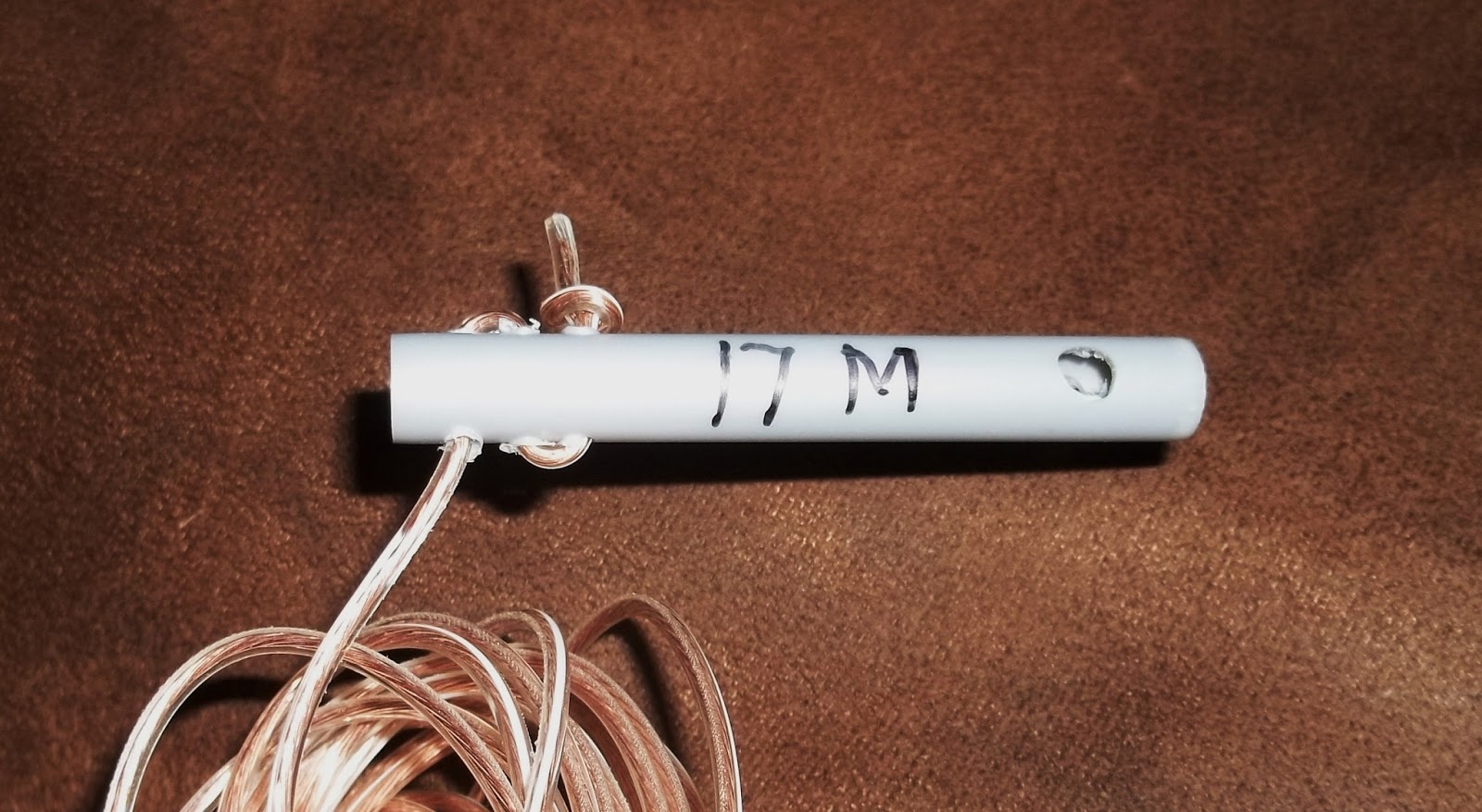
BTW, here’s a picture of the insulator I fashioned last night from the pen barrel. Sorry about the photo quality – I tried adjusting the exposure and contrast; but you’ll get the idea.
I received an e-mail from Joel N3GSE over the weekend, informing me that it’s not legal to own a slingshot in New Jersey. Who knew? I had so many as a kid! I could argue (if ever questioned about it) that since it’s attached to an “L” bracket and the projectile is attached via fishing line that it’s technically an “antenna line launcher” and not a sling shot, per se. I’ll have to ask my police officer brother-in-law about it. Another stupid New Jersey law, if you ask me.
But as I was reading the statute (and I re-read it about 3 times to be certain), I saw that there was no mention whatsoever about pneumatic antenna launchers. So I sent away for the following kit from the Joplin Amateur Radio Club:

Larry Makoski, W2LJ, is a regular contributor to AmateurRadio.com and writes from New Jersey, USA. Contact him at [email protected].
Handiham World for 08 May 2013
Pat Tice, WA0TDA, is the manager of HANDI-HAM and a regular contributor to AmateurRadio.com. Contact him at [email protected].
Short time on the radio netted 37,968 miles per watt contact.
Mike Weir, VE9KK, is a regular contributor to AmateurRadio.com and writes from New Brunswick, Canada. Contact him at [email protected].
General License Book From HamRadioSchool.com
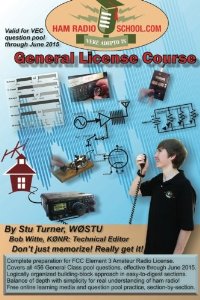 HamRadioSchool.com is off to a great start with a learning system that includes a web site, iPhone app and a great Technician License Course book. The Technician book, written by my fellow instructor Stu Turner W0STU, has turned out to be very popular. Stu did a great job of balancing “teaching the right material” with “focusing on the exam questions.” We’ve used the book in our two-day Tech license class with great success.
Many people have been asking Stu when he’s going to write a book for the FCC General Class License. So, by popular demand, here it is: HamRadioSchool.com General License Course. Using the same creative style that worked well with the Technician book, Stu has delivered an easy-t0-grok book for getting your General Class License.
I was happy to provide technical assistance to Stu for this book and earned the esteemed title of Technical Editor. It even says so on the front cover! (It says Technical Editor because I can’t be held responsible for proper grammar or spelling.)
Just like the Tech book, the General book has a companion iPhone app available on iTunes.
73, Bob K0NR
Bob Witte, KØNR, is a regular contributor to AmateurRadio.com and writes from Colorado, USA. Contact him at [email protected].
W3APL/B 903-MHz beacon
Late last Summer, it came to my attention that the 903-MHz W3APL beacon had gone off-line. The failure was intermittent and seemed to resolve itself after power was reset. Several efforts to troubleshoot it were undertaken by myself and others, including running it at high duty into a dummy load over a period of days. I was unable to get the problem to manifest itself on my bench.
A synthesized source (Analog Devices demo board) was offered by a friend of the Club, however it did not produce the desired output (or any output at all). It’s not clear whether this was the fault of the synthesizer or the user (me). The notional plan was to replace the beacon, which consists of a 75-MHz crystal oscillator followed by 12x of multiplication and a small RF power module, with the synthesizer and a new RF power module. The project languished, as they often do in my hands. But, two weeks ago I picked up the task again and made some real headway.
Really, the failure had to be one of a couple of things: 1. Intermittent connection exacerbated by thermal cycling. 2. Oscillator “unlock” due to component aging and thermal cycling. I reasoned that as long as we could eliminate #1, the multiplier chain and amplifier should be fine. The behavior seemed to point toward #2 or perhaps a combination of #1 and #2. I came across a forlorn Programmed Test Sources PTS-040 that I had rescued from another group’s surplus heap to put in my lab. I hadn’t used it in the two years that it was in my possession, so it seemed logical to provide it to the Club on a long-term loan. The problem was that it didn’t go up to 75-MHz. So, I cooked up a little multiplier chain. My “good” HP spectrum analyzer is on-loan to a paying program so I had to make do with the FFT function on the fastest Tektronix portable scope I had in the lab.
My initial effort at the multiplier chain was to build a 2N3904 amplifier that swung way into saturation producing a signal rich in harmonics. I went straight away for the 903-MHz signal but I couldn’t get a good enough lumped-element filter to eliminate the adjacent harmonics. So, I tried for the 75-MHz injection. This demanded a buffer amplifier so I lazily reached for the MMIC drawer in and retrieved one of the plentiful MAR-8s. Plenty of gain…and, as I would find out in a moment…conditionally stable! To exercise the eloquent euphemism of Ben, N3UM, the MMIC “burst into song” at about 63 MHz.
Back to the drawing board. I knew that I had something that would work, so I redesigned the deadbug layout on an SMD protoboard (the kind with all the pads in a grid). I replaced the discrete 2N3904 and MAR-8 MMIC amps with SGA-4586Z MMICs (which are a little too nice for this service, but I have a ton of them). Viola!
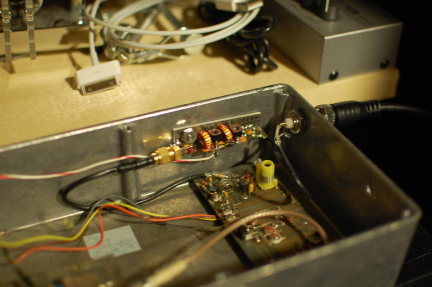
It’s the little board on the far wall of the diecast box with the SMA connector on the left and two toroids. 37-MHz RF comes in from the PTS-040 through the BNC jack in the wall. It’s multiplied up to 75 MHz on the new board and piped down to the remaining 12x multiplication and amplification stages before going to the little brick PA in the lower left (not visible).
So far, it sounds good. I was able to monitor it with my W1GHZ transverter strapped to the IC-290A in my car and using a WA5VJB cheap Yagi tossed in the back seat. I lost the signal about 5 miles away with that setup, which is really pretty decent all things considered at that frequency, etc, etc. Nominally, the frequency should be 903.054 MHz. I found it at about 903.048 MHz on the lash-up. Brian, ND3F (aka N3IQ/R) reported that he found it at 903.046 MHz with KA3EJJ’s setup. If you’re in the vicinity of FM19ne and are setup on 902/903, we’d appreciate a report. The big thing is the long-term stability. So, we’ll continue to monitor it.
Now…to get back to that 930 on my bench…
Ethan Miller, K8GU, is a regular contributor to AmateurRadio.com and writes from Maryland, USA. Contact him at [email protected].
 Ham Radio Deluxe |
 W5SWL Electronics |
 Ham Radio Prep |
 KB3IFH QSL Cards  Hip Ham Shirts  HamRadioAuctions HamRadioAuctions Reliance Antennas Reliance Antennas Enigma Shop Enigma Shop |  morseDX  Ni4L Antennas  R&L Electronics R&L Electronics antennas.us antennas.us QRV QRV |
- Matt W1MST, Managing Editor
