 |
 Museum Ships Weekend 2013
 30 May 2013 | by
http://www.nj2bb.org/museum/index.html
Beginning at 0000Z June 1 through 2359Z June 2, 2013 102 ships will be participating in the Museum Ships Weekend.
There will be Aircraft Carriers, Battleships, Cruisers, Destroyers, Submarines and more participating on most ham bands.
The details about the ships, frequencies, and certificate information has been listed on the Battleship New Jersey’s NJ2BB.org web site.
This looks like a lot of fun and a good opportunity to teach our kids and grandkids about our amazing maritime history!
Thanks to Ron, AA2RR, for reminding us of this fun weekend opportunity!
Matt Thomas, W1MST, is the managing editor of AmateurRadio.com. Contact him at [email protected].
Duff stuff
I don’t know why it is, but whenever I buy some piece of gear I always seem to end up with duff stuff. My weather station that I received a few days ago will not register any rain. A little voice says “why do you need a gadget to tell you if it’s raining in Cumbria?” but that’s not the point. I would really like it to work. I have sent an email to Nevada (the dealer not the US state) but have yet to receive a reply. Watch this space.
My UV-3R+ has also developed a fault, or at least its battery has. It started having a flat battery when I didn’t expect it, but irregularly enough for me to think that perhaps I forgot to switch it off. But now the battery won’t charge up. The charger works and I can measure a charging voltage on the battery pins but when I remove the battery from the charger the voltage across the two internal contacts is about 1.3V. I’ve ordered a replacement from 409Shop.
Julian Moss, G4ILO, is a regular contributor to AmateurRadio.com and writes from Cumbria, England. Contact him at [email protected].
Brakes are on
Well its happening again. The computer which started out life nice and zippy like a gazelle in the morning sunshine, joyfully springing across the warm savannah has me wondering what I’ve done to inherit its predictable slow down. More time now is spent watching a little blue circle than is good for anyone
If I were a real cynic I’d think that these things are made to self destruct slow enough for you not to really notice but fast enough for you to buy a new one every few years to keep the silicon industry happy. Still, its a good time to buy a new machine as there’s a sale on…..That’s it no more sarcasm, I promise, honest.
Alex Hill, G7KSE, is a regular contributor to AmateurRadio.com and writes from Cumbria, UK. Contact him at [email protected].
Handiham World for 29 May 2013
Pat Tice, WA0TDA, is the manager of HANDI-HAM and a regular contributor to AmateurRadio.com. Contact him at [email protected].
CQ WW VHF Contest Certificate
This certificate for the CQ Worldwide VHF Contest arrived in the mail today, 1st Place Single Operator All Band for Colorado. Most of these contest awards take so long to arrive, I have usually forgotten all about the contest by the time they show up in the mail.

Last year, I had a pretty good run at it with an excellent 50 MHz sporadic-e opening on Saturday that ran up the QSO and grid totals. See my previous report on the contest here.
73, Bob K0NR
Bob Witte, KØNR, is a regular contributor to AmateurRadio.com and writes from Colorado, USA. Contact him at [email protected].
Big or Small: Radio, Key and Antenna
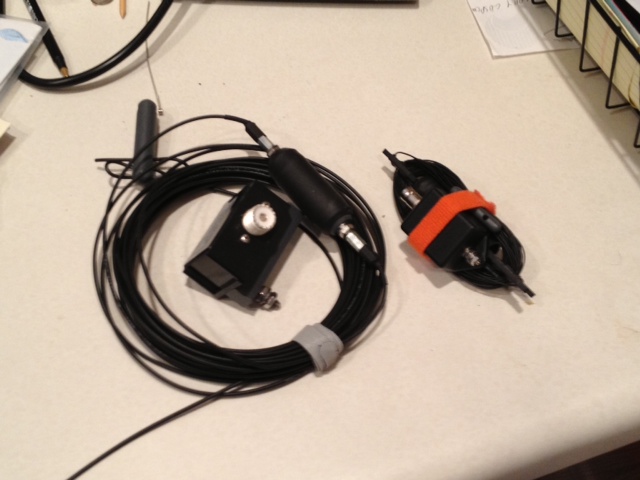
In the picture below there are two keys, actually three if you count the Begali Adventure key on the KX3. Also in the picture, on the left side, is the Te Ne Ke and next to it is the Micro Key. Clearly a size difference, but also a weight difference. Also in the picture is the KX3 (160 - 6m)and the KD1JV designed Mountain Top'er Rig (MTR), (40m/20m CW only). Again, the bigger radio brings more options, the smaller one easier to carry.

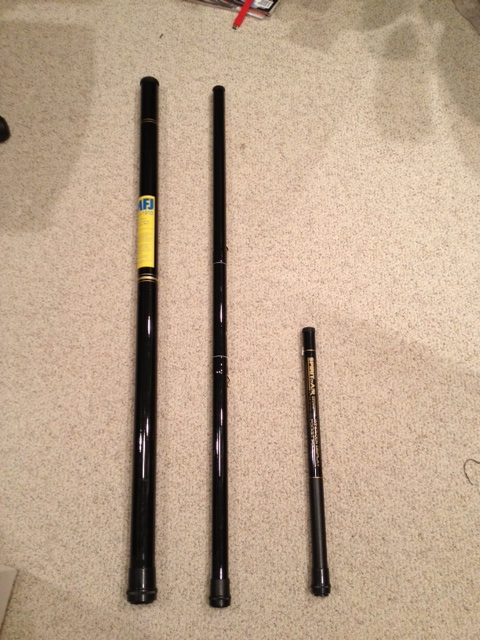
Of course you must have an antenna support. Below are three telescoping poles to choose from, a 33ft. MFJ Telecsoping Pole, a 20ft Black Widow and a 13ft Spirit of Air. Again, size, weight and optionality.
So many options and so little time. As WA0ITP says, "I like this radio stuff".
Mike Crownover, AD5A, is a regular contributor to AmateurRadio.com and writes from Texas, USA. Contact him at [email protected].
(A)Typical LBR installation
Like I mentioned, today Paul Harden, da boss, and I installed two more low-band receivers today, but with only a 50% success rate.
The receiver is dual banded for 74MHz/350MHz and is housed in a big and heavy 8″x12″ metal box. for thermal stability. We call them LBRs or 4/P receivers — 4 band is 58-80MHz (eg 4 meter wavelength) and P-band is 325-420 MHz or so. P comes from it’s old military designation, like L, S, C, X, Ka, K, Ku, radar bands, etc.
She’s mounted on a sturdy mount inside the “barrel” also known as the Focus Rotation Module, or simply the apex. It’s also my second home. Inside the barrel is a central square steel through which the 4-band antenna and receiver output cables go through. The receiver mounts near the bottom of the apex, and plugs in to 8 different cables – two pairs of Heliax for the 4/p band crossed dipoles, one Heliax pair for the output, a power cable, and a calibration signal cable.
Each antenna input requires two pair because of the dipole design — they’re orthogonal crossed dipoles that are fed into the receiver as two linear polarizations. Some magic happens in the LO-IF rack that either sends them as a linear polarization to the correlator (mainly for ionospheric observations) or combines them in quadrature to provide left- and right-circular polarization for observations outside our own solar system.
The first installation went smoothly — we removed a malfunctioning receiver from antenna 18 and replaced it with a fresh one — it’s pretty much plug and play. Somewhere through, we lost a two-way radio. No idea where it went. I think it always existed in some kind of quantum state, and now it’s hiding.
The second was troublesome. Each output, left and right polarization (or X and Y) should show clearly the band passes of each band through a spectrum analyzer. What we saw was spikes caused by the 74MHz *something* oscillating like a runaway Hartley. (that was a pretty poor play on words)
So we hit it a few times, jiggled the cables, and poof, it was back to normal! We came back down to the vertex room to find it again went nuts. So we went back up, wiggled some more, and took the SA with us. Now the X side was gone! We took the cover off and poked around, but it was dead. Methinks the oscillation was strong enough to saturate an LNA, bust a cap or diode or two, and kill X.
Paul’s gonna play with it tomorrow, and we’ll see if we can make our pseudo-deadline of getting everything working by Tuesday night. Lots of pressure from the higher ups.
Tonight, I’mma gon’ write a blurb about the SDR demonstration at the ARRL Youth Lounge at Dayton for Ward Silver, N0AX, upvote and argue things on reddit, and buy some wire and ladder line for field day. Need to make a 9:1 balun by then too.
 |
| View of South baldy and the Magdalena Ridge from the bus ride home |

Sterling Coffey, NØSSC, is a regular contributor to AmateurRadio.com. He is ARRL Youth Editor and an electrical engineering student at Missouri S&T. Contact him at [email protected].
 Ham Radio Deluxe |
 W5SWL Electronics |
 Ham Radio Prep |
 KB3IFH QSL Cards  Hip Ham Shirts  HamRadioAuctions HamRadioAuctions Reliance Antennas Reliance Antennas Enigma Shop Enigma Shop |  morseDX  Ni4L Antennas  R&L Electronics R&L Electronics antennas.us antennas.us QRV QRV |
- Matt W1MST, Managing Editor
