 |
 QRP @ 3W and an Indoor 50 ft Random Wire Antenna
 6 June 2013 | by
John Smithson, Jr., N8ZYA, is a regular contributor to AmateurRadio.com and writes from West Virginia, USA. Contact him at [email protected].
Shows Notes #106
Episode #106 Audio (Listen Now):
Introduction:
- Today on the show, Peter64 from Down Unda and from the Kernel Panic Oggcast. Welcome, Peter64!
Announcements:
- The Dayton Hamvention is coming up very soon! It will be May 17-19, 2013 at the Hara Arena in Dayton, Ohio. Linux in the Ham Shack will be there in the North Hall, booth 131. Hope to see you.
- The Beaglebone Black has been released. These are the preferred boards of Pignology and Sierra Radio Systems, who use them to create the Hamstack. They are retailing for $45 and are much more powerful than the Raspberry Pi.
Topics:
- Debian Wheezy (Version 7.0) has been released.
- KDE 4.10.3 is released, bringing in more than 75 bug fixes.
- Ham Radio Deluxe has announced a preview of version 6.1. New versions will retail $99.95. This move to commercial software was predicted by Linux in the Ham Shack. And to the developers of HRD: BOOOOOO!
- Hamux 6.0 has been released. It’s based on CentOS 6.3 and is 64-bit only.
- A new version of Tucnak has been released.
- Our hosts discuss the aircraft tracker know as FlightRadar24. It’s a web-based project that is cross platform. The project is also giving away ADS-B equipment to folks who live in areas where ADS-B coverage is sparse. You can also purchase hardware for your own home if you don’t qualify for the free stuff.
Feedback:
- New LHS Member: Allan, WA1BG. Thanks!
- New Twitter follower: Jeff B (@bundini).
Contact Info:
- Contact Russ at [email protected] or [email protected].
- Listen to the live stream every other Tuesday at 8:00pm Central time. Check the LHS web site for dates.
- Leave us a voice mail at 1-909-LHS-SHOW (547-7469), or record an introduction to the podcast.
- Sign up for the LHS mailing list.
- LHS merchandise is available at the Merch link on Web site. Check out the Badgerwear or buy one of the other LHS-branded items at PrintFection or CafePress. Thanks!
- Thanks to Dave from Gamma Leonis for the theme music.
Music:
- “No Time” by Mindil Beach Markets from the album Mindil Beach Markets. This track is not Creative Commons but is freely available from http://mindilbeachmarkets.com.
- “Delirium” by Nocreeps from the album Time to Differ, courtesy of Jamendo.
Russ Woodman, K5TUX, co-hosts the Linux in the Ham Shack podcast which is available for download in both MP3 and OGG audio format. Contact him at [email protected].
Esteemed colleagues, if I may be so bold.
I just happened to have my tablet with me at work today. During lunch, I sat down and was looking through Google News. In the science section, I happened across an article that was posted from The Christian Science Monitor, written by Peter Spotts.
Peter Spotts? W1PNS, Pete Spotts? “From the Key of W1PNS” Pete Spotts – fellow blogger?
So I clicked the little hyperlink that also served as the byline, and sure enough. Besides all the very prestigious accomplishments that were listed in the brief bio, was a mention of an interest in Amateur Radio.
So it appears that our Pete is not only an accomplished Amateur Radio op and QRPer and CW fan, but also a very accomplished author and writer. Some of you might have known that, but I didn’t and I thought that this was the coolest.
Just goes to show, there’s a lot of really talented writers authoring some of these Amateur Radio blogs. I don’t count myself among their number, but there’s a lot of quality reading to be found in the links on the right side of this blog. Don’t deprive yourself of their wordsmithing.
72 de Larry W2LJ
QRP – When you care to send the very least!
Larry Makoski, W2LJ, is a regular contributor to AmateurRadio.com and writes from New Jersey, USA. Contact him at [email protected].
SWL Reception Report from LYR1289
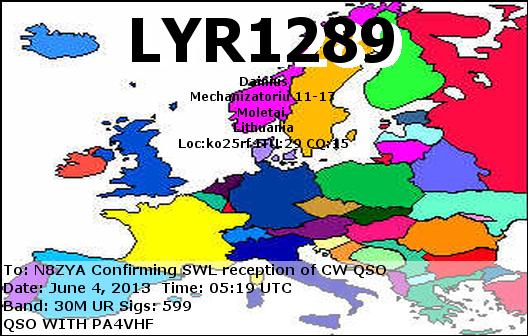
I’ve been a ham a little over 20 years now and this is the “first” time I’ve received a “reception report” from a short wave listener. I quickly confirmed the contact because the time, date, and contact information is correct. I’m always happy to encourage anyone to delve into the ham radio aspect of the hobby. This brings back good memories of my childhood when I spent many hours listening to the short wave bands with my little “Knight Kit Star Roamer” receiver.
I wonder if there’s a database that lists these call signs? Three letters and four numerals are certainly different from what I used to seeing.
This card came from Lithuania and I know I was getting into this part of the world at the time. Last night I worked a very familiar LY5O. During my later night contacts, I worked OK1PL in the Czech Republic.
John Smithson, Jr., N8ZYA, is a regular contributor to AmateurRadio.com and writes from West Virginia, USA. Contact him at [email protected].
D-Star on Hermit Lake
This afternoon I took the kayak out on Hermit Lake. I worked Orlando, Florida and Worcester, Mass with an Icom 51AD d-star handie talkie.

The setup was pretty simple. I parked the camper at the edge of the lake. On the front seat I used a Raspberry Pi computer (credit card sized) connected to a DVAP. A DVAP is a tiny repeater. It’s about 1 by 2 inches and runs a few milliwatts for local access. I also had a mifi card supplying an internet connection in the camper. This setup gave me a range of about a half a mile from the camper. I was connected to reflector 30 which is like a conference room comprising 50 local repeaters. One of the advantages of d-star is that there’s a lot of activity and it’s always easy to reach someone to chat with.
Out on the water, I talked with Dave KB1PVH in Worcester, Ma for a few minutes and headed over to an island to check out some wild irises.

This lake is also known for two varieties of carnivorous plants… the pitcher plant and the sundew plant. They aren’t in bloom yet.
As I headed back toward the shore, I said hello to Mike KA9ZRZ in Orlando, Florida. He was also using a Raspberry Pi and DVAP. Suddenly, as I passed a quiet cove on one of the islands, a huge gray heron swoshed right across the bow of the kayak a few feet above the water. I think we were both startled.
I put the kayak back in the camper and listened to VK4TUX from Australia chatting with another station. International contacts on d-star are common.
Jim Cluett, W1PID, is a regular contributor to AmateurRadio.com and writes from New Hampshire, USA. Contact him at [email protected].
Handiham World for 05 June 2013
Pat Tice, WA0TDA, is the manager of HANDI-HAM and a regular contributor to AmateurRadio.com. Contact him at [email protected].
Power Pole Connectors Added to Radio Shack 3 Amp Power Supply

POWER POLE ADDITION TO 3 AMP POWER SUPPLY
I wanted a 3 amp power supply for my Kx3. The 12 volt ‘laptop’ power supply did not quite have the ‘chutzpah’ to charge the internal batteries, all the way!
I bought it from local ham that no longer used it and wanted to make it compatible with all my other gear. I use Power Pole connectors on all my radio gear including accessories. Manufacturers are ‘Getting the picture’ by using Power Pole connectors which are superior to all other types, (in my opinion) but they are catching on slowly. My first thought was to simply place one power pole connector on the face of this Radio Shack 3 Amp power supply. (See the rectangle on the face plate)

Second Option Layout
It was a mistake to use a ‘permanent marker’ to layout the face plate cut out, but fortunately, it went away with the cut out! This, proving once again, that not all my original ideas are good ones!

Cut Out Portion of the Face Plate is Shown Here.
The internal components were removed to facilitate soldering.
There is not a ‘whole lot’ of room inside this power supply, but more than in some I’ve seen. None the less, I opted to remove the internal components to allow a good solder job from the Power Poles to the original binding posts. I covered the splices with heat shrink tubing.

I used a Dremel Tool to remove the lower right corner of the Power Pole face plate and a hacksaw on the cut out.
This was necessary in order to keep the cigarette lighter socket where it is. A good filing job was necessary to smooth out the hacksaw and Dremel tool marks. I used a cloth to shield the circuit board and transformer from flying metal chips, then vacuumed out the inside very, very well. The last thing I need in a power supply is a ‘rogue’ chip of metal bouncing around inside it. I also cleaned out the interior of the cabinet with Q-tips and rubbing alcohol to make sure I got them all. The voltage was off a bit, but that was easily adjusted by turning a small pot on the circuit board. It reads a prefect 13.8 VDC now.

This cigarette lighter plug fitted with Power Pole connector is such an example of the versatility that these sockets bring.
This particular plug works in your car as well, opening a myriad of possibilities for charging and lighting. This socket is very useful for accessories of all kinds.

My pocket flashlight is powered by 4.2 V batteries that can be charged via the cigarette lighter socket.
Cell phones usually have such an adapter too, as do Kindles, or MP3 players.

So here you have it, a 3 amp power supply modified with Power Pole connectors.
This little power supply now sits on a coffee table powering my Kx3, among other things. Please feel free to contact me for information about doing modifications like this one. Please note, this is a ‘regulated’ power supply, and not a ‘switching’ power supply. Radio Shack no longer makes this model. At least I could not find one like it in a Radio Shack Store search online. You might find one like I did, by looking for a used one.
73 de AA1IK
Ernest Gregoire
Links http://www.powerwerx.com/
http://www.dremel.com/en-us/Tools/Pages/ToolDetail.aspx?pid=4000
Ernest Gregoire, AA1IK, is a regular contributor to AmateurRadio.com and writes from Florida, USA. Contact him at [email protected].
 Ham Radio Deluxe |
 W5SWL Electronics |
 Ham Radio Prep |
 KB3IFH QSL Cards  Hip Ham Shirts  HamRadioAuctions HamRadioAuctions Reliance Antennas Reliance Antennas Enigma Shop Enigma Shop |  morseDX  Ni4L Antennas  R&L Electronics R&L Electronics antennas.us antennas.us QRV QRV |
- Matt W1MST, Managing Editor
