Archive for the ‘Uncategorized’ Category
 VHF Tropo still going well
 October 12th, 2010 |
  Author:
 Most of yesterday evening was spent very enjoyably, getting to know our new cats – they are real stars! However, just before bed, I did pop into the shack to see what was happening.
OP7V from Belgium was very loud on 432.200 and I enjoyed a QSO with him. By the time I listened, 432MHz was quieter, so I switched over to 144MHz was was pleased to find DK3EE (JO41) coming through at great strength – so had a nice quick QSO with him and also DF0WD (JO42) who I also worked quickly.
Swapped e-mails with Allan, GM4ZUK and he’d been out portable last night and worked over 300 stations on 144/432/1296 over a few hours last night. Allan’s best DX on 1296MHz was OY and SP!
(Edited this in thanks to Ralf, DK4KW for letting me know about it)
This morning conditions were still good and ON0WV was coming through at S9 on 145.650 on my drive to the station. There was a very strong repeater on 145.6375 too, with French stations QRV. I didn’t hear it ID, so it may have been the Jersey repeater, GB3GJ.

QRSS Keyer
I have operated most of the reverse beacon and weak signal modes but one that I have never tried is QRSS. “QRS” is the Morse Q code for “send slowly” so QRSS means send very slowly indeed. QRSS beacons send your call using very, very slow Morse, which listeners receive using a “grabber”, which is a slow moving waterfall display. If you’re lucky, they will email you a reception report, but you can also look for your signal yourself on one of the various online grabbers.
One day I planned to build my own QRSS beacon. When I found out that Hans Summers G0UPL had produced a QRSS beacon kit I was disappointed to learn that all the kits had been sold at the US Dayton hamfest. However I recently discovered that he had made a new batch of kits and not wanting to wait and find out they were all sold at the G-QRP Convention I ordered one at the weekend. The order process was extremely professional (amateur components suppliers who expect you to email your order and credit card details please note) and the kit arrived this morning.
I opened the envelope and was very impressed to find that the package included a printed copy of the instructions as I had expected to have to print them myself from the website. The PCB is of very high quality. But as I tipped the parts on to the workbench my heart immediately sank.
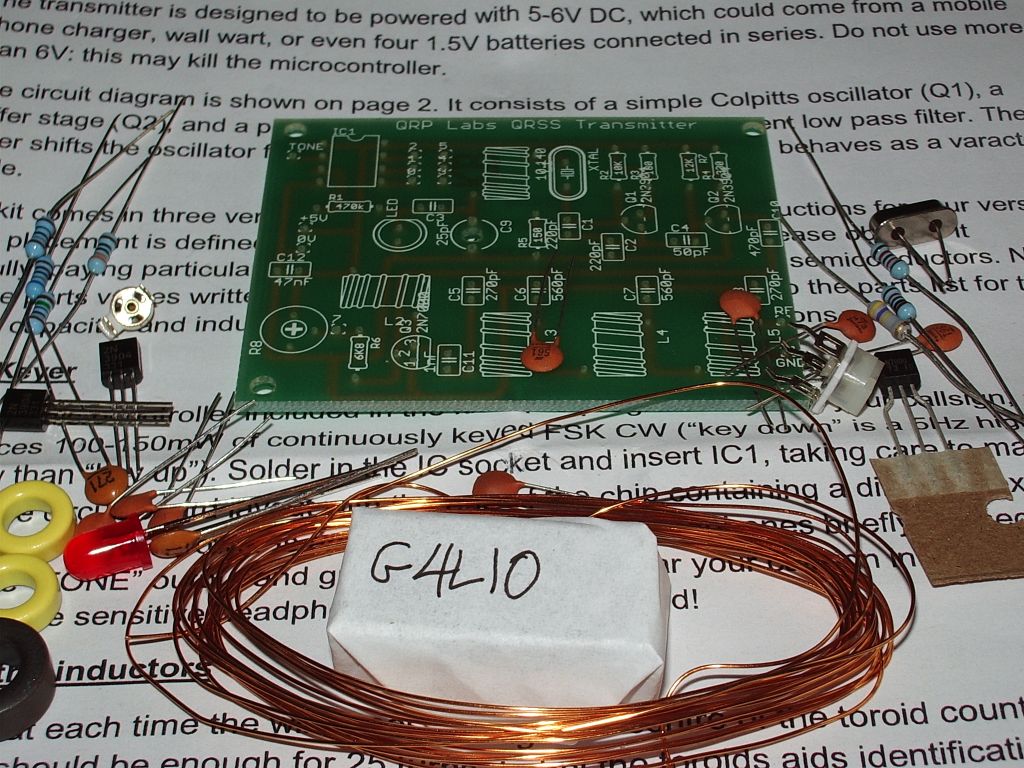
Because the microcontroller chip which keys the transmitter and has been preprogrammed with my callsign was wrapped in a slip of paper on which was written G4LIO, a transposition of my call that often afflicts people on the air as well – I don’t know why. The incorrect call was also written on the jiffy bag the kit came in. I checked the emailed copy of the order and the mistake was not mine.
After an exchange of emails with Hans I installed the chip in its socket, applied power and connected an earpiece to pin 2 which produces an audio tone to verify whether the chip had been programmed incorrectly. It sent G4LIO. 🙁 Why is it always me that gets the kits with the missing or faulty parts?

And they’re racing!
Interesting thread on the softrock40 email list about how easy it is these days to get a good sense of how well your station and the ionosphere are performing in an almost ‘hands-free’ way.
Increasingly modes like WSPR and tools like SDR have enabled us to let the radio do its thing and in a short amount of time access detailed logs of our successes – where we were heard. The softrock40ers were using this approach to compare their SDR rigs performance to other sets.
Rob KL7NA joined in the conversation. He pointed to his recent paper on what he calls ‘Robotic radio‘ that he presented to the DCC meeting in Vancouver WA recently.
Your radio is doing what the operator used to do automatically, and as you have been finding out, it is really fun to horse race different software demodulators, receivers and antennas, and radio locations this way. I am trying to promote it as a way for our youth to get into amateur radio. They seem to be very enamored by robotics.
Rob’s paper is full of interesting ideas and he lists the building blocks of Robotic radio… hardware, software and networks. He introduces his open source project CW Robot which is still in alpha and explains the thinking behind it.
This looks like a very rewarding place to play and discover – and there’s already a road map.
You know it’s autumn when the tropo starts
We’ve had a busy weekend which didn’t contain too much radio. Last week was a bit of a sad one for us; we scattered my Dad’s ashes on Monday and then on Thursday we had to say goodbye to our much-loved cat, Buttons who was 16. A cat-less house was not good for us and we were ‘directed’ to visit the animal rescue centre, run by the Blue Cross at Burford. There we met and fell in love with two new cat friends, Pippi and Max, who I am pleased to say have kindly consented to come and live with us. They moved in yesterday and needless to say, much fun and time is being spent, looking after them and trying to settle them in.
When I popped out to the garden centre yesterday, I noticed some reasonable 145MHz tropo to the east, with the GB3PO repeater in Ipswich coming in better than normal on the mobile. Just before I went to bed, I saw a tweet from G0PKT on the east coast saying that he’d been working some good DX on VHF/UHF. I stopped off in the shack on the way to bed and had a quick QSO with Juergen, DL5EBS (JO31) on 432MHz. Signals were great – also, DJ6JJ was on 432.200 working Polish stations. Interestingly, I was able to detect fragments of the signals from the Polish stations.
This morning, on the drive to work, conditions were still good. On 145.650, I heard ON0WV identify very clearly a couple of times. And during our commuter ‘net’ on GB3TD (433.075) we were surprised and delighted to be joined by John, G6HKQ from Norfolk.

2010 California QSO Party
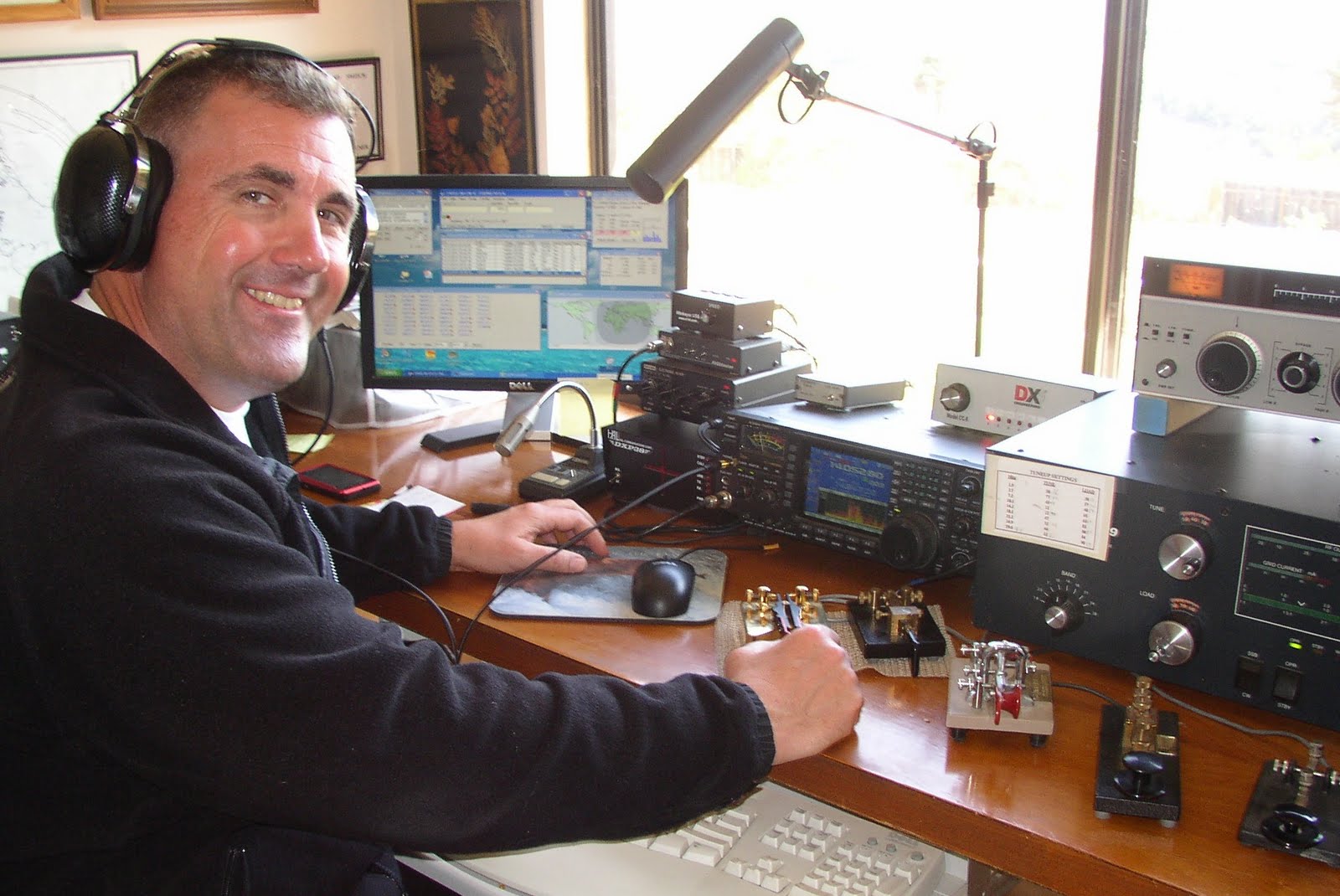 Photograph 1 taken Sunday afternoon as rate drops in half and I’m logging California counties on 20m with the yagi pointed due east.
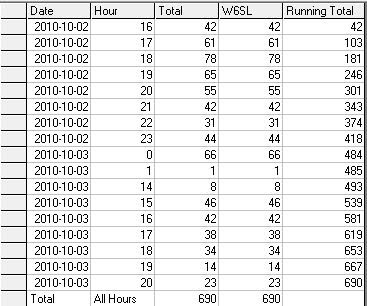 Photograph 2 illustrates my rate per hour through 17 hours of operation. What a blast operating CW through CQP weekend as 3 point Qs drove my score into six digits.
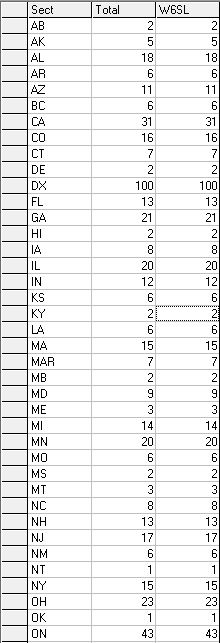 Photograph 3 is a list of sections worked and one notes band conditions were long especially on 15 and 20m however 10m never ionized over the weekend. I miss 10m activity and hope the band will finally play next year?
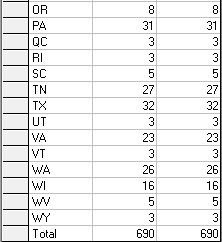 Photograph 4 is a continuation of sections worked and I did not log Nebraska, North Dakota, South Dakota, Nevada, or Utah in addition two Canadian sections as well.
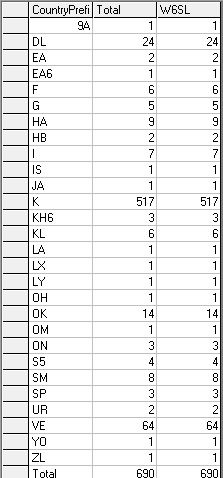 Photograph 5 breaks down my country total and each European counted as new one against my DXCC pursuit. What a joy finally hearing stations across the Atlantic on the wireless set!
California QSO Party.
Rest is important going into any RadioSport event and fatigue does not help one’s morale when butt-in-the-chair time is a priority. I was wiped out when Saturday evening rolled across the ionosphere and called it at 0100 UTC when CW signals blurred my brain. I slept 12 hours then returned to the keyer catching long skip into Europe on Sunday morning.
I recognized many stations who filled the log at the shackadelic in Shell Beach and, what a hoot, logging Dave, K2DSL and Victor, KD2HE both of whom journal their wireless activities on the Internet.
Likewise, logging Bill, N6ZFO who was booming through the ICOM wireless on Sunday morning from Lake County. A great signal from his location. I want to thank the North California Contest Club for sponsoring a stellar event. The California QSO Party is world class!
KA3DRR/6 CQP Score.
40m = 92Qs and 1 Section.
20m = 376 Qs and 25 Sections.
15m = 222 Qs and 26 Sections.
Total Qs = 690
Total Sections = 52
Total Points = 107, 640
Spirit of Ham Radio.
Likewise John, W6SL is a stellar example when speaking about the spirit of ham radio and the friendship that follows our hobby. He opened his operating chair and put me in the pilot seat of his accomplished station. John is a 5 band DXCC operator with 300 plus entities to his credit. He is one who patiently waits for a new country recently logging Andorra not an easy feat from the west coast given the mountainous terrain surrounding this country.
The spirit of ham radio moves through the ether in mysterious ways. I was speaking with Dick Norton, N6AA about moving to the next level in RadioSport during an annual swap fest in Santa Maria, California. He mentioned guest operating just as W6SL walked within range of our conversation. John asked about my guest operating interest and invited me over without hesitation.
I enjoyed operating a wireless set using an amplifier and competitive grade antenna systems through last weekend because of John, W6SL.
Conclusion.
Rest is important going into an event. RadioSport is fun and reasonably defined goals make a difference in the operating chair. I logged new countries, grid squares, and counties through last weekend while learning about propagation using competitive grade antennas.
The spirit of ham radio endures through men like John, W6SL, Bill, N6ZFO, and organizations like the Northern California Contest Club.
73 from the shackadelic.

New dual-band mobile from Wouxun?
Ham radio forums have been alive with buzz in recent days about the pending release of the KG-UV920R, a new dual-band 2m/440 mobile radio from Wouxun. Ed Griffin from Wouxun.US is in China until October 25th and was not available for comment, but a photo of the radio appears on his website. An anonymous but reliable source said that the radio is not yet in production, but that it could be available by early 2011 pending FCC certification.
How much will it cost? The same reliable source did not have a firm answer but expected the price to be less than $300. They also said that they expected a 2m/220 version in addition to the 2m/440 version. When you start looking through the feature set (remote front panel, cross-band repeat), that’s quite a bit less than a comparable radio from other manufacturers. Obviously, a lot can change between now and the final production release. The specs and price could very well change significantly. Hopefully Ed will stop by soon and provide us with some more information.
What do you think of Wouxun’s apparent entry into the mobile radio market? Will you buy one?
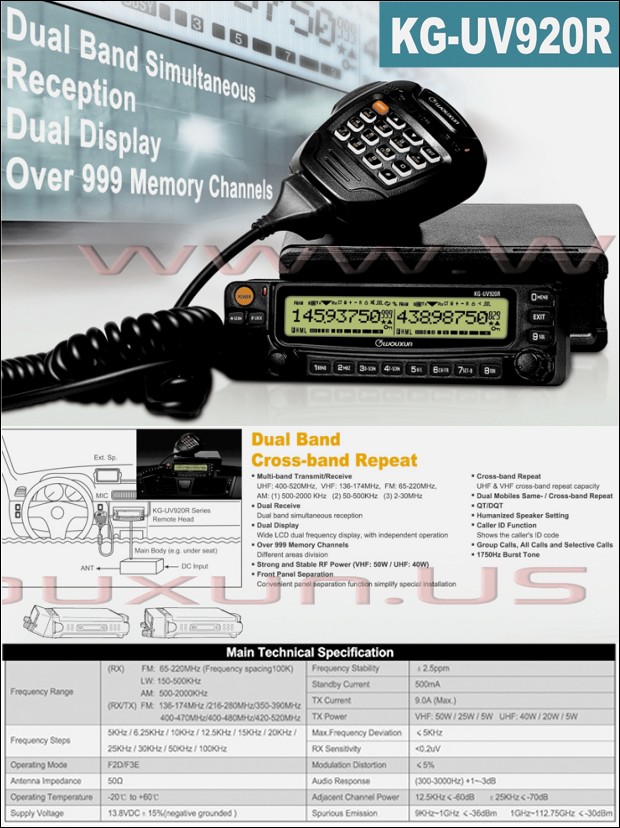 (Images above from Wouxun.US and re-formatted for viewing)
No more sunspots after 2016?
I have just updated the smoothed sunspot number data file for VOAProp with the latest predicted values up to the year 2020. It’s one of those jobs I still do even though I long ago lost interest in the program, having come to the conclusion that the most interesting thing about HF radio propagation is its unpredictability.
Although NOAA updates its sunspot number predictions every month, I only update the data file every few months as the changes are too insignificant to make any difference to the VOAProp output. Since the last time I updated the file NOAA scientists seem to think that the maximum of the next cycle will occur a little later and be a tad higher than previously predicted, with a maximum SSN of 84.6 in the middle of 2013. They also don’t expect the next minimum at the end of 2019 to be as low as the last one.
This view is not shared by solar astronomers Matthew Penn and William Livingston of the National Solar Observatory in Arizona. They have been studying the magnetic strength of sunspots since 1990 and have observed that in that time it has fallen by nearly a third. If the trend continues, the astronomers believe, then by 2016 it will have fallen to the level below which the formation of sunspots is believed to be impossible. Though this prediction seems far fetched, it becomes a little more believable when writing about it on a day when there are once again no sunspots.
A period with almost no sunspots has occurred before, and not so long ago either, between 1645 and 1715, known as the Maunder Minimum. This period was also known as the Little Ice Age due to the fact that lower than average temperatures occurred in Europe. Time to sell our radios and invest in heating appliances, perhaps?
If nothing else, this example should show us that healthy scepticism, not credulity, is the sensible response to any scientific prediction. If you don’t care for what one bunch of boffins say, don’t worry, another bunch will be along in a few months claiming to prove just the opposite. It’s about time the global warming alarmists woke up to this.














