Archive for the ‘Uncategorized’ Category
 GQRP Club and SPRAT
 November 30th, 2014 |
  Author:
I have many times said that if all radio magazines had to go, then GQRP Club’s SPRAT would be the very last to go. This quarterly magazine is low in cost, very high in simple projects to build and the back page always has GQRP Club sales items.
Of ALL the magazines I see, SPRAT is without doubt the best. Back numbers of this excellent magazine are available on a DVD.
This is a little (sized) magazine but it is excellent value. The best in fact.

The Spectrum Monitor — December, 2014

Stories you’ll find in the December, 2014 edition:
The Radio Rovers of the 1920s
By John Schneider W9FGH
Americans spent $60 million on radio sets and parts in 1922, and businessmen and hobbyists fed the radio craze by building hundreds of new broadcasting stations. Almost overnight, the radio spectrum was packed with signals from all around the country—the number of licensed stations went from 28 in January to 670 by the end of the year. But there were still many smaller cities and towns that did not yet have their own broadcast stations. To serve these cities a special class of “portable” station license was created.
Mystery Regenerative Radio
By Rich Post KB8TAD
Rich Post spotted a radio at an antique radio swap meet and was immediately drawn to it. From a distance, he thought it looked like a Lafayette Explor-Air KT-135 regenerative receiver. It used the same tubes as the Lafayette, but so did nearly all regenerative sets from the 1950s and 60s, including the Allied Knight-kit Space Spanner and the Heathkit GR-81. But who actually manufactured the set?
Testing Those Capacitors
By Rich Post KB8TAD
If you ask most radio restorers, what part or parts most often need replacement, they will answer “capacitors.” Rich has been repairing radios for over half a century, and, back in the day, often had to replace some of the capacitors. Now, those capacitors are often themselves a half-century or older. What could happen to that circuit if the capacitor was leaky or shorted? How likely is it to short? How can you test it to be sure?
Vint Hill Farms Cold War Museum Traces History of Cutting-edge Communications
By Cory Koral K2WV (Photos courtesy of Gary Morgan, Founding Member, The Cold War Museum)
Current simmering East-West tensions brings to many minds the Cold War era. At the center of electronic technology of that time was a sprawling top-secret complex in the Virginia countryside known as Vint Hill Farms, where the fine art of modern spying via HF and satellite was directed. Now, it’s a museum dedicated to remembering Cold War lessons.
Old-Time Radio Today
By Ken Reitz KS4ZR
What’s the point of having a restored vintage radio if all you can listen to are today’s ear-numbing AM talk shows? Now you can get the most out of your vintage radio by streaming the top shows of yesterday. Even if you don’t have an old-time radio you can get close to the same experience.
AmateurRadio.com Editor’s Note:
If you are a current subscriber to The Spectrum Monitor (or are interested in becoming one), don’t forget to sign up for your 2015 subscription. It’s well worth $2/month to keep this great little publication “on the air”!
Nevada bargain on 10m Multi-mode radios
See http://www.nevadaradio.co.uk/amateur-radio/transceivers/mobile-transceivers/alinco-dr-135dx-uk .
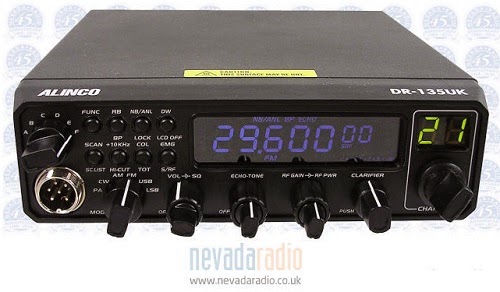
Nevada is selling Alinco multi-mode 28-29.7MHz radios on special deal at £99.95. For “export only” they can be expanded to also cover CB frequencies. Such expansion is not legal in the UK. At less than £100, this is a very good price for a 10m multi-mode rig.
I admit I “lifted” the original image from the Nevada website. As it was Javascript, I was unable to link, as I had wished, to the original images. If using this image on this blog is a problem, it will be immediately removed, although I hope Nevada see this as free publicity.

AmateurLogic launches ‘Ham College’
Ham College is a show for those new to the hobby and those wishing to get into Amateur Radio. But us old guys should find it a good review and probably learn some things we missed (or forgot) the first time around. We’ll help you study for your Amateur license exam and cover topics to get you up to speed and having fun.
If the pilot turns out good and draws enough interest, this show will be coming in 2015.
Popular Electronics 1954-1982 available as PDF downloads

I’ve discovered an archive of several older electronics and radio-related magazines available for download in PDF format.
http://www.americanradiohistory.com/Popular-Electronics-Guide.htm
In addition to Popular Electronics, they also have archives of the following titles available:
Electronics Illustrated (1958-1972)
Electronics World (1959-1972)
Radio Electronics (1948-1992)
Elementary Electronics (1964-1980 sporadic)
BYTE (1975-1984)
And many more….
Spark transmitters and modern simple rigs
In the early days of wireless, spark transmitters were all they had. Selectivity and bandwidths were not major concerns. These days it is all so different with sometimes very crowded bands and the bandwidth of both transmitter and receiver being of major importance.
See http://en.wikipedia.org/wiki/Spark-gap_transmitter for some interesting reading. I recommend you do not try a spark transmitter as you would be very unpopular because of the wide signal and interference caused. By all means read about them though.
A modern challenge is to see just how simple rigs can be made yet still function credibly on the amateur bands today. Rigs like the Pixie are fun, but such ultra-simple transceivers are let down by deaf or easily overloaded receivers. To my mind, the receivers have to be selective, sensitive, have netting, and not be easily overloaded. The challenge is to overcome these issues! Often TX power is not the deal breaker.
UPDATE 1740z: W5OLF has just shown me a photo of is tiny 1 inch ferrite rod antenna on which he has had some success with on 10m WSPR. I tried some WSPR experiments with ferrite antennas some years ago on 40m, 30m and 20m. As long as the ferrite does not saturate they do work. See www.g3xbm.co.uk .

630m Resources – Part 2
Using the transverter approach offers the advantage of providing a higher-stability signal generated by the main station's transceiver oscillator system. Most of the digital modes require a higher stability than would be needed for straight CW.
If your main interest is normal speed CW, then a digital VFO, such as the one devised by GW3UEP, would do the job.
If you are content operating on 475.0 kHz, then an inexpensive 7.6MHz crystal, in a divided-down oscillator will work well, and with good enough stability for some QRSS work as my earlier "GW3UEP Transmitter In QRSS Mode" report indicated.
The other option for frequency generation is a DDS.
 |
| N3ZI DDS |
For those wanting something a bit more robust, W1VD describes a very nice high-power transmitter. His website is packed with useful circuits and ideas for both 2200m and 630m.
 |
| W1VD Dual-Band Kilowatt : http://www.w1vd.com/ |
W7IUV also describes, in great detail, his method of generating high-power on 630m. There is much to be learned from his document describing the design and operation of his unique 'linear-mode' transmitter.
 |
| W7IUV 630m TX: http://www.w7iuv.com |
Another practical way of generating moderate power, certainly enough to meet the Canadian 5W EIRP limit, is to combine two or more 100W transmitters, such as the GW3UEP transmitter. It is reasonably simple and inexpensive to combine several modules with the use of a homebrew power combiner, as previously described.
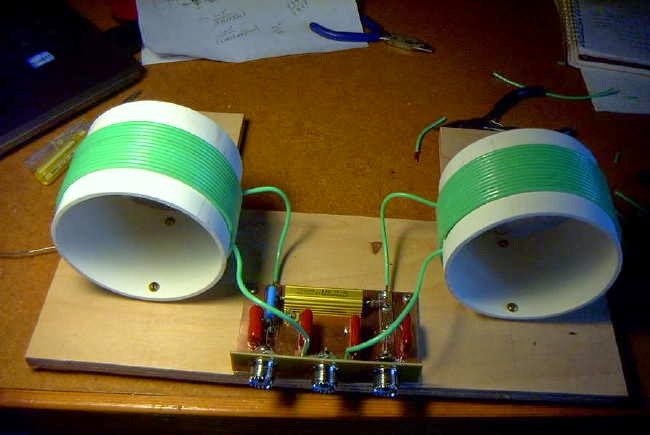 |
| Homebrew 630m two-Port Power Combiner / VE7SL |













