Archive for the ‘Uncategorized’ Category
 AmateurLogic 76: Shutdown Pi, ISS SSTV, Modulation on a Scope
 March 12th, 2015 |
  Author:
AmateurLogic.TV Episode 76 is now available for download.
A simple shutdown switch avoids trashing your Raspberry Pi’s operating system. SSTV from the ISS with Peter. George visits the Orange Texas Hamfest. Modulation on a Scope, viewer emails and more.
1:08:20
Understanding IP Ratings (Ingress Protection) – IP53 vs IP55 vs IP67
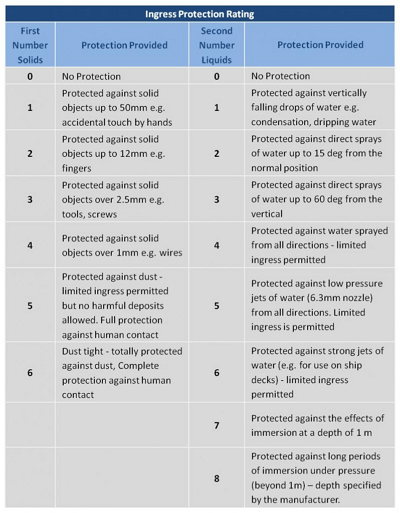
Courtesy of Wireless Telecom Group, Inc.
Have you ever seen “IP55” or something similar written on the specs of a mobile or handheld radio? Do you know what it means?
“IP” stands for “Ingress Protection” and is a standard promulgated by the International Electrotechnical Commission. It allows you to quantify somewhat nebulous marketing terms like “waterproof,” “water resistant,” “dust resistant,” etc.
The chart above shows how to easily read an IP rating code. The first number denotes the protection against solid objects (think a finger, paperclip through a ventilation hole, or even dust). The second number denotes the liquid protection which can include direct sprays under pressure or even total immersion.
One of the more common ratings we see in portable radios is “IP55” which means that it’s protected against “dust…” and “low pressure jets of water….” Some models like the Wouxun KG-UV3D, KG-UV6D, and KG-UV8D all claim this rating. Other models such as the new AnyTone Tech TERMN-8R claim an “IP53” rating which provides equal dust protection but slightly less water protection. For other radios it’s hard to find an IP rating at all. For example, the Baofeng UV-5R is listed as “IP54” on some Chinese websites but the reliability of that is unknown.
Some uses such as firefighting or military require higher standards because of more extreme environments. For example, Kenwood and Motorola both offer fully submersible models with a rating of “IP67” (dust-tight and immersion to 1m). Ed at Import Communications just announced an upcoming release of the Anytone AT-3140UV which also claims a rating of “IP67.”
Keep in mind that some manufacturers “self-certify” their products rather than submitting them to an outside testing firm. You’ll see specs like “meets IP55 rating” which doesn’t tell you anything about who really did the testing — or whether it actually meets the rating. Caveat emptor!
PRC-104 Pedestrian Mobile 03-09-2015
I was able to get outside Monday March 9th just after 1600z. I was on 18157.5 HFPack frequency using the PRC-104 with the PRC-74 antenna and a 10’7″ counterpoise. The PRc-104 runs 20 watts out on SSB. I also had the KY-116/U key on as well.
I called CQ a few times with no answers, then I heard Paul in CO. W0RW call me after seeing my posting on HFNow. He said my cw cq was a 559 and my SSB signal was a 3×3. We were able to work each other and complete a qso. Paul was a solid 5×9.
I then worked KBOSFP in MO. He was a 5×9 and I was a 5×5.
Then all the way over to Seattle Washington to Byron W7SWC also a 5×9 here in Thunder Bay and I was a 5×4, yet again another great qso.
One of the regulars from the Military Radio Net Paul WB4WCJ also was able to copy me and send me a report, Paul from South Carolina was a 5×5 and I was also a 5×5 but had some fading.
Then just before I was ready to pack things in on this 4c degree day with light snow falling I heard Greg N4KGL in Florida give me a call. Greg is a RaDAR member as well and was operating the AlexLoop with his KX3. He was a 5×5 and I was a 5×3 into Florida.
So it was a great Rapid Deployment Amateur Radio (RaDAR) session by far. I hope to work many more of you while I am portable. I am working on a few more backpack setups for my IC-703 and My KX3 as well.
Here is the link to the video of yesterdays outing.
Once again many thanks to all those who enjoy the hobby, HFNow and GORC for the groups to be able to post such outings. Those who listened but I was not able to work. Gurus and elmers like W0RW, WA3WSJ, wG0AT and others.
This is a great hobby and has so much to offer be it new or old technology, it all is fun and never gets boring.
72/73
Fred
VE3FAL
(The Ice Man)
Thunder Bay,ON EN58hh
Arduino Update
In the few free moments I could spend the last week I made some progress with the Arduino. Bought a whole kit with an Arduino UNO, breadboard, wires and all and mounted it on a…..breadboard!

My son’s Windows 7 installation was so slow in compiling sketches that I wiped it and installed Linux Mint. He wasn’t pleased with it in the beginning, but he likes it better and better now. He played with some LEDs, but I tried to get some sensors going. The thermistor was quite easy and after looking at some code and getting the appropriate libraries the 1-Wire temperature sensor put some temperatures on the serial monitor. That gave me hope because my 1-Wire weather station is getting old and Maxim has phased out some essential ICs to keep it running. A new station based on Arduino boards could be a great alternative.
So I dug out a spare HIH-4020 humidity sensor and getting that to work was also trivial. Next was a photo diode and the one on hand was the SFH203P. The current produced by that sensor is so tiny that it can hardly be measured by the analogue input on the Arduino. The answer is to use an op amp, but the only one I could find in my junk box were some UA741s. They are special to me, because I used these to build some projects together with my father when I was young, so they must be at least 30 years old. But they require a bipolar voltage rail and can’t even work rail-to-rail. I tried them anyway, using a unipolar voltage supply, but no dice.
I had some other op amps lying around, but they were all surface mounted devices and I couldn’t find the matching break out boards. Guess I will have to find some through hole versions, like the TLC271CP which sell for a buck a piece here in Taiwan. Can’t go wrong with those for that price, I guess.
January Special Event – Straight Key Century Club and K3Y/0
All month long, during January 2015, a group of volunteers using the special event callsign, “K3Y” with a slant-region number (i.e., “K3Y/3” or “K3Y/0”), were on the amateur radio HF bands (and some, on six meters). I was one of these volunteers, operating nearly every day of the month for at least one hour, but some times a few hours per day.
“K3Y,” the Straight Key Century Club’s annual January celebration, commemorates the club’s founding in 2006 following the American Radio Relay League’s Straight Key Night. A small group of participants wanted to extend the fun of SKN throughout the year. The SKCC is the result.
For the first three years, the club’s founders used K1Y, K2A, and K3Y as the celebration’s special-event calls. But someone cleverly noticed that a 3 is nothing more than a backwards, curvaceous E. This “KEY” event has operated under the K3Y call ever since.
The on-air party is open to members and non-members alike. It runs from 0000 UTC Jan. 2 through 2359 UTC Jan. 31. It’s a great time to introduce others to the joys of hand-crafted Morse code using straight keys, bugs, and side swipers.
In this video, you can see this operation at my ham radio shack, as I am the control operator of the special event station, “K3Y/0”, during one of the many shifts. “K3Y” is the special event callsign of the Straight Key Century Club (SKCC). The special event operates each January.
In the following video, you can see some of the QSL cards associated with this year’s operation, and then some other QSL cards in my collection.
https://www.youtube.com/watch?v=gOsNjT7OCyc
+ The SKCC website is at http://skccgroup.com
+ The “K3Y” special event page is http://www.skccgroup.com/k3y/index.php
+ My page is at http://NW7US.us
+ My Morse code page is http://cw.hfradio.org
AnyTone Tech TERMN-8R goes on sale today

AnyTone Tech announced that their new lineup of HTs is now available via Amazon.
Here is the price list (includes free shipping in the US):
- AnyTone Tech TERMN-8R – $138.89
- AnyTone Tech OBLTR-8R – $98.89
- AnyTone Tech NSTIG-8R – $68.89
- AnyTone Tech ANILE-8R – $46.89
Here is sales copy from their flagship radio, the TERMN-8R:
The First Licensed Radio for Amateur, Commercial, and Public Use
The most versatile two way radio on the market, certified for use for commercial, public, and amateur frequencies. The TERMN-8R includes built-in modes with 23 GMRS channels and 5 MURS Channels. The TERMN-8R is FCC Certified for Part 90 and Part 95 usage.Receive Transmissions on Six Different Bands
Customize Your Operation with Channels, Programmable Buttons, and more!
You can program your TERMN-8R exactly how you want it. There are 200 programmable memory channels. The side keys are programmable to multiple options. You can give channels alphanumeric names, without using a computer. The TERMN-8R has 2 VFO banks, and allows you to be in both VFO and channel modes at the same time. You can easily program from a PC to set-up the radio to operate exactly as needed.What’s In the Box?
TERMN-8R Radio Body
2200mAh Battery
High Gain Antenna
Earpiece with Remote Mic
Desktop Charger
120v AC Adapter
Belt Clip
Wrist StrapTERMN-8R SPECIFICATIONS
Frequency range:
[TX] 136 – 174MHz, 400 – 520MHz
[RX] 136 – 174MHz, 400 – 520MHz, 520-1710kHz (AM Broadcast), 2.3-30MHz (Shortwave), 68-108MHz (FM Broadcast), 108-136MHz (Aviation Band)
Channel Capacity: 200 Channels
Channel Spacing: 25KHz (wide band)12.5KHz (narrow band)
Sensitivity: ≤0.25μV (wide band) ≤0.3μV (narrow band)
Operation Voltage: 7.4V DC ±20%
Battery: 2200mAh
Antenna Connector: SMA-Female / Antenna Impedance: 50Ω
Accessory Connector: Kenwood 2 Pin Standard
Stability: ±2.5ppm
Output power: 5W / 2W / 1W (Max 6W)
Audio Power Output: 1000mW/10% (1 WATT)
When someone gets a chance to try one out, please comment here so we can get an idea of how well they perform. I haven’t used any of them personally.
In addition to being marketed for amateur radio user, I think it’s interesting that the radio is both Part 90 (commercial/public safety) and Part 95 certified (MURS/GMRS). It appears to share its Part 90 grant with Anytone’s AT-3318UV-A/E.
Are the features worth the price? What are your thoughts?
Over 1000km on 472kHz TX with earth-electrodes
Last night LA4ANA (1047km) copied my 5mW ERP from the earth-electrode “antenna” on 472kHz WSPR. This is my best DX yet on the non-antenna, nearly 300km further than my best previous TX record. I was also spotted by DL4YHF (556km) for the first time on the earth-electrode “antenna”. My PC decided to crash some time after midnight last night, so I missed any DX overnight. These spots were during the evening period.
In the last 2 weeks alone I have been spotted by 28 different stations when I’ve been using 5mW ERP from the earth-electrode “antenna” on 472kHz WSPR. Let no-one say 472kHz is out because they cannot fit an antenna! If my signal can span over 1000km with WSPR then you can surely do better. I make no claims for the earth-electrode “antenna” but if you are unable to erect a proper antenna give it a go.
I have still to try it at this QTH on 136kHz but at my old QTH I managed to be spotted at 250km with very low ERP.














