Archive for the ‘Uncategorized’ Category
 Amateur Radio Weekly – Issue 55
 April 4th, 2015 |
  Author:
Javascript app runs RTL-SDR in your web browser
Radio Receiver is a Chrome application that uses a USB digital TV receiver to capture radio signals and does FM and AM demodulation in the browser.
Github
DSD software decodes D-STAR audio
DSD+ is a popular Windows software tool used for decoding digital speech such as P25 and D-STAR with the RTL-SDR.
RTL-SDR.com
FCC creates Citizens Broadband Radio at 3.5GHz
The FCC staffers handling the press briefing couldn’t resist the temptation to sprinkle their discussion with CB lingo, answering some questions with things like “10-4.”
eWeek
RadioShack to be co-branded with Sprint
The current plan calls for “co-branding” about 1,440 of the surviving stores with cellular phone provider Sprint Corp.
ARRL
ISS SSTV active on weekend of April 11
The Russian Federal Space Agency (Roscosmos) has announced another round of amateur radio Slow Scan Television (SSTV) activity from the International Space Station (ISS) will take place.
AMSAT UK
Raspberry Pi Slow Scan Television (SSTV) camera
In this project the Raspberry Pi with the PiCam is used as a wireless camera which can transmit images over long distances, usually hundreds of meters!
Make:
Guerrilla Radio
How some inmates hack, rewire, and retool their radios to create walkie-talkies.
Southgate
RTL-SDR filters
A good demonstration of a pair of filters built to mitigate the front-end overload experienced on an RTL-SDR receiver.
VE7SL
Yaesu FT-450D first impressions
First impressions are of an excellent receiver with good tone and clear audio from the internal speaker.
AmateurRadio.com
A complete HF station under $1,000
I designed a complete HF radio station that would cost less than $1,000. I wanted it to operate on all modes on as many bands as possible and have it be easy to use.
KC4LMD
Is the term “ham” older than we thought?
…a telegraph station was set up, and after that, a school for training telegraph operators. In the article, they refer to the school as a “ham factory.”
KB6NU
Video
1999 introduction to Ham Radio
This vintage video gives a flavor of what amateur radio was like in the closing years of the last century.
Southgate
Deploying a Cubesat from ISS
YouTube
OFCOM again
Please don’t misunderstand my views on OFCOM here in the UK. Generally, they have been supportive of the amateur community and I am grateful for this.
However, I am very critical that they seem loath to make real decisions about anything hard. Perhaps this is because they need real teeth and less government fiddling in the wings? I believe they need to be fully independent of government interference and be able to make common sense decisions without excuses. All the time they seem to hide behind the law as a safe-guard from doing anything very hard.
I have been critical of the FCC many times but in several ways they take a more pragmatic approach to spectrum management. All the time OFCOM employees seem to fear taking any hard decisions in case they break the law. Perhaps we need to employ people who actually understand radio and spectrum issues. Oh sorry, I forgot, these are a dying breed. We only have “yes boys” left.

Four Metre Band and OFCOM rubbish decisions?
There was an announcement on the RSGB and OFCOM sites advising some UK full licence holders that 70.5 to 71.5MHz is being made available for one year by special permission for further digital experiments, a bit like 146-147MHz here in the UK.
Sorry, but has OFCOM gone stark raving mad???
I can see no good justification for this 1MHz of spectrum. 2m was already under-used and the 146-147MHz allocation is probably being used by a tiny handful of people from time to time only. DATV tests could quite as easily happen at 70cms.
I can think of far better parts of the spectrum OFCOM could have allocated e.g 100kHz around 40MHz (for Es propagation experiments), 73kHz, below 8.3kHz and a contiguous 5MHz allocation. Oh no, these require a brain to be engaged by OFCOM people.
Maybe this is an April fool’s wind-up, although I suspect it is true.
Surely if OFCOM wants to further real experimentation in radio science there are better ways of going about it? Yet again, I am totally unimpressed. Between OFCOM and the RSGB, I think this is, yet again, a stupid stupid decision. So we now have 2MHz of extra spectrum for 12 months that a very few might use. Big deal. OFCOM, engage brains, think radio science. If you want to help grow future engineers that we so badly need, these allocations will not help at all. Think again!
See http://www.rsgb.org/ .
See http://www.70mhz.org/ .

First (restarted) VLF earth-mode test
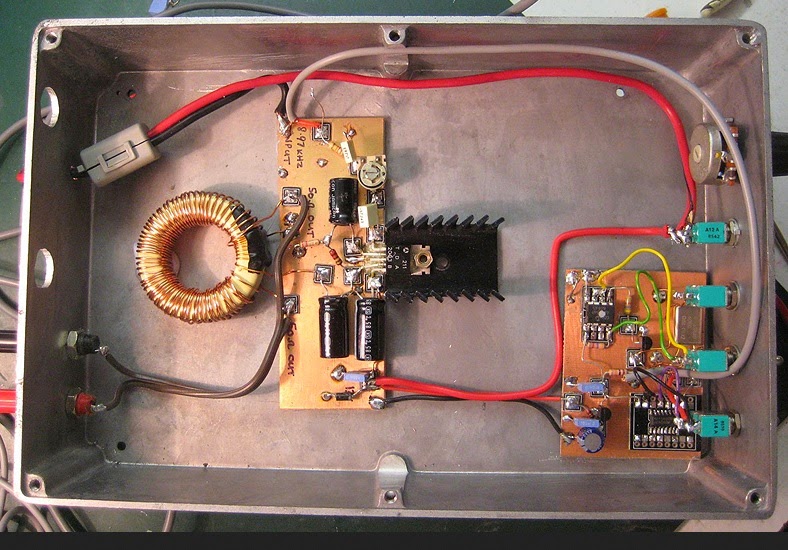 |
| 5W VLF beacon TX |
OK, I was only testing from the shack to the lounge, but this is a start. TX is 5W from my TDA2003 beacon.
TX frequency 8.976kHz initially with 10wpm CW, 300Hz bandwidth, sending my callsign and a dash. Nothing copied at first using a dummy load but over 70dB over noise using the earth-electrode “antenna” with no attempt to optimise match (fed via the same 3C90 step-up transformer used on 472kHz). With no probe at all (i.e.no RX antenna) the S/N was still some 40dB i.e. very good using the TX into the earth-electrodes.
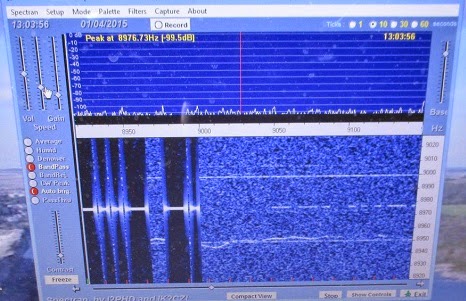 |
| QRSS3 signal received on Spectran (0.37Hz BW) |
Later with QRSS3, a 50 ohm TX dummy load, E-field probe at the RX, I got the signal at 10-20dB S/N. At the RX end I was using my simple E-field probe into a USB soundcard into my Windows 8.1 laptop.
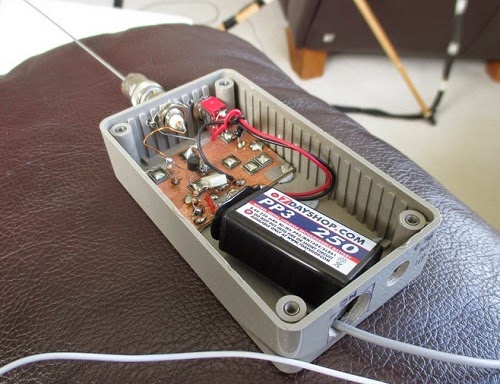 |
| E-field probe |
The blue photo shows the signal at the RX. The first part shows the TX signal on the earth-electrodes and the second part (weaker) was the signal on the EFP with the TX into a dummy load.
Honestly, this has really exhausted me!

Hacking the Amazon Dash Button
Amazon announced a new product today called a Dash Button. Amazon sends you a little self-stick wireless pushbutton. When you run out of a product, you just push the button and it sends a wireless signal which triggers your phone to send an order for the product.

With a little creativity, could you “re-purpose” one of these to be a wi-fi doorbell or some other kind of signaling device? A push-button wi-fi panic alarm? I’m sure it would be against the terms of service to open one up and modify it, but geeks like me wonder just what’s inside one of these little buttons.
A lot of the media are reporting that it’s a wi-fi button, but I wonder if it actually uses Bluetooth communication. Basically you press a button and the signal goes to your phone via bluebooth, and then you’re phone places an order via the Amazon app.
I wonder what it contains for a microcontroller? I expect there will be plenty more info to come once these start getting in the hands of consumers. According to their website, Amazon Prime members will be eligible receive three of them at no charge. At the moment it’s by invitation only.
What uses could you think of for a cute little wi-fi push-button transmitter?
5/11/15 Update:
http://www.amateurradio.com/inside-the-802-11bgn-amazon-dash-button/
The Spectrum Monitor — April, 2015

Stories you’ll find in our April, 2015 issue:
Scanning North America’s Railroads
By Richard Fisher KI6SN
The good news for the vast majority of railroad scanners is that 95 percent of railroad communication takes place on good ol’ analog FM. So, if you have a scanner capable of covering the railroads’ 96 FCC-assigned VHF channels, you’ve already got everything you need. You’ll be known in the vernacular as a “railfan” – of the radio-operatus specie.
FT-991: Yaesu’s Latest Shack-in-the-Box
By Mark Haverstock K8MSH
The Yaesu FT-991is both a competent rig that has a feature set that will satisfy most hams. Added VHF/UHF capabilities make it a very versatile rig for many applications. Yaesu’s touch screen goes a long way to help demystify menu selections. Find out why Mark thinks the FT-991 is a perfect fit for just about any ham shack, portable and Field Day use.
Digitally Speaking: Battery Considerations for Digital Portables
By Cory Sickles WA3UVV
Digital voice transceivers have more sophistication and complexity going on inside of them than similar analog FM rigs—especially when it comes to portables. That little radio in your hand, and the computer chips driving the extra features needs, additional current to keep everything going.
The Thrift Store Amateur
By Chris Friesen VE4CWF
If money has never been a problem, and you’ve always been able to buy your equipment factory fresh—congratulations—this article is not for you. If however, you have always had difficulty justifying the purchase of a new piece of station equipment, because you need your money to buy groceries, then you might find some encouragement in what Chris is writing about.
2015 Winter SWL Fest Recap
By Thomas Witherspoon K4SWL
Every year at the end of at the first of March for the last 28 years, the North American Shortwave Association (NASWA) has hosted its annual Winter Shortwave Listening Fest. This year saw over 100 devoted SWLers brave severe winter weather to gather in Pennsylvania to share their passion for shortwave.
Scanning America By Dan Veenaman
P25: A Tale of Two Systems
Federal Wavelengths By Chris Parris
Super Bowl XLIX Wrap-up
Utility Planet By Hugh Stegman NV6H
New Use for US Marine Channels?
Digital HF: Intercept and Analyze By Mike Chace-Ortiz AB1TZ/G6DHU
3G Wideband Protocols Are Arriving on HF
HF Utility Logs By Mike Chace-Ortiz and Hugh Stegman
Amateur Radio Insights By Kirk Kleinschmidt NT0Z
My Friend Ferrite: Interference Part 3
Radio 101 By Ken Reitz KS4ZR
The Art and Science of Chasing DX
Radio Propagation By Tomas Hood NW7US
More Sunspot Mysteries Revealed
The World of Shortwave Listening By Rob Wagner VK3BVW
The QSL Card – At What Cost?
The Shortwave Listener By Fred Waterer
Radio, History and Business Today
Maritime Monitoring By Ron Walsh VE3GO
Radio Surprises and Changes
The Longwave Zone By Kevin O’Hern Carey WB2QMY
Tuning in to Natural Radio
Adventures in Radio Restoration By Rich Post KB8TAD
The Real McCoy: A 1957 Novice Transmitter
The Broadcast Tower By Doug Smith W9WI
Stuffing 85 Channels into a 32-Channel Sack
Antenna Connections By Dan Farber AC0LW
Nothing Ventured: Understanding Antenna Gain
The Spectrum Monitor is available in PDF format which can be read on any desktop, laptop, iPad®, Kindle® Fire, or other device capable of opening a PDF file. Annual subscription (12 issues, beginning with the January 2015 issue) is $24. Individual monthly issues are available for $3 each.
CLE192 NAVTEX edition report
As Steve announced a week ago, CLE192 was a special NAVTEX edition. I like NAVTEX for several reasons. It’s an open format, easily decodable and messages are mostly in plain English. Then it’s just like fishing with a fish pod: you can leave your setup on over night and in the morning see what nice DX you have caught.
Normally I use the FRISNIT software for decoding NAVTEX. It’s plain and simple and messages are stored in plain text files. This time I tried YaND (Yet another NAVTEX Decoder) and found it to be better in decoding weak signals than FRISNIT. I don’t like the interface and message handling, but those are minor issues.
Here is my list of catches:
YYYYMMDD HHMM KHz ID CALL STATION,COUNTRY DIST (Km)
—————————————————————-
20150327 1604 518 $13A UIK Vladivostok,RSE 2377
20150327 1656 518 $11F HAS Bangkok (Nonthaburi),THA 2525
20150327 1700 518 $11G JNB Naha ,JPN 723
20150328 1500 518 $11H JNR Moji,JPN 1359
20150327 1507 518 $11I JGC Yokohama ,JPN 2199
20150330 1737 518 $11J JNL Otaru ,JPN 2730
20150326 1519 518 $11K JNX Kushiro ,JPN 3010
20150327 1812 518 $11N XSQ Guangzhou,CHN 773
20150330 2218 518 $11O XSL Foochow ,CHN 235
20150327 2234 518 $11P XSX Keelung,TWN 1600
20150328 1053 518 $11Q XSG Shanghai ,CHN 704
20150327 1901 518 $11R XSZ Dalian ,CHN 1656
20150330 2150 518 $11L VRX Hong Kong, HKG 0
20150327 1801 518 $11M XSI Sanya, CHN 0
20150330 1900 518 $11S XSV Tianjin, CHN 0
20150328 1613 518 $11U 9MG Penang, MLA (tent.) 0
20150326 1933 518 $11V HL.. CHUKPYONG, KOR 0
20150329 1942 518 $11W HL.. PYONGSAN, KOR 0
20150327 1740 518 $11K JNX Kushiro 0
20150327 2140 518 $11K XVT, Da Nang Radio (tent.) 0
The catches with 0 km distance were not automatically identified by YaND and the two tentative catches were identified by the content of the message, so 99% sure it was them.
The last reason I like NAVTEX is the content being broadcast. It provides a window on a world that most of us don’t know much about. Most messages are warnings about military exercises, weather reports and changes in locations of buoys, etc. But occasionally you see distress messages and then you realize how much hardship and suffering there is out at sea and how mighty it is. I’ll leave you with two of those messages from the last few days. 73
—–
2015-03-28 13:20:15> ZCZC ID86
2015-03-28 13:20:19> 281320 UTC MAR 15
2015-03-28 13:20:21> OVERBOARD NO.141
2015-03-28 13:20:26> ONE PASSENGER FELL OVERBOARD FROM
2015-03-28 13:20:33> FERRY ISHIKARI ALONG TRACKLINE BETWEEN
2015-03-28 13:20:36> NAGOYA PORT AT 261000UTC
2015-03-28 13:20:41> AND SENDAI PORT AT 270740UTC OR
2015-03-28 13:20:46> SENDAI PORT AT 271040UTC AND
2015-03-28 13:20:51> TOMAKOMAI PORT AT 280200UTC.
2015-03-28 13:20:57> SHIPS ARE REQUESTED TO REPORT ANY
2015-03-28 13:21:03> INFORMATION TO 1TH REGIONAL JAPAN COAST
2015-03-28 13:21:08> GUARD. PHONE 81-134-276172.
2015-03-28 13:21:09> NNNN
2015-03-27 17:40:15> ZCZC KD57
2015-03-27 17:40:18> 271740 UTC MAR 15
2015-03-27 17:40:20> CAPSIZE NO.139
2015-03-27 17:40:27> TUGBOAT CAPSIZED IN 41-45N 140-44E
2015-03-27 17:40:30> AT 270610UTC.
2015-03-27 17:40:33> CREW WENT MISSING.
2015-03-27 17:40:39> SHIPS IN THE VICINITY ARE REQUESTED TO
2015-03-27 17:40:46> KEEP A SHARP LOOKOUT AND REPORT ANY
2015-03-27 17:40:52> INFORMATION TO 1ST REGIONAL JAPAN COAST
2015-03-27 17:40:56> GUARD. PHONE 81-13427-6172.
2015-03-27 17:40:57> NNNN













