Archive for the ‘Technology’ Category
 Learning Morse code? Want to increase your skill?
 June 1st, 2014 |
  Author:
 Are you looking for some aids on learning Morse code, or to increase speed and skill? Let’s look at some great information and some software aimed at making your efforts successful.
(Note: I am not associated with any of the software. I just want to help you…)
I encourage you to look at the time-proven Koch method of learning Morse code. Below, we’ll look a little closer at this method of learning and honing your Morse code skill. In the meantime, if you just wish to skip the details, here are some software links for learning tools using the Koch method:
+ For the PC, I prefer the G4FON Morse code ‘Koch Trainer‘. It is a slick program that is set up to help you learn and enhance your skills with Morse code: http://nw7us.us/g4fontrainer – and his web site is at: http://www.g4fon.net/

G4FON Koch Trainer – Morse code learning on the PC
+ For the iPad and iPhone: On these devices, I use the ‘Koch Trainer’ by Nick / N3WG, found in the store here: https://itunes.apple.com/us/app/koch-trainer/id405137883?mt=8
+ For the Android: I use the same software as for the iPad and iPhone, the ‘Koch Trainer’ by Nick / N3WG, here: https://play.google.com/store/apps/details?id=com.n3wg.kochtrainer – however, note that it is not compatible on the S4.
+ Some other Android possibilities that I have not tried:
- https://play.google.com/store/apps/details?id=net.iz2uuf.cwkoch
- https://play.google.com/store/apps/details?id=uk.co.bitninja.kmtpro
Again, I have not tried those last few.
Now, let’s talk about the Koch Method of Morse code training!
From my page on the Koch method (text was used by permission from the author):
Koch’s method is a simple, direct way of building reflexes. However, it requires either a computer and Morse software or a personal trainer. That’s why it was overlooked for so many years. Now that computers are commonplace, it should become the standard Morse training method. Here’s how it works:
You start out by setting up your computer (or a microprocessor-based code tutor machine) to send you Morse characters at 20 wpm and at an overall sending speed of at least 15 wpm. You then get out your paper and pencil and have the machine start sending — but only two characters. That’s right, for your first sessions, you’ll only have two choices. Copy on paper for five minutes, then stop the machine and compare what you copied with what the machine sent. Count characters and calculate your percentage of correct copy.
If your score is 90 percent or better — congratulations! You just learned your first two characters, and, importantly, you learned them at full speed. You’ll never have to learn them over again. If you didn’t make 90 percent, practice some more. As soon as you can copy the first two characters with 90 percent accuracy, add a third character to your practice. Your accuracy will drop as you work on assimilating the new character, but it will rise again to 90 percent or better. Then you add the fourth character, and so on.
This method does not allow you to build that lookup table in your brain. To copy at full speed, you must build the reflexes in order to achieve 90 percent accuracy. And that’s what you’re spending your time doing — building reflexes. Think of it as a parallel to perfecting a tennis swing or mastering a gymnastic routine; you’re practicing until you get it right. The Koch method of building code proficiency character-by-character is similar to standard methods of teaching touch typing, another skill that must be reflexive.
…
While the Koch method is the fastest method of Morse training, speed alone is not its principal advantage. Its principal advantage, and a major difference from other methods, is that it provides you with constant positive reinforcement. This begins with your realization, after mastering the first two characters, that you can copy code at 15 or 20 wpm, because you just did it. After that, each new character mastered is further proof of your progress. Contrast that to slowly trying to build speed up from 4 or 5 wpm, then hitting the plateau at 10 wpm and seeing no progress for a long time. With the Koch method, frustration is at a minimum.
Constant testing is necessary to ensure that you maximize the effectiveness of the Koch method. You must copy on paper, so you can grade yourself. Remember, if you score 90 percent accuracy or better, add another character. If you score any less than that, try again. By constantly testing yourself on continuous copying of at least five minutes, you know exactly how you’re doing and exactly when you should add another character. This results in the fastest progress possible.
…
As you proceed toward your goal, remember that some days are just going to be better than others and some characters will take longer to assimilate than others.
(Read the entire article: the Koch method).
Again, here’s the PC software link: http://nw7us.us/g4fontrainer
And, here’s a web-based way to learn Morse code.
Good luck! If you have questions, please share them – I’m @NW7US
There’s a new radio hobby magazine in town!
Recently, a number of hobby radio magazines have either retired, or have merged into a digital mix of several. Filling that void is the new The Spectrum Monitor, a creation of Ken Reitz KS4ZR, managing editor for Monitoring Times since 2012, features editor since 2009, columnist and feature writer for the MT magazine since 1988. Ken offers this digital, radio communications magazine monthly. The web site is at http://www.thespectrummonitor.com/

The Spectrum Monitor magazine – get your’s, today.
Ken, a former feature writer and columnist for Satellite Times, Satellite Entertainment Guide, Satellite Orbit magazine, Dish Entertainment Guide and Direct Guide, is also contributing editor on personal electronics for Consumers Digest (2007 to present). He is the author of the Kindle e-books “How to Listen to the World” and “Profiles in Amateur Radio.”
The Spectrum Monitor Writers’ Group consists of former columnists, editors and writers for Monitoring Times, a monthly print and electronic magazine which ceases publication with the December, 2013 issue. Below, in alphabetical order, are the columnists, their amateur radio call signs, the name of their column in The Spectrum Monitor, a brief bio and their websites:
Keith Baker KB1SF/VA3KSF, “Amateur Radio Satellites”
Past president and currently treasurer of the Radio Amateur Satellite Corporation (AMSAT). Freelance writer and photographer on amateur space telecommunications since 1993. Columnist and feature writer for Monitoring Times, The Canadian Amateur and the AMSAT Journal. Web site: www.kb1sf.com
Kevin O’Hern Carey WB2QMY, “The Longwave Zone”
Reporting on radio’s lower extremes, where wavelengths can be measured in miles, and extending up to the start of the AM broadcast band. Since 1991, editor of “Below 500 kHz” column forMonitoring Times. Author of Listening to Longwave (http://www.universal-radio.com/catalog/books/0024u.html). This link also includes information for ordering his CD, VLF RADIO!, a narrated tour of the longwave band from 0 to 530 kHz, with actual recordings of LW stations.
Mike Chace-Ortiz AB1TZ/G6DHU “Digital HF: Intercept and Analyze”
Author of the Monitoring Times “Digital Digest” column since 1997, which follows the habits of embassies, aid organizations, intelligence and military HF users, the digital data systems they use, and how to decode, breakdown and identify their traffic. Web site: www.chace-ortiz.org/umc
Marc Ellis N9EWJ, “Adventures in Radio Restoration”
Authored a regular monthly column about radio restoration and history since 1986. Originally writing for Gernsback Publications (Hands-On Electronics, Popular Electronics, Electronics Now), he moved his column to Monitoring Times in January 2000. Editor of two publications for the Antique Wireless Association (www.antiquewireless.org): The AWA Journal and the AWA Gateway. The latter is a free on-line magazine targeted at newcomers to the radio collecting and restoration hobbies.
Dan Farber ACØLW, “Antenna Connections”
Monitoring Times antenna columnist 2009-2013. Building ham and SWL antennas for over 40 years.
Tomas Hood NW7US, “Understanding Propagation”
Tomas first discovered radio propagation in the early 1970s as a shortwave listener and, as a member of the Army Signal Corps in 1985, honed his skills in communications, operating and training fellow soldiers. An amateur Extra Class operator, licensed since 1990, you’ll find Tomas on CW (see http://cw.hfradio.org ), digital, and voice modes on any of the HF bands. He is a contributing editor for CQ Amateur Radio (and the late Popular Communications, and CQ VHF magazines), and a contributor to an ARRL publication on QRP communications. He also wrote for Monitoring Times and runs the Space Weather and Radio Propagation Center at http://SunSpotWatch.com. Web site: http://nw7us.us/ Twitter: @NW7US YouTube: https://YouTube.com/NW7US
Kirk Kleinschmidt NTØZ, “Amateur Radio Insight”
Amateur radio operator since 1977 at age 15. Author of Stealth Amateur Radio. Former editor,ARRL Handbook, former QST magazine assistant managing editor, columnist and feature writer for several radio-related magazines, technical editor for Ham Radio for Dummies, wrote “On the Ham Bands” column and numerous feature articles for Monitoring Times since 2009. Web site: www.stealthamateur.com.
Cory Koral K2WV, “Aeronautical Monitoring”
Lifelong air-band monitor, a private pilot since 1968 and a commercial pilot licensee since 1983, amateur radio licensee for more than 40 years. Air-band feature writer for Monitoring Times since 2010.
Stan Nelson KB5VL, “Amateur Radio Astronomy”
Amateur radio operator since 1960. Retired after 40-plus years involved in mobile communications/electronics/computers/automation. Active in radio astronomy for over twenty years, specializing in meteor monitoring. Wrote the “Amateur Radio Astronomy” column for Monitoring Timessince 2010. A member of the Society of Amateur Radio Astronomers (SARA). Web site: www.RoswellMeteor.com.
Chris Parris, “Federal Wavelengths”
Broadcast television engineer, avid scanner and shortwave listener, freelance writer on federal radio communications since 2004, wrote the “Fed Files” column for Monitoring Times.http://thefedfiles.com http://mt-fedfiles.blogspot.com Twitter: @TheFedFiles
Doug Smith W9WI, “The Broadcast Tower”
Broadcast television engineer, casual cyclist and long distance reception enthusiast. “Broadcast Bandscan” columnist for Monitoring Times since 1991. Blog:http://americanbandscan.blogspot.com Web site: http://w9wi.com
Hugh Stegman NV6H, “Utility Planet”
Longtime DXer and writer on non-broadcast shortwave utility radio. Former “Utility World” columnist for Monitoring Times magazine for more than ten years. Web site: www.ominous-valve.com/uteworld.html Blog: http://mt-utility.blogspot.com/ Twitter: @UtilityPlanet YouTube: www.youtube.com/user/UtilityWorld
Dan Veeneman, “Scanning America”
Software developer and satellite communications engineer writing about scanners and public service radio reception for Monitoring Times for 17 years. Web site: www.signalharbor.com
Ron Walsh VE3GO, “Maritime Monitoring”
Retired career teacher, former president of the Canadian Amateur Radio Federation (now the Radio Amateurs of Canada), retired ship’s officer, licensed captain, “Boats” columnist and maritime feature writer for Monitoring Times for eight years. Avid photographer of ships and race cars.
Fred Waterer, “The Shortwave Listener”
Former “Programming Spotlight” columnist for Monitoring Times. Radio addict since 1969, freelance columnist since 1986. Fascinated by radio programming and history. Website: http://www.doghousecharlie.com/
Thomas Witherspoon K4SWL, “World of Shortwave Listening”
Founder and director of the charity Ears To Our World (http://earstoourworld.org), curator of the Shortwave Radio Archive http://shortwavearchive.com and actively blogs about shortwave radio on the SWLing Post (http://swling.com/blog). Former feature writer for Monitoring Times.
TXtra from TX Factor is On The Air!
 TX Factor, the UK’s first TV show dedicated entirely to amateur radio has launched TXtra, a regular supply of extra features with new and exciting content related to amateur radio and associated technology.
HamRadioNow: MotoTRBOStar
Last night I uploaded HamRadioNow Episode 138. I’m calling it MotoTRBOStar because it’s about a newly announced handheld radio that will claim some firsts: it’s the first “dual-digital” mode radio (D-STAR; and MOTOTRBO, or generically DMR – Digital Mobile Radio); and it’s the first non-ICOM off-the-shelf radio to do D-STAR.* The episode is an interview with the CEO of Connect Systems, Inc., Jerry Wanger (rhymes with Ranger). CSI (isn’t that a TV show?) has been selling analog, trunked and DMR digital handheld radios in the commercial service. Recently, Jerry learned that a lot of hams have latched onto his radios for use on the ham-band MOTOTRBO repeaters. The radios are quite inexpensive, and apparently pretty high quality.
Jerry had a novice license long ago, but never mastered the code to upgrade. Side note: back in the 60’s, a Novice license ran one year and couldn’t be renewed. And Novices had voice privileges on only one band: two meters. So Novices who spent too much time on two-meter AM (there was almost no FM then) and didn’t get their code speed up to 13 wpm for a General could get a Tech, but then they were confined to VHF/UHF. Again, repeaters were just barely getting started and were mostly unknown, so Techs were in a kind of Purgatory. But it was a way to keep licensed. Evidently Jerry didn’t choose that route. But he’s about to get re-licensed now.
So Jerry appreciates ham radio, and decided to make a model radio (CS700) that was more “ham-friendly,” with features like DTMF and the ability to program frequencies and parameters directly from the keypad. Then he decided to add D-STAR. That model, the CS7000, is planned for Fall release. He’ll be at Dayton to show it off.
Jerry does the software and designs the hardware specs himself, and has the radios manufactured in China. As he says, he can buy the finished radios cheaper than he can buy the parts.
So that’s all in the interview. Now I’ll wax a bit philosophical on the topic.
I’ve been a ham since 1965, WN9NSO, in the Chicago suburbs. And while I did play on two meter AM with a Heathkit Twoer (to the displeasure of my mentors, who warned sternly about neglecting the code), I also spent enough time in the 40 and 15 meter Novice cw bands to wick the speed up and pass my General after just a few months. And while I have almost always had a presence on HF, I’ve felt more at home on VHF/UHF. I was introduced to FM almost immediately. I had a Motorola 30D base station in my shack, and 80D mobile in my Dad’s car by 1967 (these were ancient, all-tube radios. The 80D even had a Dynamotor to power the transmitter). There were only two or three repeaters on the air in Chicago at the time. I was too young (and never an engineer) to be much of a leader at the time, but I watched the FM boom from a front row seat.
Fast forward to the early 2000’s. I’m editor of the SERA Repeater Journal, the magazine published by the SouthEastern Repeater Association, the group that does frequency coordination for 8 states. I come across a reference to D-STAR, and while I didn’t think much about it at the time, I did ponder a digital future in my column. But D-STAR wasn’t one of those flights of fancy that came and went. With ICOM behind it, D-STAR grew beyond it’s original 1200 MHz system as ICOM added radios for 144 and 440 MHz. Meanwhile, I had moved from editing the magazine to producing ham radio video on DVD as ARVN:Amateur Radio//Video News. I bought ICOM’s first D-STAR dual-band mobile, the ID-800, and handheld, the IC-91, and soon after produced a documentary titled Digital Voice for Amateur Radio. The DVD also featured a segment on HF digital voice, and a little on APCO-25, another VHF/UHF digital mode being adapted from Public Safety radio to Amateur Radio. I’ve written a few articles and reviews in QST on D-STAR and ICOM radios. I’m not the foremost authority on it by any means – I consider myself a journalist (with a side of pundit these days), not an expert – but I’ve learned a lot. And ham radio doesn’t have many pure journalists. Everybody’s involved.
D-STAR was met by hams with sharply divided reaction (and more than a few yawns). A few embraced it immediately (best thing ever). A few more were rigidly opposed (End Of Amateur Radio As We Know It). Most, if they were even aware of it in the early years, were more wait-and-see. Not gonna sink a lot of money into a radio that might not go anywhere. All the D-STAR radios were good Analog radios, too, but they were a few hundred bucks more expensive, so while the radio wouldn’t be useless, it would have been a costly experiment.
Turns out D-STAR has hung around and grown fairly quickly. It’s in most major and medium metro areas, and even some rural areas, of the US and many countries around the world. But there’s still plenty of territory that has had analog FM for decades but no D-STAR at all yet. Any long road trip will quickly bear that out. You’ll drive a long way between “islands” of D-STAR coverage. It’s very much like FM was in 1970 – available mostly in the larger cities. I remember being excited when driving toward Denver way back then. A mountainside repeater on 146.94 broke my squelch about 100 miles out after hours and hours of radio silence.
D-STAR proponents, and even us “objective journalists” (OK, I’m not objective on this) point out how much technology is going digital (TV, cell phones, a fair amount of two-way business and Public Safety radio) while hams have barely moved the needle, except for the all-text modes. Yeah, we led the way with Packet Radio in the 80’s (a few did, anyway… not most of us). But for a group that likes to talk more than anything else, our voices have remained mostly analog, right up to today. Digital has some advantages (signal to noise, voice+data, and spectrum efficiency), but they haven’t been compelling enough yet to get wholesale adoption. Except for D-STAR, they mostly haven’t been built-in to radios. And on HF especially, we don’t know how we’d use them for some of the core activities like contests and DX.
As we gaze outside of our pasture to that real world that’s growing increasingly digital, there’s another issue to note. Digital doesn’t stand still very long. Upgrades happen fast, and sometimes older stuff becomes obsolete – even unusable – pretty quickly. Analog TV made it about 60 years. Vinyl records a little longer. CDs aren’t dead, but sales went to nearly zilch, after about 20 years. On the Internet, where software and apps can be easily upgraded or replaced, we’re talking a few years or even months. Remember “RealTV”? And you know that 70″ 1080p High-Def TV you just got. Obsloete. Here comes 4k. Then 8k. Broadcast TV stations are going nuts trying to figure out to squeeze that into their “Advanced” television system. **
I’m about to edit my next HamRadioNow that I recorded yesterday with Bruce Perens K6BP. Bruce is a serious open-source guy, so he never had a great love for D-STAR. Bear that in mind when he declares it obsolete. Objectively, things in ham radio move slower. Whenever there’s fixed hardware involved, upgrades can’t happen that fast – it costs too much. But D-STAR is 15 years old, and better technology is available. Yaesu claims their new C4FM “System Fusion” is “better.” Bruce disputes that, and I don’t have the background to determine it for myself. But I can say that if Yaesu is correct now, what can they say in 5 years (0r 5 months) when the next something better comes along?
Bruce is involved in a couple of projects. For HF, there’s FreeDV, and for VHF/UHF, it’s the “HT of the Future.” Both are based on the open-source CODEC2, which is still very much under development, and always will be, at least for the foreseeable future. Today, FreeDV is a sound-card mode that you can run much like PSK-31. Tomorrow, you might punch it up on the mode switch (Flex will probably be the first radio to have that option). FreeDV – and probably a lot of new modes – will be upgradable by downloading software. I won’t say it will never be obsolete, but it’s the kind of thing that will move us from being slow-moving dinosaurs tied to our fixed-technology hardware, into a more nimble future where we are not walled off from each other by incompatible modes. All this stuff is coming up in HamRadioNow Episode 139, as soon as I can stop typing here and get back to editing it (maybe tomorrow or Monday).
Ya know… I’ve never operated FreeDV or it’s predecessors (FDMDV, WinDRM) that I featured in Digital Voice for Amateur Radio. I don’t have a computer sitting next to my HF rig… at least not yet. All my computers are busy doing something else. But I’ll find one soon, and give it a try.
73, Gary KN4AQ
* Devices like the DVDongle are cool, but they’re not standalone radios. There are a few modules that you can use to turn an analog radio into a D-STAR radio using its 9600 packet port, but that’s not off-the-shelf. The NW Digital radio might lay claim to being the first non-ICOM commercial D-STAR capable radio if it reaches production before the CS-7000 does, and right now it’s a race. But while it will do D-STAR’s DV voice mode, it’s really designed as a multi-mode platform for medium-speed data, using D-STAR’s DD mode and many others. It will have exciting uses, but it’s not your grab-and-go handheld or mobile radio.
** My career has been in the audio/video production business, mostly making commercials. I quickly learned a lesson: never stick a label on anything that calls it “new.” And never call anything “final.” OK, sort of two lessons.
The “new” lesson came from a reel of alignment videotape that we used at a TV station I worked for. You had to run that through the old 2″ “Quad” videotape machines to align the heads before making a recording, so the reel got used several times a day. It started life as a 5-minute piece of tape, but every time you used it, you’d then rewind it and thread a piece of blank tape for recording onto the machine. That rewind was high-speed, and if you didn’t catch it fast enough, the end of the tape would flap like crazy, and get frayed. You had to cut the frayed piece off lest it get caught in the high-speed spinning video heads next time, clogging the hell out of them and maybe ruining a head assembly that cost tens of thousands of dollars to replace. The boss would be very angry.
When I started working at the station, that alignment reel had about 45 seconds of tape left on it, having had a half-inch of frayed end cut off many, many times. And the flange was grimey from all the hands that had loaded it on the machines over the years. But there beneath the grime, just barely readable in faded Sharpie, were the words that some engineer wrote just after he took that reel out of the box for the first time: Alignment Tape. 5 min. NEW.
MGM 1939 film: Radio Hams / More than a Hobby
“Radio Hams” do more than play with their machines. They are also invaluable in relaying vital information during times of tragedy and disaster.
Here is a mildly entertaining look at radio hams, those amateurs sending and receiving coded messages during the late thirties when films first dealt with the subject of “radio hams.” In this case, the ham operators manage to be helpful during situations of stress, using their abilities with code to help someone in distress and to seek aid for pilots flying a missing plane.
The humorous ending has the family gathered around the radio listening to someone speaking Chinese while the narrator tells us how impressed the family was to be hearing someone across the world on their radio set.
http://www.youtube.com/watch?v=bZi7LiPNMt8
This little vintage film, a rather more serious film than many of Pete Smith’s other presentations, takes a look at how ham radios can become priceless aids during emergencies. The two stories shown, one dealing with sickness, the other with a missing plane, are bookended by a humorous look at a typical three-generation family’s fascination with their ham radio.
Of course, amateur radio, or “ham radio”, is alive and doing very well, in our modern times. Using satellites, moon-bounce communications, repeater networks, as well as shortwave, mediumwave, and longwave telecommunications technology, amateur radio continues to provide emergency services in times of need, from hurricanes, tornadoes, earthquakes, and even during such times as the infamous 9/11 atrocity. But, amateur radio also breeds invention and experimentation, always at the cutting edge of science. It is a hobby worth investigating, having room for a wide-range of interests. Preppers, science lovers, experimenters, and those with a passion to meet people from all over the world by way of radio waves, all together make up the radio hobby of amateur radio.
Clayton Moore, later famous as the Lone Ranger, appears uncredited as a ship radio operator.
Directed by Felix E. Feist
Writing Credits Buddy Adler (screenplay) (as E. Maurice Adler)
Cast (in alphabetical order)
Barbara Bedford – Mrs. Crane (uncredited)
Eleanor Counts – Miss Mulligan, Jimmy’s Sister (uncredited)
Jack Daley – Pa Mulligan (uncredited)
Robert Homans – Lighthouse Keeper (uncredited)
Clayton Moore – Ship Radio Operator (uncredited)
Alonzo Price – Clyde DeVinna (uncredited)
Jason Robards Sr. – Pilot in Distress (uncredited)
Pete Smith – Narrator (voice) (uncredited)
Harry Strang – Man in Montage (uncredited)
Phillip Terry – Co-Pilot (uncredited)
Dorothy Vaughan – Ma Mulligan (uncredited)
Produced by Pete Smith – producer (uncredited)
Music by David Snell (uncredited)
Cinematography by Robert Pittack
Film Editing by Philip W. Anderson (as Philip Anderson)
Music Department Jack Virgil – orchestrator (uncredited)
Other crew Douglas Smith – technical advisor
According to https://archive.org/details/wwIIarchive this film is in the Public Domain.
Creative Commons copyright.
1920 film: How the Telephone Talks (A Silent Film)
This is for you vintage science film buffs: here is a circa 1920 film: How the Telephone Talks (A Silent Film).
This is an educational film from 1920 that explained the “modern” telephone. The concepts are still relevant to today’s modern versions, including the cell phone, which is both radio and telephone.
From Wiki:
A telephone, or phone, is a telecommunications device that permits two or more users to conduct a conversation when they are not in the same vicinity of each other to be heard directly. A telephone converts sound, typically and most efficiently the human voice, into electronic signals suitable for transmission via cables or other transmission media over long distances, and replays such signals simultaneously in audible form to its user. The word telephone has been adapted into the vocabulary of many languages. It is derived from the Greek: τῆλε, tēle, far and φωνή, phōnē, voice, together meaning distant voice.
First patented in 1876 by Alexander Graham Bell and further developed by many others, the telephone was the first device in history that enabled people to talk directly with each other across large distances. Telephones became rapidly indispensable to businesses, government, and households, and are today some of the most widely used small appliances.
The essential elements of a telephone are a microphone (transmitter) to speak into and an earphone (receiver) which reproduces the voice of the distant person. In addition, most telephones contain a ringer which produces a sound to announce an incoming telephone call, and a dial used to enter a telephone number when initiating a call to another telephone. Until approximately the 1970s most telephones used a rotary dial, which was superseded by the modern Touch-Tone push-button dial, first introduced by AT&T in 1963. The receiver and transmitter are usually built into a handset which is held up to the ear and mouth during conversation. The dial may be located either on the handset, or on a base unit to which the handset is connected by a cord containing wires. The transmitter converts the sound waves to electrical signals which are sent through the telephone network to the receiving phone. The receiving telephone converts the signals into audible sound in the receiver, or sometimes a loudspeaker. Telephones are a duplex communications medium, meaning they allow the people on both ends to talk simultaneously.
A landline telephone is connected by a pair of wires to the telephone network, while a mobile phone, such as a cellular phone, is portable and communicates with the telephone network by radio transmissions. A cordless telephone has a portable handset which communicates by radio transmission with the handset base station which is connected by wire to the telephone network.
The telephone network, consisting of a worldwide net of telephone lines, fiber optic cables, microwave transmission, cellular networks, communications satellites, and undersea telephone cables connected by switching centers, allows any telephone in the world to communicate with any other. Each telephone line has an identifying number called its telephone number. To initiate a telephone call the user enters the other telephone’s number into a numeric keypad on the phone.
Although originally designed for simple voice communications, most modern telephones have many additional capabilities. They may be able to record spoken messages, send and receive text messages, take and display photographs or video, play music, and surf the Internet. A current trend is phones that integrate all mobile communication and computing needs; these are called smartphones.
Milestone at the end of the road
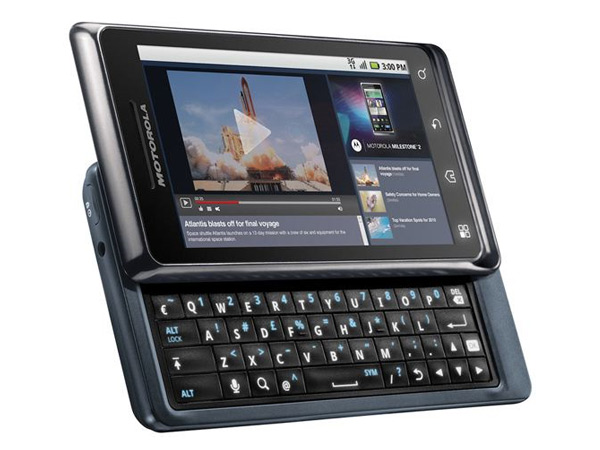
My Motorola Milestone 2 smartphone, which I bought nearly two years ago, has gone kaput. When I slide out the keyboard, the display goes blank. The device is usable, but only as an ordinary phone. I can imagine what has happened. There is probably a flexible ribbon cable like in the KX3 connecting the two halves, and a trace has broken. (A good job I’ve got the charger for the KX3 so I don’t have to keep opening it up to change the batteries.)
Of course, it is out of warranty. The question is, is it repairable at a reasonable cost? Motorola’s support site won’t give an estimated cost of repair. “Send it to us and we’ll give you a quote” they say. I’d really like a ballpark figure for what it is going to cost before doing that.
I guess I’ll just have to spring for a new phone. But there weren’t many alternatives with a real hardware keyboard and I expect there are even fewer now. I wish I could type using the software keyboard (which I’ll have to for now) but I have a 50% error rate. I don’t think my fingers are much fatter than normal. How do you guys manage? Perhaps you don’t text much and don’t do email on the phone.













