Archive for the ‘Technology’ Category
 A Solar flare, A CME, A Proton Storm: Magnitude M2.5 X-ray Flare
 July 30th, 2015 |
  Author:
 Watch this amazing explosion on the Sun. From sunspot complex 1226-1227 comes an X-ray Flare peaking at a magnitude of M2.5 at 0640 UTC on 7 June, 2011.
Source: https://www.youtube.com/watch?v=KQMrRu8BWDo
This X-ray flare hurled a massive coronal mass ejection (CME) toward the Earth. This not-squarely Earth-directed CME is moving at 1400 km/s according to NASA models. The CME did not deliver even a noticeable glancing blow to Earth’s magnetic field late June 8th or June 9th.
What can be seen clearly in this movie is one of the most spectacular prominence eruptions ever observed. In fact, one could call it a “prominence explosion”. The prominence material expanded to a volume some 75 times as big across as the earth!
This X-ray flare also triggered an S1-level solar radiation storm, causing a long-lasting polar cap absorption (PCA) event. A polar cap absorption (PCA) event affects the propagation of a shortwave radio signal as it makes its way over the polar regions. In short, radio communications on lower shortwave radio frequencies become more difficult, as those radio signals are absorbed by the ionosphere (in the D-region) over the polar regions.
What does this mean in real-world communications? Trans-polar airline pilots may find it more difficult to communicate with regional air traffic control, shortwave radio listeners who want to hear a broadcast from a country by receiving a transmission from a country by way of a transmission beamed over the pole (like, from Europe into the USA via the North Pole), or other such communications, will find those signals all but gone. The stronger the PCA event, the higher the frequencies absorbed over the polar regions, with the greatest absorption occurring at the lower frequencies.
This movie spans the period of time from 0300 UTC through 1556 UTC, and is composed of the 171-Angstrom, 304-Angstrom, and 335-Angstrom wavelength views as captured by the filters of the Solar Dynamics Observatory (SDO) Atmospheric Imaging Assembly (AIA). In this movie, the AIA instruments capture the Sun’s extreme ultraviolet light and reveal a very large eruption of cool gas. It is somewhat unique because at many places in the eruption there seems to be even cooler material–at temperatures less than 80,000 K.
The following is a linked video that is part of this event: http://www.youtube.com/watch?v=L4CsjcUGoaw
Watch as we zoom out to see a total view of the June 7, 2011 moderately-powerful X-ray Flare and Prominence Eruption. This movie will give you a full perspective of the immense size of this prominence eruption as it spews out away from the Sun.
The X-ray Flare peaked at a moderate magnitude of M2.5 at 0640 UTC, but unleashed a huge prominence eruption. The massive cloud of plasma was ejected out into interplanetary space, but missed the Earth. This movie stars with a “close-up” view by the Solar Dynamics Observatory at a combined wavelength view at 94 and 304 Angstroms. Then, the movie views the event further back through the eyes of the COR1 spacecraft (with the SDO AIA 304 image superimposed in the middle). Next, we zoom out to the COR2 spacecraft and superimpose the COR1 and SDO views. Then, we zoom further back to the H1 view… and finally look again at the event close-up.
More info: http://sunspotwatch.com/
Google Plus:
http://g.nw7us.us/gplus_spacewx
Facebook:
http://www.facebook.com/spacewx.hfradio
http://www.facebook.com/NW7US
Twitter:
@hfradiospacewx
@NW7US
Source: SDO AIA NASA SOHO
Inverted High Frequency Loss with LMR-450G
By John ‘Miklor’ K3NXU
PERFORMANCE TESTS – LMR-450G
The recently announced LMR-450G cable has aroused much curiosity since its characteristics have not been collectively available by any one source. By multiple inquiries to several manufactures (only three at this time) and numerous lab tests, we hope to put many of the existing questions to rest.
DESCRIPTION
The physical make up of this cable varies slightly from most conventional RF cables. The center conductor is a semi-stranded copper alloy surrounded by Telfon, which will absorb and distribute cable ‘hot spots’ caused by excessive standing wave. The double silver braid and foil outer coating which provides a 98.6% shield is what the inverted high frequency loss characteristics are attributed. The loss is substantially less as the frequency increases, making this cable especially attractive for UHF, cellular, PCS and microwave applications.

Measuring cable loss under lab conditions
LOSS PER 100′
30 MHz 2.4 db
50 MHz 2.1 db
150 MHz 1.6 db
450 MHz 1.1 db
800 MHz .51 db
1200 MHz .37 db
1950 MHz .31 db
The cable’s most unique property is attributed to the outer jacket material Neo-glow, an RF sensitive composite plastic which will visibly indicate RF ‘hot spots’ in the cable. Adjusting the cable length to the antenna system for the ‘perfect’ impedance match is crucial at high frequency, thus the importance of a low SWR for peak performance.

From 100 Watts and up this cable will brighten up your world.
PROPER INSTALLATION
The low level emission of light from LMR-450G cable can be enhanced by wearing lightly tinted sunglasses with UV protection, which enhances the light radiation from the cable. Select an approximate length of cable needed for the installation which must be multiples of a 1/4 wavelength for the desired frequency. The exact length can be determined by using the formula 467 / Freq (MHz) plus approximately 18 inches.
The initial tests should be run with a 50 ohm dummy load at one end of the cable. With a minimum of 7 watts from the transmitter, you will see a faint glow from the cable indicating the ‘hot spots’ to be eliminated. These are the points along the cable where the RF is at its maximum. It is at these points where the RF connectors should be mounted. Trimming the excess cable may be required at both ends of the cable to produce the most effective match. Use caution not to trim too much cable as the loss characteristics improve with longer cable lengths.
SUMMARY
This could be the beginning of the long awaited high frequency “SUPER” cables. Only available in limited quantities at this time; contact your local cable supplier for more details.


Inverted High Frequency Loss with LMR-450G
By John ‘Miklor’ K3NXU
PERFORMANCE TESTS – LMR-450G
The recently announced LMR-450G cable has aroused much curiosity since its characteristics have not been collectively available by any one source. By multiple inquiries to several manufactures (only three at this time) and numerous lab tests, we hope to put many of the existing questions to rest.
DESCRIPTION
The physical make up of this cable varies slightly from most conventional RF cables. The center conductor is a semi-stranded copper alloy surrounded by Telfon, which will absorb and distribute cable ‘hot spots’ caused by excessive standing wave. The double silver braid and foil outer coating which provides a 98.6% shield is what the inverted high frequency loss characteristics are attributed. The loss is substantially less as the frequency increases, making this cable especially attractive for UHF, cellular, PCS and microwave applications.
Measuring cable loss under lab conditions
LOSS PER 100′
30 MHz 2.4 db
50 MHz 2.1 db
150 MHz 1.6 db
450 MHz 1.1 db
800 MHz .51 db
1200 MHz .37 db
1950 MHz .31 db
The cable’s most unique property is attributed to the outer jacket material Neo-glow, an RF sensitive composite plastic which will visibly indicate RF ‘hot spots’ in the cable. Adjusting the cable length to the antenna system for the ‘perfect’ impedance match is crucial at high frequency, thus the importance of a low SWR for peak performance.
From 100 Watts and up this cable will brighten up your world.
PROPER INSTALLATION
The low level emission of light from LMR-450G cable can be enhanced by wearing lightly tinted sunglasses with UV protection, which enhances the light radiation from the cable. Select an approximate length of cable needed for the installation which must be multiples of a 1/4 wavelength for the desired frequency. The exact length can be determined by using the formula 467 / Freq (MHz) plus approximately 18 inches.
The initial tests should be run with a 50 ohm dummy load at one end of the cable. With a minimum of 7 watts from the transmitter, you will see a faint glow from the cable indicating the ‘hot spots’ to be eliminated. These are the points along the cable where the RF is at its maximum. It is at these points where the RF connectors should be mounted. Trimming the excess cable may be required at both ends of the cable to produce the most effective match. Use caution not to trim too much cable as the loss characteristics improve with longer cable lengths.
SUMMARY
This could be the beginning of the long awaited high frequency “SUPER” cables. Only available in limited quantities at this time; contact your local cable supplier for more details.
‘USA 1776’ DMR Talk Group
 One of the nice things of D-Star and DMR is the ability to talk all over the world without the need of an HF rig and a bunch of big antennas. While this largely reduces a radio to a simple Internet-driven communication tool – just like Skype or other VoIP apps – it’s definitely nice to use.
There are a few problems surrounding DMR, one of which is the lack of more than two time slots. For example, if hams are using the Dutch Hytera network and occupying talk group 204 on slot 1, World Wide (which uses the same time slot) will be unavailable. Because 204-1 is a busy place, world wide QSOs are often impossible. It’s one of the reasons I thought of dumping DMR all together — I can talk to the same Dutch guys on analog while enjoying a much better quality audio.
There are reasons to keep DMR too. DMR is maturing; there are more than enough possibilities to put less pressure on the nation-wide network by going local. Now if only hams would do that…. but most don’t. Another reason to keep DMR for now is the gateway we recently added, which connects D-Star to our DMR network.
Not available on the Motorola network, sorry — some people responsible for that network appear to be so scared of such innovations that they will ban a repeater from the network if such a gateway is detected.
Talk group ‘USA 1776’ could add to the appeal of DMR. It’s unclear on which network this talk group will reside, but my best guess is that it will be the Motorola network. MITCON writes:
The “USA 1776″ (English preferred) Talk Group will be distributed worldwide to DMR networks upon request. The spirit of “1776” is to continue the Amateur Radio tradition of international friendship and to push the boundaries of technology in the new frontier of digital communications.
 USA 1776 is intended to be a flexible, politically neutral, unrestricted Talk Group that can be used as Push-To-Talk (PTT) or Full-Time (FT) to meet the operating requirements of a DMR Network. DMR subscribers are welcome to use 1776 as a universal meeting place to “Rag Chew” or as a jumping off point and QSY to an alternative Talk Group if desired. To add USA 1776 to your DMR Network please contact us to schedule a time for configuration & testing.


‘USA 1776′ DMR Talk Group
One of the nice things of D-Star and DMR is the ability to talk all over the world without the need of an HF rig and a bunch of big antennas. While this largely reduces a radio to a simple Internet-driven communication tool – just like Skype or other VoIP apps – it’s definitely nice to use.
There are a few problems surrounding DMR, one of which is the lack of more than two time slots. For example, if hams are using the Dutch Hytera network and occupying talk group 204 on slot 1, World Wide (which uses the same time slot) will be unavailable. Because 204-1 is a busy place, world wide QSOs are often impossible. It’s one of the reasons I thought of dumping DMR all together — I can talk to the same Dutch guys on analog while enjoying a much better quality audio.
There are reasons to keep DMR too. DMR is maturing; there are more than enough possibilities to put less pressure on the nation-wide network by going local. Now if only hams would do that…. but most don’t. Another reason to keep DMR for now is the gateway we recently added, which connects D-Star to our DMR network.
Not available on the Motorola network, sorry — some people responsible for that network appear to be so scared of such innovations that they will ban a repeater from the network if such a gateway is detected.
Talk group ‘USA 1776′ could add to the appeal of DMR. It’s unclear on which network this talk group will reside, but my best guess is that it will be the Motorola network. MITCON writes:
The “USA 1776″ (English preferred) Talk Group will be distributed worldwide to DMR networks upon request. The spirit of “1776” is to continue the Amateur Radio tradition of international friendship and to push the boundaries of technology in the new frontier of digital communications.
USA 1776 is intended to be a flexible, politically neutral, unrestricted Talk Group that can be used as Push-To-Talk (PTT) or Full-Time (FT) to meet the operating requirements of a DMR Network. DMR subscribers are welcome to use 1776 as a universal meeting place to “Rag Chew” or as a jumping off point and QSY to an alternative Talk Group if desired. To add USA 1776 to your DMR Network please contact us to schedule a time for configuration & testing.
Tubular Bells and VLF interference
 Remember that album from Mike Oldfield? A user on YouTube found out that this album contains a hidden and unintentional CW message.
This was caused by a powerful VLF station located next to the recording studio, which interfered with the recording equipment. Because the signal is very weak nobody ever noticed it — until now.
The video below shows you how to receive VLF signals with nothing else than an antenna plugged into the microphone input of your sound card and SDRSharp to make it visible and audible.
The decoding of the the Tubular Bells signal is shown at 9:54.


Getting there
As opposed to probably a majority of you, I am SO far behind the times from a technological point of view. I still do a majority of my logging with paper and pencil before I manually enter the information to my logging software.
When it comes to QRP Sprints or the Fox Hunts, most of my compatriots use N1MM or some such program. Again, I still use paper and pencil. I feel that I am lucky to be able to walk and chew gum at the same time. Operating a radio and trying to computer log simultaneously during a Sprint or a Hunt used to send shivers up and down my spine.
But I am getting better. As long as I am not furiously trying to keep up with a pileup of QSOs in the midst of a frenzy during a Sprint or a Hunt, I have trained myself to log and operate at the same time (See? You CAN teach old dogs new tricks!). I recently purchased a small keyboard for my Nexus 7, so that I can log during casual portable ops without the need for pencil and paper. It cost me all of 8 smackers on eBay.
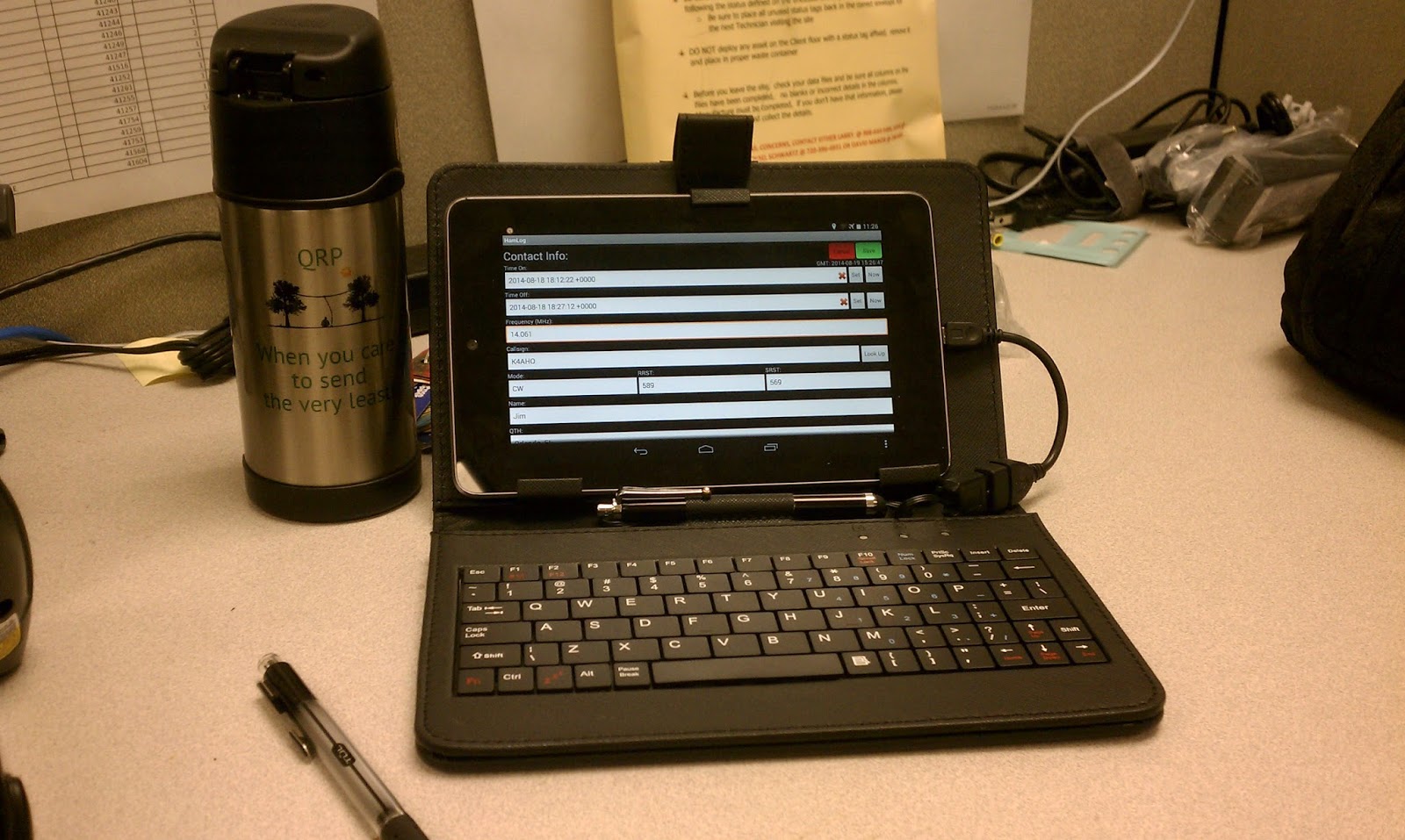
That’s Ham Log that I keep on there, which in and of itself is a great piece of logging software for Android. The problem was that it’s always been a pain in the butt to use the Nexus touchpad keyboard, which caused me to “one-finger” type, and slowed me down, holding me back. So for the longest time, I was doing the same thing – logging on paper and entering the data later, at my leisure (which makes no sense). This “tactile feel” keyboard brings a lot of familiarity and works a whole lot better for me, and now I am actually able to use the Nexus 7 for logging in real time (sometimes). I know that it’s pathetic, but while I am able to use this setup for general QSOing, the melee of contests or Fox Hunts drives me back to the security of “old technology”.
I guess the next step will be to install the KX3 Companion app. Boy, that will be like Star Trek for me!
72 de Larry W2LJ
QRP – When you care to send the very least!













