Archive for the ‘Technology’ Category
 1920 film: How the Telephone Talks (A Silent Film)
 November 9th, 2013 |
  Author:
 This is for you vintage science film buffs: here is a circa 1920 film: How the Telephone Talks (A Silent Film).
This is an educational film from 1920 that explained the “modern” telephone. The concepts are still relevant to today’s modern versions, including the cell phone, which is both radio and telephone.
From Wiki:
A telephone, or phone, is a telecommunications device that permits two or more users to conduct a conversation when they are not in the same vicinity of each other to be heard directly. A telephone converts sound, typically and most efficiently the human voice, into electronic signals suitable for transmission via cables or other transmission media over long distances, and replays such signals simultaneously in audible form to its user. The word telephone has been adapted into the vocabulary of many languages. It is derived from the Greek: τῆλε, tēle, far and φωνή, phōnē, voice, together meaning distant voice.
First patented in 1876 by Alexander Graham Bell and further developed by many others, the telephone was the first device in history that enabled people to talk directly with each other across large distances. Telephones became rapidly indispensable to businesses, government, and households, and are today some of the most widely used small appliances.
The essential elements of a telephone are a microphone (transmitter) to speak into and an earphone (receiver) which reproduces the voice of the distant person. In addition, most telephones contain a ringer which produces a sound to announce an incoming telephone call, and a dial used to enter a telephone number when initiating a call to another telephone. Until approximately the 1970s most telephones used a rotary dial, which was superseded by the modern Touch-Tone push-button dial, first introduced by AT&T in 1963. The receiver and transmitter are usually built into a handset which is held up to the ear and mouth during conversation. The dial may be located either on the handset, or on a base unit to which the handset is connected by a cord containing wires. The transmitter converts the sound waves to electrical signals which are sent through the telephone network to the receiving phone. The receiving telephone converts the signals into audible sound in the receiver, or sometimes a loudspeaker. Telephones are a duplex communications medium, meaning they allow the people on both ends to talk simultaneously.
A landline telephone is connected by a pair of wires to the telephone network, while a mobile phone, such as a cellular phone, is portable and communicates with the telephone network by radio transmissions. A cordless telephone has a portable handset which communicates by radio transmission with the handset base station which is connected by wire to the telephone network.
The telephone network, consisting of a worldwide net of telephone lines, fiber optic cables, microwave transmission, cellular networks, communications satellites, and undersea telephone cables connected by switching centers, allows any telephone in the world to communicate with any other. Each telephone line has an identifying number called its telephone number. To initiate a telephone call the user enters the other telephone’s number into a numeric keypad on the phone.
Although originally designed for simple voice communications, most modern telephones have many additional capabilities. They may be able to record spoken messages, send and receive text messages, take and display photographs or video, play music, and surf the Internet. A current trend is phones that integrate all mobile communication and computing needs; these are called smartphones.
Milestone at the end of the road
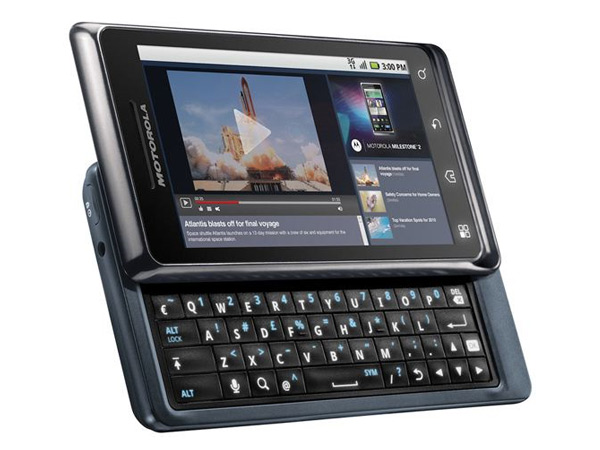
My Motorola Milestone 2 smartphone, which I bought nearly two years ago, has gone kaput. When I slide out the keyboard, the display goes blank. The device is usable, but only as an ordinary phone. I can imagine what has happened. There is probably a flexible ribbon cable like in the KX3 connecting the two halves, and a trace has broken. (A good job I’ve got the charger for the KX3 so I don’t have to keep opening it up to change the batteries.)
Of course, it is out of warranty. The question is, is it repairable at a reasonable cost? Motorola’s support site won’t give an estimated cost of repair. “Send it to us and we’ll give you a quote” they say. I’d really like a ballpark figure for what it is going to cost before doing that.
I guess I’ll just have to spring for a new phone. But there weren’t many alternatives with a real hardware keyboard and I expect there are even fewer now. I wish I could type using the software keyboard (which I’ll have to for now) but I have a 50% error rate. I don’t think my fingers are much fatter than normal. How do you guys manage? Perhaps you don’t text much and don’t do email on the phone.
Print me an enclosure
 |
| Picture from nextdayreprap.co.uk |
Jason, NT7S has just posted an article entitled “3D Printed Enclosures” on his blog. As a ham with a drawer full of unboxed projects who has often spent hours searching for suitable enclosures for a project and only finding ones that are either a wee bit too small or miles too big, the idea of being able to make my own custom enclosures is very appealing.
I had heard about 3D printing before, but thought it was either an April Fool spoof gone wild or one of those blue sky ideas that never become reality. My (admittedly cursory) searching has so far failed to turn up any articles that explain how it works, who makes 3D printers or what they cost. (However the site from which the picture was taken, nextdayreprap.co.uk, looks like a good place to start.)
Not so smart phone
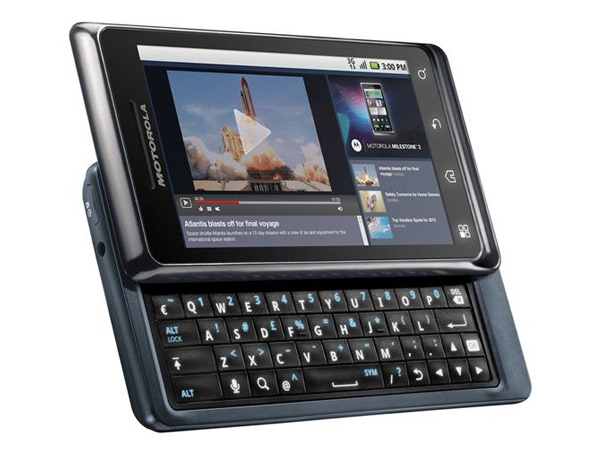
My Motorola Milestone 2 (which I think is known in some places as a Motorola Droid) has started acting up. I’ve had it more than a year now so it is out of warranty.
A couple of days ago I picked it up one evening and it was stone cold dead. Pulling the battery made no difference so I dropped it into the multimedia base and when it came to life it showed the battery was at 0%. The phone sleeps in the multimedia base so it is always fully charged and there is normally 60% left by the evening unless I’ve been running some GPS applications, which for just this reason I don’t. How odd.
The next day after a full charge the phone appeared to be OK. A couple of hours later I scrolled to the page where the Gmail app lives and its icon had changed to a box with a gear wheel in front of it. When I tried to run it I got a message “Application not installed.” Even odder.
I tried the tech support guy’s standard fix which is to switch it off and then switch it on again. To my relief this did the trick. The Gmail icon was back again and the app seemed to be working normally. Until this morning.
When I got up I was surprised that the phone wasn’t winking its green light at me to show there was email waiting. Had no-one at all commented to my blog? After breakfast I turned on the shack PC and lo and behold there were 4 messages in my inbox. The phone still showed nothing. Eventually I checked the account settings and every one of my Google accounts had the “Synchronize Gmail” setting turned off. How very peculiar.
I turned sync on again and the phone is checking my mail as normal. But I just wonder what it’s going to do next?
OK, OK! I Will Write that Ham Radio Book!
Ever since I began writing articles about my hobby of choice–amateur or “ham” radio–for my ham radio web site and several others, people have been asking me when I was going to do an amateur radio book. The truth is, I have just been too darn busy to even think of such a thing. And I also knew, in my heart of hearts, that it be would difficult indeed to get any kind of decent book contract for such a niche book. I presented my idea of a half-fiction/half-nonfiction book to the ARRL and they passed, so that confirmed my feelings. If they had no interest, I doubted anyone else who published books would either.
Fast-forward to July 2012. Things have changed, both in my personal life and in the wild and woolly world of big-time book publishing.
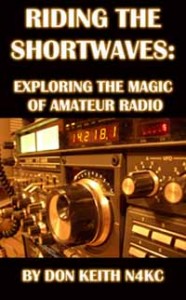
Don Keith N4KC has just published his new book of short stories, articles, advice, and more about ham radio.
First, I retired from my 60-hour-a-week day job back in May. And as I shuffled through the articles I had in the can, several more I was working on, and a few still in my head, I realized I was closer to a book than I had thought. And I truly believed I had something that would be different and could find a readership.
Secondly, as I investigated Kindle Direct Publishing at Amazon.com for the re-issue of a couple of my previous now-out-of-print books, I realized that I should absolutely pull the ham radio book together for that outlet–Kindle and some other e-book readers–at least. Amazon has become a real threat to traditional publishing companies–especially when it comes to e-books–as the old-line publishing houses struggle to figure this newfangled thing out. At the very least, it gives me the opportunity to make my book available at a very reasonable price to those interested in amateur radio. No, I don’t make much money at the price I set, even if I actually sell some downloads of the book, but that is not really the object anyway. As I have said many times, and not totally facetiously, if I wanted to make a fortune writing books, I would write pornography (See FIFTY SHADES OF GREY).
Then, as I considered other options, I realized that Amazon offers a truly unique opportunity for works like this one that allows me to offer the book in a traditional paperback format with minimal investment up front. Remember, I’m retired, on a fixed income these days! Amazon’s is a print-on-demand deal, but they seem to have it down to a science. I ordered some copies as soon as I got the book and cover uploaded and accepted for publication. The very next day I got the email that they were being shipped that day. Wow!
Again, this was with very little upfront cost and minimal hassle. Now, the paperback will be available not only via Amazon.com, but through major distributors, for order by libraries, and even in many European markets. We will see how good the print job is, but believe me on this: the major houses don’t necessarily produce the highest quality book any more either. They have to cut where they can to make a profit and printing, binding, and warehousing is a big drain on them.
Talk about rapid technological change and its effect on society and the media! Broadcast radio, TV, the Internet and telephone communications are not the only things evolving at a dizzying pace. Include the anachronistic business of book publishing in that mix, too!
Realistically, will tons of booksellers and all the Barnes & Noble stores order a box full of the books each? Or will hundreds of thousands of libraries order up a couple dozen copies each? Of course not. The big publishers do have sales staff to encourage that sort of thing. But a) no big publishing house was going to do a contract for RIDING THE SHORTWAVES: EXPLORING THE MAGIC OF AMATEUR RADIO and b) even if they did, it would be somewhere near the bottom of the sales staff’s sample case, so c) Amazon’s various self-publishing options are perfect for this kind of book.
By the way, if you have any interest in the dynamic and rapidly growing hobby of ham radio–believe me, it ain’t your weird uncle’s past-time any more!–then you may want to stop by Amazon.com and take a look “Inside the Book,” read the description, and maybe buy a copy or two…for yourself or someone you know and want to spark the interest in our amazing hobby.
See, right there in that last sentence, I did more publicity for RIDING THE SHORTWAVES than the big publishers do for most of the books they print up and ship out!
73,
Don Keith N4KC
www.donkeith.com www.n4kc.com
Did Yaesu miss the boat?
Unfortunately I was unable to attend the Dayton Hamvention this year. It was on my list of things to try to accomplish for 2012, but since I’m heading out west to Pacificon in October, I needed to save my pennies for that adventure. The Dayton Hamvention will be moved to my “things to accomplish list” for 2013.
As you may know from my recent blogging, I do own the brand new Elecraft KX3. I described this little rig in a recent podcast as “ultra-lite, ultra-portable, ultra-awesome” and the KX3 certainly lives up to all of these fine attributes. While I’ve owned my Yaesu FT-817 for about 4 years, I really love the larger display of the KX3 and of course all the updated features certainly don’t hurt either.
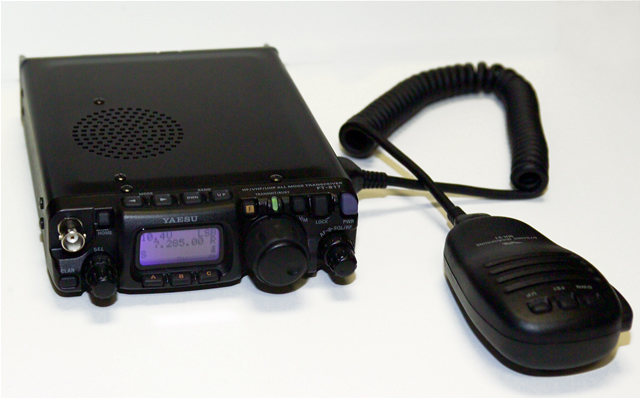
The Yaesu FT-817 was first released in 2001 and an updated FT-817ND model was made available in 2004. The 817 is based on the main circuit board design of its bigger and more powerful brothers, the FT-857 and FT-897.
As I stated, I purchased my 817 back in the 2008 timeframe and used it for portable operations and carried it along with me on hiking and backpacking trips. I became hooked on SOTA or Summits On The Air in the fall of 2011 and this became my main radio for that purpose.
While I’m perfectly happy with my KX3 and have already used it on one SOTA adventure, I was (like many) thinking, hoping, expecting, anticipating Yaesu to unveil it’s new QRP portable offering at the 2012 Dayton Hamvention. However, the Dayton Hamvention is over and there was no announcement or news of any kind from Yaesu regarding their future QRP/Portable offering. I’m wondering if the boat has sailed and left Yaesu high and dry?
With Elecraft announcing the KX3 at the 2011 Dayton Hamvention and opening the KX3 up for orders in late December 2011 and beginning to ship orders in the Spring of 2012, the 2012 Dayton Hamvention would be the perfect place to announce a new QRP offering from Yaesu. Well…that is if a new offering was planned.
Of course, Yaesu is big enough and perhaps powerful enough not to necessarily need to leverage an event like the Dayton Hamvention to announce a new QRP rig. Also, there is absolutely nothing wrong with the FT-817. While it may be over 10 years old, the old dinosaur is still kicking and screaming and loved in the QRP community. As I stated I do own one and I plan to keep it….for now!
So why do I even bring this up? Well I do have an interest in QRP operations and an updated offering from Yaesu would be great news for the hobby. However, I don’t view this as doom and gloom. I figure Yaesu will update their aging line of 817’s, 857’s and 897’s when they feel the time is right. However, I just wonder if that time is NOW!
Until next time…
73 de KDØBIK
Allow me to introduce myself
Hello AmateurRadio.com readers! I am Neil, W2NDG, a resident of the North Shore of Long Island in New York. I am a recent ham (August 2011), but a life-long techie and a shortwave listener since 1973. I will be posting from time-to-time here and wanted you to know a little about me first. I write mostly on my own sites, which can all be reached through the landing page at neilgoldstein.com.
I will be taking a look at the hobby from a newcomer’s point of view, but also covering the areas where computers and amateur radio cross over. I intend to learn code and build some QRP equipment by the end of the summer, so follow along, and we’ll have some fun with all of this. I also have some interesting plans involving SDR that I hope to be able to share in the months to come. I want to try to appeal to those of you out there on a limited budget, and help you find what you need without breaking the bank. These are tough times for many of us, but it shouldn’t keep us from having a great time with amateur radio. I also have 3 (possibly more) family members currently studying for their Technician licenses, which should make things interesting. My first post is a research piece I did for my club (LIMARC) here on Long Island about kit sources for amateur radio. So, 73s for now. See everyone soon.
Neil, W2NDG