Archive for the ‘qrp’ Category
 Stunning Video of the Sun Over Five Years, by SDO
 July 31st, 2015 |
  Author:
 Watch this video on a large screen. (It is HD). Discuss. Share.
This video features stunning clips of the Sun, captured by SDO from each of the five years since SDO’s deployment in 2010. In this movie, watch giant clouds of solar material hurled out into space, the dance of giant loops hovering in the corona, and huge sunspots growing and shrinking on the Sun’s surface.
April 21, 2015 marks the five-year anniversary of the Solar Dynamics Observatory (SDO) First Light press conference, where NASA revealed the first images taken by the spacecraft. Since then, SDO has captured amazingly stunning super-high-definition images in multiple wavelengths, revealing new science, and captivating views.
February 11, 2015 marks five years in space for NASA’s Solar Dynamics Observatory, which provides incredibly detailed images of the whole Sun 24 hours a day. February 11, 2010, was the day on which NASA launched an unprecedented solar observatory into space. The Solar Dynamics Observatory (SDO) flew up on an Atlas V rocket, carrying instruments that scientists hoped would revolutionize observations of the Sun.
Capturing an image more than once per second, SDO has provided an unprecedentedly clear picture of how massive explosions on the Sun grow and erupt. The imagery is also captivating, allowing one to watch the constant ballet of solar material through the sun’s atmosphere, the corona.
The imagery in this “highlight reel” provide us with examples of the kind of data that SDO provides to scientists. By watching the sun in different wavelengths (and therefore different temperatures, each “seen” at a particular wavelength that is invisible to the unaided eye) scientists can watch how material courses through the corona. SDO captures images of the Sun in 10 different wavelengths, each of which helps highlight a different temperature of solar material. Different temperatures can, in turn, show specific structures on the Sun such as solar flares or coronal loops, and help reveal what causes eruptions on the Sun, what heats the Sun’s atmosphere up to 1,000 times hotter than its surface, and why the Sun’s magnetic fields are constantly on the move.
Coronal loops are streams of solar material traveling up and down looping magnetic field lines). Solar flares are bursts of light, energy and X-rays. They can occur by themselves or can be accompanied by what’s called a coronal mass ejection, or CME, in which a giant cloud of solar material erupts off the Sun, achieves escape velocity and heads off into space.
This movie shows examples of x-ray flares, coronal mass ejections, prominence eruptions when masses of solar material leap off the Sun, much like CMEs. The movie also shows sunspot groups on the solar surface. One of these sunspot groups, a magnetically strong and complex region appearing in mid-January 2014, was one of the largest in nine years as well as a torrent of intense solar flares. In this case, the Sun produced only flares and no CMEs, which, while not unheard of, is somewhat unusual for flares of that size. Scientists are looking at that data now to see if they can determine what circumstances might have led to flares eruptions alone.
Scientists study these images to better understand the complex electromagnetic system causing the constant movement on the sun, which can ultimately have an effect closer to Earth, too: Flares and another type of solar explosion called coronal mass ejections can sometimes disrupt technology in space as well as on Earth (disrupting shortwave communication, stressing power grids, and more). Additionally, studying our closest star is one way of learning about other stars in the galaxy.
Goddard built, operates and manages the SDO spacecraft for NASA’s Science Mission Directorate in Washington, D.C. SDO is the first mission of NASA’s Living with a Star Program. The program’s goal is to develop the scientific understanding necessary to address those aspects of the sun-Earth system that directly affect our lives and society.
A Solar flare, A CME, A Proton Storm: Magnitude M2.5 X-ray Flare
Watch this amazing explosion on the Sun. From sunspot complex 1226-1227 comes an X-ray Flare peaking at a magnitude of M2.5 at 0640 UTC on 7 June, 2011.
Source: https://www.youtube.com/watch?v=KQMrRu8BWDo
This X-ray flare hurled a massive coronal mass ejection (CME) toward the Earth. This not-squarely Earth-directed CME is moving at 1400 km/s according to NASA models. The CME did not deliver even a noticeable glancing blow to Earth’s magnetic field late June 8th or June 9th.
What can be seen clearly in this movie is one of the most spectacular prominence eruptions ever observed. In fact, one could call it a “prominence explosion”. The prominence material expanded to a volume some 75 times as big across as the earth!
This X-ray flare also triggered an S1-level solar radiation storm, causing a long-lasting polar cap absorption (PCA) event. A polar cap absorption (PCA) event affects the propagation of a shortwave radio signal as it makes its way over the polar regions. In short, radio communications on lower shortwave radio frequencies become more difficult, as those radio signals are absorbed by the ionosphere (in the D-region) over the polar regions.
What does this mean in real-world communications? Trans-polar airline pilots may find it more difficult to communicate with regional air traffic control, shortwave radio listeners who want to hear a broadcast from a country by receiving a transmission from a country by way of a transmission beamed over the pole (like, from Europe into the USA via the North Pole), or other such communications, will find those signals all but gone. The stronger the PCA event, the higher the frequencies absorbed over the polar regions, with the greatest absorption occurring at the lower frequencies.
This movie spans the period of time from 0300 UTC through 1556 UTC, and is composed of the 171-Angstrom, 304-Angstrom, and 335-Angstrom wavelength views as captured by the filters of the Solar Dynamics Observatory (SDO) Atmospheric Imaging Assembly (AIA). In this movie, the AIA instruments capture the Sun’s extreme ultraviolet light and reveal a very large eruption of cool gas. It is somewhat unique because at many places in the eruption there seems to be even cooler material–at temperatures less than 80,000 K.
The following is a linked video that is part of this event: http://www.youtube.com/watch?v=L4CsjcUGoaw
Watch as we zoom out to see a total view of the June 7, 2011 moderately-powerful X-ray Flare and Prominence Eruption. This movie will give you a full perspective of the immense size of this prominence eruption as it spews out away from the Sun.
The X-ray Flare peaked at a moderate magnitude of M2.5 at 0640 UTC, but unleashed a huge prominence eruption. The massive cloud of plasma was ejected out into interplanetary space, but missed the Earth. This movie stars with a “close-up” view by the Solar Dynamics Observatory at a combined wavelength view at 94 and 304 Angstroms. Then, the movie views the event further back through the eyes of the COR1 spacecraft (with the SDO AIA 304 image superimposed in the middle). Next, we zoom out to the COR2 spacecraft and superimpose the COR1 and SDO views. Then, we zoom further back to the H1 view… and finally look again at the event close-up.
More info: http://sunspotwatch.com/
Google Plus:
http://g.nw7us.us/gplus_spacewx
Facebook:
http://www.facebook.com/spacewx.hfradio
http://www.facebook.com/NW7US
Twitter:
@hfradiospacewx
@NW7US
Source: SDO AIA NASA SOHO
Field Day 2015
I haven't participated in Field Day for a couple of decades. This year I was invited to participate in the Field Day operation of W5YA. W5YA has won their entered category numerous times and has finished in the top 10 of all Field Day stations multiple times, operating QRP. Their success is directly correlated to meticulous planning and the excellent execution of that plan by the team of KT5X, K1JD, K5KM, NM5S, K7SO, K6XT, W0CCA and WD9FJL. The primary antennas are wire antennas strung in the trees at the Field Day site near Chama, NM.
My role this year was to fill in some shifts at the CW stations but primarily to supervise the operation of the GOTA (Get On The Air) station along with my son, Michael Jr., AB5EB. The GOTA station used my call, AD5A, as the GOTA station must operate under a different callsign than the primary Field Day station. The GOTA operators were my grandsons Reid, KF5GYE, age 14 and Boogie, KF5GYD, age 13. Both have their General tickets, but are not very active, which is a requirement of the GOTA station. My son and I would coach them during the event. Neither of my grandsons do CW, so we would be operating SSB, QRP. Not the easiest of assignments. Operating on a crowded band with beginner level operators is quite a learning experience for all involved. What was slightly frustrating in the first 12 hours was a delight in the last 12. Both boys learned a lot about operating QRP, proper procedures and amateur radio etiquette. In the final hours of the event, no coaching was needed. They learned to handle both calling CQ and answering stations in a pile-up. Overall a fantastic result, the boys finished with 158 SSB QSO's from the GOTA station using 5 watts from a KX3 and a wire in the trees.
The final tally hasn't been made yet, but the CW station contributed over 1,400 QSO.s with wire antenna's and 5 watts of power. A very cool accomplishment and a testament to what is possible with amateur radio. Teaching us those lessons and getting new hams involved is what Field Day is all about.
We camped in a tent for two nights so I got to enjoy my son and grandsons in a great outdoor radio experience. Below is a video of the two GOTA operators. KF5GYD is operating and KF5GYE is cooking. The video should give you a flavor of Field Day.
PIXIE 2 QRP Transceiver build
PIXIE 2 QRP Transceiver build
Mizuho QRP SSB rigs

I don’t think this company still exists.
At one time you could buy Mizuho single band SSB handhelds for many bands up to 2m including many HF bands. I owned the 2m 200mW pep version (MX2) and managed to work some decent SSB DX with mine mostly with a 1/2wave whip on the rig. The main issue was the poor battery life, so I tended to use an external 9.6V battery.
My rig was used in the main with a homebrew 2m-10m transverter and I worked all over the world on 10m with just the tiny Mizuho rig on the desk.
If I remember right I covered the CW and main SSB parts of 10m by having a couple of crystals in the transverter. Somewhere I still have the transverter, although it has not been used for years.

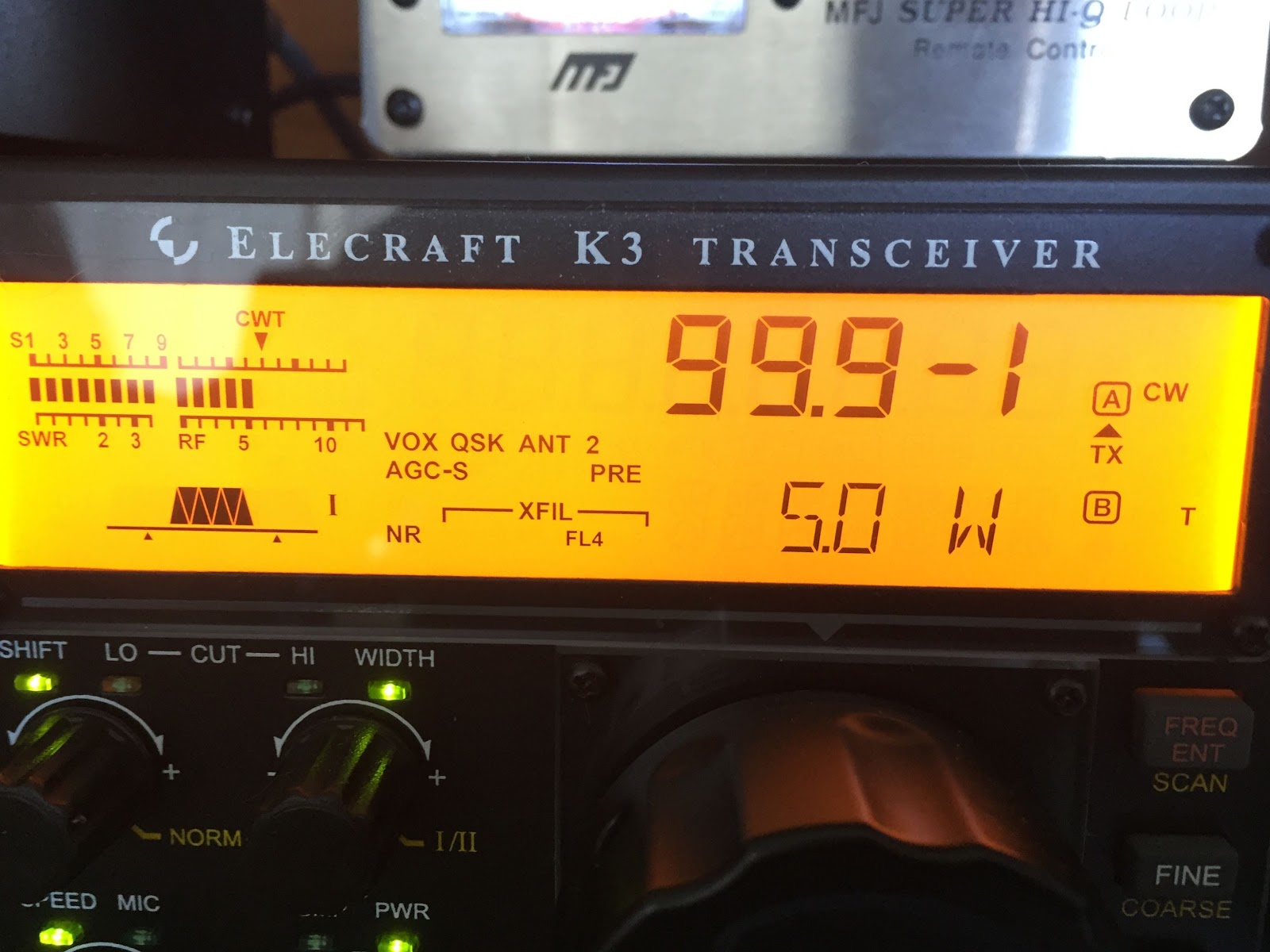
WHAT an SWR of 99:9!!
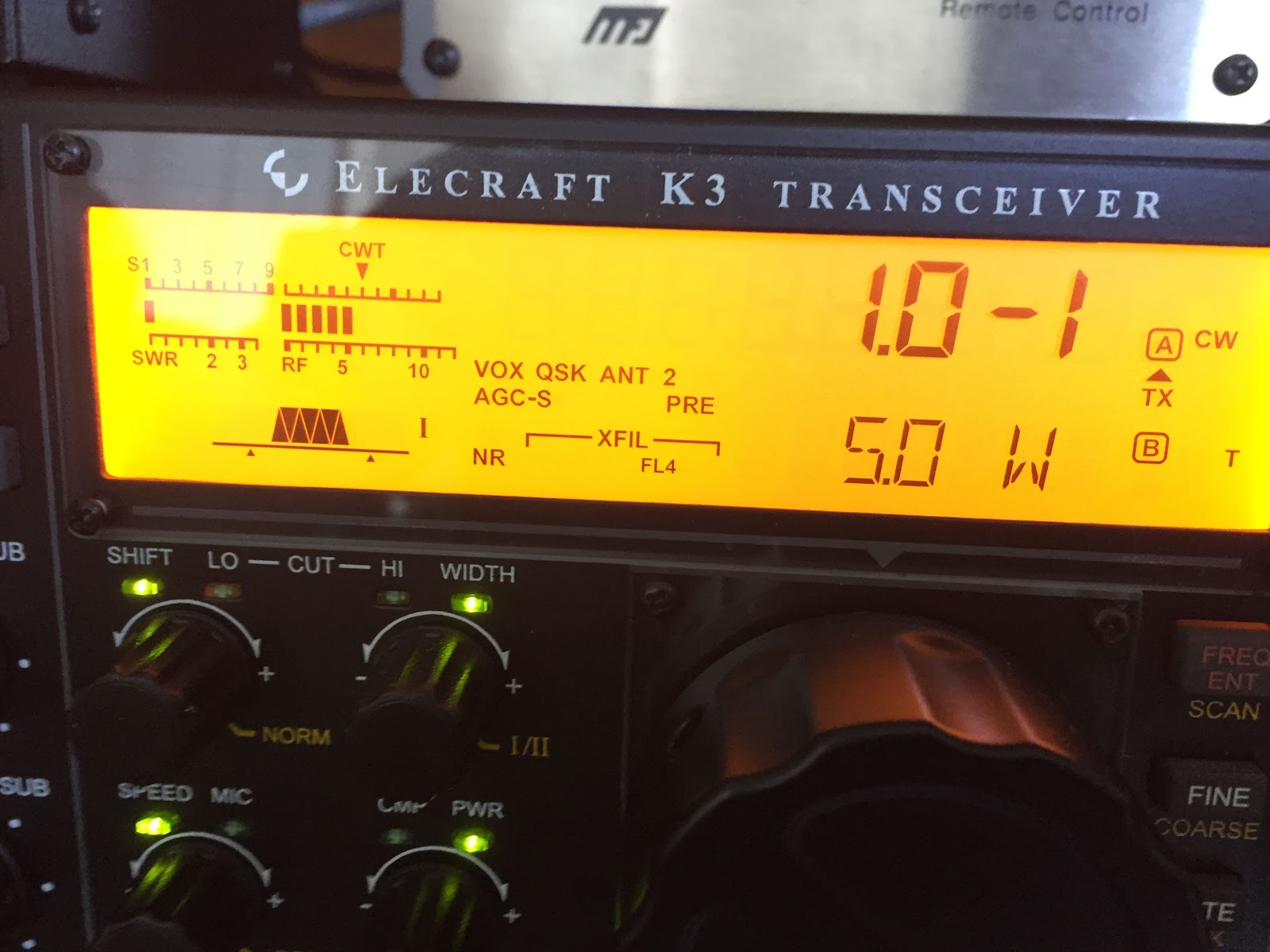 |
| Without LDG antenna switch |
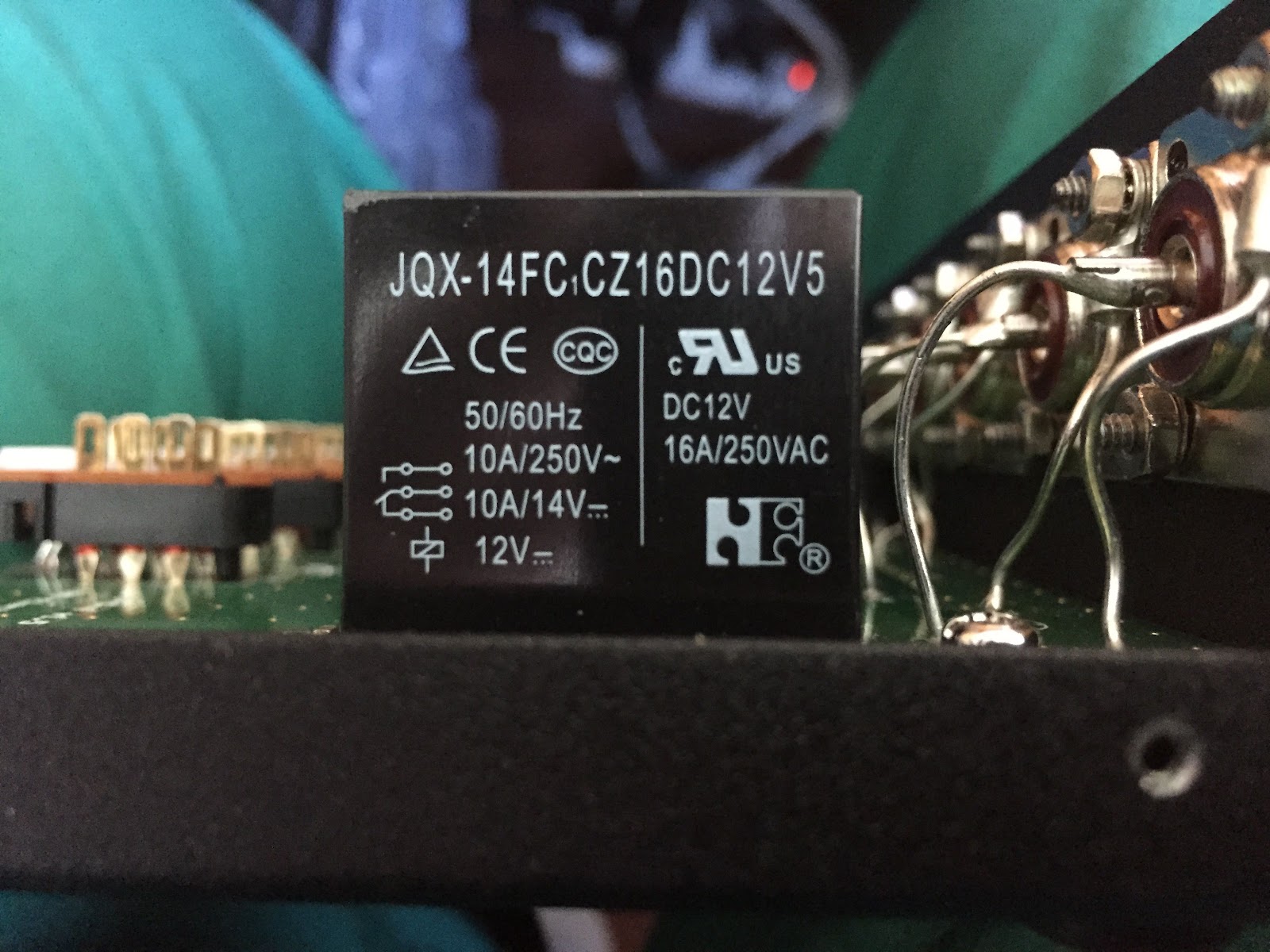 |
| Relay in the LDG antenna switch |













