Archive for the ‘qrp’ Category
 The Perception of Power
 October 3rd, 2015 |
  Author:
 Power... or lack thereof
SX-2000 HF (to 4m) QRP transceiver and SunSDR-MB1
This was news to me. I have never seen this before although the post on the website below was earlier this summer. It looks like a poor man’s IC7300 and covers the same range but at QRP power levels. It is an Italian transceiver. Personally I prefer the ICOM. I have no idea about price. It looks like a “back shed job” to me.
See http://www.cqdx.ru/ham/qro-qrp/qrp-hf-transceiver-with-touch-screen/ .
On the same website are details of the Sun SDR-MB1 assembled prototype, which is another rig I have never heard about! There is a video of this at https://youtu.be/SIfvVUw0774 . This rig looks more professional and the YouTube link quotes a price of $5500. This was 3 months ago.

QRP commercial rigs
The FT817 successor may be announced at Dayton next year. If correct, this is about 3-4 years too late.
The ICOM IC703 is not being replaced by the 10W version of the IC7300 outside of Japan. Personally, I do not understand the major Japanese manufacturers. Surely there is a worldwide demand for a 5-10W SDR based, radio?
It seems the huge world-wide QRP market is not being well addressed by the Japanese. It is their loss. I think they are all nuts!
Ten-Tec seem to be struggling with their latest Argonaut judging by recent price cuts. See http://www.rkrdesignsllc.com/products/transceivers-receivers/ten-tec-model-539-argonaut-vi-qrp-1-10-watt-transceiver/ .
No, personally I think we are seeing QRPers getting a rough deal of late.

Chuck Adams, K7QO on a Mission
Charming audio interview with Chuck Adams, K7QO on a recent QSO Today podcast. Chuck’s infectious enthusiasm for the hobby, CW, and especially his austere approach to getting on the air will delight many, especially dedicated low-power enthusiasts.

Don’t miss it and be sure to visit the program Web site as there are many links referenced from the interview. This episode highlights precisely why Eric Guth, 4Z1UG and his program are firmly affixed at the top of the ham radio podcast pile.

Tuna Tin Fun
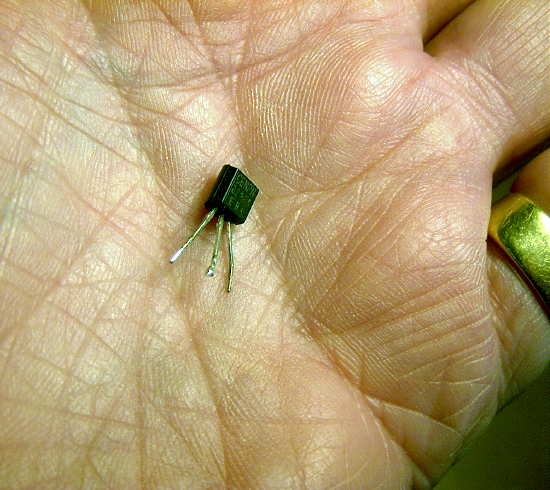
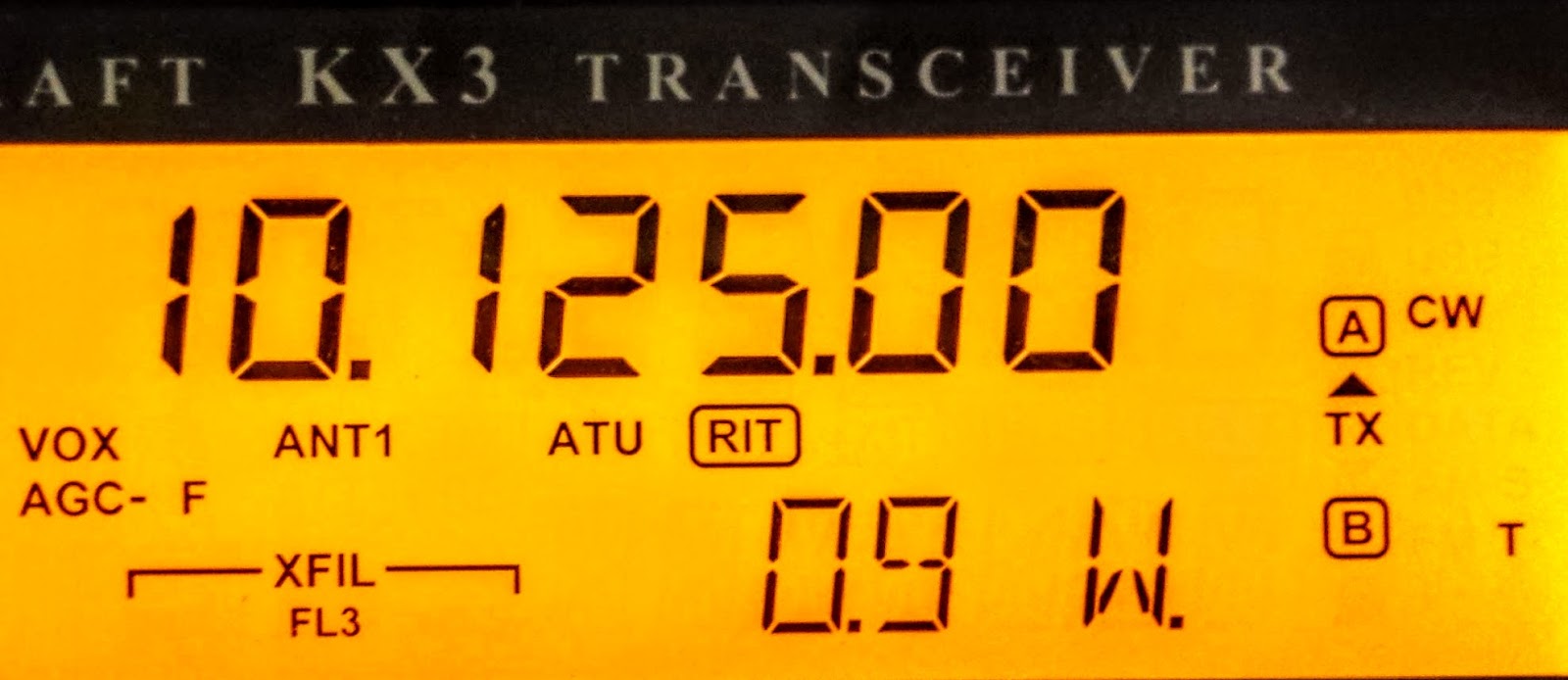
I was doing a little housekeeping in the shack this past week and ran across small piece of anti-static foam with a transistor sticking out of it. It was the transistor from my Tuna Tin II final amplifier's stage ... the actual transistor that I had used to 'Work All States' on 7040KHz using my Tuna Tin back in 2000. Looking at it in my hand brought back a lot of wonderful memories from the fall of that year when I spent so much of my time looking for new states.
Like many others at the time, I was swept up in the second 'Tuna Tin revolution' when the NorCal QRP Club released a very inexpensive kit for the Tuna Tin II. It turned out to be the best $13 I had ever spent on ham radio bits as it brought me so much operating fun while making many new acquaintances in the process.
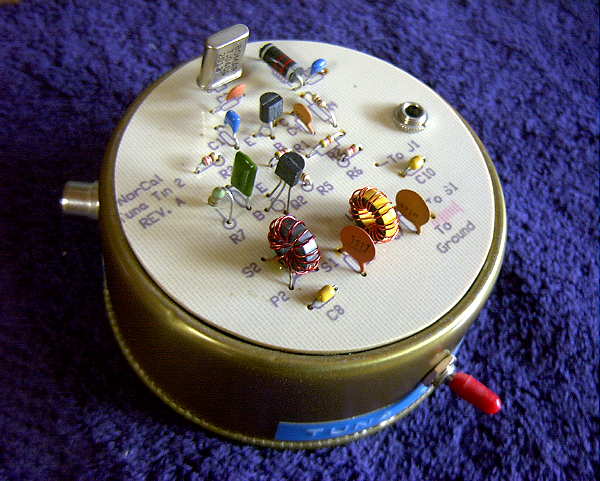
I recall the afternoon that I completed the kit ... attaching my antenna and calling 'CQ' on 7040 with a hand key plugged into the Tin. My afternoon call brought an immediate response from a station in Oregon who gave me a 579 report! Needless to say I was elated that it's ~360mw had done so well.
Over the next few days I worked a few more stations in the western states even stretching out to northern California and had pretty much decided that most of my QSO's with it would be fairly short range ... until the pre-dawn hours of August 6th when my hand-keyed 'CQ' was answered by NØTU (Steve), in Colorado! We had a nice solid ragchew until we ran out of darkness but the contact had given me re-newed optimism. If I could get a decent signal into Colorado, then perhaps I could actually work further afield ... maybe it was even possible to work all 50 states!
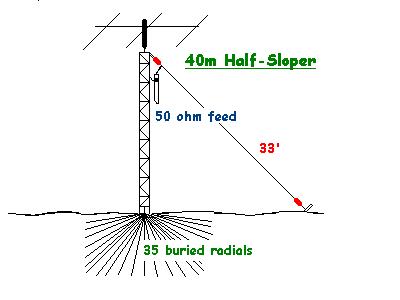
With that, I set myself a goal of trying to work them all. Although my 40m half-sloper was well matched and had proven to be a good performer in the 40m pileups, it only had four buried radials. The first thing I did was to bury another 30 radials around the base of the 48' tower, hoping to lower my ground losses as much as possible. With just one-third of a watt, there was no power to waste.
Back in those days, I was still working and could only get to the Mayne Island QTH on weekends. With the Friday night ferry arriving at around 8PM, by the time the woodstove had been fired-up and dinner taken care of, I very often didn't get to the Tuna Tin until around 11PM. As it turned out, the late hour operation worked out well and it didn't take long for my state total to climb. The toughest states were the New England '1's and as I neared the end, I still needed several. In late November, 40m revealed its magic-side and an early-evening 'CQ' brought replies from three W1's, all at once, each one a new state. Finally, in early December, I worked Wyoming for state number fifty!
The fifty QSL's were duly gathered and sent to the ARRL for an official "WAS" award. Although there was no special endorsement for the Tuna Tin, other than for 'QRP', there was a nice note about it in the 'ARRL Letter' as well as in QST:
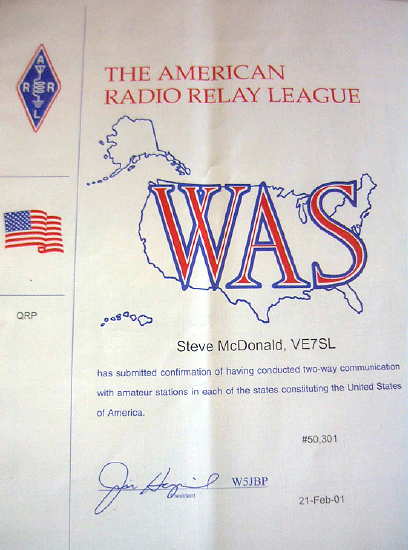
First Tuna Tin 2 WAS claimed: When the Tuna Tin 2 low-power transmitter article appeared in QST in 1976, its author Doug DeMaw, W1CER (later W1FB), envisioned it as a weekend project that could be used for short-range contacts.
Now, a quarter of a century later, a Canadian amateur has claimed the first Tuna Tin 2 Worked All States Award! Steve McDonald, VE7SL, got caught up in "Tuna Tin 2 Mania" and bought one of the popular TT2 kits. After working about 30 states with the little rig, WAS suddenly seemed plausible. McDonald realized his dream several months later when he turned in his cards for WAS. All contacts for the award had been completed while he was running about 400 mW from a Tuna Tin 2. As far as the ARRL awards folks know, this marked the first time WAS was achieved with a Tuna Tin 2--although there is no special endorsement for having done so. "Doug DeMaw knew in his heart that the rig would be useful and popular, but I don't think he ever envisioned that this little transmitter would still be working its QRP magic over 25 years after it first appeared in the pages of QST," said ARRL Lab Supervisor Ed Hare, W1RFI--himself a QRP and TT2 aficionado who has promoted the Tuna Tin 2 Revival and was McDonald's Connecticut contact for WAS. Congratulations to VE7SL on a tremendous operating accomplishment.--Ed Hare, W1RFI
Holding the battle-scarred 2N2222 in the palm of my hand reminded me of just how much excitement can be had with just a few simple parts and the magic of radio.
Frog Transceiver
You will have doubtlessly heard about the super cheap Pixie QRP TXRX. Well for those feeling a little flush there is a (and always has been) a real high powered alternative knocking about on eBay. The Frog Transceiver is around the £8 mark at the moment and will give you about 1.5w on 40m and an evenings worth of fun putting it together.
 I’m off work this week for my summer hols and in between kayaking on the sea, being eaten alive in Ennerdale by voracious midges (my own fault for going there when there was no wind and not taking any insect repellent) I’d planned on assembling this little friend to add to my growing collection (along with the Pixie).
The PCB is as one would expect, not bad but not brilliant, components are fit for purpose but the packaging was a little shabby with everything just thrown in a bag, not much protection for the IC’s. So I’m getting my excuses in early….this might not work!
Still £8 is less than an evening at the pub, less than a trip to the cinema (for one) but more than a Pixie 
Our Amazing Sun and HF Radio Signal Propagation
Space Weather. The Sun-Earth Connection. Ionospheric radio propagation. Solar storms. Coronal Mass Ejections (CMEs). Solar flares and radio blackouts. All of these topics are interrelated for the amateur radio operator, especially when the activity involves the shortwave, or high-frequency, radiowave spectrum.
Learning about space weather and radio signal propagation via the ionosphere aids you in gaining a competitive edge in radio DX contests. Want to forecast the radio propagation for the next weekend so you know whether or not you should attend to the Honey-do list, or declare a radio day?
In the last ten years, amazing technological advances have been made in heliophysics research and solar observation. These advances have catapulted the amateur radio hobbyist into a new era in which computer power and easy access to huge amounts of data assist in learning about, observing, and forecasting space weather and to gain an understanding of how space weather impacts shortwave radio propagation, aurora propagation, and so on.
I hope to start “blogging” here about space weather and the propagation of radio waves, as time allows. I hope this finds a place in your journey of exploring the Sun-Earth connection and the science of radio communication.
With that in mind, I’d like to share some pretty cool science. Even though the video material in this article are from 2010, they provide a view of our Sun with the stunning solar tsunami event:
On August 1, 2010, the entire Earth-facing side of the sun erupted in a tumult of activity. There was a C3-class solar flare, a solar tsunami, multiple plasma-filled filaments of magnetism lifting off the stellar surface, large-scale shaking of the solar corona, radio bursts, a coronal mass ejection and more!
At approximately 0855 UTC on August 1, 2010, a C3.2 magnitude soft X-ray flare erupted from NOAA Active Sunspot Region 11092 (we typically shorten this by dropping the first digit: NOAA AR 1092).
At nearly the same time, a massive filament eruption occurred. Prior to the filament’s eruption, NASA’s Solar Dynamics Observatory (SDO) AIA instruments revealed an enormous plasma filament stretching across the sun’s northern hemisphere. When the solar shock wave triggered by the C3.2-class X-ray explosion plowed through this filament, it caused the filament to erupt, sending out a huge plasma cloud.
In this movie, taken by SDO AIA at several different Extreme Ultra Violet (EUV) wavelengths such as the 304- and 171-Angstrom wavelengths, a cooler shock wave can be seen emerging from the origin of the X-ray flare and sweeping across the Sun’s northern hemisphere into the filament field. The impact of this shock wave may propelled the filament into space.
This movie seems to support this analysis: Despite the approximately 400,000 kilometer distance between the flare and the filament eruption, they appear to erupt together. How can this be? Most likely they’re connected by long-range magnetic fields (remember: we cannot see these magnetic field lines unless there is plasma riding these fields).
In the following video clip, taken by SDO AIA at the 304-Angstrom wavelength, a cooler shock wave can be seen emerging from the origin of the X-ray flare and sweeping across the sun’s northern hemisphere into the filament field. The impact of this shock wave propelled the filament into space. This is in black and white because we’re capturing the EUV at the 304-Angstrom wavelength, which we cannot see. SDO does add artificial color to these images, but the raw footage is in this non-colorized view.
The followling video shows this event in the 171-Angstrom wavelength, and highlights more of the flare event:
The following related video shows the “resulting” shock wave several days later. Note that this did NOT result in anything more than a bit of aurora seen by folks living in high-latitude areas (like Norway, for instance).
This fourth video sequence (of the five in the first video shown in this article) shows a simulation model of real-time passage of the solar wind. In this segment, the plasma cloud that was ejected from this solar tsunami event is seen in the data and simulation, passing by Earth and impacting the magnetosphere. This results in the disturbance of the geomagnetic field, triggering aurora and ionospheric depressions that degrade shortwave radio wave propagation.
At about 2/3rd of the way through, UTC time stamp 1651 UTC, the shock wave hits the magnetosphere.
This is a simulation derived from satellite data of the interaction between the solar wind, the earth’s magnetosphere, and earth’s ionosphere. This triggered aurora on August 4, 2010, as the geomagnetic field became stormy (Kp was at or above 5).
While this is an amazing event, a complex series of eruptions involving most of the visible surface of the sun occurred, ejecting plasma toward the Earth, the energy that was transferred by the plasma mass that was ejected by the two eruptions (first, the slower-moving coronal mass ejection originating in the C-class X-ray flare at sunspot region 1092, and, second, the faster-moving plasma ejection originating in the filament eruption) was “moderate.” This event, especially in relationship with the Earth through the Sun-Earth connection, was rather low in energy. It did not result in any news-worthy events on Earth–no laptops were fried, no power grids failed, and the geomagnetic activity level was only moderate, with limited degradation observed on the shortwave radio spectrum.
This “Solar Tsunami” is actually categorized as a “Moreton wave”, the chromospheric signature of a large-scale solar coronal shock wave. As can be seen in this video, they are generated by solar flares. They are named for American astronomer, Gail Moreton, an observer at the Lockheed Solar Observatory in Burbank who spotted them in 1959. He discovered them in time-lapse photography of the chromosphere in the light of the Balmer alpha transition.
Moreton waves propagate at a speed of 250 to 1500 km/s (kilometers per second). A solar scientist, Yutaka Uchida, has interpreted Moreton waves as MHD fast-mode shock waves propagating in the corona. He links them to type II radio bursts, which are radio-wave discharges created when coronal mass ejections accelerate shocks.
I will be posting more of these kinds of posts, some of them explaining the interaction between space weather and the propagation of radio signals.
For live space weather and radio propagation, visit http://SunSpotWatch.com/. Be sure to subscribe to my YouTube channel: https://YouTube.com/NW7US.
The fourth video segment is used by written permission, granted to NW7US by NICT. The movie is copyright@NICT, Japan. The rest of the video is courtesy of SDO/AIA and NASA. Music is courtesy of YouTube, from their free-to-use music library. Video copyright, 2015, by Tomas Hood / NW7US. All rights reserved.













