Archive for the ‘hf’ Category
 Portable Pains
 June 9th, 2015 |
  Author:
 Indeed during the last twelve months I have done some more portable operating, but while VHF/UHF have been rewarding HF portable has been a mixed bag with at best satisfactory results, but then the same can be said of operating HF from home.
This year I planned to again operate in the 2m UKAC Contest but rather than working from the comfort of the caravan I was going to work from some higher ground near the camp site. Unfortunately the weather was awful with very strong winds gusting upward of 50mph and driving rain, even working from the caravan was a no go.
So rather than enjoying this view with a microphone in hand...

... this was the how I spent the evening and as you can see Eddie was equally impressed.
When the wind and rain subsided toward the end of the week we did have some nice weather so I decided to try some HF. I had taken just the M0CVO Magitenna end-fed wire and using a 9m fibreglass pole I tried operating with it as a vertical and as a sloper both with and without counterpoises and despite receiving some very big S9+ signals on a number of bands seemed to be incapable of making myself heard, I did make a number of contacts but many reported weak signals and stood little chance of working many of the special event station pile-ups.
It wasn't helped that on the first day the radiating element connector broke, which necessitated cutting it off and stripping back the wire. I suppose in retrospect I should have been expected it as there is no strain relief on this wire, unlike the loops on the other antennas in the M0CVO range, I rectified this with a few cable ties.
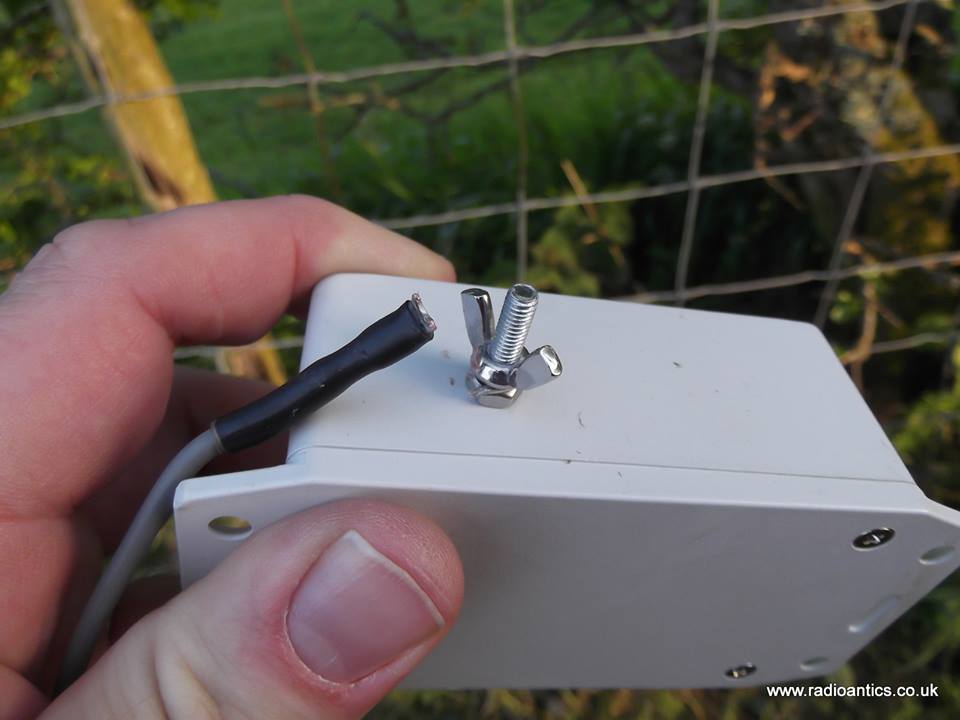
I was running the Yaesu FT857-D from a leisure battery and around 30W as I didn't wish to interfere with the TV reception as I knew most caravans would be using wide-band antenna amplifiers because of the poor coverage. Indeed the one time I did wind the power up to 100W one caravan mains breaker tripped out, it may have been coincidence but I didn't wish to put it to the test.
Despite the lack of performance it was great just sitting under the majestic Skiddaw and surrounding hills while I spent a few enjoyable hours operating. I even discovered one of my neighbours was also licensed, nice to meet you Joe (G4LIA)

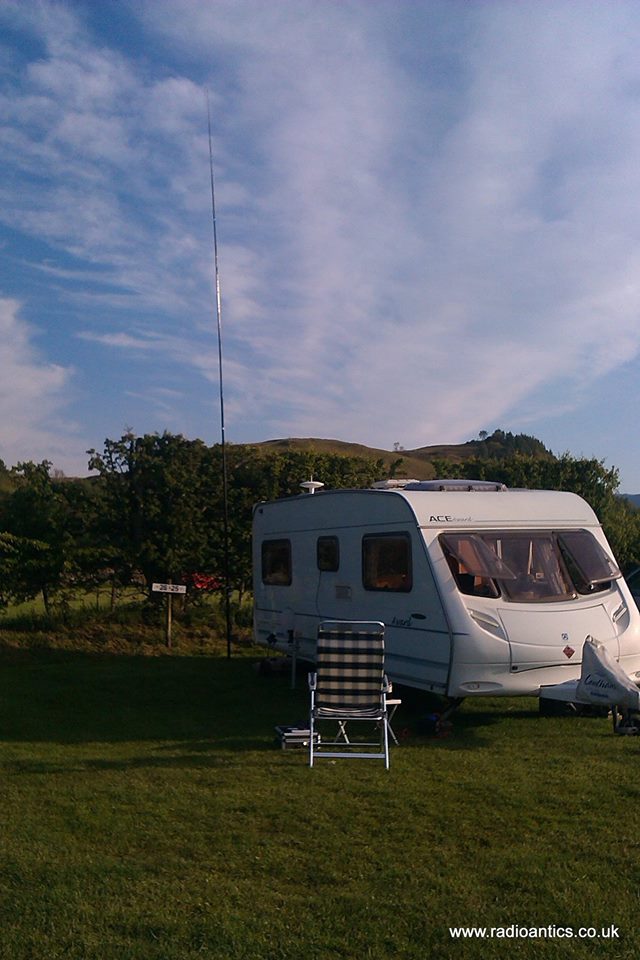
It was frustrating from a contact point of view and I willingly accept I could be a bad workman so don't wish to blame my tools but I think some serious rethinking on a portable HF antenna is needed. I am away to Scotland next month for a week on the Isle of Skye and a week on Islay, this time in rented cottages and am hoping to make a QSO with the South Kesteven ARS on the club night.
Anyway that all has to wait as the launch of Eggsplorer-1 HAB and the GB2EGG Special Event Station are rapidly approaching.
Weekly Propagation Summary – 2015 Jun 08 16:10 UTC
Here is this week’s space weather and geophysical report, issued 2015 Jun 08 0221 UTC.
Highlights of Solar and Geomagnetic Activity 01 – 07 June 2015
Solar activity was low this period. Low to mid-level C-class flare activity dominated the period and Region 2361 (N16, L=105, class/area=Dai/110 on 06 Jun) was responsible for the bulk of the activity. Region 2361 produced a total of nine C-class flares throughout the week, the largest of which was C8/Sf flare at 0947 UTC on 04 Jun. Region 2360 (N15, L=132, class/area=Eac/140 on 07 Jun) grew in total sunspot count, area, and magnetic complexity late in the week but was only responsible for three low-level C-class flares this period. In addition to the low-level solar activity, multiple disappearing solar filaments and eruptive prominence liftoffs were observed throughout the week, but none resulted in Earth-directed coronal mass ejections.
No proton events were observed at geosynchronous orbit.
The greater than 2 MeV electron flux at geosynchronous orbit was at normal levels throughout the period.
Geomagnetic field activity was at quiet levels throughout the period under an ambient solar wind environment with unsettled levels observed early on 01 Jun and late on 07 Jun which were attributed to minor perturbations in the solar wind.
Forecast of Solar and Geomagnetic Activity 08 June – 04 July 2015
Solar activity is expected to be at low levels with a slight chance for M-class (R1-Minor) flare activity for 08-16 Jun due to the flare potential from Regions 2360 (N15, L=132), 2361 (N16, L=105), and 2362 (N07, L=100). As Regions 2360, 2361, and 2362 rotate off the visible disk, very low levels of solar activity are expected with a chance for C-class flare activity for 17 Jun-04 Jul.
No proton events are expected at geosynchronous orbit.
The greater than 2 MeV electron flux at geosynchronous orbit is anticipated to reach high levels on 10-14 Jun with moderate levels likely on 15-19 Jun in response to an enhanced solar wind environment caused by the influence of coronal hole high speed streams (CH HSSs). Normal levels are expected for the remainder of the period.
Geomagnetic field activity is expected to reach active levels on 08, 10 Jun with G1 (Minor) geomagnetic storm conditions anticipated on 09 Jun in response to a recurrent negative polarity CH HSS. Unsettled geomagnetic field conditions are expected on 11-12 Jun as CH HSS effects subside. A recurrent positive polarity CH HSS is expected to bring about isolated periods of unsettled conditions on 15 Jun. Generally quiet field conditions are expected for 16 Jun-03 Jul with unsettled levels likely again on 04 Jul due to a solar sector boundary crossing ahead of a negative polarity CH HSS.
Don’t forget to visit our live space weather and radio propagation web site, at: http://SunSpotWatch.com/
Live Aurora mapping is at http://aurora.sunspotwatch.com/
If you are on Twitter, please follow these two users: + https://Twitter.com/NW7US + https://Twitter.com/hfradiospacewx
Get the space weather and radio propagation self-study course, today. Visit http://nw7us.us/swc for the latest sale and for more information!
Check out the stunning view of our Sun in action, as seen during the last five years with the Solar Dynamics Observatory (SDO): https://www.youtube.com/watch?v=zXN-MdoGM9g
We’re on Facebook: http://NW7US.us/swhfr
Weekly Propagation Summary – 2015 Jun 01 16:10 UTC
Here is this week’s space weather and geophysical report, issued 2015 Jun 01 0141 UTC.
Highlights of Solar and Geomagnetic Activity 25 – 31 May 2015
Solar activity was at very low levels for the majority of the period with the exception of 27 May when low levels were observed. The period was dominated by only low-to-mid level B-class flares with an isolated C1 flare at 2131 UTC on 27 May. The only C-class event of the period originated from Region 2456 (S16, L=199, class/area=Cso/70 on 30 May) but no coronal mass ejection (CME) was observed with this event. Multiple prominence and filament eruptions were observed throughout the period but none resulted in Earth-directed CMEs.
No proton events were observed at geosynchronous orbit.
The greater than 2 MeV electron flux at geosynchronous orbit was normal levels throughout the period.
Geomagnetic field activity was generally quiet throughout the period with an isolated period of unsettled activity observed between 27/1200-1500 UTC.
Forecast of Solar and Geomagnetic Activity 01 June – 27 June 2015
Solar activity is expected to be very low with a chance for C-class flare activity throughout the outlook period.
No proton events are expected at geosynchronous orbit.
The greater than 2 MeV electron flux at geosynchronous orbit is expected to be at moderate levels on 15-19 Jun and high levels on 10-14 Jun with normal levels expected for the remainder of the period.
Geomagnetic field activity is expected to be at active levels on 10 and 14-15 Jun with G1 (Minor) geomagnetic storms likely on 08-09 Jun, all in response to recurrent coronal hole high speed stream influence. Quiet to unsettled geomagnetic field activity is expected for the remainder of the period.
Don’t forget to visit our live space weather and radio propagation web site, at: http://SunSpotWatch.com/
Live Aurora mapping is at http://aurora.sunspotwatch.com/
If you are on Twitter, please follow these two users: + https://Twitter.com/NW7US + https://Twitter.com/hfradiospacewx
Get the space weather and radio propagation self-study course, today. Visit http://nw7us.us/swc for the latest sale and for more information!
Check out the stunning view of our Sun in action, as seen during the last five years with the Solar Dynamics Observatory (SDO): https://www.youtube.com/watch?v=zXN-MdoGM9g
We’re on Facebook: http://NW7US.us/swhfr
User Hostile! Radios that you love to hate!

Three band HT Radio, 2 Meters, 70 CM and 6 Meters
“I hate this radio”
Have you ever said this?
I certainly have. Some radios are a joy to use. They are intuitive, easy to use and you don’t ‘NEED THE MANUAL’ every time you want to change something!
HT’s seem to be the most ‘user hostile’ radios available to hams. I know! All HT radios should have certain things, VFO, on off knob/button, volume control and keypad, and in my opinion, they should not be so difficult to use that you need to read the manual every time you want to do, what should be a simple task; change CTCSS tone of a repeater, for example!
When HT’s were reduced in size, they became more complicated to use. Menu systems were instituted. They were further reduced in size and menus were multi-layered! How many times have I yelled at my HT after holding button a for 1 second, then within 4 seconds, tried to press button 2, for 1 second but no more than 2.5 seconds, while doing 3 pirouette turns on my left foot, only then, can I use my radio. That same button has 3 functions now a days. Press it once for one thing, press it again within a specified number of seconds and you get another function. Press and hold it and you get yet another option.
Enter the English Translation, manual! Poorly translated from Japanese, but at least its in English! (With many pertinent things omitted!)
Why do manuals go to great lengths to tell you in great detail everything that you ‘don’t want to know’ and will most likely never use or use very seldom?
But tell you want you NEED TO KNOW, naw! Tell you how to ‘undo’ something? That would make it too easy!
Actually, I really like this VX5-R HT from Yaesu. It’s a love/hate relationship, however! So very handy, it fits in the palm of my hand, has lots of memories, and many many nice features. Accessing those features is not always easy, especially without the manual right in front of you. If you ever push the wrong button, and send it into ‘never-never-land’, its hard to un-do what you just did! One thing that was left out of the VX 5 is a memory clear feature! That omission makes life with this radio difficult at best!
You cannot return a designated memory channel to its ‘no data’ state. The only thing you can do from the radio itself is to overwrite that particular memory with another frequency!

2 Meter IC V8000
I’m not picking only on Yaesu!
This Icom V 8000 is the most ‘User Hostile’ radio that I have ever owned.
Not only is it difficult to use, but it has problems as well. The mic is notorious for a mechanical problem with the PTT button, and the external speaker jack does not work well. Unfortunately, the external speaker jack is where you have to plug the programming cable in to program the radio. The Icom program for doing this is also ‘user hostile’ BTW!
Editing and Cloning Software RT Systems I bought software and cable from RT systems to program and manage the Icom T 70-A. The HT and its programming software arrived yesterday.

IC T 70 programming software and cable

Icom T70 A with spare battery, left, drop in charger, and speaker mic
The Icom T-70-A, is the replacement radio for the Yaesu VX 5
It will replace the VX5 as my ‘go to’ HT. Just last night, I picked up the Yaesu VX5 the wrong way, mashed some buttons on its face and sent it into never-never-land! Try as I may, I could not undo it with normal button press. Since the radio has an RT Systems program and cable on its way, I went nuclear, and reset the processor. Finally, the radio was operational once more. It needs programming of course but the display is no longer stuck!
It programmed the Icom T 70-A radio to my specifications with only a cursory reading of the manual. The radio is intuitive, easy to use and has some great features. RT Systems Programming Software and Cable

IC 7100 with Touch Paddles
Funny, I just installed an Icom 7100 mobile HF/VHF/UHF/MF radio in my truck. That radio was ‘done right’ by the manufacturer! Its easy to program and use, so there is no need to keep the manual handy for simple tasks. I run mobile CW/SSB and VHF repeaters with it. If there were any UHF in the area, I’d have that programmed in there too. Its a joy to use!
This photo shows the IC 7100 on a modified clip board held in place with bungee cords. So far, I have not seen the need for programming software. That said, there is an SD card on board this radio. It can save the settings to the SD card. I have not explored this avenue yet. It would be nice to keep a copy of the settings on an SD card and on my laptop for future use. Something unexpected can happen. Spare radio data would come in very handy then. Replacing all the settings would be very easy with the programming/clone software. RT systems sells that one too.
Do you have a radio that you love to hate?
Weekly Propagation Summary – 2015 May 25 16:10 UTC
Here is this week’s space weather and geophysical report, issued 2015 May 25 0854 UTC.
Highlights of Solar and Geomagnetic Activity
18 – 24 May 2015
Solar activity was at low levels from 18-23 May with very low levels observed on 24 May. Only low level isolated C-class flaring was observed during the period originating from Regions 2349 (S21, L=002, class/area Dao/060 on 24 May), 2351 (N22, L=330, class/area Cso/020 on 20 May), and 2353 (N07, L=344, class/area Dao/060 on 24 May). Region 2339 (N13, L=129, class/area Fkc/900 on 08 May), which was very productive last period, decayed as it quietly rotated around the NW limb on 18 May. Region 2349 emerged on the visible disk on 18 May, but did not show any significant growth until 23 May. Region 2353 emerged on 21 May and exhibited growth through the end of the period. However, both regions only managed 60 millionths of coverage by the end of the period. No Earth directed coronal mass ejections were observed.
No proton events were observed at geosynchronous orbit.
The greater than 2 MeV electron flux at geosynchronous orbit was at normal levels on 19 and 24 May, moderate levels from 20-23 May, and at high levels on 18 May.
Geomagnetic field activity ranged from quiet to major storm conditions. The period began under the influence of a co-rotating interaction region followed by a positive polarity equatorial coronal hole high speed stream (CH HSS). Total field increased to a maximum of 18 nT at 19/0052 UTC while the Bz component fluctuated between +13 nT and -15 nT late on 18 May through early on 19 May. Solar wind increased to near 575 km/s by midday on 19 May before slowly returning to nominal conditions by late on 20 May. The geomagnetic field responded with minor to major storm conditions late on 18 May through early on 19 May. Quiet to unsettled levels were observed on 20 May. A return to quiet conditions occurred on 21 May and persisted through the end of the period.
Forecast of Solar and Geomagnetic Activity
25 May – 20 June 2015
Solar activity is expected to be at very low to low levels. A chance for moderate levels exists from 30 May through 11 Jun with the return of Region 2339.
No proton events are expected at geosynchronous orbit.
The greater than 2 MeV electron flux at geosynchronous orbit is expected to be at normal to moderate levels with high levels possible from 31 May-01 Jun, 04-06 Jun, 10-12 Jun, and 16-20 Jun due to recurrent CH HSS effects.
Geomagnetic field activity is expected to be at unsettled to active levels from 28-30 May, 02-03 Jun, 07-11 Jun, and 13-15 Jun with possible minor storm levels on 08-09 Jun due to recurrent CH HSS effects.
Don’t forget to visit our live space weather and radio propagation web site, at: http://SunSpotWatch.com/
Live Aurora mapping is at http://aurora.sunspotwatch.com/
If you are on Twitter, please follow these two users:
+ https://Twitter.com/NW7US
+ https://Twitter.com/hfradiospacewx
Get the space weather and radio propagation self-study course, today. Visit http://nw7us.us/swc for the latest sale and for more information!
Check out the stunning view of our Sun in action, as seen during the last five years with the Solar Dynamics Observatory (SDO):
https://www.youtube.com/watch?v=zXN-MdoGM9g
We’re on Facebook: http://NW7US.us/swhfr
Weekly Propagation Summary – 2015 May 18 16:10 UTC
Here is this week’s space weather and geophysical report, issued 2015 May 18 0402 UTC.
Highlights of Solar and Geomagnetic Activity
11 – 17 May 2015
Solar activity was low from 11-15 May. The largest event of the
period was a C9/1n at 13/1838 UTC associated with a filament
eruption near Region 2345 (N16, L=113, class/area Axx/020 on 13
May). Region 2339 (N13, L=129, class/area Fkc/900 on 08 May) was the
most active region on the disk and produced 19 C-class events during
the period. There were several filament eruptions observed during
the period however, none of them turned out to be geoeffective.
Solar activity decreased to very low levels for 16-17 May.
The greater than 10 MeV proton flux at geosynchronous orbit was
enhanced on 12 May reaching a peak flux of 6 pfu at 12/0720 UTC but
never crossed alert threshold.
The greater than 2 MeV electron flux at geosynchronous orbit was at
normal to moderate levels on 11-13 May before reaching high levels
daily for the remainder of the period in response to effects from a
negative polarity coronal hole high speed stream (CH HSS).
Geomagnetic field activity was at unsettled to active levels on 11
May and mostly unsettled levels on 12 May due to extended periods of
negative Bz. On 13 May, geomagnetic field conditions increased to
active to major storm levels due to the onset of a recurrent
negative polarity CH HSS. Quiet to unsettled levels persisted on
14-15 May as effects from the HSS subsided. Quiet conditions
prevailed for the remainder of the period.
Forecast of Solar and Geomagnetic Activity
18 May – 13 June 2015
Solar activity is expected to be at very low levels with a chance
for C-class flares and a slight chance of M-class flares on 18 May
before decreasing further to only a chance for C-class flares once
Region 2339 rotates fully around the west limb on 19 May. The chance
for M-class activity increases on 25 May with the return of old
Region 2335 (S15, L=192) and remain elevated through the remainder
of the forecast period.
No proton events are expected at geosynchronous orbit.
The greater than 2 MeV electron flux at geosynchronous orbit is
expected to be at moderate to high levels from 18-28 May due to
residual effects from last weeks negative polarity CH HSS followed
by effects from an anticipated positive polarity HSS due to become
geoeffective on 18 May. Normal to moderate levels are expected to
prevail with the exception of 31 May-01 Jun, 04-06 Jun, and 10-12
Jun following various recurrent CH high speed streams.
Geomagnetic field activity is expected to be quiet to active on
18-19 May due to effects from a positive polarity CH HSS. Mostly
quiet conditions are expected from 20 May to 01 Jun. Quiet to
unsettled conditions with a chance for active periods are expected
on 02-03 Jun due to effects from a negative polarity HSS followed by
quiet conditions through 06 Jun. Unsettled conditions are expected
on 07 and 10 Jun as well as active to minor storm conditions on
08-09 Jun due to the anticipated return of the recurrent negative
polarity CH HSS that yielded major storm conditions this week.
Mostly quiet conditions are expected for the remainder of the
period.
Don’t forget to visit our live space weather and radio propagation web site, at: http://SunSpotWatch.com/
Live Aurora mapping is at http://aurora.sunspotwatch.com/
If you are on Twitter, please follow these two users:
+ https://Twitter.com/NW7US
+ https://Twitter.com/hfradiospacewx
Get the space weather and radio propagation self-study course, today. Visit http://nw7us.us/swc for the latest sale and for more information!
Check out the stunning view of our Sun in action, as seen during the last five years with the Solar Dynamics Observatory (SDO):
https://www.youtube.com/watch?v=zXN-MdoGM9g
We’re on Facebook: http://NW7US.us/swhfr
Weekly Propagation Summary – 2015 May 11 16:10 UTC
Here is this week’s space weather and geophysical report, issued 2015 May 11 0537 UTC.
Highlights of Solar and Geomagnetic Activity
04 – 10 May 2015
Solar activity ranged from low to high levels during the period. The
largest and most active regions on the solar disk this period were
Regions 2335 (S15, L=192, class/area Eac/310 on 04 May) and 2339
(N13, L=129, class/area Fkc/900 on 08 May). Region 2335 began the
period reaching its peak in area and magnetic complexity
(Beta-gamma). On 05 May it produced two M-class flares; an M1 at
05/1425 UTC and an M2 at 05/1724 UTC. By 06 May, Region 2335 was in
decay and ended the period as a simple Cro spot class with a beta
magnetic configuration. Region 2339 was in a growth phase since it
rotated around the NE limb on 05 May. This region was responsible
for multiple M-class flaring spanning 05-06 May and an impulsive X2
flare at 05/2211 UTC with an associated Type II radio sweep (1163
km/s), a 590 sfu Tenflare and a non-Earth directed coronal mass
ejection (CME) first observed in SOHO/LASCO C2 imagery at 05/2224
UTC off the NE limb. Solar activity declined to low levels from
07-10 May.
No proton events were observed at geosynchronous orbit.
The greater than 2 MeV electron flux at geosynchronous orbit was at
moderate levels on 04-05 May and at normal levels from 06-10 May.
Geomagnetic field activity ranged from quiet to minor storm levels
during the period. The period started off with quiet conditions on
04 and 05 May under a nominal solar wind regime. At 06/0053 UTC, a
shock was observed at the ACE satellite associated with a 02 May CME
that occurred as a result of an 18 degree filament eruption observed
between 02/1500-1830 UTC. Total field increased to a maximum of 18
nT at 06/0614 UTC while the Bz component went southward to a maximum
of -13 nT at 06/1216 UTC. Solar wind speeds increased from 363 km/s
to around 490 km/s. A geomagnetic sudden impulse was subsequently
observed at 06/0143 UTC with a 31 nT deviation in the Boulder
magnetometer. As a result, quiet to minor storm levels were observed
on 06 May. By late on 06 May and through 07 May, the Bz component
deflected north and remained so as CME effects diminished. Nominal
solar wind conditions prevailed through 10 May when the total field
became enhanced once again. Total field increased to 14 nT with
prolonged periods of southward Bz. No appreciable increase in solar
wind speed was observed with this event, however. The geomagnetic
field was quiet on 07 May, quiet to unsettled on 08 and 09 May and
quiet to active on 10 May.
Forecast of Solar and Geomagnetic Activity
11 May – 06 June 2015
Solar activity is expected to be at low levels with a chance for
M-class (R1-R2, Minor-Moderate) flares from 11-18 May as Region 2339
transits the visible disk and again from 31 May-06 June when Region
2339 returns.
No proton events are expected at geosynchronous orbit.
The greater than 2 MeV electron flux at geosynchronous orbit is
expected to be at normal to moderate levels with high levels
possible from 13-18 May and again from 21-23 May due to coronal hole
high speed stream (CH HSS) activity.
Geomagnetic field activity is expected to be at unsettled to active
levels from 11 through 14 May with periods of minor storming
(G1-Minor) likely on 12-13 May due to a combination of a co-rotating
interaction region followed by a CH HSS. Unsettled to active levels
are also expected from 18-19 May and 02 -03 June with possible
periods of minor storming on 18 May due to multiple recurrent CH
HSS.
Don’t forget to visit our live space weather and radio propagation web site, at: http://SunSpotWatch.com/
Live Aurora mapping is at http://aurora.sunspotwatch.com/
If you are on Twitter, please follow these two users:
+ https://Twitter.com/NW7US
+ https://Twitter.com/hfradiospacewx
Get the space weather and radio propagation self-study course, today. Visit http://nw7us.us/swc for the latest sale and for more information!
Check out the stunning view of our Sun in action, as seen during the last five years with the Solar Dynamics Observatory (SDO):
https://www.youtube.com/watch?v=zXN-MdoGM9g
We’re on Facebook: http://NW7US.us/swhfr













