Archive for the ‘hf’ Category
 V29RW: Slacker DXpedition to Antigua
 February 29th, 2016 |
  Author:
 Recently, I had another opportunity to take ham radio along on vacation to a Caribbean island, this time to Antigua. This was not a super-gonzo turbo-charged DXpedition. I just worked in some radio action in between snorkeling and beach walking. This is referred to as a “holiday style” DXpedition, or maybe it’s just the slacker approach.

Radio Equipment
The radio gear needed to fit easily into my luggage. After all, we’ve got snorkel gear to take along. I wanted to put out a healthy signal from the island, so I rejected the idea of running QRP, opting instead for a 100W transmitter. Ultimately, I chose to take a Yaesu FT-991 which is full-power and full-featured but still relatively compact. It easily fit into my carry-on bag along with some other items. Having a built-in antenna tuner was a real plus and it was also good to have the 2m and 70 cm bands.
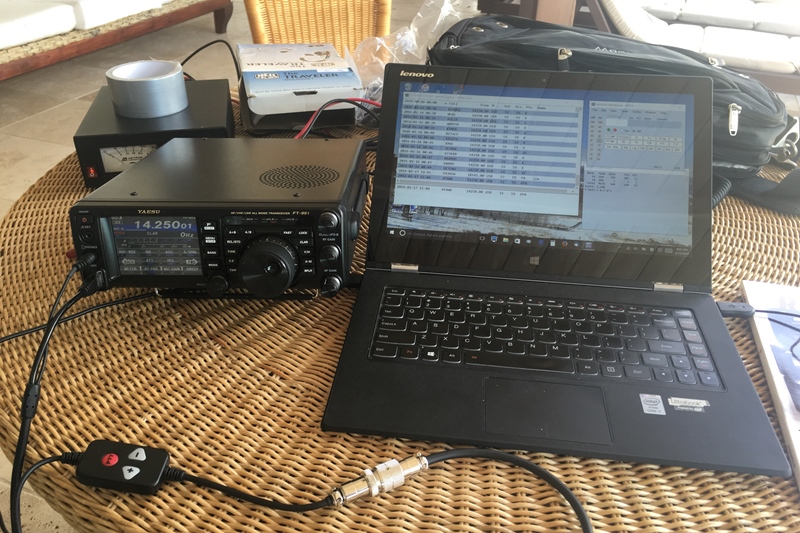
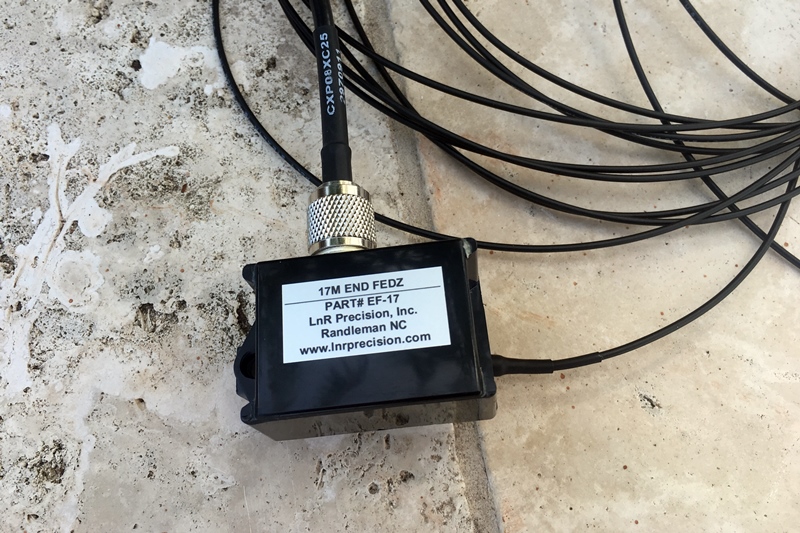
Choosing an antenna was a critical item. My first thought was to take my Buddistick antenna which covers the HF bands I was interested in working: 20m, 17m, 15m and 10m. I used that antenna from the Virgin Islands and it was really handy for taking to the beach. This time I wanted something bigger under the theory that size does matter. On the other hand, I wasn’t going to take full size yagis for each of the bands. I finally settled in on using End-Fed Half Wave (EFHW) antennas for the 4 bands (from LNR Precision). This gave me a simple half-wave antenna on each band with no coils, no traps, nothing funny going on. These antennas radiate well and have decent bandwidth…any SWR degradation can be tweaked up quickly using the FT-991 antenna tuner.
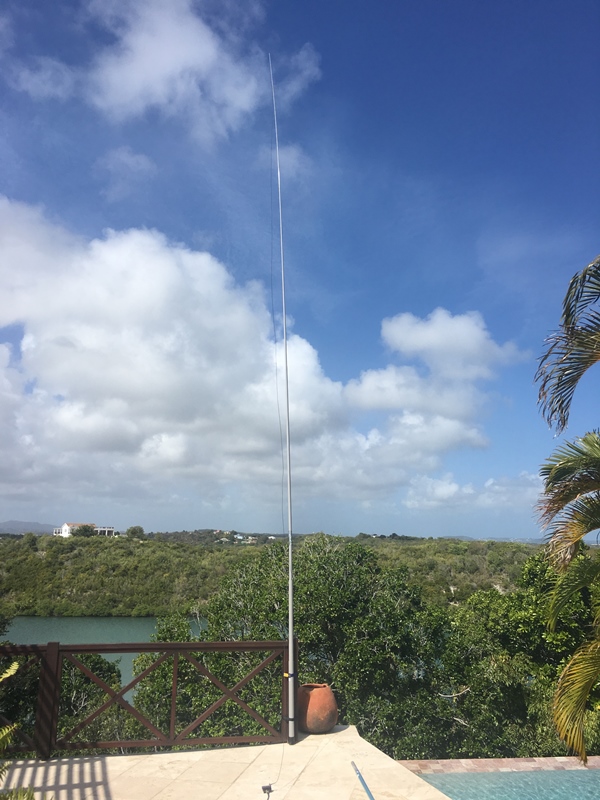
Steve WGØAT suggested I use the SOTABEAMS 30-foot mast to support the EFHW antennas. It is an incredible mast that collapses to 26.5 inches, small enough to fit into my bag. This antenna set up is common with the SOTA activators: EFHW supported by some kind of lightweight pole. I also tossed in a 19-inch magmount antenna for 2m and 70cm. (I did find a good repeater on on 147.0 MHz but did not spend much time on it.)
Rounding out the kit was an Astron switching power supply, a 25-foot length of RG-8X coaxial cable, a Heil Traveler headset and a few patch cords. I found it tempting to keep throwing more stuff in the bag so I adopted the backpacker mentality of taking just what I needed and not much more. For computer logging, I chose N1MM Plus software, set to log type to “DX”.
I have to confess that I did manage to break the 30-foot mast early in the trip. The house was on a hill and we always had a strong breeze coming through. One day it flexed the mast enough to break it. This was quickly repaired with duct tape. After that, I did not use the 2 top sections of the mast which reduced the amount of sway in the wind (and stress on the mast).
On The Air

My operating time was a bit sporadic and my operating strategy was simple: work the highest band (of 20m, 17m, 15m and 10m) that had some decent propagation to somewhere. Antigua is not extremely rare but it seemed to attract attention. Typically, I called CQ, worked a few stations and then a big pileup would develop. I made lots of QSOs with stations in North America, South America and Europe. I also made a few contacts into Africa but none with Asia. Signal reports were generally good (S9 +), so the antennas were doing the job.
All in all, I was pleased with the contacts I made, given the slacker effort. I especially enjoyed working 17m, a band I have not spent that much time on. The propagation is similar to 20m but noticeably less jammed with signals.
  Band  QSOs DXCC
    14   309   36
    18   162   13
    21    21   10
    28    91    6
 Total   583   65
QSLs for V29RW should be sent to my home callsign: KØNR (direct or via the bureau). Logbook of the World contacts have already been confirmed. Instant gratification, baby!
73, Bob KØNR, V29RW
Licensing info: It was relatively easy to get a ham radio license in Antigua, based on my US license (fees were $30 US). See this web page.
The post V29RW: Slacker DXpedition to Antigua appeared first on The KØNR Radio Site.
Useful propagation charts
This series of charts (change months and bands as required) is a useful guide to HF propagation. Like all such forecasts, caveat emptor as they said in Rome. I think this comes from G0KYA. See http://www.infotechcomms.net/propcharts/february/ .
Another source for solar data was http://www.solan.info/solar , but when I last checked this page had gone. I am not sure what happened. All I get now is a link for hotels!
Another source (which works) is http://www.solarham.net/ .
As you know, I try to add current data on my blog most days. This comes from http://www.hamqsl.com/solar.html .
Somewhere in this lot you should find the data you need.

Weekly Propagation Summary – 2016 Feb 22 16:10 UTC
Here is this week’s space weather and geophysical report, issued 2016 Feb 22 0359 UTC.
Highlights of Solar and Geomagnetic Activity 15 – 21 February 2016
Solar activity reached moderate levels early in the period due to an M1/1n flare (R1-minor radio blackout) from Region 2497 at 1056 UTC on 15 Feb, but low levels of activity were observed on 16-19 Feb with very low levels observed on 20-21 Feb as Region 2497 rotated behind the west limb. Region 2497 (N13, L=087, class/area=Eac/250 on 12 Feb) was the largest, most magnetically complex and active sunspot region on the disk this period, however, despite the frequency of solar activity this period no Earth-directed coronal mass ejections (CMEs) were observed.
No proton events were observed at geosynchronous orbit.
The greater than 2 MeV electron flux at geosynchronous orbit reached moderate levels on 15-16 Feb but an enhanced solar wind environment due to a coronal hole high speed stream (CH HSS) caused an increase to high flux levels throughout the remainder of the period (17-21 Feb), with a peak value of 36,500 pfu observed at 1755 UTC on 19 Feb.
Geomagnetic field activity reached G2 (Moderate) geomagnetic storm levels this period. The onset of a south polar-connected negative polarity CH HSS caused and isolated period of active conditions late on 15 Feb, unsettled to G2 (Moderate) geomagnetic storms on 16-17 Feb, and unsettled to G1 (Minor) geomagnetic storms on 18 Feb. As the CH HSS rotated out of geoeffective position, geomagnetic field activity decreased from quiet to unsettled levels on 19-20 Feb to quiet levels on 21 Feb due to the return of a nominal solar wind regime.
Forecast of Solar and Geomagnetic Activity 22 February – 19 March 2016
Solar activity is likely to be at low levels with a slight chance for M-class flares (R1-R2 (Minor-Moderate) Radio Blackouts) on 22-29 Feb and 15-19 Mar. C-class flares are expected on 01-14 Mar with a chance for M-class flares due to the anticipated return of Region 2497 (N12, L=087) which produced four M-class flares last rotation.
No proton events are expected at geosynchronous orbit, barring any significant flare activity.
The greater than 2 MeV electron flux at geosynchronous orbit is expected to reach high levels on 22 Feb and 15-19 Mar due to an enhanced solar wind environment caused by coronal hole high speed streams (CH HSSs). Moderate levels are likely on 23-24 Feb, 04-05, 07-08 and 13-14 Mar with low flux levels expected for the remainder of the period.
Geomagnetic field activity is likely to reach G1 (Minor) geomagnetic storm levels on 14-16 Mar and active field conditions are likely on 01, 03, 06 and 17 Mar, all due to the effects of multiple CH HSSs. The remainder of the period is expected to be at quiet or quiet to unsettled levels under a nominal solar wind regime.
Don’t forget to visit our live space weather and radio propagation web site, at: http://SunSpotWatch.com/
Live Aurora mapping is at http://aurora.sunspotwatch.com/
If you are on Twitter, please follow these two users: + https://Twitter.com/NW7US + https://Twitter.com/hfradiospacewx
Get the space weather and radio propagation self-study course, today. Visit http://nw7us.us/swc for the latest sale and for more information!
Check out the stunning view of our Sun in action, as seen during the last five years with the Solar Dynamics Observatory (SDO): https://www.youtube.com/watch?v=zXN-MdoGM9g
We’re on Facebook: http://NW7US.us/swhfr
Weekly Propagation Summary – 2016 Feb 15 16:10 UTC
Here is this week’s space weather and geophysical report, issued 2016 Feb 15 0238 UTC.
Highlights of Solar and Geomagnetic Activity 08 – 14 February 2016
Solar activity was low from 08-11 Feb. The largest C-class event during that period was a C8/1f observed at 11/2103 UTC from Region 2497 (N13, L=087, class/area Eac/250 on 12 Feb) with associated Type II (est. speed 483 km/s) and Type IV radio sweeps. A CME was visible following this event and is anticipated to arrive at Earth early on 15 Feb. Solar activity was moderate from 12-14 Feb with Region 2497 producing an M1 flare each day. No other Earth-directed CMEs were observed.
No proton events were observed at geosynchronous orbit.
The greater than 2 MeV electron flux at geosynchronous orbit was at normal to moderate levels during the period.
Geomagnetic field activity began the week at minor storm levels due to effects from a co-rotating interaction region (CIR) ahead of a CH HSS. Predominately quiet to unsettled levels were observed for the remainder of the period with isolated active periods on 09, 11 and 12 Feb associated with extended periods of negative Bz.
Forecast of Solar and Geomagnetic Activity 15 February – 12 March 2016
Solar activity is expected to be at very low to low levels with a chance for M-class flares from 15-17 Feb. Activity is expected to decrease to very low levels with only a chance for C-class flares from 18-29 Feb as Region 2497 moves beyond the west limb. Low levels are anticipated once again on 01-12 Mar as well as a chance for M-class flares with the return of Region 2497.
A slight chance for a proton event exists at geosynchronous orbit from 15-17 Feb due to the flare potential and position of Region 2497.
The greater than 2 MeV electron flux at geosynchronous orbit is expected to be at normal to moderate levels for the majority of the period. High levels are likely on 18-20 Feb following effects from a CME and a subsequent CH HSS.
Geomagnetic field activity is expected to reach minor storm levels on 15 Feb due to effects from the 11 Feb CME. Quiet to active conditions are expected on 16 Feb as CME effects subside. Minor storm conditions are likely again on 17 Feb as a recurrent negative polarity CH HSS becomes geoeffective. Quiet to unsettled conditions are expected with isolated active periods possible on 18-20 Feb as CH HSS effects continue. Mostly quiet conditions are expected on 21-29 Feb. Quiet to unsettled conditions are expected from 01-03 Mar due to effects from a positive polarity CH HSS. Mostly quiet conditions are expected for the remainder of the period with unsettled to active periods possible on 06-07 Mar and 11 Mar as two sequential small recurrent coronal holes affect the field.
Don’t forget to visit our live space weather and radio propagation web site, at: http://SunSpotWatch.com/
Live Aurora mapping is at http://aurora.sunspotwatch.com/
If you are on Twitter, please follow these two users: + https://Twitter.com/NW7US + https://Twitter.com/hfradiospacewx
Get the space weather and radio propagation self-study course, today. Visit http://nw7us.us/swc for the latest sale and for more information!
Check out the stunning view of our Sun in action, as seen during the last five years with the Solar Dynamics Observatory (SDO): https://www.youtube.com/watch?v=zXN-MdoGM9g
We’re on Facebook: http://NW7US.us/swhfr
Weekly Propagation Summary – 2016 Feb 08 16:10 UTC
Here is this week’s space weather and geophysical report, issued 2016 Feb 08 0222 UTC.
Highlights of Solar and Geomagnetic Activity 01 – 07 February 2016
Solar activity was at low levels throughout the entire period. Several regions produced low level C-class events, the largest a C5/Sf at 04/1822 UTC from Region 2494 (S11, L=162, class/area Dki/270 on 07 Feb). A filament eruption observed beginning on 05/1939 UTC near S19W28 was associated with a CME that is anticipated to be a glancing blow midday on 09 Feb. Several other small filament eruptions occurred but none were expected to be geoeffective.
No proton events were observed at geosynchronous orbit.
The greater than 2 MeV electron flux at geosynchronous orbit was at normal to moderate levels.
Geomagnetic field activity began the week at quiet to unsettled levels. Active to minor storm conditions were observed early on 03 Feb due to a co-rotating interactive region (CIR) followed by the onset of a positive polarity coronal hole high speed stream (CH HSS). Quiet to unsettled conditions were observed during largely nominal solar wind conditions from 04-07 Feb, with the exception of an isolated active period on 07 Feb due to prolonged negative Bz.
Forecast of Solar and Geomagnetic Activity 08 February – 05 March 2016
Solar activity is expected to be at low levels throughout the forecast period.
No proton events are expected at geosynchronous orbit.
The greater than 2 MeV electron flux at geosynchronous orbit is expected to be at normal to moderate levels with high levels possible from 12-16 Feb and 19-23 Feb following subsequent CH HSS events.
Geomagnetic field activity is expected to be at unsettled to active levels with isolated minor storm periods on 08 Feb due to prolonged negative Bz and negative polarity CH HSS effects. Quiet to active conditions are likely to continue into 09 Feb as effects continue along with a possible glancing blow from the 05 Feb CME. Quiet to unsettled conditions are expected from 10-12 Feb as a recurrent positive polarity HSS moves into a geoeffective position. Mostly quiet conditions are expected from 13-16 Feb. Quiet to unsettled conditions are expected from 17-19 Feb with active periods possible on 18 Feb due to effects from a recurrent negative polarity HSS. Predominately quiet conditions are expected from 20-29 Feb. Quiet to unsettled conditions are expected with isolated active periods possible on 01-03 Mar as another positive polarity CH HSS becomes geoeffective. Quiet conditions are expected to close out the forecast period.
Don’t forget to visit our live space weather and radio propagation web site, at: http://SunSpotWatch.com/
Live Aurora mapping is at http://aurora.sunspotwatch.com/
If you are on Twitter, please follow these two users: + https://Twitter.com/NW7US + https://Twitter.com/hfradiospacewx
Get the space weather and radio propagation self-study course, today. Visit http://nw7us.us/swc for the latest sale and for more information!
Check out the stunning view of our Sun in action, as seen during the last five years with the Solar Dynamics Observatory (SDO): https://www.youtube.com/watch?v=zXN-MdoGM9g
We’re on Facebook: http://NW7US.us/swhfr
Weekly Propagation Summary – 2016 Feb 01 16:10 UTC
Here is this week’s space weather and geophysical report, issued 2016 Feb 01 0641 UTC.
Highlights of Solar and Geomagnetic Activity 25 – 31 January 2016
Solar activity was at very low to low levels during the period. Low levels were observed from 25-29 January with Regions 2488 (N02, L=320, class/area Dai/240 on 25 January) and 2489 (N10, L=253, class/area Eko/300 on 29 January) producing the majority of the C-class flaring. The largest flare of the period was a C9/1f at 28/1202 UTC from Region 2488. Region 2488 was in slow decay over the period. Region 2489 continued to exhibit growth through 28 January and slowly decayed thereafter. Several filament eruptions, and subsequent coronal mass ejections (CMEs), were observed during the period, but none had an Earth-directed component.
No proton events were observed at geosynchronous orbit.
The greater than 2 MeV electron flux at geosynchronous orbit was at high levels from 25-27 January, moderate levels on 28 January, and normal levels from 29-31 January. The maximum flux of the period was 2,117 pfu observed at 26/1500 UTC.
Geomagnetic field activity was at mostly quiet levels throughout the period with isolated unsettled periods on 27-28 and 31 January and an isolated active period observed late on 31 January. Solar wind parameters were in decline as the period began under the waning influence of a negative polarity coronal hole high speed stream (CH HSS). Solar wind speed gradually decreased from approximately 480 km/s early in the period to around 260 km/s by 30 January before increasing slightly to 300 km/s by the end-of-the-period. A solar sector boundary crossing into a positive (away) orientation occurred at approximately 27/0834 UTC, accompanied by a slight increase in total field (Bt) measurements to 9 nT on 27 and 28 January. On 31 January, another increase in Bt to 10 nT was observed along with a prolonged period of southward Bz. The geomagnetic field responded with isolated active levels to end the period.
Forecast of Solar and Geomagnetic Activity 01 February – 27 February 2016
Solar activity is expected to be at very low to low levels with a chance for M-class flares (R1-R2, Minor-Moderate) from 03-25 February with the return of old Regions 2484 (N08, L=094) and 2488 (N02, L=320).
No proton events are expected at geosynchronous orbit.
The greater than 2 MeV electron flux at geosynchronous orbit is expected to be at normal to moderate levels with high levels likely on 04-07, 09-15, and 18-23 February as a result of CH HSS influence.
Geomagnetic field activity is expected to be at unsettled to active levels on 01 February due to continued effects from a prolonged period of southward Bz. Unsettled to active levels are likely from 02-04, 08-09, and 17-20 February due to recurrent CH HSS activity.
Don’t forget to visit our live space weather and radio propagation web site, at: http://SunSpotWatch.com/
Live Aurora mapping is at http://aurora.sunspotwatch.com/
If you are on Twitter, please follow these two users: + https://Twitter.com/NW7US + https://Twitter.com/hfradiospacewx
Get the space weather and radio propagation self-study course, today. Visit http://nw7us.us/swc for the latest sale and for more information!
Check out the stunning view of our Sun in action, as seen during the last five years with the Solar Dynamics Observatory (SDO): https://www.youtube.com/watch?v=zXN-MdoGM9g
We’re on Facebook: http://NW7US.us/swhfr
Weekly Propagation Summary – 2016 Jan 25 16:10 UTC
Here is this week’s space weather and geophysical report, issued 2016 Jan 25 0701 UTC.
Highlights of Solar and Geomagnetic Activity 18 – 24 January 2016
Solar activity was at very low to low levels during the period. Only weak C-class flares (<C3) were observed on 20-21 January and 24 January from Regions 2484 (N08, L=094, class/area Dro/030 on 20 January), 2487 (S13, L=336, class/area Dai/100 on 21 January), and 2488 (N04, L=319, class/area Dai/200 on 24 January). Region 2487 was in a growth phase since its emergence on 18 January, but entered into a decay phase after 22 January and was only responsible for three weak C-class flares. Region 2488 continued to exhibit growth since its emergence on the disk on 18 January and was responsible for two weak C-class flares. No Earth-directed coronal mass ejections (CMEs) were observed during the summary period.
No proton events were observed at geosynchronous orbit.
The greater than 2 MeV electron flux at geosynchronous orbit was at normal levels on 19-20 January, moderate levels on 21 January and high levels on 18 January and again on 22-24 January. The maximum flux of the period was 12,881 pfu observed at 24/1550 UTC.
Geomagnetic field activity ranged from quiet to major storm (G2-Moderate) levels. The period began under quiet conditions for the majority of 18 January. At approximately 18/2056 UTC, a small shock was observed in ACE data indicating the arrival of a CME from a filament eruption on 14 January. Total field (Bt) initially increased from 6 nT to 12 nT with solar wind speed increasing from 300 km/s to near 380 km/s while the Bz component fluctuated between +6 nT and -9 nT. By 19/0935 UTC, the Bz component deflected north and total field increased to 14 nT. A subsequent rotation of the Bz component occurred after 20/0325 UTC to a maximum of -13 nT followed by another increase in the total field to a maximum of 21 nT at 21/0545 UTC. By this time, the Bz component was fluctuating between +/-18 nT. By 21/1006 UTC, Bt decreased to around 8 nT, while the solar wind speed increased to around 530 km/s as the solar wind began to transition into a negative polarity coronal hole high speed stream (CH HSS). The geomagnetic field responded with an unsettled period late on 18 January, quiet to active levels on 19 January, quiet to minor storm levels (G1-Minor) on 20 January, and unsettled to major storm levels (G2-Moderate) on 21 January. Solar wind speeds continued around 500-550 km/s under CH HSS influence until late on 23 January. Solar wind speeds continued to be elevated in the 450-500 km/s range through the end of the period. As a result, the geomagnetic field was at quiet to active periods from 22-24 January.
Forecast of Solar and Geomagnetic Activity 25 January – 20 February 2016
Solar activity is expected to be at very low to low levels with a slight chance for an M-class flare (R1-R2, Minor-Moderate) from 25-31 January as Region 2488 continues to develop.
No proton events are expected at geosynchronous orbit.
The greater than 2 MeV electron flux at geosynchronous orbit is expected to be at mostly high levels due to recurrent CH HSS activity. A return to moderate levels is expected on 25-26 January, 07-08 February, and 14-18 February.
Geomagnetic field activity is expected to be at unsettled to active levels from 25-30 January, 02-03 February, 07-10 February, and 17-20 February due to recurrent CH HSS activity.
Don’t forget to visit our live space weather and radio propagation web site, at: http://SunSpotWatch.com/
Live Aurora mapping is at http://aurora.sunspotwatch.com/
If you are on Twitter, please follow these two users: + https://Twitter.com/NW7US + https://Twitter.com/hfradiospacewx
Get the space weather and radio propagation self-study course, today. Visit http://nw7us.us/swc for the latest sale and for more information!
Check out the stunning view of our Sun in action, as seen during the last five years with the Solar Dynamics Observatory (SDO): https://www.youtube.com/watch?v=zXN-MdoGM9g
We’re on Facebook: http://NW7US.us/swhfr













