Archive for the ‘ham radio’ Category
 K0NR June VHF Contest
 June 16th, 2013 |
  Author: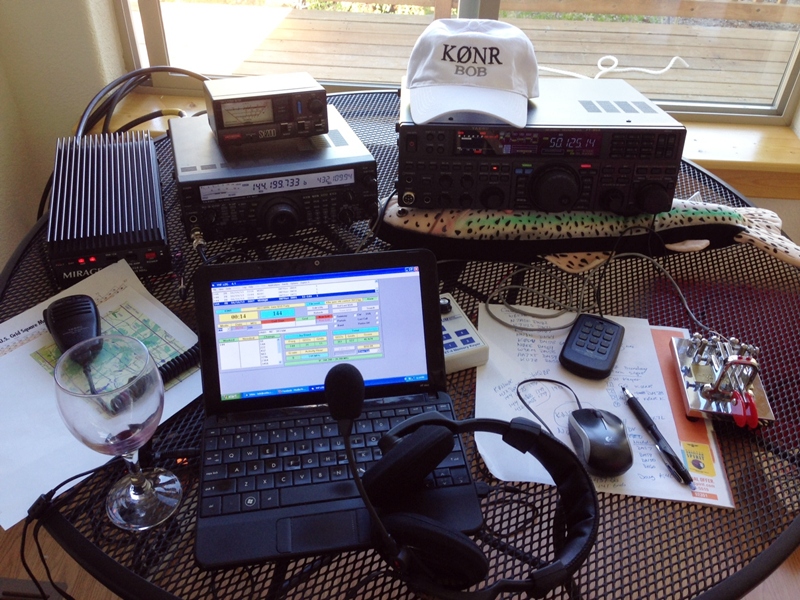
My June VHF Contest operation was at the cabin DM78av, operating in the new 3-band single-op category this year. Usually, I have been a two-band guy just focusing on 2M and 6M. I drug along my 432 MHz antenna and drove it with 50W from my FT-847, picking up a few more QSOs that way.
My score is down from the previous two years, which I think relates to the 50 MHz propagation. I subscribe to the theory that any June contest that has any sporadic-e is a success, so I am not going to complain. However, it did seem like I spend more time digging weak signals out of the noise on 6 Meters this year. It was often just barely open and the QSO rate was slow.
Best DX was XE2WK in EL03 on 50 MHz.
73, Bob K0NR
2013 ARRL June QSO Party K0NR DM78
Band QSOs X pt = QSO pts. X Grids = Points
 ---------------------------------------------------------------
 50 320 1 320 112 35840
 144 34 1 34 11 374
 432 13 2 26 6 156
 ---------------------------------------------------------------
 TOTALS 367 380 129 49020
Claimed score = 49020
Six Meter Summer

My Buddipole Antenna, Configured as a 2 Element Yagi for 6 Meters
The ribbons are to keep me from poking my eyes out on the end of the whips.
Here, I’m trying the antenna out in my driveway before I take it to the beach.

Kx3 QRP Radio
Six Meter Summer!
 This pavilion is my favorite operating spot at Hagen’s Cove.
It overlooks Dead Man’s Bay, on the Gulf of Mexico in Perry Florida.
I’m going to spend the summer playing around with my Kx3 on 6 meters. The antenna here is a Buddipole, configured as a 2 element Yagi. Its easy to assemble in the field, so I’ll take it to the beach (Hagen’s Cove) and try to make some contacts with it. I’ve been a ham for 22 years but have never done much with 6 meters. This will be a 6 meter summer for me. Join me, I’d love to have a ham radio buddy to share the adventure with.
de AA1IK, 73
CQ WW VHF Contest Certificate
This certificate for the CQ Worldwide VHF Contest arrived in the mail today, 1st Place Single Operator All Band for Colorado. Most of these contest awards take so long to arrive, I have usually forgotten all about the contest by the time they show up in the mail.
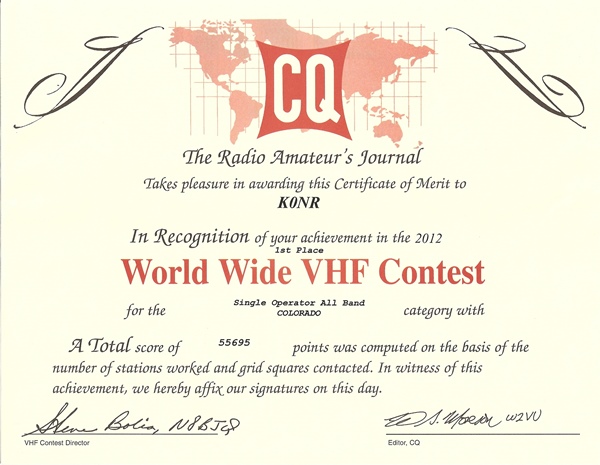
Last year, I had a pretty good run at it with an excellent 50 MHz sporadic-e opening on Saturday that ran up the QSO and grid totals. See my previous report on the contest here.
73, Bob K0NR
What I’m up to at the VLA
Back last November I was offered this internship to work for up to 8 months at the Very Large Array, as you see pictured behind this post. The VLA is the worlds most prolific radio observatory, having the most citations in of any radio observatory in all of science. I could not turn this offer down/
The VLA is a well oiled machine of 27 cassegrain feed parabolic reflectors each 25 meters, or 82 feet wide, that send concentrated RF to massive feedhorns at its vertex. One VLA dish covers all frequencies from 1-50 GHz, and has two extra bands at 74 and 350 MHz using extra antennas. Together, they can make a dish that theoretically measures over 20 miles in diameter!
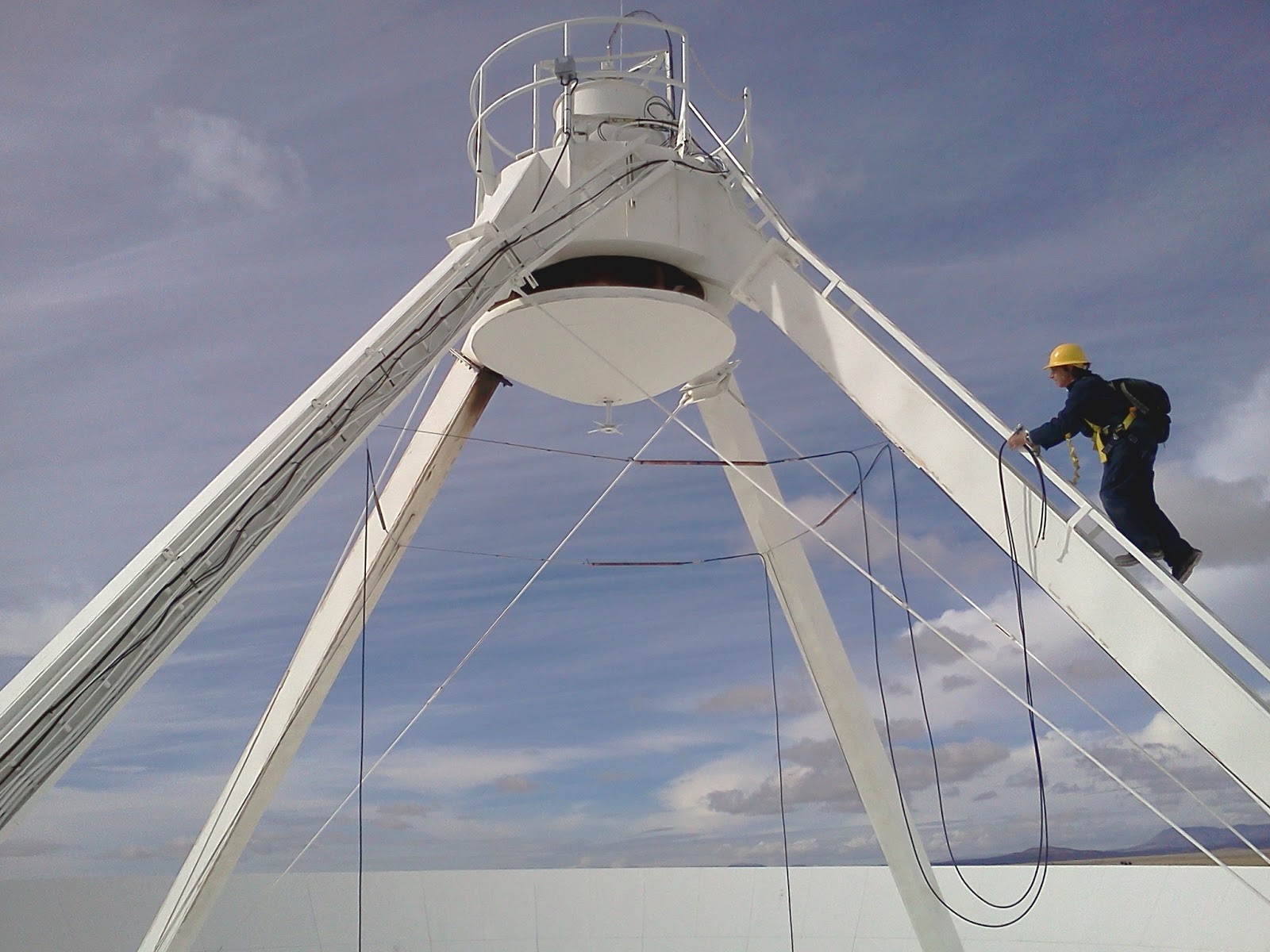 |
| Apex of a Dish Showing the Cassegrain Subreflector, 350MHz cross-dipole at the center of it, and the new strut-straddling sleeve-dipoles for 74MHz around the edges being installed |
My primary job at the VLA is to learn. Everything RF exists here, so I’m soaking up as much as I can. I’ve learned more about microwave RF design, Radar, synthetic aperture synthesis, correlation, radio astronomy, antenna design, transmission lines, test equipment, RFI, and much more that I have ever (and perhaps will have ever) at college.
Learning is a sort of meta-job. What I really do is two-fold.
The first fold is Interference Protection. The IPG specializes in the detection, location, analysis, and mitigation of radio frequency interference that has the potential of ruining and/or corrupting observations of the radio sky. The VLA is located in a lake bed, 20 miles away from any town, 90 miles from Albuquerque, surrounded by 360° of mountains that buffer the observatory from radar, wifi, cellular, aircraft, and other terrestrial sources of RFI. Satellites are also a source of RFI, so they must be documented and their transmissions well understood so that the VLA Correlator can learn how to discern orbiting transmitters from galactic transmitters.
On IPG, we’ve done a few RFI Site Surveys at places like the Magdalena Research Observatory on South Baldy and at the Pie Town VLBA site. Unfortunately, a Verizon 4G LTE cell tower exists on a hill only 5 miles from the center of the array. The signal it produces isn’t bad — it’s the amount of visitors who show up with a full signal, assuming it’s okay to use their smartphones to upload photos, videos, sprout WiFi APs, and cause all kinds of problems. That’s when we break out the CELL PHONE DESTROYER 6000.
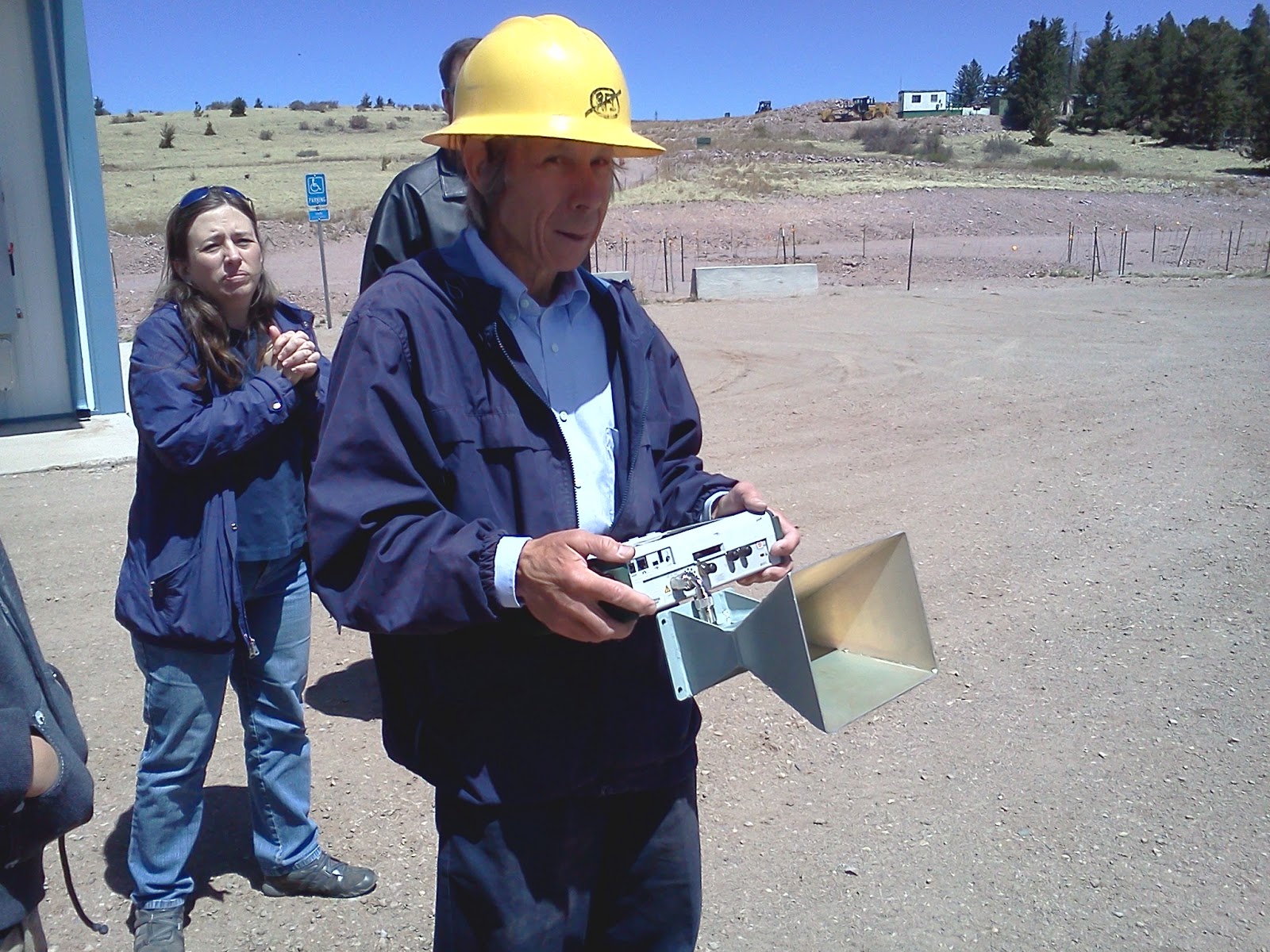 |
| THE CELL PHONE DESTROYER 6000 is nothing more than a 1.8-2.4 GHz feedhorn attached to a spectrum analyzer, which is directly integrated into the neural cortex of this RFI Seeking Unit known only as Mert. |
For quieter RFI, like satellites and terrestrial transmitters, we use a big-ugly 10-foot dish with a wideband conical-log spiral feedhorn to determine bearings to RFI:
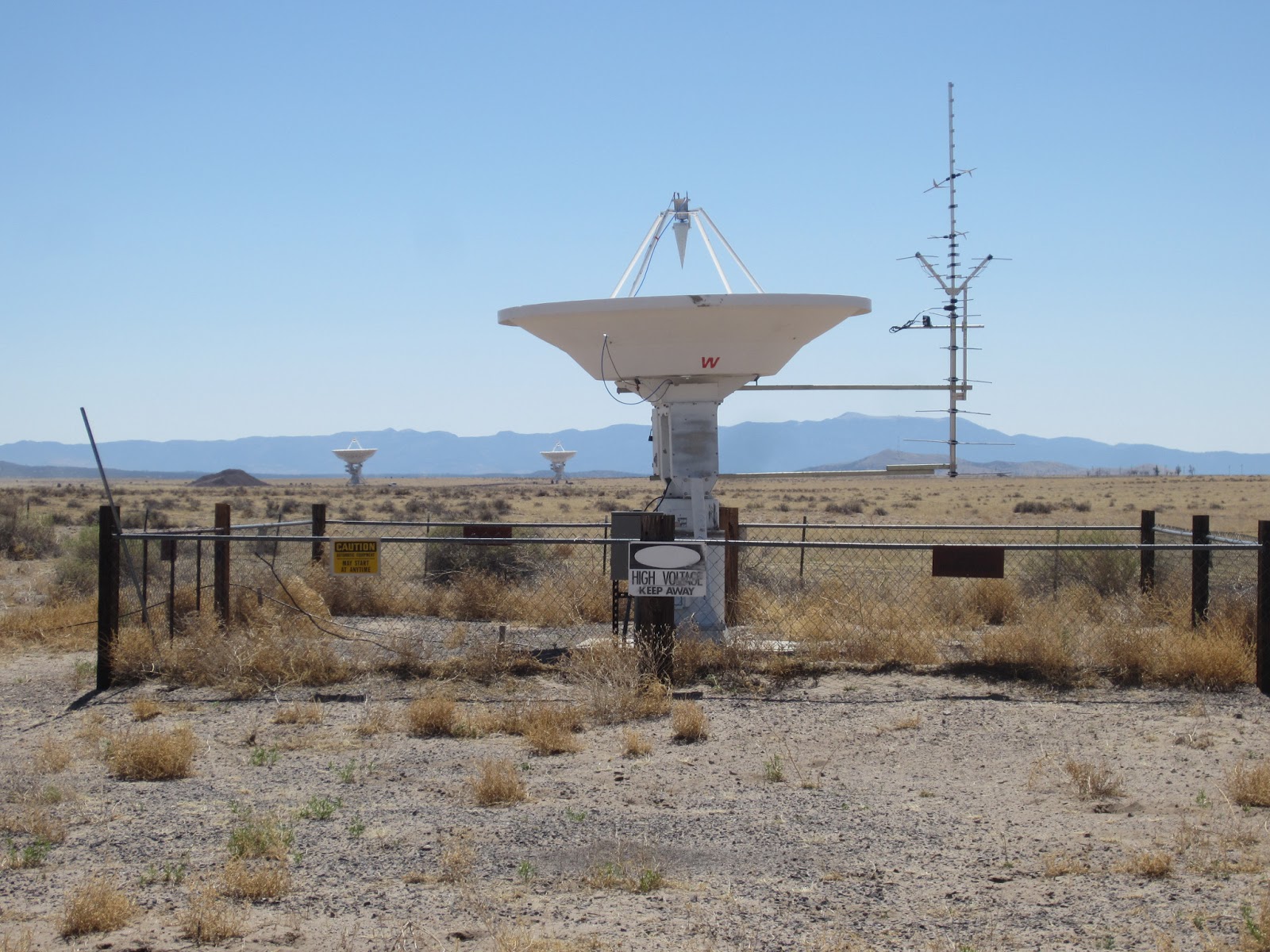
Along with intentional radiators, unintentional transmitters like microprocessors, screens, TVs, and other electronics produce noise that can be detrimental to the RF environment. Such electronics need to be tested in the Reverberation Chamber, and shielded if necessary.
The second fold is Front End — Front end of receivers that is. On the FE group, I’ve been tasked of removing old low-band receivers (74 and 350MHz) and installing new consolidated ones along with about 200 feet of heliax and control cables for them. I’ve also been building and improving antenna designs for the LBRs, including the new strut straddling dipoles pictured above. I’ve come across a cool 74MHz widebanded antenna design that may or may not be patentable, so we’ll see from it’s creator if I can get acknowledged in a paper or something 🙂
The LBRs are located in the apex, also pictured above. It’s fun becoming a grease monkey while getting a view of the VLA few have seen.
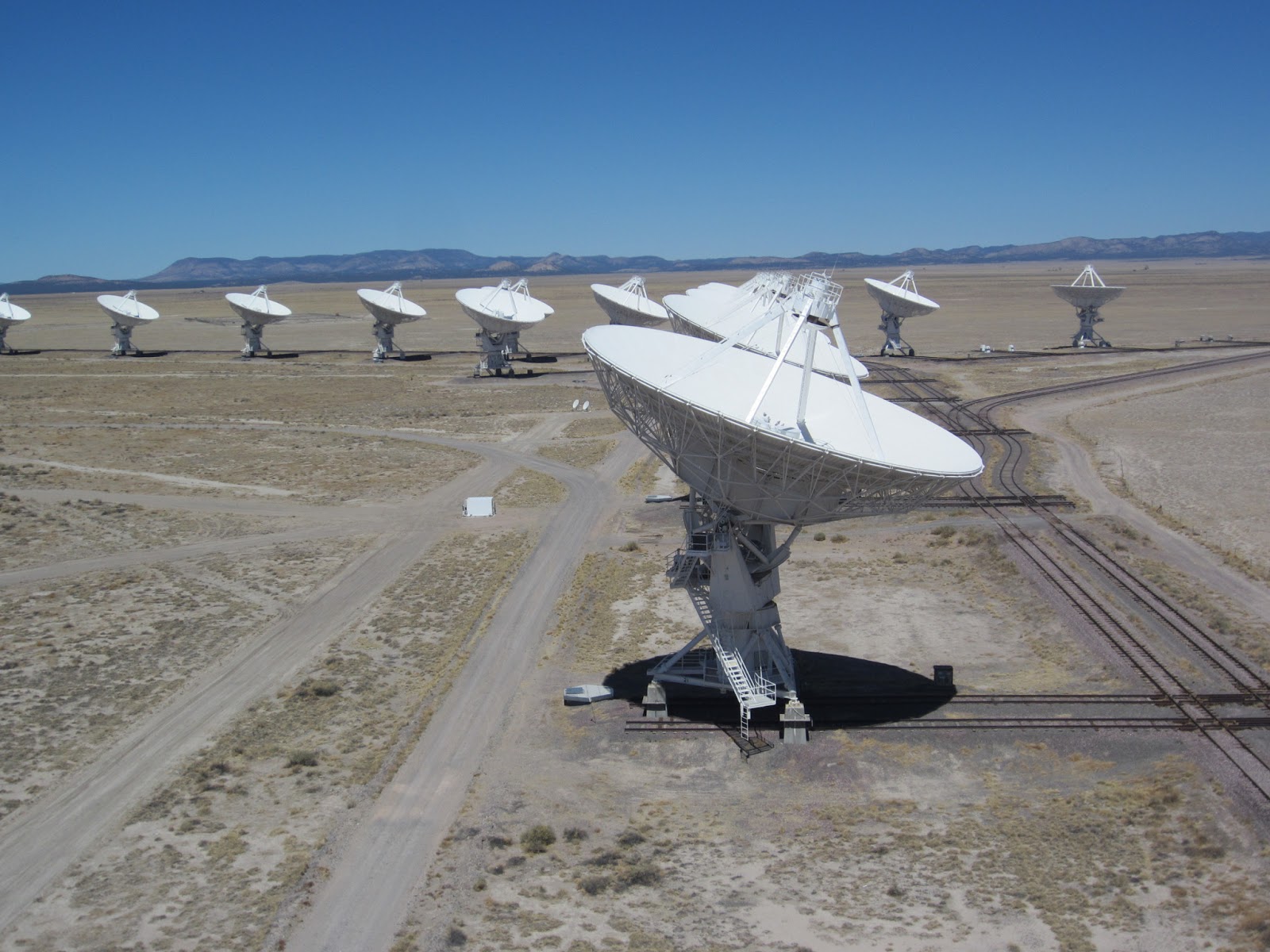 |
| Such a view |
So how did I get this job? Ham radio of course! My boss actually e-mailed me after an unsuccessful run through career fairs and internship searches for this summer. He noted my experience with the Missouri S&T ARC, W0EEE, as a big kicker on my resume. At S&T I’ve done a lot of work mitigating RFI, fixing repeaters, learning about radio, and having fun with it. He himself is a ham, albeit inactive, but still understands the value a license can have at such a job.
Ham radio gets jobs! (Girls? No.)
Today Paul Harden (NA5N) and I will be installing a few new LBRs in antennas 18 and 20. The weather looks beautiful for it too! Check out Paul’s personal website, chock full of receiver data, photos, and the history of the area.
That’s about the gist of it. 73 for now!
A Zero in Five Land – Welcome
With midnight inspiration comes morning desperation. For sleep. Heh heh.
Welcome to the new blog of N0SSC — ARRL Youth Editor, EE degree seeker, Very Large Array intern, and among other things, a radio amateur. Ideas have been flowing from my mind into thin air, so I have done up this blog to start to capture them.
I’m a zero in five land. My call sign – N0SSC, shows that I am from zero-land: the ham radio call district that makes up most of the midwest. Due to my internship, i’ve been displaced to New Mexico, which is in the fifth call district – 5 land.
So, this blog will focus on my ham radio activities while in New Mexico, as well as my internship at the Very Large Array. I have a lot of fun stories to share!
Stay tuned for more! For now, follow me on your favorite social networking site — just google N0SSC and you’ll find me.













