Archive for the ‘ham radio’ Category
 HamRadioNow: MotoTRBOStar
 March 22nd, 2014 |
  Author:
 Last night I uploaded HamRadioNow Episode 138. I’m calling it MotoTRBOStar because it’s about a newly announced handheld radio that will claim some firsts: it’s the first “dual-digital” mode radio (D-STAR; and MOTOTRBO, or generically DMR – Digital Mobile Radio); and it’s the first non-ICOM off-the-shelf radio to do D-STAR.* The episode is an interview with the CEO of Connect Systems, Inc., Jerry Wanger (rhymes with Ranger). CSI (isn’t that a TV show?) has been selling analog, trunked and DMR digital handheld radios in the commercial service. Recently, Jerry learned that a lot of hams have latched onto his radios for use on the ham-band MOTOTRBO repeaters. The radios are quite inexpensive, and apparently pretty high quality.
Jerry had a novice license long ago, but never mastered the code to upgrade. Side note: back in the 60’s, a Novice license ran one year and couldn’t be renewed. And Novices had voice privileges on only one band: two meters. So Novices who spent too much time on two-meter AM (there was almost no FM then) and didn’t get their code speed up to 13 wpm for a General could get a Tech, but then they were confined to VHF/UHF. Again, repeaters were just barely getting started and were mostly unknown, so Techs were in a kind of Purgatory. But it was a way to keep licensed. Evidently Jerry didn’t choose that route. But he’s about to get re-licensed now.
So Jerry appreciates ham radio, and decided to make a model radio (CS700) that was more “ham-friendly,” with features like DTMF and the ability to program frequencies and parameters directly from the keypad. Then he decided to add D-STAR. That model, the CS7000, is planned for Fall release. He’ll be at Dayton to show it off.
Jerry does the software and designs the hardware specs himself, and has the radios manufactured in China. As he says, he can buy the finished radios cheaper than he can buy the parts.
So that’s all in the interview. Now I’ll wax a bit philosophical on the topic.
I’ve been a ham since 1965, WN9NSO, in the Chicago suburbs. And while I did play on two meter AM with a Heathkit Twoer (to the displeasure of my mentors, who warned sternly about neglecting the code), I also spent enough time in the 40 and 15 meter Novice cw bands to wick the speed up and pass my General after just a few months. And while I have almost always had a presence on HF, I’ve felt more at home on VHF/UHF. I was introduced to FM almost immediately. I had a Motorola 30D base station in my shack, and 80D mobile in my Dad’s car by 1967 (these were ancient, all-tube radios. The 80D even had a Dynamotor to power the transmitter). There were only two or three repeaters on the air in Chicago at the time. I was too young (and never an engineer) to be much of a leader at the time, but I watched the FM boom from a front row seat.
Fast forward to the early 2000’s. I’m editor of the SERA Repeater Journal, the magazine published by the SouthEastern Repeater Association, the group that does frequency coordination for 8 states. I come across a reference to D-STAR, and while I didn’t think much about it at the time, I did ponder a digital future in my column. But D-STAR wasn’t one of those flights of fancy that came and went. With ICOM behind it, D-STAR grew beyond it’s original 1200 MHz system as ICOM added radios for 144 and 440 MHz. Meanwhile, I had moved from editing the magazine to producing ham radio video on DVD as ARVN:Amateur Radio//Video News. I bought ICOM’s first D-STAR dual-band mobile, the ID-800, and handheld, the IC-91, and soon after produced a documentary titled Digital Voice for Amateur Radio. The DVD also featured a segment on HF digital voice, and a little on APCO-25, another VHF/UHF digital mode being adapted from Public Safety radio to Amateur Radio. I’ve written a few articles and reviews in QST on D-STAR and ICOM radios. I’m not the foremost authority on it by any means – I consider myself a journalist (with a side of pundit these days), not an expert – but I’ve learned a lot. And ham radio doesn’t have many pure journalists. Everybody’s involved.
D-STAR was met by hams with sharply divided reaction (and more than a few yawns). A few embraced it immediately (best thing ever). A few more were rigidly opposed (End Of Amateur Radio As We Know It). Most, if they were even aware of it in the early years, were more wait-and-see. Not gonna sink a lot of money into a radio that might not go anywhere. All the D-STAR radios were good Analog radios, too, but they were a few hundred bucks more expensive, so while the radio wouldn’t be useless, it would have been a costly experiment.
Turns out D-STAR has hung around and grown fairly quickly. It’s in most major and medium metro areas, and even some rural areas, of the US and many countries around the world. But there’s still plenty of territory that has had analog FM for decades but no D-STAR at all yet. Any long road trip will quickly bear that out. You’ll drive a long way between “islands” of D-STAR coverage. It’s very much like FM was in 1970 – available mostly in the larger cities. I remember being excited when driving toward Denver way back then. A mountainside repeater on 146.94 broke my squelch about 100 miles out after hours and hours of radio silence.
D-STAR proponents, and even us “objective journalists” (OK, I’m not objective on this) point out how much technology is going digital (TV, cell phones, a fair amount of two-way business and Public Safety radio) while hams have barely moved the needle, except for the all-text modes. Yeah, we led the way with Packet Radio in the 80’s (a few did, anyway… not most of us). But for a group that likes to talk more than anything else, our voices have remained mostly analog, right up to today. Digital has some advantages (signal to noise, voice+data, and spectrum efficiency), but they haven’t been compelling enough yet to get wholesale adoption. Except for D-STAR, they mostly haven’t been built-in to radios. And on HF especially, we don’t know how we’d use them for some of the core activities like contests and DX.
As we gaze outside of our pasture to that real world that’s growing increasingly digital, there’s another issue to note. Digital doesn’t stand still very long. Upgrades happen fast, and sometimes older stuff becomes obsolete – even unusable – pretty quickly. Analog TV made it about 60 years. Vinyl records a little longer. CDs aren’t dead, but sales went to nearly zilch, after about 20 years. On the Internet, where software and apps can be easily upgraded or replaced, we’re talking a few years or even months. Remember “RealTV”? And you know that 70″ 1080p High-Def TV you just got. Obsloete. Here comes 4k. Then 8k. Broadcast TV stations are going nuts trying to figure out to squeeze that into their “Advanced” television system. **
I’m about to edit my next HamRadioNow that I recorded yesterday with Bruce Perens K6BP. Bruce is a serious open-source guy, so he never had a great love for D-STAR. Bear that in mind when he declares it obsolete. Objectively, things in ham radio move slower. Whenever there’s fixed hardware involved, upgrades can’t happen that fast – it costs too much. But D-STAR is 15 years old, and better technology is available. Yaesu claims their new C4FM “System Fusion” is “better.” Bruce disputes that, and I don’t have the background to determine it for myself. But I can say that if Yaesu is correct now, what can they say in 5 years (0r 5 months) when the next something better comes along?
Bruce is involved in a couple of projects. For HF, there’s FreeDV, and for VHF/UHF, it’s the “HT of the Future.” Both are based on the open-source CODEC2, which is still very much under development, and always will be, at least for the foreseeable future. Today, FreeDV is a sound-card mode that you can run much like PSK-31. Tomorrow, you might punch it up on the mode switch (Flex will probably be the first radio to have that option). FreeDV – and probably a lot of new modes – will be upgradable by downloading software. I won’t say it will never be obsolete, but it’s the kind of thing that will move us from being slow-moving dinosaurs tied to our fixed-technology hardware, into a more nimble future where we are not walled off from each other by incompatible modes. All this stuff is coming up in HamRadioNow Episode 139, as soon as I can stop typing here and get back to editing it (maybe tomorrow or Monday).
Ya know… I’ve never operated FreeDV or it’s predecessors (FDMDV, WinDRM) that I featured in Digital Voice for Amateur Radio. I don’t have a computer sitting next to my HF rig… at least not yet. All my computers are busy doing something else. But I’ll find one soon, and give it a try.
73, Gary KN4AQ
* Devices like the DVDongle are cool, but they’re not standalone radios. There are a few modules that you can use to turn an analog radio into a D-STAR radio using its 9600 packet port, but that’s not off-the-shelf. The NW Digital radio might lay claim to being the first non-ICOM commercial D-STAR capable radio if it reaches production before the CS-7000 does, and right now it’s a race. But while it will do D-STAR’s DV voice mode, it’s really designed as a multi-mode platform for medium-speed data, using D-STAR’s DD mode and many others. It will have exciting uses, but it’s not your grab-and-go handheld or mobile radio.
** My career has been in the audio/video production business, mostly making commercials. I quickly learned a lesson: never stick a label on anything that calls it “new.” And never call anything “final.” OK, sort of two lessons.
The “new” lesson came from a reel of alignment videotape that we used at a TV station I worked for. You had to run that through the old 2″ “Quad” videotape machines to align the heads before making a recording, so the reel got used several times a day. It started life as a 5-minute piece of tape, but every time you used it, you’d then rewind it and thread a piece of blank tape for recording onto the machine. That rewind was high-speed, and if you didn’t catch it fast enough, the end of the tape would flap like crazy, and get frayed. You had to cut the frayed piece off lest it get caught in the high-speed spinning video heads next time, clogging the hell out of them and maybe ruining a head assembly that cost tens of thousands of dollars to replace. The boss would be very angry.
When I started working at the station, that alignment reel had about 45 seconds of tape left on it, having had a half-inch of frayed end cut off many, many times. And the flange was grimey from all the hands that had loaded it on the machines over the years. But there beneath the grime, just barely readable in faded Sharpie, were the words that some engineer wrote just after he took that reel out of the box for the first time: Alignment Tape. 5 min. NEW.
Arduino Frequency Display For Kenwood TS-520S HF Ham Radio PART 2
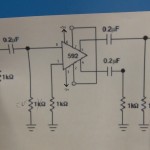
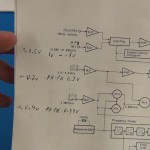
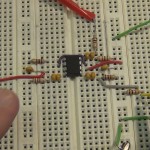
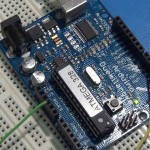
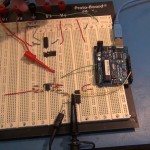
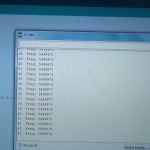
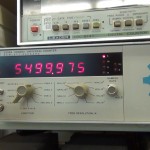
This is (PART 2A & 2B) of the project “Arduino Frequency Display For a Kenwood TS-520S HF Ham Radio”. This part covers small signal amplification of a 0.2 volt peak-to-peak 5.5 MHz signal into Schmitt triggered NAND gate for cleanup before being cleanly counted by the Arduino. All parts: (PART 4), (PART 3), (PART 2), (PART 1)
(PART 2A)
(PART 2B)
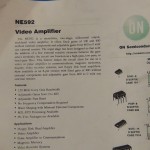
Here are the datasheets for the two chips I used in (PART 2)
74HCT132 Quad 2-input NAND Schmitt trigger (PDF)
NE592 video Amplifier (PDF)
Thanks for joining!
Photo Gallery
CLICK PHOTO for gallery view and click a SECOND time for hi-resolution image. Click thumbnails on lower right and lower left of gallery to navigate gallery photos.
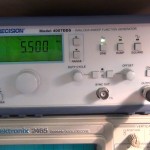
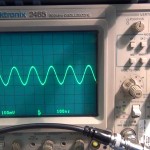
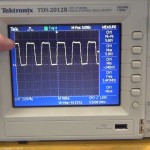
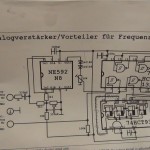
Thanks for joining!
Get Your Mobile Frequency Sticker On
One of the things I try to do is monitor the National Simplex Calling Frequency for 2 meter FM: 146.52 MHz, especially when mobile. It is fun to see who might show up on 2m simplex: SOTA operators, hikers, mobile stations, campers, etc. See these two posts on operating ideas: A Simple Wilderness Protocol: 146.52 MHz and The Use of 146.52 MHz.
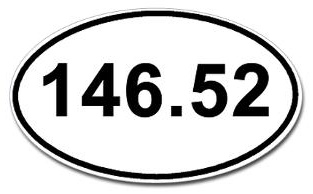 It is also fun to say hello to another ham when you pass them on the highway. While you may see their call letter license plates or notice their mobile antenna, you may not know what frequency they are monitoring. The Noise Blankers Radio Club has solved this problem — just put this sticker on your vehicle.
After poking around cafepress.com, I found some additional options for indicating your radio frequency:
The 2meter SSB calling frequency:
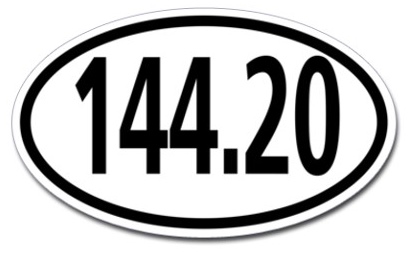
The APRS frequency:
And there’s this magnet for your refrigerator:
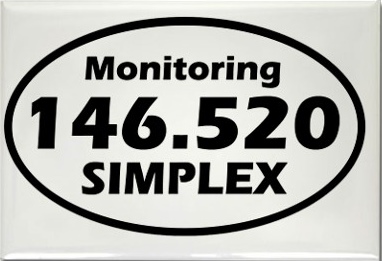
If you don’t like any of these, cafepress.com makes it easy to create your own. Go for it!
73, Bob K0NR
Bloody Proprietary Connectors
I came across this video rant by David L. Jones on the EEVblog concerning proprietary cables on consumer devices. I agree with him completely. Warning: some language not suitable for kids.
Unfortunately, if you look at ham radio gear, we are in even worse shape than the consumer market. Heck, even the freaking microphone connectors are unique to each manufacturer.
LHS Episode #123: Busted for Jaycasting
 Hello, folks! It’s February 2014, and we finally announce the winner of our Raspberry Pi contest! But before all that excitement, we have a great interview with a fellow radio amateur. Around that, we have news and information about the usual suspects, and covering it all is a thick layer of fun. Thanks for tuning in, and we hope to see you all in Dayton in May. Please donate to our Indiegogo campaign if you can. Every little bit helps. And don’t forget about the perks!
73 de The LHS Guys
Colorado 14er Event – August 3, 2014
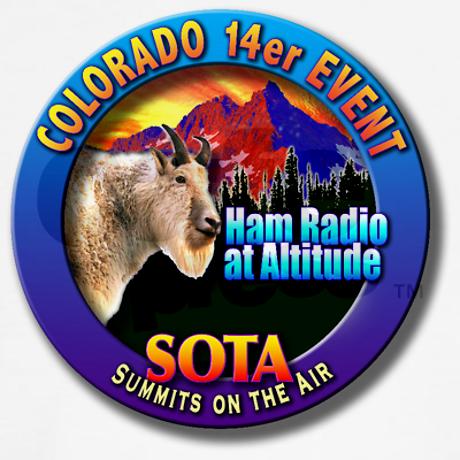 During the Colorado 14er Event, Amateur Radio operators will be climbing many of Colorado’s 14,000-foot mountains and SOTA summits to set up amateur radio stations to communicate with other radio amateurs across the state and around the world. Join in on the fun on Sunday August 3 and see how many of the mountaintop stations you can contact.
The new Colorado 14er Event logo is now available on t-shirts and more.
Starting in 2012, Summits on The Air (SOTA) is part of this event. This means there are over 1700 summits that you can activate in Colorado, with a wide variety of hiking difficulty. This opens up the event to a lot more people and a lot more summits. See the new SOTA page.
Radio operators with 14er climbing experience who plan to activate a summit should log their name and intended peak at the Ham14er Yahoo group. This is also the email list for discussing the event and asking questions.
Solving the Baofeng Cable Problem
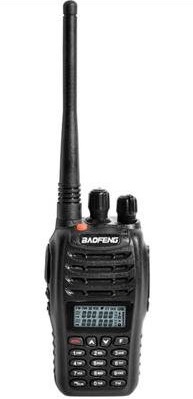 The various models of Baofeng handheld transceivers keep popping up everywhere. At prices less than $50, radio amateurs (including veterans and newbies) are scarfing up these radios. See my postings or check out PD0AC’s blog for more information.
Also very frequently, the new owner of such a radio finds that they cannot figure out how to program it. Of course, the solution is “use the programming software” which is often helpful (and often not). The really gnarly problem that usually surfaces is getting the programming cable to work.
It appears that many of the cheap Baofeng USB programming cables use a clone of the Prolific PL-2303 chip that is not supported by the latest Windows driver. This Miklor web page does a good job of explaining the driver problem and giving some helpful advice. (Actually the Miklor site has tons of information on these radios, so check it out.) I’ll also note that the same cable can be used to program a Wouxun radio, so the same remedies apply. Using the info on the Miklor site allowed me to get my Baofeng/Wouxun cable working with my old Windows XP computer. When I bought a new notebook PC, it came with Windows 8 installed, which I later “upgraded” to Win 8.1. (I will spare you the sad story of dealing with Win 8 and 8.1) Anyway, I have not gotten the Baofeng cables to work on Win 8 or 8.1, even following the Miklor advice.
I started using the Chirp programming software, an open source application that supports a wide variety of radios. (I have found the supplied Baofeng and Wouxun software to be, uh, well, crapware. It can be made to work but it is a pain.) While the Chirp software is not bug free and is in perpetual beta, it basically works well and does a great job of supporting a wide range of radios. I noticed that the Chirp Cableguide recommends the use of programming cables with an FTDI USB chip. I found this one on Amazon for $19, a little more expensive than the cheapo cables but not bad. I plugged it into my Win8.1 computer and it started working immediately. I did not load any drivers, Windows actually did its job and took care of it for me. In minutes, I was programming a variety of Baofeng and Wouxun radios. Success!!!
My strong recommendation at this point is to use the Chirp software and get a FTDI-based programming cable. You will be a much happier Baofeng or Wouxun owner.
73, Bob K0NR













