Archive for the ‘ham radio’ Category
 Three Steps to Getting Your Ham Radio License
 October 13th, 2014 |
  Author:
  These are the three basic steps to getting your USA amateur (ham) radio license: 1) Learn the Material 2) Take Practice Exams and 3) Pass the Real Exam.
This article is very short and to the point, for a more detailed explanation see Stu’s article over at HamRadioSchool.com.
1. Learn The Material
The entry level ham radio license is the Technician License, so you’ll need to get a book that covers the theory, regulations and operating procedures required by the Federal Communications Commission (FCC). My recommendation is the Technician License Course over at HamRadioSchool.com, which offers an integrated learning system (web, book and smartphone app).
While you can learn the material on your own, many people find classroom instruction to be very helpful. Check the ARRL web site for courses in your area or just do an internet search for “ham radio license class” and your location.
2. Take Practice Exams
The question pool for the Technician Level Exam is made public, so you have access to every possible question that will be on the exam. Better yet, various organizations have created online practice exams so you can test yourself in advance. After you study the material, take these practice exams to test your knowledge. Go back and study any topics you are having trouble with on the exam. A passing grade is 74%, so you’ll want to be consistently above that before trying the real exam.
These are a few of the available online practice exams: qrz.com, eham.net and aa9pw.
3. Pass the Real Exam
The FCC exams are administered by radio hams known as Volunteer Examiners (VEs), so the exam session is sometimes called a VE session. In most areas, there are exam sessions given on a regular basis. Check the ARRL web site to find a license exam session in your area.
Be sure to follow the instructions of the local VE team, since policies and procedures do vary. If you’ve studied the material and checked your knowledge by taking the practice exams, you should have no problem passing the Technician level exam.
4. One More Thing
Actually, there is one more step to this process. Getting the required FCC license is just the start, a learners permit for amateur radio. You’ll need to get on the air and gain some practical experience. It is extremely helpful to have some help during this process, so I highly recommend that you connect up with a local ham radio club. If you can’t find a club then perhaps make contact with a local ham or two.
There are many hams out there that are willing to help. However, it may be a challenge to find one. You can always drop me an email and I will try to assist.
73, Bob K0NR
This Spewed Out of the Internet #29
 More important
 information insight stuff spewing forth from the interwebz:
The actor Tim Allen, who’s character on the TV show Last Man Standing is a ham radio operator, recently received his Technician License. According to Wikipedia, Allen holds the callsign KK6OTD under the name Tim Dick.
The FCC says that Marriott has been interfering with their customers’ use of WiFi hotspots at the Gaylord Opryland Hotel and Convention Center in Nashville, Tennessee. It seems that they wanted to “encourage” customers to pay for WiFi service.
ICOM has made available some cool amateur radio guides on their web site, including a World Map, USA Band Plan Chart and a USA VHF Grid Map. Oh, ICOM, please note that those grid locators are not actually “squares.”
Those Ham Hijinks guys must have bought a new ribbon for their typewriter since they’ve cranked our these articles: Obama Signs Ham Radio Executive Order and Man Creates Multi-Purpose Rotator.
Over at HamRadioSchool.com, I added another Shack Talk article, this one about ham radio awards: Operating Awards: Chasing Wallpaper.
73, Bob K0NR
Mt Herman: SOTA plus VHF Contest
The North America SOTA Weekend coincided with the ARRL September VHF Contest, which I interpreted as a great opportunity to do a combination SOTA activation and QRP VHF operation. A few other folks thought that was a good idea so we all got on the air from SOTA peaks on the Sunday of the weekend. I decided to operate from Mount Herman (W0C/FR-063) in grid DM79. I hiked up the same mountain for last year’s September contest and got soaked by the rain. Fortunately, the weather was excellent this year, making it a great day.

View from the south side of Mt Herman
For radio equipment, I took a couple of HTs for 2m and 70 cm FM and the FT-817 for CW/SSB on 6m, 2m and 70 cm. Most of the SOTA action would be on 2m FM but SSB is critical for working the VHF contest. I did put out the word to the usual VHF contesters that there would be FM activity and did work a few of them via 2m FM. The 2m FM calling frequency, 146.52 MHz, is commonly used for SOTA but is not allowed for contest use. (Another example of how this rule is just a barrier to contest activity.) We used 146.55 MHz for the contest contacts. 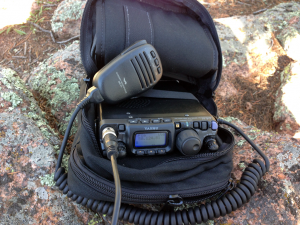 I had coordinated with Brad WA6MM who was going to be on Grays Peak (W0C/FR-002), one of the Colorado 14ers. When he made the summit, I had my 2m yagi antenna pointed in his direction and easily worked him on 2m FM at a distance of 65 miles. Brad was using an HT with a 1/2-wave vertical antenna. Also, I worked Stu W0STU and Dan N0OLD on Bald Mountain (W0C/FR-093) , which sits on the east side of I-25 right at Monument Hill. Contest activity was light, as usual for the September contest in Colorado. We did have two rover stations that activated a few of the unpopulated grids in eastern Colorado: George AB0YM and Jonesy W3DHJ.
Band       QSOs X pt =  QSO pts.  X   Grids   =     Points
 -----------------------------------------------------------
 50         8      1      8             5             40
 144        23     1      23            5             115
 432        14     2      28            3             84
 -----------------------------------------------------------
 TOTALS     45            59            13            767
My contest score was not bad for a few hours of operating QRP portable. It turns out that I had set the Colorado section record for “single-op portable” back in 1990 with just 624 points (using my old callsign KB0CY). Oddly enough, 24 years later it appears that I set a new record. (This speaks more to the lack of QRP activity during the September contest and less about my incredible operating ability.)
All in all, it was a great day in the mountains to take a hike and play with radios. I will probably do the SOTA + VHF Contest activation again.
73, Bob K0NR
Portable All-Mode VHF Radio: FT-817 vs KX3
For truly portable mountaintop all-mode VHF operating, especially SOTA and VHF contests, the Yaesu FT-817ND has been my rig of choice. You might say that it is really the “only game in town” for a 6m/2m/70cm radio that fits in a backpack.
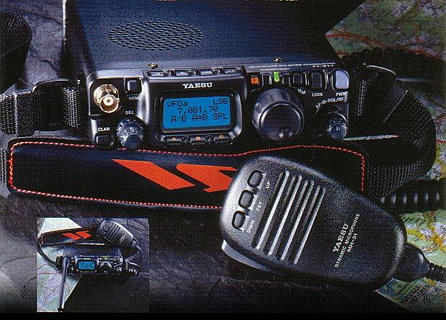
The Yaesu FT-817ND
I’ve had my eye on the Elecraft KX3 transceiver ever since it was introduced, but really I have been waiting for the 2m module to become available. (The KX3 has HF plus 6m standard.) After being announced over a year ago, the 2m module is now shipping and radio amateurs are getting their hands on the unit.
I do enjoy getting on the HF bands but my radio passion has always been centered on 50 MHz and higher. For my purposes, the manufacturers could have left off the HF bands and just designed a portable rig that does 6m, 2m and 70 cm (and maybe 1.25m, too). Or how about a dualband HT that does SSB?
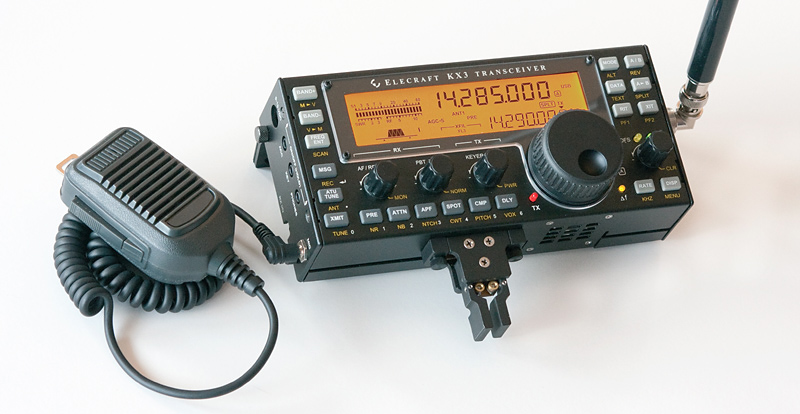
The Elecraft KX3
I’ve used my 817 for many portable operations, so I have quite a bit of stick time on that rig. I’ve not really used a KX3, other than to play with it at hamfests. I’ve also talked with a number of KX3 owners that really like the rig. I was a bit surprised that the KX3 power is only 2.5W minimum (3W typical), compared to 5W with the FT-817. (Yeah, I know, that’s only 3 dB difference, blah, blah, blah.) One of the big complaints on the 817 is that it is a bit of a battery hog on receive (450 mA) but the KX3 is not that much better at 300 to 350 mA. Here’s my comparison table for the two radios — with the emphasis on VHF operation.
| FT-817ND | KX3 with 2m Module | |
| Bands | HF + 6m, 2m, 70cm | HF + 6m, 2m |
| 6m Power Out | 5W | 8W |
| 2m Power Out | 5W | 2.5 -3W |
| Standby rx current (2m) | 450mA | 300 to 350 mA |
| Transmit current (2m) | 2A | 1.7A |
| Weight | 2.5 lbs, 1.2 kg | 1.5 lbs, 0.7 kg |
| Price | $690 | KX3 assembled $900 Hand mic $60 2m module $260 Total: $1220 |
The price comparison is a bit tricky because the KX3 can be purchased in kit form for $100 less. Many hams will actually see the kit assembly as a plus, since they get the satisfaction of building their own radio. A microphone is not standard on the KX3, so I added that to the list. Also, there are several different variations on the 2m module, depending on whether the automatic antenna tuner for HF is installed and whether the factory installs the option. I just picked a price that was in middle of the range.
The table would lead you to conclude that the FT-817ND is the clear winner mostly based on price (and the 70cm band). But its not that simple. There is a lot to like about the KX3, including the nice big display and the trail friendly layout. It also has more features for CW, PSK31 and RTTY.
For me, the answer is clear: keep on keepin’ on with the 817, since there is not enough of an advantage to go to the KX3. But I will probably keep lusting after it anyway. This also raises the question: what does Yaesu have coming to replace the aging 817?
What do you think?
73, Bob K0NR
Bit About Antenna Tuners
Something has bugged me for a long time — the way some radio manufacturers market and sell their transceivers with built-in automatic antenna tuners. These are almost always intended to be used with antennas that are sold by the manufacturer (for instance, a specific mobile antenna) but this is seldom clear in large print in the adverts.
An unsuspecting ham may think the auto-tuner in his shiny new HF rig is going to work with the new dipole he hung up between the trees, only to discover it’s a hot mess.
Due to their size, most internal tuners (there are some exceptions) can manage only a slight mismatch in impedance and cannot begin to cover a wide range like that presented by ladder line and wire antennas. The explanation for this is fairly straight forward.The antenna and feed line present a load to the output of your transceiver. Most modern equipment has been designed to work with a load impedance of 50 ohms. Get close enough to that, and the transmitter is a happy camper. But if the load impedance is something other than 50 ohms, you have a mismatch. A mismatch causes a certain amount of the power that you’re trying to get out to be reflected back down the line — where it encounters forward power from the transmitter resulting in standing waves on the feed line.
You’ve doubtless heard of this in discussions about SWR or standing wave ratio.
A high SWR can cause considerable RF voltages in the feed line — and at the output of your shiny new radio. This isn’t healthy for modern transceivers (tubes are a little more forgiving) so manufacturers have taken to protecting equipment from this condition. When it’s sensed, your rig may fold back its output power, or shutdown altogether in order to prevent damage.
And this is why hams use antenna tuners. Most of us would like to be able to operate over many frequencies with a single antenna. Since the impedance of that single antenna will change depending on the frequency of the transmission, a tuner becomes a useful tool.
Basically, a tuner is a combination of inductors and capacitors that act to balance the load reactance at the transceiver end of the feed line. With the reactance effectively canceled, the load impedance at the transceiver is 50 ohms and all is right with the world.
Well, maybe not everything. Your antenna might still be a highly inefficient radiator — but with a 50 ohm load, the transceiver will happily pump all of its juice up into that inefficient aerial system as though it were perfect.
What’s really taking place here is that the load mismatch has been moved down the feedline from the output of the transceiver to the output of the antenna tuner. The reflected energy and standing waves still exist, though a well-designed tuner should be able to handle it better than your transceiver. The tuner protects the transceiver and permits it to generate full-power output.
Higher power and wider ranging tuners are physically larger than can be made to fit inside most tiny, whiz-bang transceivers. Physics is a tough master that demands attention at some point.
The moral of the story is that wire antennas, ladder line and open feed lines are great systems for launching RF into the aether, so long as you have a proper antenna tuner in the circuit. But internal tuners offered with most modern transceivers simply won’t cut it with these kinds of antenna systems.
There are notable exceptions. The low-power internal tuners offered by Elecraft and the slightly larger internal tuners offered by TenTec are downright amazing. There may be others that I’m not aware of so do your homework but as always, the buyer should beware…


Getting My Radio Fix – QRP Portable Today!
I was finally able to sneak off at lunch time for some quick portable QRP op’s with the KX3 and my Portable QRP Antenna from the local park.
I did a quick scan of the bands when I got there, and made one quick contact with a mobile station…
N7IV/M 14.056 599 both ways. I am not exactly sure where he was, but had a little pileup going. (UPDATE: I found him on APRS – I appears he was in Wisconsin)
Then I decided to just plant myself on a frequency and call CQ to see what happened. I spotted myself on Twitter hoping to maybe make contact with a Twitter follower. VA3QV sent me a Tweet and said he was listening but could not hear me.
But I did manage to get some replies to my CQ on 14.057!
W4FO Pat in Florida
KD3CA Don in Pennsylvania
W9DCQ Doug in Wisconsin
WD9DWE Dennis in Indiana
Thanks for the QSO’s guys!
I then decided to spin the dial a bit. I heard W1AW/0 in ND, but could not break the pileup. It sounded like he was working some DX but I could not hear the DX.
Then I went to 17 meters and worked…
W1AW/8 in Ohio – it took a bit to bust the pileup, but I finally made it!
So a fun lunch hour on the radio today! Thanks to everyone that worked me, and to those on Twitter that tried to work me. It was a fun adventure.
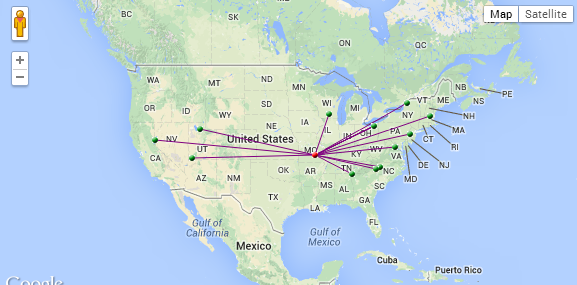
Here is where I was spotted by RBN:
Getting My Radio Fix – QRP Portable Today!
I was finally able to sneak off at lunch time for some quick portable QRP op’s with the KX3 and my Portable QRP Antenna from the local park.
I did a quick scan of the bands when I got there, and made one quick contact with a mobile station…
N7IV/M 14.056 599 both ways. I am not exactly sure where he was, but had a little pileup going. (UPDATE: I found him on APRS – I appears he was in Wisconsin)
Then I decided to just plant myself on a frequency and call CQ to see what happened. I spotted myself on Twitter hoping to maybe make contact with a Twitter follower. VA3QV sent me a Tweet and said he was listening but could not hear me.
But I did manage to get some replies to my CQ on 14.057!
W4FO Pat in Florida
KD3CA Don in Pennsylvania
W9DCQ Doug in Wisconsin
WD9DWE Dennis in Indiana
Thanks for the QSO’s guys!
I then decided to spin the dial a bit. I heard W1AW/0 in ND, but could not break the pileup. It sounded like he was working some DX but I could not hear the DX.
Then I went to 17 meters and worked…
W1AW/8 in Ohio – it took a bit to bust the pileup, but I finally made it!
So a fun lunch hour on the radio today! Thanks to everyone that worked me, and to those on Twitter that tried to work me. It was a fun adventure.
Here is where I was spotted by RBN:













