Archive for the ‘ham radio’ Category
 SOTA Activation: Kaufman Ridge HP (W0C/SP-081)
 November 1st, 2014 |
  Author:
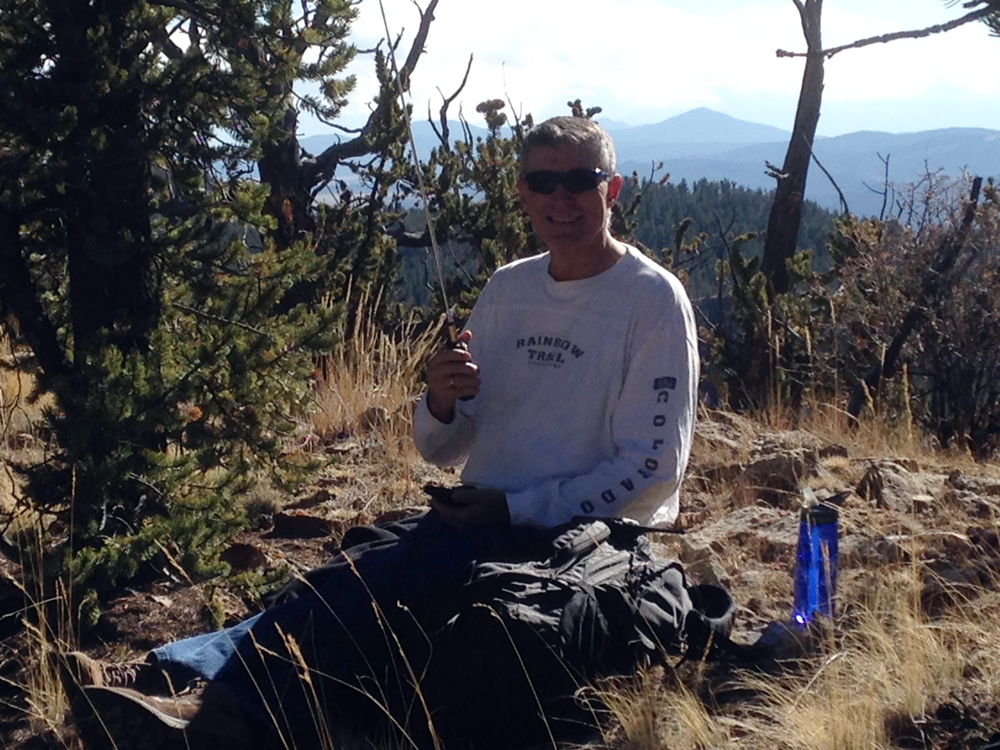
 It was a nice fall day, so Joyce K0JJW and I decided to go for an easy hike up Kaufman Ridge HP (W0C/SP-081) and do some SOTA operating. Well, maybe the hike was her idea and the Summits On The Air thing was my contribution to the plan. The hike is less than a mile and has about 900 feet in elevation gain, depending on where you start the hike.
This definitely a slacker operation: easy access, easy hike, great weather and 2m FM activation via a handheld radio and the 1/2-wave whip.
Note that there are two SOTA peaks with the “Kaufman Ridge” name: Kaufman Ridge North (W0C/SP-085) and Kaufman Ridge HP (W0C/SP-081), located near Trout Creek Pass in Colorado. Today we headed to SP-081 which we reached by following County Road 318 from Trout Creek Pass, which is also called Buckrake Drive and then Windmill Drive. These roads pass through private property to reach the San Isabel National Forest, where there is a gate that closed from December to April (see map). At this point, the road is easy 4WD, most 2WD high clearance vehicles will do fine. You can also approach from the south on FS 308 through Mushroom Gulch. 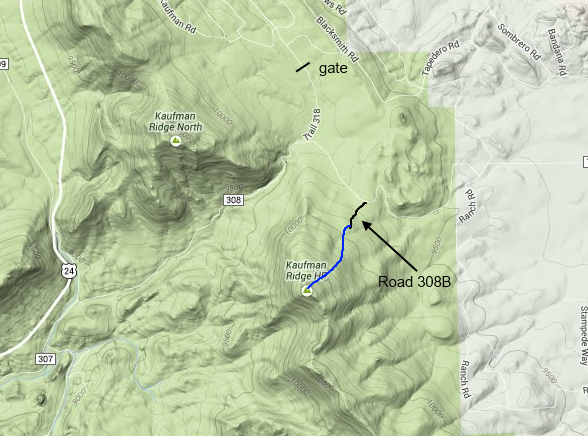
We turned left onto FS 308 and then took a short side road FS 308B toward the summit. There are several over turn offs but 308B seems the best (shown in black on map). The road is blocked for vehicular traffic at 38.858659° N / 105.933921°W. You can continue walking on the road a ways or just head straight for the summit. While the hike is short and not that steep, there are plenty of downed logs to give you a challenge.
You never know who is going to show up on 146.52 MHz in the mountains but I had put the word out via email to some of the local hams to let them know I was doing a SOTA activation. When I got to the summit, I had a few stations already calling me and I quickly worked Ron N0MQJ, Fred N0VXE, Dave K0HTX, Jim KD0MRC, Bob W0BV and Don K0DRJ. Don was my “best DX”, about 60 miles away in Woodland Park with a few mountains in the way. Thanks to everyone that came on frequency and contacted me.
Side note: if you want to activate SP-085, go north on a forest service road (not shown on map) near where 318 and 308 intersect. Just drive a short ways north, find a parking spot and bushwack your way up the summit. You could easily activate both summits in one day.
73, Bob K0NR
The post SOTA Activation: Kaufman Ridge HP (W0C/SP-081) appeared first on The KØNR Radio Site.
The Completely Updated Incomplete List of Ham Radio iPhone Apps
 It is about time I updated one of my more popular posts about my favorite ham radio apps on the iPhone and IPad. As usual, I will focus on free or low cost (less than $5) apps that I am actively using. Some apps have just disappeared from iTunes and new ones have emerged. While this list is completely updated, it is still incomplete, because there are so many apps to choose from.
From the Simple Utility Category:
Ham I Am (Author: Storke Brothers, Cost: Free) A handy app that covers some basic amateur radio reference material (Phonetic alphabet, Q Signals, Ham Jargon, Morse Code, RST System, etc.) Although I find the name to be silly, I like the app!
Maidenhead Converter (Author: Donald Hays, Cost: Free) Handy app that displays your grid locator, uses maps and does lat/lon to grid locator conversions.
HamClock (Author: Ben Sinclair, Cost: $0.99) A simple app that displays UTC time and local time. This one reads out to the second.
There are quite a few good apps for looking up amateur radio callsigns:
CallBook (Author: Dog Park Software, Cost: $1.99) Simple ham radio callbook lookup with map display.
Call Sign Lookup (Author: Technivations, Cost: $0.99) Another simple ham radio callsign lookup with map display.
There are a few repeater directory apps out there and my favorite is:
RepeaterBook (Author: ZBM2 Software, Cost: Free) This app is tied to the RepeaterBook.com web site, works well and is usually up to date.
For a mobile logbook (and other tools):
HamLog (Author: Pignology, Cost: $0.99) This app is much more than a logbook because it has a bunch of handy tools including UTC Clock, Callsign Lookup, Prefix list, Band Plans, Grid Calculator, Solar Data, SOTA Watch, Q Signals and much more.
To track propagation reports, both HF and VHF:
WaveGuide (Author: Rockwell Schrock, Cost: $2.99) This is an excellent tool for determining HF and VHF propagation conditions at the touch of a finger.
If you are an EchoLink user, then you’ll want this app:
EchoLink (Author: Synergenics, Cost: Free) The EchoLink app for the iPhone.
There are quite a few APRS apps out there. I tend to use this one because my needs are pretty simple….just track me, baby!
Ham Tracker (Author: Kram, Cost: $2.99) APRS app, works well, uses external maps such as Google and aprs.fi. “Share” feature allows you to send an SMS or email with your location information.
Satellite tracking is another useful app for a smartphone:
Space Station Lite (Author: Craig Vosburgh, Cost: Free) A free satellite tracking app for just the International Space Station. It has annoying ads but its free.
ProSat Satellite Tracker (Author: Craig Vosburgh, Cost: $9.99) This app is by the same author as ISS Lite, but is the full-featured “pro” version. Although it is a pricey compared to other apps, I recommend it.
For Summits On The Air (SOTA) activity, there are a few apps:
Pocket SOTA (Author: Pignology, Cost: $0.99) A good app for finding SOTA summits, checking spots and accessing other information.
SOTA Goat (Author: Rockwell Schrock, Cost: $4.99) This is a great app for SOTA activity. It works better when offline than Pocket SOTA (which often happens when you are activating a summit).
For ham radio license training, I like the HamRadioSchool.com apps. (OK, I am biased here as I contribute to that web site.)
HamRadioSchool Technician (Author: Peak Programming, Cost: $2.99) There are a lot of Technician practice exams out there but this is the best one, especially if you use the HamRadioSchool.com license book.
HamRadioSchool General (Author: Peak Programming, Cost: $2.99) This is the General class practice exam, especially good for use with the HamRadioSchool.com book.
Morse Code is always a fun area for software apps:
Morse-It (Author: Francis Bonnin, Cost: $0.99) This app decodes and sends Morse audio. There are fancier apps out there but this one does a lot for $1.
Well, that’s my list. Any other suggestions?
– Bob K0NR
The post The Completely Updated Incomplete List of Ham Radio iPhone Apps appeared first on The KØNR Radio Site.
LHS Episode #134: Boxers, For Sure
 In today’s episode, we have our final listener interview from the Hamvention 2014 Indiegogo campaign that actually ended back in February. Mike Maydaniuk, VA7XXM, was kind enough to donate to our Hamvention ambitions, and now comes on the show to share with us his thoughts on Linux, amateur radio, life, and some random silliness. Hope you enjoy, and please make sure to send us feedback, either via e-mail, social media or voice mail.
73 de The LHS Guys
Disturbing the Force
Smartphones keep getting bigger. Out of the noise about the rising popularity of phablets, one notable observation bubbled to the surface, and that by tech pundit and radio amateur Leo Laporte, W6TWT. Laporte likes the large phones and when chided that it would appear he was holding a waffle to his head when making a telephone call he responds, “who uses a smartphone to make telephone calls anymore?”
That sounds funny, and seems to go against the grain, however, it’s spot on accurate. We very rarely use mobile devices to “talk” with someone after the manner of the ancient rotary phone. We send texts, photos, and Tweet’s. We Facetime, Hangout, Facebook, Instagram and Snapchat. Fact is, we do almost everything with our mobile devices EXCEPT use them as wireless telephones. It’s not a telephone, it’s a personal communicator and the demand for larger screens simply reflects the rapid changes we observe in the way we communicate with each other in the 21st century.
I find that notable because there’s an oddity in the ham radio world that might be explained by it.
Contest organizers and RBN data detectives tell us that CW activity has been on the rise for nearly a decade. We can infer by the increase in QST advertising of paddles, keys, and other such devices that the sale of Morse instruments is at nearly a fever pitch. And yet, despite that, you talk to guys who live in the code trenches and they will lament the serious lack of activity. Sure, some of that may just be the imagination of old men who dream of the better day that never really was, but that doesn’t negate the many credible observations that casual CW use, especially rag chewing, is getting harder to come by.
So what’s really happening?
Hard to say for certain but there is one possibility that would explain the observed rise and fall, at the same time, of CW. It is possible that the way we communicate in the new age has changed from the way we used to do it. The efficacy of CW is legendary and highly advantageous in a contest or when chasing DX. It’s just possible that we’re using CW more for short, rapid exchanges of information — and less for casual operation.
This would explain why the RBN is telling us one thing (way more CW activity) while the good old boys who do nothing but pound the brass tell us something different (CW is dying). Both are right, and wrong. (I told you it was an oddity).
It also explains why way back in our long ago a spiral bound ARRL logbook would last an entire year or more while these days, many of the brethren are putting 2,000 Q’s in the log over a good weekend.
Short, rapid fire CW exchanges = text messaging. Get used to it. Besides, who needs to be loquacious in the 21st century?
(But if you really want to chew the rag using CW, meet me on 7.120 and we’ll do it 20th century style!)
OMG WTF? LOL 73


Radio Scouting Adventure
The Jamboree-on-the-Air, or JOTA, is an annual Scouting event that uses amateur radio to link Scouts around the world, around the nation, and in your own community. Held on the third full weekend of October each year, this worldwide jamboree requires no travel, other than to a nearby radio amateur’s ham shack. Many times the hams will come to you by setting up at a Scout camporee, or perhaps they already have a ham shack at your council’s camp. There are many ways to get your Scouts involved in JOTA.
I look forward to monitoring IRLP reflector 9091 for JOTA traffic all day.


Ten-Tec Update
Ten-Tec Factory Relocation Update
Internet access is working, working on phones, carts, shelves, desks, etc. We are far from having enough set up to do any real work at the new location yet, but, the move is occurring, boxes are getting moved, and unpacked. Phones will transition from one service provider to another so that will be a mess for a short spell when the porting occurs, but by end of October, we “should” be business as usual, no, not “as usual”, better. We are still making rigs and will continue to do throughout the move, so, Eagles will still leave the nest throughout the rest of this month, so will Argonaut VIs and so will OMNI-VIIs.
Thanks, and 73,
John Henry, KI4JPL
TEN-TEC Engineering, a Division of RFConcepts LLC
It appears that the special transceiver pricing continues to hold. That Eagle package at $1499 is an amazing price.


Ham Radio Mystery
I wrote, produced, and recorded Cornbread Road, a ham radio mystery series in 2010 when it was released one episode per week for thirteen weeks. After a successful run, I removed the files from the server as I never intended it to be continuously available.
But ever since then I have made the thirteen audio files available once a year for a limited run — for those who might have missed it. The audio series is available again right now, but only until the end of the month. On Halloween I’ll pull down the files until next year. Download them now or wait until next year.
It’s all fun, fiction and unlike any ham radio story you’ve ever heard told.















