Archive for the ‘ham radio’ Category
 Inverted High Frequency Loss with LMR-450G
 April 1st, 2015 |
  Author:
 By John ‘Miklor’ K3NXU
PERFORMANCE TESTS – LMR-450G
The recently announced LMR-450G cable has aroused much curiosity since its characteristics have not been collectively available by any one source. By multiple inquiries to several manufactures (only three at this time) and numerous lab tests, we hope to put many of the existing questions to rest.
DESCRIPTION
The physical make up of this cable varies slightly from most conventional RF cables. The center conductor is a semi-stranded copper alloy surrounded by Telfon, which will absorb and distribute cable ‘hot spots’ caused by excessive standing wave. The double silver braid and foil outer coating which provides a 98.6% shield is what the inverted high frequency loss characteristics are attributed. The loss is substantially less as the frequency increases, making this cable especially attractive for UHF, cellular, PCS and microwave applications.

Measuring cable loss under lab conditions
LOSS PER 100′
30 MHz 2.4 db
50 MHz 2.1 db
150 MHz 1.6 db
450 MHz 1.1 db
800 MHz .51 db
1200 MHz .37 db
1950 MHz .31 db
The cable’s most unique property is attributed to the outer jacket material Neo-glow, an RF sensitive composite plastic which will visibly indicate RF ‘hot spots’ in the cable. Adjusting the cable length to the antenna system for the ‘perfect’ impedance match is crucial at high frequency, thus the importance of a low SWR for peak performance.

From 100 Watts and up this cable will brighten up your world.
PROPER INSTALLATION
The low level emission of light from LMR-450G cable can be enhanced by wearing lightly tinted sunglasses with UV protection, which enhances the light radiation from the cable. Select an approximate length of cable needed for the installation which must be multiples of a 1/4 wavelength for the desired frequency. The exact length can be determined by using the formula 467 / Freq (MHz) plus approximately 18 inches.
The initial tests should be run with a 50 ohm dummy load at one end of the cable. With a minimum of 7 watts from the transmitter, you will see a faint glow from the cable indicating the ‘hot spots’ to be eliminated. These are the points along the cable where the RF is at its maximum. It is at these points where the RF connectors should be mounted. Trimming the excess cable may be required at both ends of the cable to produce the most effective match. Use caution not to trim too much cable as the loss characteristics improve with longer cable lengths.
SUMMARY
This could be the beginning of the long awaited high frequency “SUPER” cables. Only available in limited quantities at this time; contact your local cable supplier for more details.


Inverted High Frequency Loss with LMR-450G
By John ‘Miklor’ K3NXU
PERFORMANCE TESTS – LMR-450G
The recently announced LMR-450G cable has aroused much curiosity since its characteristics have not been collectively available by any one source. By multiple inquiries to several manufactures (only three at this time) and numerous lab tests, we hope to put many of the existing questions to rest.
DESCRIPTION
The physical make up of this cable varies slightly from most conventional RF cables. The center conductor is a semi-stranded copper alloy surrounded by Telfon, which will absorb and distribute cable ‘hot spots’ caused by excessive standing wave. The double silver braid and foil outer coating which provides a 98.6% shield is what the inverted high frequency loss characteristics are attributed. The loss is substantially less as the frequency increases, making this cable especially attractive for UHF, cellular, PCS and microwave applications.
Measuring cable loss under lab conditions
LOSS PER 100′
30 MHz 2.4 db
50 MHz 2.1 db
150 MHz 1.6 db
450 MHz 1.1 db
800 MHz .51 db
1200 MHz .37 db
1950 MHz .31 db
The cable’s most unique property is attributed to the outer jacket material Neo-glow, an RF sensitive composite plastic which will visibly indicate RF ‘hot spots’ in the cable. Adjusting the cable length to the antenna system for the ‘perfect’ impedance match is crucial at high frequency, thus the importance of a low SWR for peak performance.
From 100 Watts and up this cable will brighten up your world.
PROPER INSTALLATION
The low level emission of light from LMR-450G cable can be enhanced by wearing lightly tinted sunglasses with UV protection, which enhances the light radiation from the cable. Select an approximate length of cable needed for the installation which must be multiples of a 1/4 wavelength for the desired frequency. The exact length can be determined by using the formula 467 / Freq (MHz) plus approximately 18 inches.
The initial tests should be run with a 50 ohm dummy load at one end of the cable. With a minimum of 7 watts from the transmitter, you will see a faint glow from the cable indicating the ‘hot spots’ to be eliminated. These are the points along the cable where the RF is at its maximum. It is at these points where the RF connectors should be mounted. Trimming the excess cable may be required at both ends of the cable to produce the most effective match. Use caution not to trim too much cable as the loss characteristics improve with longer cable lengths.
SUMMARY
This could be the beginning of the long awaited high frequency “SUPER” cables. Only available in limited quantities at this time; contact your local cable supplier for more details.
‘USA 1776’ DMR Talk Group
 One of the nice things of D-Star and DMR is the ability to talk all over the world without the need of an HF rig and a bunch of big antennas. While this largely reduces a radio to a simple Internet-driven communication tool – just like Skype or other VoIP apps – it’s definitely nice to use.
There are a few problems surrounding DMR, one of which is the lack of more than two time slots. For example, if hams are using the Dutch Hytera network and occupying talk group 204 on slot 1, World Wide (which uses the same time slot) will be unavailable. Because 204-1 is a busy place, world wide QSOs are often impossible. It’s one of the reasons I thought of dumping DMR all together — I can talk to the same Dutch guys on analog while enjoying a much better quality audio.
There are reasons to keep DMR too. DMR is maturing; there are more than enough possibilities to put less pressure on the nation-wide network by going local. Now if only hams would do that…. but most don’t. Another reason to keep DMR for now is the gateway we recently added, which connects D-Star to our DMR network.
Not available on the Motorola network, sorry — some people responsible for that network appear to be so scared of such innovations that they will ban a repeater from the network if such a gateway is detected.
Talk group ‘USA 1776’ could add to the appeal of DMR. It’s unclear on which network this talk group will reside, but my best guess is that it will be the Motorola network. MITCON writes:
The “USA 1776″ (English preferred) Talk Group will be distributed worldwide to DMR networks upon request. The spirit of “1776” is to continue the Amateur Radio tradition of international friendship and to push the boundaries of technology in the new frontier of digital communications.
 USA 1776 is intended to be a flexible, politically neutral, unrestricted Talk Group that can be used as Push-To-Talk (PTT) or Full-Time (FT) to meet the operating requirements of a DMR Network. DMR subscribers are welcome to use 1776 as a universal meeting place to “Rag Chew” or as a jumping off point and QSY to an alternative Talk Group if desired. To add USA 1776 to your DMR Network please contact us to schedule a time for configuration & testing.


‘USA 1776′ DMR Talk Group
One of the nice things of D-Star and DMR is the ability to talk all over the world without the need of an HF rig and a bunch of big antennas. While this largely reduces a radio to a simple Internet-driven communication tool – just like Skype or other VoIP apps – it’s definitely nice to use.
There are a few problems surrounding DMR, one of which is the lack of more than two time slots. For example, if hams are using the Dutch Hytera network and occupying talk group 204 on slot 1, World Wide (which uses the same time slot) will be unavailable. Because 204-1 is a busy place, world wide QSOs are often impossible. It’s one of the reasons I thought of dumping DMR all together — I can talk to the same Dutch guys on analog while enjoying a much better quality audio.
There are reasons to keep DMR too. DMR is maturing; there are more than enough possibilities to put less pressure on the nation-wide network by going local. Now if only hams would do that…. but most don’t. Another reason to keep DMR for now is the gateway we recently added, which connects D-Star to our DMR network.
Not available on the Motorola network, sorry — some people responsible for that network appear to be so scared of such innovations that they will ban a repeater from the network if such a gateway is detected.
Talk group ‘USA 1776′ could add to the appeal of DMR. It’s unclear on which network this talk group will reside, but my best guess is that it will be the Motorola network. MITCON writes:
The “USA 1776″ (English preferred) Talk Group will be distributed worldwide to DMR networks upon request. The spirit of “1776” is to continue the Amateur Radio tradition of international friendship and to push the boundaries of technology in the new frontier of digital communications.
USA 1776 is intended to be a flexible, politically neutral, unrestricted Talk Group that can be used as Push-To-Talk (PTT) or Full-Time (FT) to meet the operating requirements of a DMR Network. DMR subscribers are welcome to use 1776 as a universal meeting place to “Rag Chew” or as a jumping off point and QSY to an alternative Talk Group if desired. To add USA 1776 to your DMR Network please contact us to schedule a time for configuration & testing.
Review Pofung (Baofeng) GT-1
I didn’t pay much attention to the GT-1 because I assumed it was just old wine in a new bottle. Time to rectify this, due to popular demand.
We all know the Baofeng BF-666S / BF-777S / BF-888S radios: 16 UHF channels, no display, low power output, a receiver which can be overloaded by snapping your fingers, but they are dirt cheap. The GT-1, co-developed by SainSonic, promises to improve on this concept by adding FM radio, a higher capacity battery and higher power output.
Look & feel
When it comes to looks, the GT-1 looks a bit more modern than its predecessors. The radio is slightly taller and less deep. All in all the GT-1 looks and feels nice. The basic concept didn’t change: 16 programmable UHF channels between 400 MHz and 470 MHz, scramble (voice inversion), a on/off/volume pot, a 16-step rotary encoder and a flashlight. Apart from emitting a steady beam of light the flashlight now offers an ‘SOS- mode: three short, three long and three short pulses.
You can order the radio with side keys in different colors: yellow, orange or green. The (of reasonable quality) manual comes in three languages: English, French and German. Nice touch.
 Battery
 According to the specs printed on the battery the nominal voltage is 7.4 Volts @ 1800 mAh, the same capacity as the UV-5R battery. Such a capacity would be in line with the higher power output promised on the radio label: a solid 5 Watts instead of ‘less or equal to 5 Watts’ printed on a BF-888S (which proved to be 2 Watts only).
The first hint of something being terribly wrong was the weight of the battery. It felt so light that I was afraid that it might end up at the other end of the living room if I had a nasty cough. Time to to take a closer look at things. Let’s take a look at the weight first as more cells always translates into a heavier battery. The amount of plastic used plays a role too, of course. So while this is not a 100% reliable method, it does give you an indication.
Battery weight comparison
Pofung GT-1: 47 grams
Baofeng BF-666S: 54 grams
Baofeng UV-5R: 80 grams
Anytone NSTIG-8R: 96 grams
As you can see the weight of the GT-1 and BF-666S batteries are close. The UV-5R and NSTIG-8R batteries are too, both proven to be 7.4 Volts @ 1800 mAh. The GT-1 battery seems just too light to be in the same 7.4 Volts / 1800 mAh league.
I took my multimeter and checked the GT-1 battery. Not to my surprise it only measured 4.0 Volts (freshly charged), so the nominal voltage is 3.7 Volts only, just like the BF-666S battery. The capacity will likely be the same too, somewhere between 1000 mAh and 1500 mAh.
 Transmitter
After finding out that the battery might even be inferior to the one supplied with its predecessor I didn’t expect the GT-1 to be able to reach 5 Watts output at all. That proved to be correct. Two samples measured the same: between 1.5 – 2 Watts, depending on the frequency.
TX Audio
A bit brighter and slightly louder than my BF series, which is a plus.
Phase noise and harmonics
Less phase noise than the BF series. There are some unusual peaks visible, but nothing scary.
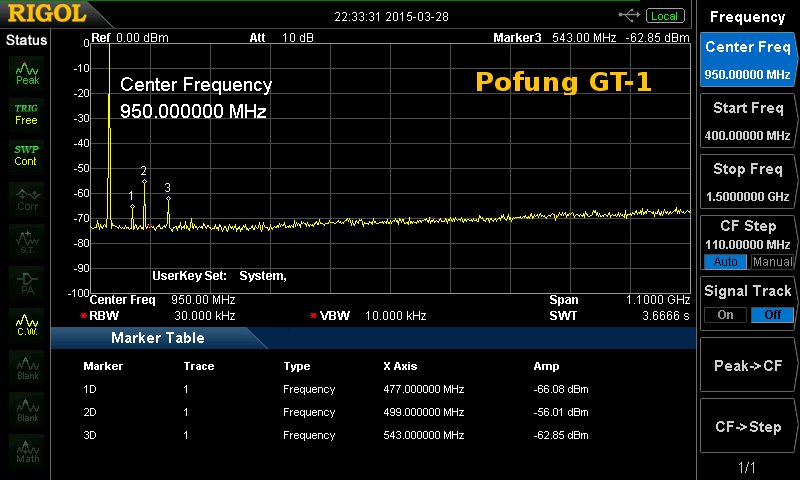 Receiver
At -126 dBm the GT-1 is sensitive enough, but that won’t help you much. It doesn’t take much of an out-of-band signal to make the radio as deaf as a post. Even the local repeater can’t be received in my city center; only if I’m about 3 kilometers away from the center the receiver comes to life.
FM Radio
By holding the upper side key while switching on the radio, the GT-1 will switch to FM radio, something the BF series don’t offer. There doesn’t appear to to be a way to tune to a preferred station though; it randomly tunes into stations it finds. This makes the feature of limited use.
RX Audio
A bit raw, just like with the BF series, but more tinny. Audio distorts quickly if you crank up the volume.
Software
The GT-1 can be programmed with the same software developed for the BF series. CHIRP works too, but lacks a few options such as switching on scramble. Changing power output from ‘High’ to ‘Low’ in the software still doesn’t work; the radio just ignores that setting.
The verdict
After being confronted with all the lies surrounding the Pofung GT-1 there’s no way I can justify a diplomatic way of saying things. The GT-1 is just old wine in a new bottle, the battery voltage / capacity is one big lie and so is the promised power output.
The receiver is still disappointing unless you live in the proverbial ‘middle of nowhere’. To make matters worse the GT-1 is more expensive than a Baofeng BF-666S / BF-777S / BF-888S.
In short: don’t buy one unless you’re a notorious masochist. Go for a UV-5R instead or, if you like/need this particular concept, buy the superior Anytone ANILE-8R.


Review Pofung (Baofeng) GT-1
I didn’t pay much attention to the GT-1 because I assumed it was just old wine in a new bottle. Time to rectify this, due to popular demand.
We all know the Baofeng BF-666S / BF-777S / BF-888S radios: 16 UHF channels, no display, low power output, a receiver which can be overloaded by snapping your fingers, but they are dirt cheap. The GT-1, co-developed by SainSonic, promises to improve on this concept by adding FM radio, a higher capacity battery and higher power output.
Look & feel
When it comes to looks, the GT-1 looks a bit more modern than its predecessors. The radio is slightly taller and less deep. All in all the GT-1 looks and feels nice. The basic concept didn’t change: 16 programmable UHF channels between 400 MHz and 470 MHz, scramble (voice inversion), a on/off/volume pot, a 16-step rotary encoder and a flashlight. Apart from emitting a steady beam of light the flashlight now offers an ‘SOS- mode: three short, three long and three short pulses.
You can order the radio with side keys in different colors: yellow, orange or green. The (of reasonable quality) manual comes in three languages: English, French and German. Nice touch.
Battery
According to the specs printed on the battery the nominal voltage is 7.4 Volts @ 1800 mAh, the same capacity as the UV-5R battery. Such a capacity would be in line with the higher power output promised on the radio label: a solid 5 Watts instead of ‘less or equal to 5 Watts’ printed on a BF-888S (which proved to be 2 Watts only).
The first hint of something being terribly wrong was the weight of the battery. It felt so light that I was afraid that it might end up at the other end of the living room if I had a nasty cough. Time to to take a closer look at things. Let’s take a look at the weight first as more cells always translates into a heavier battery. The amount of plastic used plays a role too, of course. So while this is not a 100% reliable method, it does give you an indication.
Battery weight comparison
Pofung GT-1: 47 grams
Baofeng BF-666S: 54 grams
Baofeng UV-5R: 80 grams
Anytone NSTIG-8R: 96 grams
As you can see the weight of the GT-1 and BF-666S batteries are close. The UV-5R and NSTIG-8R batteries are too, both proven to be 7.4 Volts @ 1800 mAh. The GT-1 battery seems just too light to be in the same 7.4 Volts / 1800 mAh league.
I took my multimeter and checked the GT-1 battery. Not to my surprise it only measured 4.0 Volts (freshly charged), so the nominal voltage is 3.7 Volts only, just like the BF-666S battery. The capacity will likely be the same too, somewhere between 1000 mAh and 1500 mAh.
Transmitter
After finding out that the battery might even be inferior to the one supplied with its predecessor I didn’t expect the GT-1 to be able to reach 5 Watts output at all. That proved to be correct. Two samples measured the same: between 1.5 – 2 Watts, depending on the frequency.
TX Audio
A bit brighter and slightly louder than my BF series, which is a plus.
Phase noise and harmonics
Less phase noise than the BF series. There are some unusual peaks visible, but nothing scary.
Receiver
At -126 dBm the GT-1 is sensitive enough, but that won’t help you much. It doesn’t take much of an out-of-band signal to make the radio as deaf as a post. Even the local repeater can’t be received in my city center; only if I’m about 3 kilometers away from the center the receiver comes to life.
FM Radio
By holding the upper side key while switching on the radio, the GT-1 will switch to FM radio, something the BF series don’t offer. There doesn’t appear to be a way to tune to a preferred station though; it randomly tunes into stations it finds. This makes the feature of limited use.
Edit: pressing the upper side key shortly will make the radio switch from station to station. Some in-house interference made the system fail when I tested it. The interference caused the scan to stop when encountering these false positives.
RX Audio
A bit raw, just like with the BF series, but more tinny. Audio distorts quickly if you crank up the volume.
Software
The GT-1 can be programmed with the same software developed for the BF series. CHIRP works too, but lacks a few options such as switching on scramble. Changing power output from ‘High’ to ‘Low’ in the software still doesn’t work; the radio just ignores that setting.
The verdict
After being confronted with all the lies surrounding the Pofung GT-1 there’s no way I can justify a diplomatic way of saying things. The GT-1 is just old wine in a new bottle, the battery voltage / capacity is one big lie and so is the promised power output.
The receiver is still disappointing unless you live in the proverbial ‘middle of nowhere’. To make matters worse the GT-1 is more expensive than a Baofeng BF-666S / BF-777S / BF-888S.
In short: don’t buy one unless you’re a notorious masochist. Go for a UV-5R instead or, if you like/need this particular concept, buy the superior Anytone ANILE-8R.
ARRL Field Day: Season To Taste
 I’ve written before about the flexibility of Field Day and the need to season to taste to make it your own. I have always thought that one of the great things about Field Day is that it can be tuned to whatever interests you or your club. It can be a serious radio contest (well, almost); it can be an emcomm drill. It can be a radio campout; it can be a foodfest, it can be a beer-drinking party. Insert your idea here.
This year, our local club, the Tri-Lakes Monument Radio Association is going to try a new approach that we call Tech Field Day. We previously have held a one-day educational event that we call Tech Day, that featured a series of presentations and hands-on demonstrations. The main theme of Tech Day was to help the Technician level hams gain more knowledge and help them move on up to General class operating.
We are taking the basic idea of Tech Day and combining with a shortened one-day version of Field Day. So on Saturday June 27th, we’ll offer a series of educational presentations along with some classic Field Day radio operating. The operating emphasis will be on giving newer hams a chance to get on the air, probably on both HF and VHF. (Our plans are still coming together.) We will also promote the theme of emergency communications, operating off a emergency power source, etc.
There are a number of things that we are intentionally leaving out. We won’t operate the entire 24 hour period…in fact, we’ll probably just be on the air Saturday afternoon. We won’t worry about making a lot of contacts or running up the score. Our stations will be relatively simple (no towers, no amplifiers).
So that’s our idea of a fun Field Day. What are you planning to do?
73, Bob K0NR
The post ARRL Field Day: Season To Taste appeared first on The KØNR Radio Site.













