Archive for the ‘ham radio’ Category
 So, You Want to Get into the Ham Radio Hobby
 July 12th, 2017 |
  Author:
 Come spend some time with me in this ride-along video blog episode, the first in a series that I am doing to help you begin your journey into the amateur radio hobby. This video is an experiment in that I am trying out this format as a type of “chat” in which I share my thoughts and experiences regarding the ham radio hobby, and how you might start out exploring the hobby.
Regarding the experiment: I have tried to edit the sound to reduce the road noise. Please comment on the noise level, and how well you can hear me talking about the topic. Should I ditch the ride-along format? Comments directly on the YouTube channel are better if you leave a comment on the actual video as displayed on my YouTube channel.
..
73 de NW7US
..
What is an Amateur Radio Repeater and How Do They Work?
What is an amateur radio repeater and how do they work?
In this video, with a non-amateur-radio viewer in mind, I chat about the very basic concepts of a repeater. This is a vlog (video blog) entry on my video channel, and it is shot in a relaxed, “ride along with me” format. Feel free to share this short overview with those who might be interested in our hobby. There are more of these sorts of ridealongs coming.
Thank you for watching, and for sharing…
..
Using 1.2 GHz for SOTA
One of the cool things about the Summits On The Air program is that it has many different awards available. The SOTA database records the QSOs of everyone involved in the program and is used to qualify for the awards. QSL cards are not required. The most coveted awards are Shack Sloth (reaching 1000 points as a “chaser”) and Mountain Goat (reaching 1000 points as an “activator”). There are so many SOTA activators on the air these days, reaching Shack Sloth is not too difficult. Just get on the air and make the contacts. (Last year, I completed Shack Sloth using VHF and higher frequencies only.) Mountain Goat is much more of a challenge because you have to physically go out and activate each summit, one at a time. Currently, there are 9 radio hams that achieved Mountain Goat status in Colorado. I have a long way to go for Mountain Goat.
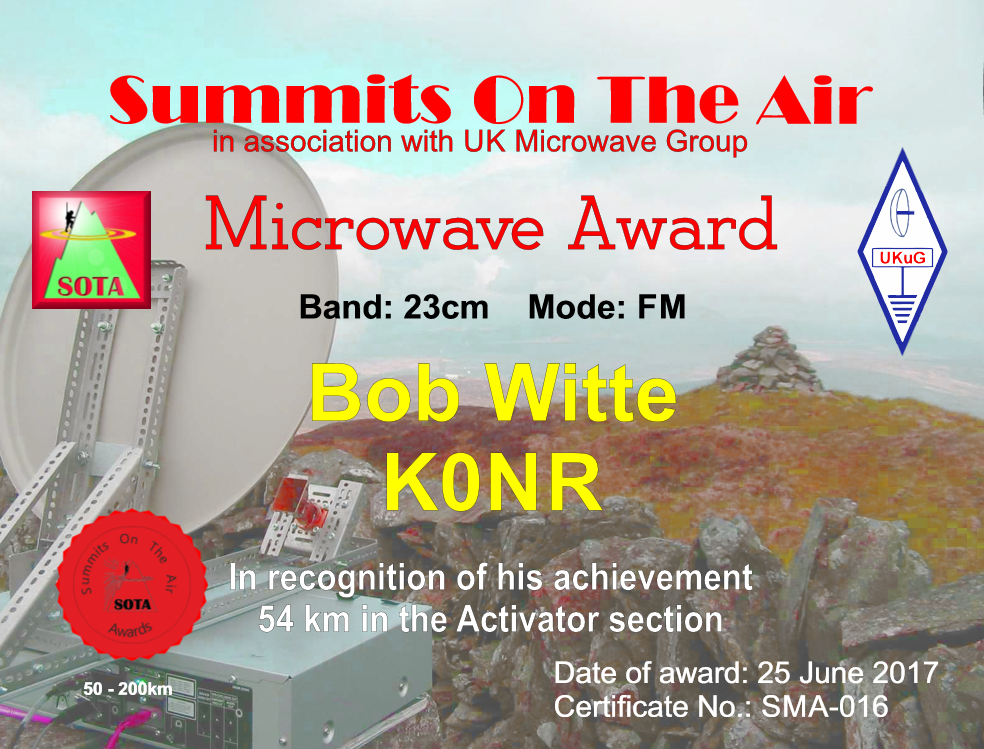 Most of my SOTA contacts have been on the 2 meter band (144 MHz) using FM, SSB and CW. Recently, I put additional emphasis on making QSOs on two of the UHF bands: 70 cm (433 MHz) and 23 cm (1.2 GHz). With the SOTA scoring system, there are no extra points or credit for working the same station on additional bands. Still, I’ll often check with the other station on 2m to see if they want to make a QSO on one of the other bands…just because. The SOTA database does keep track of these QSOs separately so you can go in and look at your results on, say, just the 70 cm band.
For some unexplained reason, 1.2 GHz has my interest right now and I’ve been trying out my capabilities on that band. The 23 cm amateur band is one huge hunk of spectrum: 1240 to 1300 MHz (US allocation). To put this in perspective, this 60 MHz swath of spectrum is 171 times the size of the 20m amateur band. (Yeah, I grant you, the propagation on 20m is usually a lot more interesting.) So the first thing I ran into on this band is the lack of commercially available equipment. I think the number of radios that will do 1.2 GHz has actually declined in the last decade. I ended up buying a pair of Alinco DJ-G7T handheld tranceivers that put out 1W of RF power on 1.2 GHz.The second thing I ran into is the lack of other hams that have 1.2 GHz gear. But when you do find them, they usually are interested in making a contact! (I suppose it gets lonely on that band.)
Initially, Joyce K0JJW and I made some short-range SOTA contacts on 1.2 GHz using the two handheld radios, on the 1294.5 MHz FM calling frequency. Then I started looking for DX contacts from local stations that have 23 cm gear. To provide some additional antenna gain, I used a 4-foot yagi antenna (Comet CYA-1216E), specified as 16.6 dBi. One of the cool things about UHF and higher is that compact antennas can provide some serious gain. My best DX so far is 54 km (33.5 miles) but I expect to be able to do distances 3 to 4 times that. The SOTA awards system considers the 23 cm band to be “microwave” so my 54 km QSO just barely qualifies me for the 50 km award. (The microwave awards are based on distance worked, unlike the other SOTA awards.)
Just another fun thing to do on the ham bands, pursuing the Universal Purpose of Amateur Radio.
73, Bob K0NR
The post Using 1.2 GHz for SOTA appeared first on The KØNR Radio Site.
Easy SOTA: Blue Mountain (W0C/SP-123)
Joyce K0JJW and I were preparing to drive back home from the mountains and began to consider what Summits On The Air (SOTA) peaks might be on the way and easy to access. I consulted with Steve WG0AT, who had a number of good suggestions but we ultimately decided on Blue Mountain (W0C/SP-123). This is an easy summit to get to and an easy summit to hike.
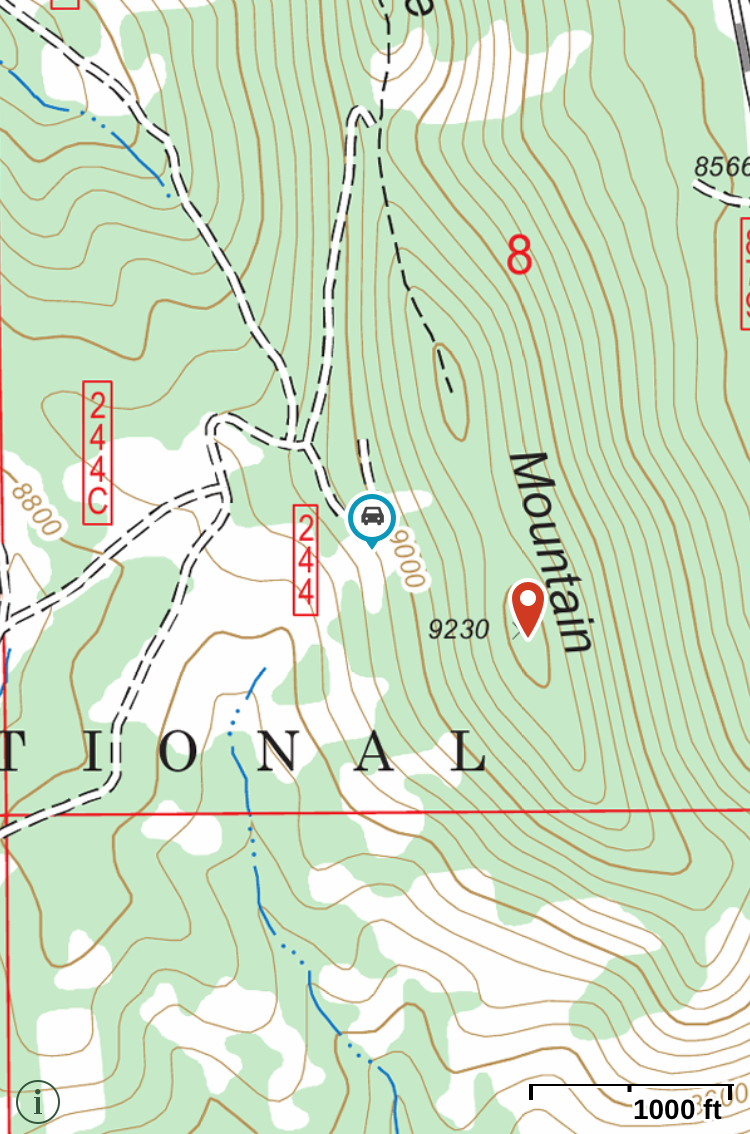 I found Carey’s (KX0R) trip report to be helpful, so I suggest reading that information. To get to Blue Mountain, just get on Blue Mountain Road (CR 61) heading south out of Lake George. Looking at your Pike National Forest map (you do have a National Forest map, right?), you’ll see that this road passes by Blue Mountain on the east side and then turns west. Take forest service road FS 244 to the right (north), which takes you up to the west side of Blue Mountain.This road turns into easy 4WD (challenging 2WD with high clearance). We just kept going on FS 244 (ignoring the side roads) and parked at the very last turn, as shown on the map (38.93108N, 105.35597W). At this point, you can just take aim at the summit (40.33530N, 105.28100W) and hike your way up. Approaching the slope at an angle makes it not quite so steep.
 For this activation, we took along gear for 2m, 70cm and 23cm, FM only. Basically, this amounts to a pile of HTs and a few compact antennas. All of our contacts were on 2m FM except I did work Paul W0RW on Wilkerson Pass using 1.2 GHz (23 cm). At an elevation of 9230 feet, this location does pretty well on VHF and higher, so we easily worked stations in Buena Vista (W0BV), Woodland Park (WA6TTY) and Como (KD0VHD). We also worked a hiker (Jim, KD0MRC) on the side of Mount Yale, about 50 miles away.
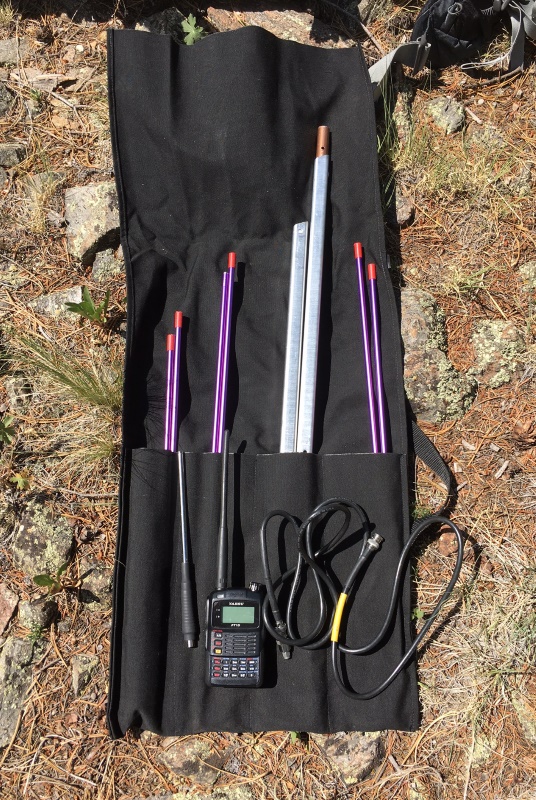
The photo on the left shows my portable 2m FM station: Yaesu FT-1DR handheld transceiver, 1/2-wave Flex antenna (Smiley Antenna), and the dismantled 3-element Yagi (Arrow Antenna). I recently started using the Smiley halfwave antenna because it flexes on the connector end, making it more resilient to on trail use.
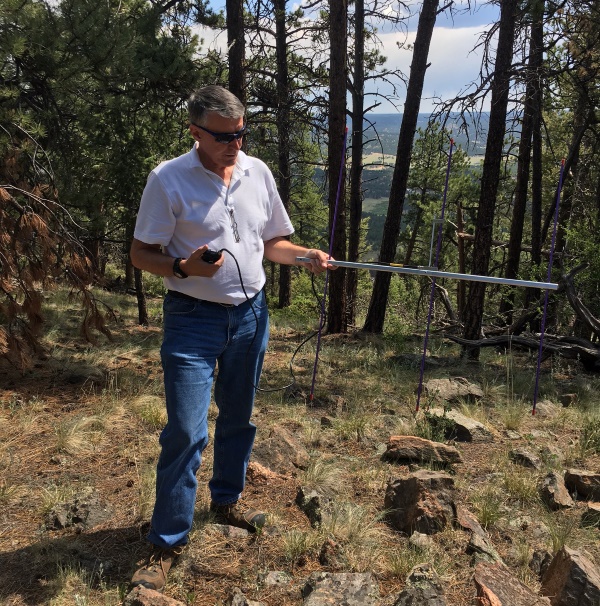 In the photo to the left, I’ve got the yagi antenna assembled and I’m using it to make contacts. With a little practice, the Arrow antenna screws together quickly and provides some nice gain over the halfwave vertical (about 6 dB).
We had excellent weather today so that helped make for a fun day. If you are in the Lake George, CO area consider Blue Mountain for an easy and fun activation.
73, Bob K0NR
The post Easy SOTA: Blue Mountain (W0C/SP-123) appeared first on The KØNR Radio Site.
ETH075 – RFinder
If you are anything like me you have used those little repeater  directories and strained your eyes in the process. I use to hate trying to find a repeater to use while I was on a trip. Most of the time, while I was on a trip, the town that I was in didn’t have any repeaters in it, but the next town over did. Maybe it was two towns over, or the third of fourth town that I look at in the directory. Either way, it was a pain in the…well you know.
Bob had the same thinking that I did all those years ago, but he acted on it. He went and digitized all the repeater data that was available and made it into an Android app. It is now available to IPhone, Android and on the web for just a small fee.
RFinder is the official repeater directory of Canada, the United Kingdom as well as 13 other countries. This year the ARRL partnered with RFinder to print the 2017 ARRL repeater directory. This years directory has 10,000 more listings and is the first time that the ARRL has crowd sourced the repeater information. The data that RFinder uses comes from many different places including Repeater societies, club websites and directly from repeater owners.
For more information about RFinder, hear it from Bob himself in the latest episode of the Everything Ham Radio Podcast at http://www.everythinghamradio.com/podcast/75
ETH074 – 13 Colonies Special Event with Bob Josuweit, WA3PZO
It is hard to believe that June is almost over and Independence day will be here in less that ten days! It is time for that long weekend off, where families and friends get together to have a bar-b-que and “party” together. While celebrating the day is good, celebrating the week is even better, and that is exactly what we talk about in this interview.
This special event started back in 2009 and has grown every year since. Operators from each of the original 13 colonies will be on the air from Jul 1 through Jul 7 at different times. You can be part of this special event by making contact with any or all of the 13 colony stations or the two bonus stations.
Check out the show notes and listen to the episode for more information
2017 June VHF Contest (K0NR)
 Last weekend, I was able to participate in the ARRL June VHF Contest, my favorite ham radio operating event. I thought conditions were pretty good…mostly I am satisfied if we have some decent sporadic-e propagation on 50 MHz, which we did. Once again, I entered in the Single Operator – 3 Band category with a claimed score of 34,969.
This is the first contest where I used WSJT modes and was successful but certainly not highly skilled. I know I blew a couple of MS144 contacts due to operator error on my part. As I prepared for the contest, I was really focused on getting the computer/radio connections sorted out in advance, which I did accomplish. I made some JT65 and MSK144 contacts a few days ahead of the contest, so I was good to go. The issue that I totally missed was thinking through the operating position so that I could switch modes/bands easily. Instead, I had lots of cable plugging and unplugging as I moved things around. More to learn and improve on next time.
K0NR Single Op - 3 Band
Band QSOs Mults
-------------------
 6:   254 110
 2:    29 10
 222:
 432:   3 1
-------------------
Total: 286 121
Total Score = 34,969
I made a dozen JT65 QSOs, all on the 6 meter band. These contacts were with very weak signals so I probably would have missed them on SSB. I have concluded that the main purpose of JT65 is to give bored operators something to fiddle with when band conditions are poor. It always seemed like there was just enough signal present for me to keep trying, sometimes with success, sometimes not.
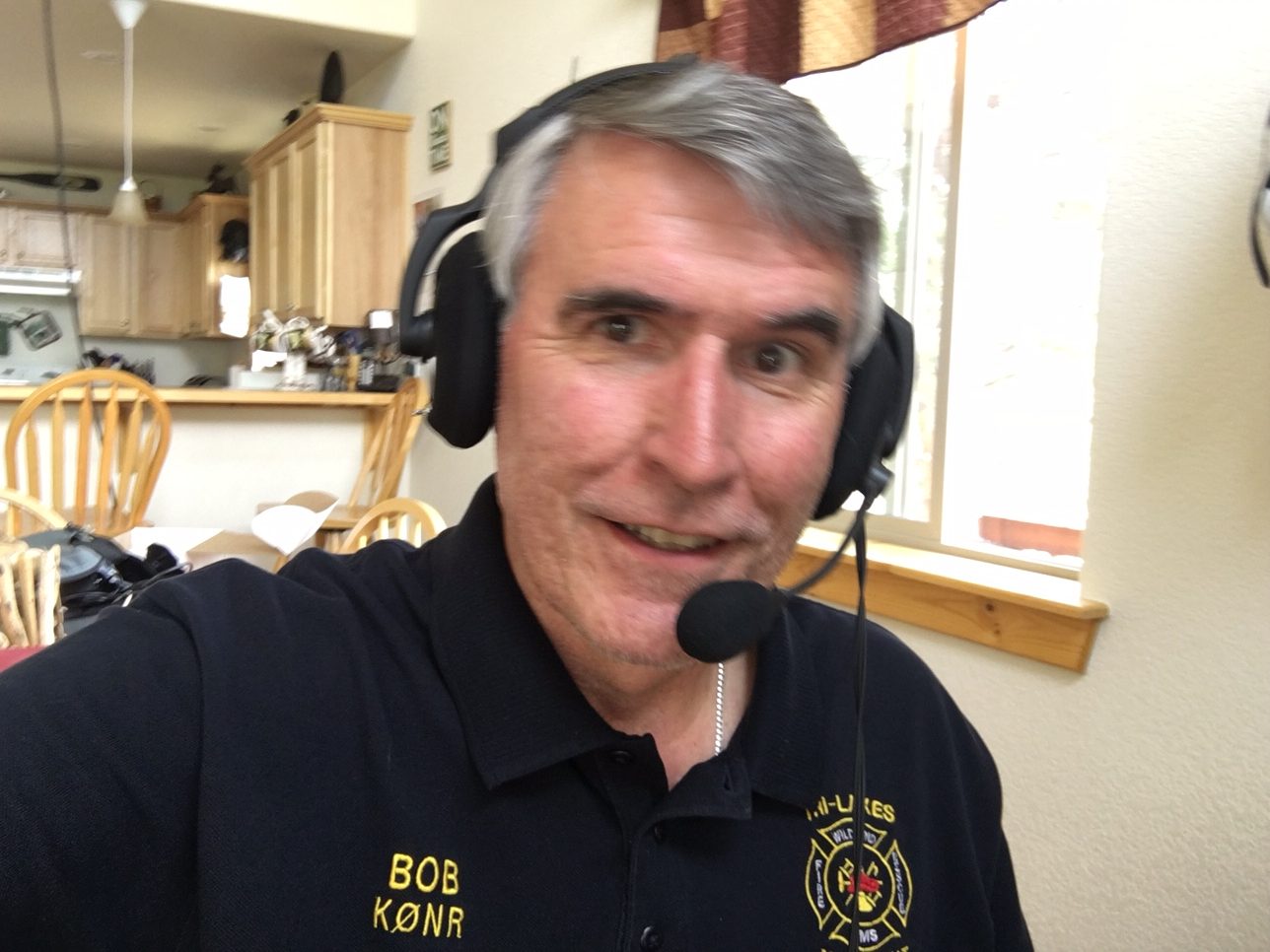 I was very pleased to work K5QE for my first 2m meteor scatter QSO (MSK144). My intent is to spend more time with this mode in the coming year and focus on chasing grids on 2 meters.
I looked back at my previous scores in the 3-band category. My best score (48,117) was back in 2013, the first year there was a 3-band category. Looking back at my blog posting from that year, at the time I didn’t think the band conditions were very good. I also came across this article by W0VG which indicates that stations from Colorado scored pretty well that year compared to other parts of the country. The results article in QST for that contest provides more detail.
So maybe propagation wasn’t that great this year after all. At least not in Colorado. (The DX spotting map looked really good in the eastern side of the US.) But I’ll go back to my earlier statement that any June VHF contest with some decent sporadic-e propagation on 50 MHz is a win.
Thanks to everyone that came out and played radio on the VHF bands.
73, Bob K0NR
The post 2017 June VHF Contest (K0NR) appeared first on The KØNR Radio Site.













