Archive for the ‘ham radio’ Category
 How About An Icom IC-905?
 March 20th, 2023 |
  Author:
 Being an enthusiast for bands above 50 MHz, I suppose I should weigh in on the new IC-905 from Icom. The street price for the basic unit is ~$3500, with various options and accessories at additional cost.
Let’s be clear about one thing, this radio is one impressive piece of technology. There is no other radio on the market that comes close to covering these VHF/UHF/SHF bands: 144, 430, 1200, 2400, and 5600 MHz (and optional 10 GHz). I won’t mention all of the features and specs covered here. I really appreciate that Icom is investing in equipment for VHF and higher, as evidenced by the IC-9700 and this radio.
 For me, there are two main uses I would consider for the IC-905: Summits On The Air (SOTA) and base station use:
SOTA
I focus on VHF/UHF for SOTA with 144 MHz always carrying the load in terms of making radio contacts. Lately, I have put more effort into 432 MHz and 1.2 GHz. I’ve also been trying to get out of the FM rut and work more SSB and CW on those bands. I really should get going on a portable digital station for FT8 and other modes. I have a good collection of gear to choose from, ranging from basic 5-watt FM handhelds to an IC-705 and an IC-9700. OK, the IC-9700 is a bit large to drag up most summits but I have taken it on some easy hikes and drive-up summits. Joyce/K0JJW and I also have a pair of Alinco triband handheld radios (DJ-G7T) that have 1.2 GHz FM. These radios are popular with SOTA enthusiasts due to their affordability and compact size.
What does the IC-905 offer for SOTA? Well, obviously it is a reasonable way to get on 5 or 6 bands with all modes. However, I already have the IC-705 that covers 144 and 432 MHz (and 50 MHz). Having CW/SSB on 1.2 GHz is very attractive to me but 2.4 GHz and 5.6 GHz are rarely used for SOTA. Sure, maybe the introduction of the IC-905 will change that. Maybe, but probably not. Someone commented in an online forum that you better buy two IC-905s and loan one out so you have someone to work. For my interests, I would much rather have a VHF/UHF-only variant of the IC-705 that covers the 50, 144, 440, and 1200 MHz bands. But I have come to accept the fact that radio manufacturers don’t develop radios just for me.
Base Station
The other option is to use the IC-905 to get on the higher bands from my home station. I am in the process of building a VHF+ station at our cabin in the mountains, which is in a good VHF/UHF location. Honestly, my focus is on getting a tower up with good size Yagi antennas for 50 MHz and 144 MHz. Although I have operated a lot on these bands, it has usually been from portable and rover stations, during one of the VHF contests, or as a SOTA activation. I am looking forward to having an effective permanent station on the two most popular VHF bands. I am debating how much effort to put into the 430 MHz and 1200 MHz bands at the new station, and 2400 and 5600 MHz are not currently in my plans. Besides, the IC-9700 has me covered for 144, 430, and 1200 MHz. So right now, I don’t see the IC-905 being part of the home station, but that could certainly change with time.
Price
What about the price? $3500 is a serious piece of change but probably not unreasonable for what this radio can do. Some people have said it is worth it and some think it is way too expensive. Price is always an issue, but for me it probably doesn’t matter that much. For the most part, I am saying the radio doesn’t fit a need I have. OK, if the price were a lot lower (like $1500), it would affect my point of view. But at that price, Icom would be leaving money on the table with the folks that really want to get on 2.4, 5.6 and 10 GHz.
So my conclusion is that I probably won’t be buying an IC-905 at this time, but things can always change.
What are your thoughts?
73 Bob K0NR
The post How About An Icom IC-905? appeared first on The KØNR Radio Site.
New Book: Learning, Living, and Loving Morse Code…
There is a new book from a fellow Morse code amateur radio operator, Chris Rutkowski (NW6V), about “Learning, Living, and Loving Morse Code (in a Digital World).” NICE!
Title: “The CW Way of Life“
link: https://amzn.to/3Tm3KfD

I received a new book! Here it is, at my radio shack operations desk, at NW7US radio station.
Already, I think it rivals any other book on the topic, including “The Art and Skill of…,” or, “The Zen of…”
It is not, however, meant to replace, but to augment, what is available. But, it is a complete guide, including a “work book” section (nearly half of the book?) on how to improve your skill. Really good stuff, but I’m only in one day.
73 de NW7US dit dit
https://nw7us.us
..
ARRL DX (SSB) Contest
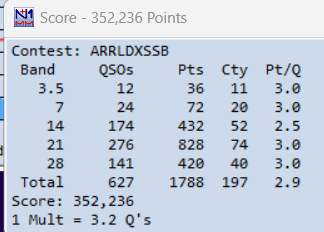
Another successful event
I think we made a commendable showing this weekend, thanks to
all. Statistics below and log attached.
Thanks to all participants and especially the new guys, Doug and Larry,
who jumped in got their feet wet.
The bands were open although a recent solar storm could have had an impact. Most remarkable was 10m which was wide open worldwide on Sunday morning. The best contact of the event was Namibia, V55Y, by John VE7TI, on Sunday
afternoon 10m. Also Reunion Island FR8TZ off the SE coast of Africa. This is a good way to learn your geography!



Close to Denver: Green Mountain (W0C/FR-107)
Sometimes you just want a close-in SOTA summit that is easy to access and allows you to get on the air. On the west side of greater Denver, a few summits meet that requirement. One of them is Green Mountain (W0C/FR-107), near the intersection of I-70 and C-470. This would make a good beginner summit or an easy-access summit for visitors to the area. Joyce/K0JJW and I activated this 1-point summit today.

Access is easy and convenient, the trailhead can be found by going west on Alameda Parkway, off C-470, then north on S Rooney Road. There is a large parking lot there and an obvious trailhead with pit toilets. From here we hiked east over C-470 into William Frederick Hayden Park. We followed signs for the Green Mountain Trail, which is basically an unimproved road, to the summit of Green Mountain (see map above). This is not the only option because the park has an extensive trail system to explore. Check out the Lakewood parks map here. Also, you can check the trail conditions here. My mapping app recorded the hike as 1.6 miles (one way) with an elevation gain of 800 feet, not very difficult but still a decent hike. On a cool Saturday afternoon, we met many hikers and mountain bikers on the trail.

This hike starts out with a lot of road noise from C-470 but things soon quiet down as we left the highway behind. On the summit, we could see many higher summits to the west and downtown Denver to the east. We only had a couple of handheld VHF/UHF radios with us and made a bunch of contacts on 2m FM. This is usually the case when you have line-of-sight to the Denver area, with plenty of activity on 146.52 MHz.
This summit is not the best SOTA summit in the state but if you are itching to do a SOTA activation without driving deep into the mountains, this one will work!
73 Bob K0NR
The post Close to Denver: Green Mountain (W0C/FR-107) appeared first on The KØNR Radio Site.
The March – April 2023 SARC Communicator
Another BIG issue!
'The Communicator' digital periodical of Surrey Amateur Radio Communications is now available for viewing or download.
Read in over 145 countries now, with almost 10,000 downloads for the November-December issue, we bring you 124 pages of Amateur Radio news from the South West corner of Canada and elsewhere. With less fluff and ads than other Amateur Radio publications, you will find Amateur Radio related articles, projects, profiles, news, tips and how-to's for all levels of the hobby.
You can view or download it as a .PDF file:

Previous Communicator issues are at:
https://ve7sar.blogspot.com/search/label/The%20Communicator
and a full index is HERE.
As always, thank you to our contributors, and your feedback is always welcome.
The deadline for the next edition is April 15th.
If you have news or events from your club or photos, stories, projects or other items of interest from BC or elsewhere, please contact us at [email protected]
73,
John VE7TI
'The Communicator' Editor
My Story on QSO Today
 About five years ago, Eric/4Z1UG interviewed me for the QSO Today podcast. He recently retrieved and remixed the audio recording and posted it on the QSO Today webpage. There are a few places where the discussion seems dated (such as the discussion of Yaesu Fusion, which was relatively new at the time.) However, for the most part, the dialog was good and still relevant. Well, at least to me, because it was my story.
During the interview, I mention some of my Elmers, including Virgil/W0INK who influenced me early in my ham career. I also talk about the concept of 360-Degree Elmering, which means that Elmers (mentors) can be found in many different places. Other topics include: Summits On The Air, Colorado 14ers, the Tri-Lakes Monument Radio Association (W0TLM), repeaters, DMR in Colorado. There is a plug for Ham Radio School, where I continue to help out. Somehow we got on the topic of lists in amateur radio: DXCC entities, SOTA summits, states, etc.
Anyway, you may find it interesting.
73 Bob K0NR
The post My Story on QSO Today appeared first on The KØNR Radio Site.
Another AI Blog Post: Who is Bob K0NR?
Here is another lazy attempt by me at generating a blog post using ChatGPT. This time I asked the machine to “tell me about Bob Witte K0NR”. I figured there are quite a few things available in the public domain about me, so it would be interesting to see what the AI came up with. Here’s the result with [my comments] inserted.
Bob Witte, also known by his callsign K0NR, is an experienced and respected ham radio operator who has been licensed since the mid-1970s. He is based in Colorado, USA and is known for his contributions to the amateur radio community. [I like the sound of this.]
Bob has a passion for promoting amateur radio and encouraging others to get involved in the hobby. He is a regular contributor to the popular ham radio blog, “The KØNR Radio Site,” where he shares his experiences and knowledge with other hams. He also co-hosts the “HamRadioNow” video podcast series, which covers a wide range of topics related to amateur radio. [Correct on my blog, but I don’t co-host any type of podcast.]
Bob is an active member of several ham radio clubs and organizations, including the American Radio Relay League (ARRL) and the Radio Society of Great Britain (RSGB). He has served in various leadership roles within these organizations and has been recognized for his contributions to the amateur radio community. [Yes on the ARRL, but I am not an RSGB member.]
Bob’s interests in ham radio include VHF/UHF weak signal work, contesting, and digital modes. He is also an avid outdoorsman and enjoys portable operations from remote locations. He has a strong interest in emergency communications and is involved in several emergency communication organizations, including the Amateur Radio Emergency Service (ARES). [Not too bad, but my involvement in ARES and other emcomm groups has faded quite a bit.]
Overall, Bob Witte K0NR is a highly respected and knowledgeable ham radio operator who has made significant contributions to the amateur radio community. [Well, I like the sound of this part.]
I would like to get under the hood of ChatGPT to find out how they connected me with HamRadioNow and the RSGB. These are two statements that can easily be checked and found to be false.
73 Bob K0NR
The post Another AI Blog Post: Who is Bob K0NR? appeared first on The KØNR Radio Site.













