Archive for the ‘ham radio’ Category
 Results and a Few Thoughts On the June VHF Contest
 June 11th, 2012 |
  Author:
 As hoped, I had a great weekend working the ARRL June VHF QSO Party (AKA the June VHF Contest). Band conditions were not as good as last year but we had some very good sporadic-e propagation on 50 MHz.
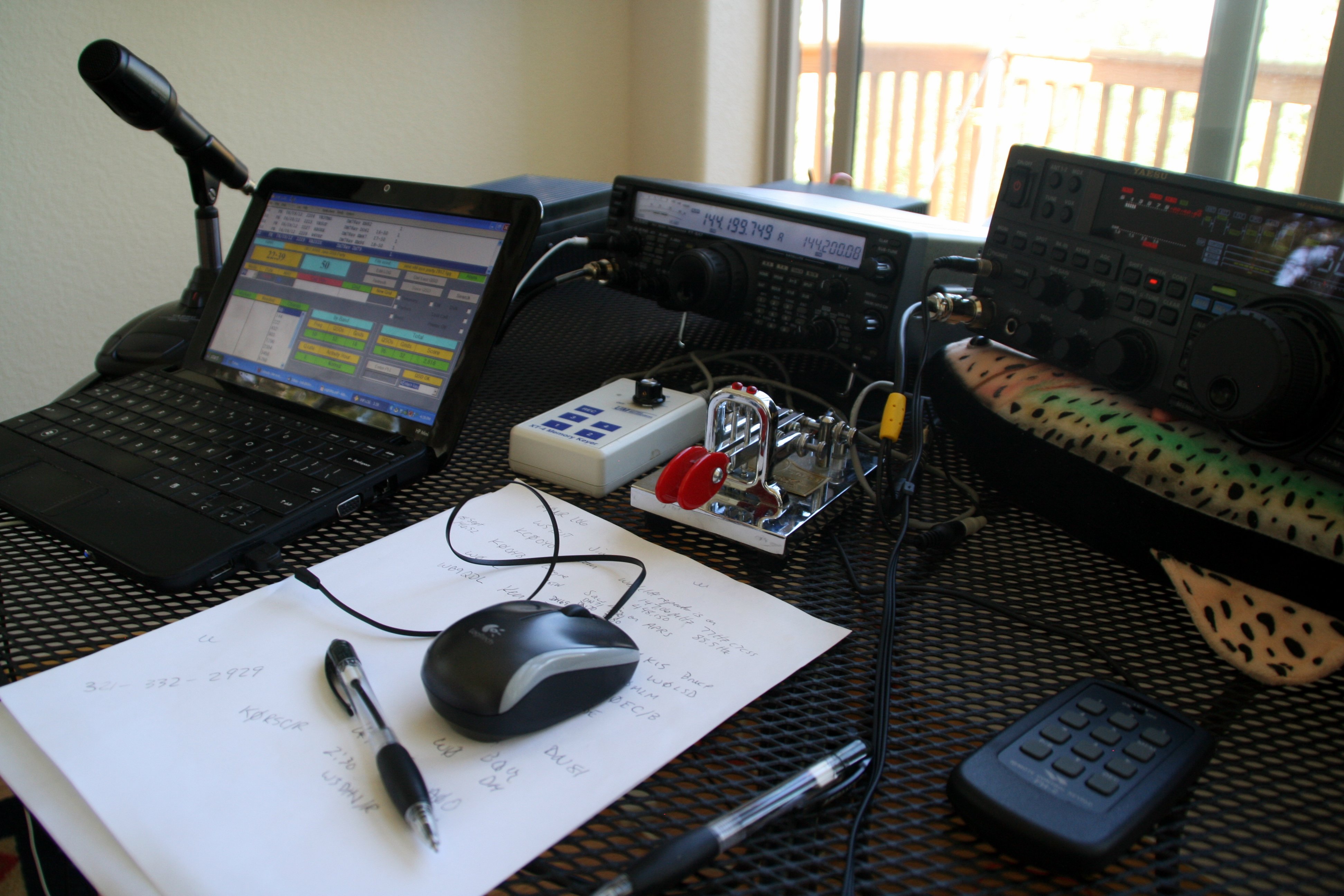
I operated from the cabin “portable style” in DM78av, near Trout Creek Pass. It was a two band effort (50 MHz, 144 MHz) but I did make a few Qs on 440 FM. Everything worked pretty well except my portable mast struggled with the high winds we experienced.
I kept my Yaesu FT-847 on 2 Meters the entire time, using its 50 Watt output to drive a 180W Mirage amplifier to a 2M9SSB yagi antenna. My FT-950 was put to work on 6 Meters, with its 100 Watt output driving a 6M5HP Yagi.
The contest started out slow with just a few local contacts on 2 Meters. About 3 hours into the contest, 6 Meters started to percolate and I heard east coast and midwest stations popping up. Soon, the sporadic-e was in high gear and I was working stations at a decent clip. Later in the day, the band swung around and I worked quite a few stations in pretty much every part of the USA. Sunday started out in the morning with a few contacts to the south, including XE2X in grid EL06. Later the band flipped over to the east coast, then hovered over the midwest. Later in the day, the VE stations from Canada were pounding in and it seemed they were having a blast working many different states.
    Band       QSOs X pt =  QSO pts.  X   Grids   =     Points
    ---------------------------------------------------------------
    50         398    1      398           126           50148
    144        38     1      38            13            494
    432        3      2      6             3             18
    ---------------------------------------------------------------
    TOTALS     439           442           142           62764
Note the CW keyer and paddles in the picture. I am not a great CW op but I end up making a few CW contacts “when the going gets tough” during VHF contests. Not shown in the photo is the Heil Pro Set headset with HC-4 microphone element and optional PTT foot switch. I have really come to appreciate how effective and efficient this headset is for contesting. I’ll also give a shout-out for the VHFLOG contest software by W3KM. I’ve tried a number of logging programs and really like this one for VHF contests.
73, Bob K0NR
Gremlins Lurk in the Junk Heap
Three weeks ago my EchoLink station went deaf. Thanks to the West Central MN Amateur Radio Club’s antenna analyzer, I figured out right away that the problem was in the feedline/antenna system. Ever since then I have been either too busy or too nervous to go on the roof, so it has remained a mystery . . . until this afternoon.

Antonio Mitchell checking SWR on the Edison Fong J-Pole
Antonio, my son, went up on the roof with the antenna analyzer while I watched from the ground. He did a great job taking all the tape and coax seal off the PL-259, disconnecting the coax from the antenna, and hooking up the antenna analyzer to the antenna with a patch cord. “One point two!” he called down to me. There you have it — it was the coax! I realized what I’d done. Here I had some brand-new coax in my field-kit, but I ended up grabbing a different coil of junk coax and got bitten by a Gremlin. I found the new, already-terminated coil of coax and Antonio swapped it for the bad length, carefully wrapping the PL-259 with coax seal and rescue-tape. In short order we had the station back on the air.
All that, and Antonio doesn’t even get to use it yet. Hopefully soon! Antonio has been studying hard for his Technician exam this week. He is eager to take the test.
Thanks, Antonio, for getting the EchoLink back up and running for all of us.


Gear Up for the June VHF Contest!
 This weekend is the ARRL June QSO Party (also known as The June VHF Contest). It is a great opportunity to get on the air and try out the VHF bands. In particular, 6 Meters usually has some fun sporadic-e propagation during the contest. It is a blast when that band comes alive with signals from across North America.
For complete info see: http://www.arrl.org/june-vhf-qso-party
I am going to operate from our cabin near Trout Creek Pass (DM78), focusing on 6 Meters and 2 Meters.
Check out this article that I wrote on how to work a VHF contest:
http://www.k0nr.com/rwitte/vhf_contest.html
Most of the activity will be on SSB, calling frequencies are: 50.125 MHz, 144.200 MHz, 432.100 MHz, all USB
On FM, try these frequencies: 146.55 MHz, 223.5 MHz, 446.0 MHz
Get up off the couch and have some radio fun this weekend!
73, Bob K0NR
The Johnson 275W Matchbox Antenna Tuner
I had purchased a Johnson Matchbox from an estate a while back & decided that while I was home with the flu I would open it up and check on its condition.
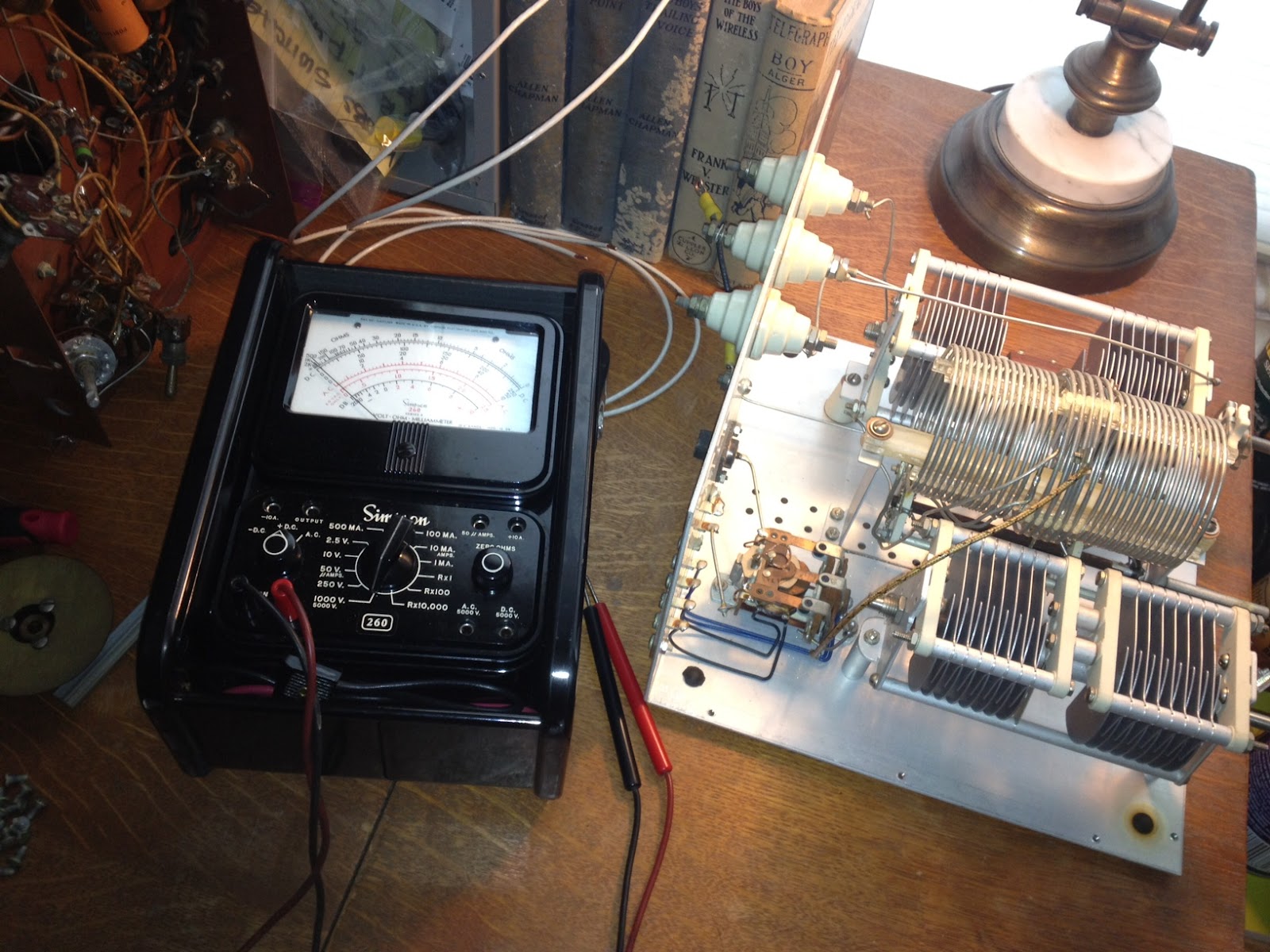 The Johnson Matchbox is found most commonly in two versions, the smaller “275W” unit and the larger Kilowatt Matchbox. Why did I use quotation marks around 275W? Well, these units were manufactured back in the good old days when men were men and transmitting voice meant using AM, not single side band. The conservative rating of 275W of AM translates into roughly 800W of peak SSB (Not really but close enough so you get the idea)
Unlike many who own a Matchbox I was hoping to keep it 100% original and that it would contain all its original components, including the antenna change-over relay and wiring for the high-impedance receiver antenna connections. I plan to use this Johnson Matchbox with a Heathkit AT-1 transmitter and Hallicrafters SX-25 receiver so the inclusion of an antenna change over relay and 300 Ohm receiver connections will make life MUCH easier. Something I didn’t realize until I had the unit apart (There are a LOT of screws holding this thing together) is that there is also a receiver control contact on the relay to break HT and mute the receiver during transmit which will work with my SX-25.
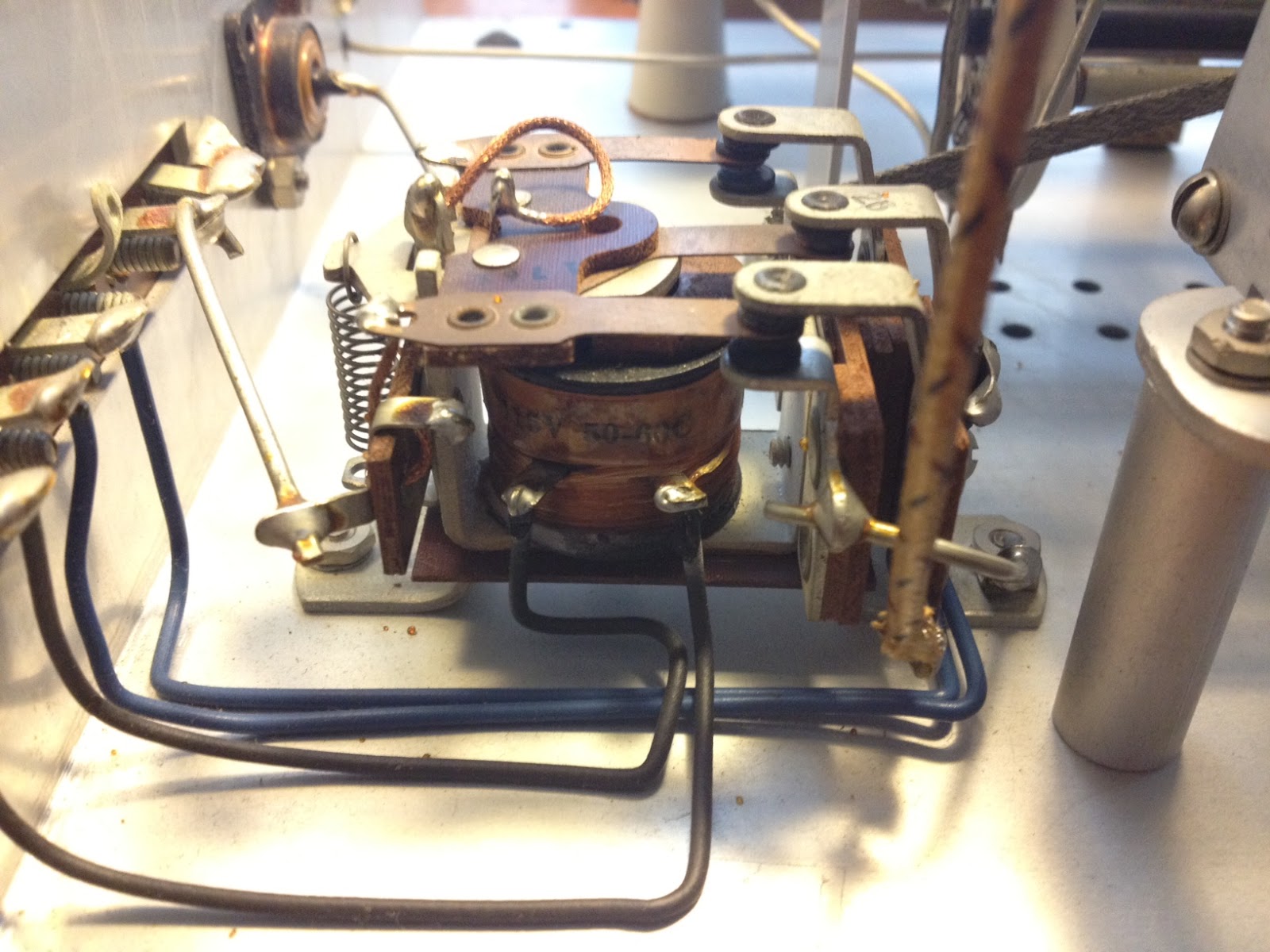 An initial inspection showed that the only modification was a small piece of plastic wedged into the relay contacts that held the relay in the transmit position. It was easily removed and the relay coil and contacts tested for continuity. The contacts seem a bit dirty which, from the little I have read online, seems to be a common problem.
Once the relay contacts and band-switch are cleaned I will button the unit back up and connect it to the loop antenna I have recently run around the eaves of the house. The loop has been a huge improvement to the long-wire and magnetic antennas I have run in the past, at least as far as reception goes … but that is a topic for another post.
Solar Power for QRP
-

- 3.37 Amps in the Sun
-

- Brace Detail
-

- Close Up of Curved Leg End
-

- Close Up of Leg Braces
-

- Close Up of Leg Braces 2
-

- Close up of Solar panel controller
-

- Corner Detail of Leg Attachment
-

- Corner Detail of Leg Attachment For Other Leg
-

- Curved Leg Section Cut Away to Allow Legs to Swing Out, Avoiding Panel Damage
-

- Drilling to Set Legs in Place
-

- Go Box on the Left, 100 Watt 5 Amp Solar Panel on the Right
-

- Legs Attached to the Solar Panel Allows it to be Self Standing
-

- Legs Fold Into the Solar Panel Frame for Easy Storage
-

- Rear of Solar Panel, Controler is mounted with Velcro
-

- Right Leg Attached to Panel Frame
-

- Solar Panel Stored in its shipping case.
I’ve always wanted to operate my radio on Solar Power. This was a fun to do project. I can’t wait to bring it to a Field Day Event.
I bought the aluminum from Metals Depot in Kentucky. (link attached) They have lots of aluminum shapes and parts to choose from. The parts arrived via UPS. It nice to have a good source like this for ham radio projects.http://www.metalsdepot.com/
HQRP is a good company to buy solar panel parts and controlers from. The QRP part of their name is just coincidental to this being a QRP project. http://hqrp.com/
de AA1IK
Ernest Gregoire
72
This Spewed Out of the Internet #22
 The internet keeps spewing forth a river of bits, some of it actually useful information.
Reliable sources tell me that the date for the 2013 Hamcon Colorado has been set: June 28-30 in Estes Park, Colorado. This event is the best hamfest in Colorado and happens every 4 years. (It is the ARRL Rocky Mt Division Convention which rotates between Colorado, Utah, Wyoming and New Mexico.) The date is a little later in the year than previous Hamcon Colorado’s which I think will be even better for attracting out of state visitors. The 2012 division convention will be held July 27-29 in Bryce, Utah.
The ARRL June VHF QSO Party is coming up on June 9-11. This is my favorite ham radio event of the year, since it stimulates VHF activity and (usually) has some good propagation on 50 MHz. Get on the air and have some fun!
For the EEs in the crowd, my friend Ken Wyatt (WA6TTY) is now writing an EMC Blog for Test and Measurement World. Ken is a industry expert on Electromagnetic Compatibility and a pretty darn good author as well.
This article in The Atlantic says that people are using their WiFi SSID to share their political position (“I Heart Obama”). This is sad, really sad.
Neil Armstrong is one my personal heroes, not just because he was the first man on the moon (I mean, if you believe that really happened). He has had every opportunity to promote himself as a celebrity but instead he keeps a low profile. I like that. I came across the video of an excellent (and rare) interview with him on an Australian web site.
There is a new ham radio podcast on the air: Ham Radio Podcast. Check it out and give it a try. And, in case you haven’t found this one, check out the Practical Amateur Radio Podcast by my friend Jerry Taylor (KD0BIK).
The ARRL has launched the digital version of QST magazine. It seems to work but it’s not a very satisfying experience on my little netbook. Probably better with a large monitor. See comments from AA6E and KE9V.
- 73, Bob K0NR
West Central MN Amateur Radio Club
This morning was the monthly meeting of the West Central MN Amateur Radio Club. I joined this club about four months ago thanks to the invitation of Dean Herzberg, NYØI.

June 2, 2012 meeting of the West Central MN Amateur Radio Club. Photo taken by Antonio Mitchell.
It’s the first amateur radio club I’ve ever joined. I wish I’d joined one sooner! Certainly I wouldn’t have had to drive as far to attend club meetings while I lived in the Twin Cities. This club meets in Madison, about 45 minutes away from my house. It’s worth the drive, though. I get to put faces with call signs and catch up on local developments. Speaking selfishly, it’s already benefited me a great deal. Dean helped me mount my dual-band antenna on the roof, and he allowed me to borrow the club’s antenna analyzer, too. I hope I can return the favor somehow. That’s the sort of thing that happens in an amateur radio club.
My son, Antonio, came along this morning, hoping to take his Technician exam. Unfortunately the test-materials hadn’t arrived yet, so he was understandably disappointed. I invited the Volunteer Examiners to my house for dinner when the materials do arrive. Since my son has become adept at grilling, maybe he’ll be the one to serve them steak if they decide to make the trip.
One of the things we discussed this morning was the possibility of helping out at the airshow two weeks away here in Granite Falls. There is a gap that needs filled in their operations, namely the coordination of shuttles running between the airport and remote parking lots. It remains to be seen whether we can muster enough volunteers, but if we can it would be a great way to demonstrate our capabilities and practice working together for the day we assist in an emergency. I’m hoping we will get some more volunteers from another ARES® group nearby. It would really be neat if we had enough hams with APRS to put the shuttles on a map, but that’s a pretty tall order right now. I’ll be happy just to put one ham in each parking lot, one at the airport, and perhaps one NCS at the midpoint if we decide to use simplex. The local sheriff has a portable tower that he has offered for our use, and it might be just the thing for an NCS to use. All these details need to be worked out, but that’s exactly why these opportunities are so valuable — better to figure out how to do these things now rather than in a time of crisis.
If you aren’t a member of a local amateur radio club, I encourage you to look into one. It is well worth your while!















