Archive for the ‘ham radio’ Category
 2012 Field Day: K0NR Results
 June 25th, 2012 |
  Author:
  For 2012 ARRL Field Day, we operated from the cabin in portable style. Temporary wire antennas were tossed into the trees and the trusty Honda EU1000 generator provided emergency power. The Spousal Unit, Joyce KØJJW got on the air and made some contacts, making this a multi-op effort.
We used a similar approach as last year, see my post, ARRL Field Day: Season to Taste. The main difference is that the sporadic-e on 50 MHz wasn’t as good this year, but we had a fun time working the event.
  Band  Mode  QSOs
     7  SSB     15
    14  USB     78
    21  USB     73
    50  USB     33
   144  USB      3
   420  FM       1
 Total  Both   203
        Score: 406
As usual for Field Day, most of the time the 20 Meter phone band was crammed with stations calling CQ Field Day. There were many times that I responded to one call and had another radio operator think I was working them. It occurs to me that we have this emphasis on exposing new people to ham radio during Field Day via the GOTA stations and public demonstrations. However, this is kind of like showing someone the joy of driving a car by having them experience a giant traffic jam. Is this really the best way to introduce people to ham radio?
Field Day: Make it your own!
73, Bob K0NR
How a Cross-band Repeater Helps My Family
Yesterday my son, Antonio, got his call sign: KDØSGL! He’s been putting his HT to use, too. It came in handy yesterday evening when we were at opposite ends of Walmart, and this morning he took it along with him when he went to mow grass for a widow. My daughter dropped him off along with the lawnmower, and I waited to hear Antonio on the radio so she could go pick him up when he finished. We have a couple of “private” channels programmed in our radios for simplex on 2m and 70cm with a sub-audible tone set for CTCSS.

My own personal repeater, sitting in the driveway!
The thing is, our handhelds don’t go quite that far if one of us is indoors — and I was. No problem! Once my daughter returned with the pickup, I just set my new (used) Kenwood TM-V71A to cross-band repeat between our two channels. It is as simple as turning it off and turning it on again while holding down the [TONE] button, so it only took a second. When my son finally called me, he was sending to the high-gain antenna on my pickup on 2m and being rebroadcast on 70cm at 50 watts. Needless to say he boomed in on my handheld on 70cm when he finally called, even though I was indoors. And when I replied on 70cm, the Kenwood in my pickup rebroadcast my signal on 2m at 50 watts, booming in on his handheld. He would have to have been mighty far away for us to have had trouble communicating.
One thing I like about the Kenwood TM-V71A is that you can set it to identify every 10 minutes using morse code when it is in repeater mode. I have it set to do just that. Sure enough, while I was working indoors waiting for Antonio to call, I heard “NØIP/R” a couple times in morse as my own personal repeater announced itself.
My friend tells me to watch out lest I drain my battery doing this, so I’m being careful how much I use my mobile radio in cross-band repeater mode. But for short periods for just my son and I, it is the perfect solution to extend the range of our handhelds.


Handiham World for 20 June 2012
Welcome to Handiham World.
2012 ARRL Field Day is coming up this next weekend. It is always the last FULL weekend in June, which is Saturday and Sunday June 23 and 24.
Summer begins in the Northern Hemisphere on June 20, 2012, at 6:09 P.M. USA Central Daylight Time. Of course this means that our hours of daylight are at their maximum around this time of the year, and that always helps with getting set up for Field Day. There is always a lot of antenna work and temporary infrastructure to be set up at a multiple station club Field Day site. Having those extra hours of daylight can make it a little easier to get to the site and get things ready to go. On the other hand, more hours of daylight are likely to mean more absorption of signals on the lower frequency HF bands such as the 75 m band and – it goes without saying – more thunderstorm activity since thunderstorms are driven by convection and that takes place when you have long, hot, sunny days.
Field Day is different things to different participants. Some clubs are highly competitive, and this goes for individual participants as well. They are in it for the points and there is nothing wrong with that approach because if that is what you like and enjoy, then that is what you should do!
My feeling is that Field Day should ALWAYS be about having fun. I know that I have mentioned this before, but it certainly bears repeating: it is up to you to find a radio club Field Day that matches your expectations for what you expect the day to be all about. A mismatch between your expectations and the type of operating that is going on at the Field Day site will probably result in a disappointing experience for you and a bit of consternation on the part of the event organizers. If your idea of having fun is to get on the air and operate a highly competitive Morse code station to rack up hundreds and hundreds of points, you need to find a club Field Day whose goal matches yours. If you would rather spend most of the day socializing, greeting visitors to the Field Day site, helping newcomers get on the air, or experimenting with different modes of operation, then you should try to find a club that emphasizes those things over highly competitive operations.
If I hear from someone that they did not have a good experience on Field Day, I like to try to find out what went wrong. After talking with them for a while, I usually find out that there was a mismatch of expectations. They expected to do one thing at Field Day while the club’s event organizers had arranged for something entirely different. That is why you need to do a little bit of research to find the kind of Field Day operation that will suit you. If you do this, you are almost guaranteed to have an excellent time during what many of us consider the highlight of the amateur radio calendar – ARRL Field Day.
Incidentally, you do not have to feel as if you are all on your own when trying to find a club that will meet your Field Day expectations. ARRL Field Day sites across your state are probably going to be visited by your local League Section Manager. If you drop your Section Manager an e-mail or call him or her on the telephone, you can ask which Field Day sites they have visited and which they might recommend to a person like you with your expectations. Local League officials are a good resource to help you get connected with the right radio club as well. You can find lots of information on the ARRL website, which you can link to from the Handiham website.
Email me at [email protected] with your questions & comments.
Patrick Tice, WA0TDA
Handiham Manager

I Love It When a Plan Comes Together

Three of Mr. Fagen’s beautifully-restored, award-winning aircraft. Photo copied from fagenfighters.com.
Weeks ago I called Fagan Fighters & Warhawks, Inc. inquiring if they could use help with communications at the Ray Fagen Memorial Airshow on Saturday, June 16. The answer was yes! They had a gap in their communications between the airport and their remote parking lots. I put out a request for volunteers and started doing some tests. The challenges I faced were:
- Terrain and distance: The first overflow lot was at a casino located quite close to the airport but down in a valley. The other overflow lots were located in the City of Granite Falls itself, down in a valley and far enough away to make it impossible for handhelds to communicate with the airport.
- Intermod: The AWOS (Automated Weather Observing System) station on the airport blows away my handheld on some 2 meter frequencies.
- Manpower: Out here in the sticks finding ham-volunteers is not easy.
Repeater coverage is patchy out here and not an option for handhelds at the airport. It quickly became apparent that to conquer terrain and distance we would need to set up a station on high ground running either as a net control station or as a cross-band repeater. Since I wanted to run a net anyway, I elected to simply run a simplex net. CTCSS would be necessary to combat intermod at the airport. I drove around until I found a likely spot at the top of a bluff roughly midway between the airport and the City of Granite Falls (where some overflow lots were located), and I secured permission from the property owner to set up a net control station for the airshow. After tests demonstrated significantly better performance on 70cm than 2m, I settled on 70cm, specifically MN ARES simplex channel HU-CHARLIE, 443.000 PL 203.5. I worked with a fellow at the airport and tested to make sure we would not interfere with their radios, then announced the plan by email to the group of volunteers who were forming up.
I was overwhelmed by the willingness of these volunteers (KCØPMF, ABØRE, KDØQEA, KCØQNA, KØNUT, KCØYBG and KCØYFY) to drive all the way out here, especially considering that they knew they’d be stuck in parking lots during the airshow. We needed their help since there aren’t very many active hams around here that I know of. Including myself we had eight hams lined up for Saturday morning.
After filling a cooler with water bottles, pop and ice I zipped over to the airport early on Saturday to find out who was in charge of parking. When I introduced myself to him I found out he had not heard anything about our involvement. I gulped, then explained that a ham would be assigned to shadow him and relay messages between him and remote lots. I encouraged him to ask anything he wanted of his shadow and we’d try to get it done for him.
 When I set up as net control high on the bluff around 10:30 A.M., I assigned tactical call signs to make things easier: the ham shadowing the parking-director was AIRPORT-1, his partner was AIRPORT-2, the hams at the hayfield lot were HAYFIELD-1 and HAYFIELD-2, the hams at the gate were GATE-1 and GATE-2, and the ham at the casino was CASINO-1. At first I wasn’t sure just how helpful we would really be, but pretty soon we were very busy! Without us the parking-director had no way of knowing how full the lots were getting (information he needed to redirect traffic to the next lot) nor where the greatest demand for buses was at any given moment. We helped him with these things as well as a couple of miscellaneous tasks, including a search for two missing children (who were soon found). We finally shut down at 4:00 P.M. after the flow of traffic died, and then we all met at the airport office for a debriefing.
The parking-director said that at first, when I introduced myself to him that morning, he was a little irritated because he had no idea we were coming. I don’t blame him! My fault for not tracking him down. But after having worked with us, he said, “I don’t ever want to do another airshow without you guys!” He was positively glowing as he continued to praise us. I credited the volunteers who did the real work that day, and I encouraged the parking-director to spread the news about what we can do. This was a great opportunity to demonstrate our capabilities and work out some kinks in communicating in this area, too.
So many things came together to make this happen. Not only did these volunteers drive in from up to 80 miles away, but several others helped me prepare. Alfio Levy, KJ6JGS, went the extra mile and priority-shipped the Kenwood TM-V71A rig I bought from him last week so that I could get it installed in my pickup in time for the airshow. Caleb Streblow, the fellow who is courting my daughter, machined a bracket for me last week so that I could get a dual-band antenna mounted on my pickup. And Andrew Rosenau, KCØYFY, lent me his crimper, supplied me with Anderson Powerpole connectors, zipcord and fusing, and helped me with testing our radios around the area prior to the event. My thanks to all!


How Not to Do a SOTA Activation
This weekend my wife and I were out exploring the San Juan Mountains near Ouray, Colorado. We found ourselves on a Jeep road to Engineer Pass. When we got to the pass, we stopped to have lunch and I examined the high peaks nearby. I saw some people on the summit of one of the peaks, which I determined was Engineer Mountain by looking at a topo map.
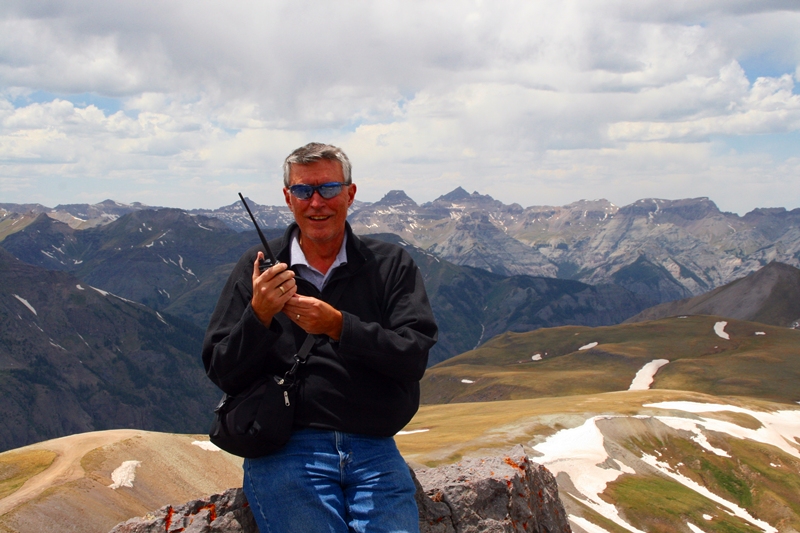
Hmmm, I said to myself, Engineer Mountain is a valid peak (W0/SJ-011, 12968 feet elevation) for a Summits On the Air (SOTA) activation. The only portable radio I had with me was a Yaesu VX-8GR with the stock rubber duck antenna. Not a great SOTA station. But if I could whistle up 4 contacts on 2M FM simplex, I would have a legitimate activation. We had already decided to climb to the summit, so any radio activity was just icing on the cake.
So off we went up the mountain. I got to the top and started calling on 146.52 MHz FM. Now it hits me that we are in the middle of a national forest, away from population centers and, to top it off, no one is expecting a SOTA activation here today. This might be a bit of a challenge to make 4 contacts. Then Thomas, KRØNK, answered my CQ. OK, there’s one contact. A little bit later Dave, AKØMR, comes on frequency and gives me a second contact. Both of these guys were in Grand Junction, CO, which is about 100 miles from Engineer Mountain. Not bad for a peanut-whistle HT using a standard rubber duck antenna.
I needed two more contacts. I tuned around for a repeater in the area and came across the 147.27 MHz machine which turned out to be a stones throw away from my location. It requires a CTCSS tone, so I fumbled around until I figured that out. No, I did not have a repeater directory with me…that was safely stored in the Jeep at the bottom of the mountain. I gave a quick call with my location and Ben WB5ITS came back to me. We QSY’d over to 146.52 to make my third contact. Anticipating a rough go of it, I asked my wife Joyce K0JJW to descend off the peak while I remained at the top, so she could be my fourth contact. (SOTA rules do not allow contacts between parties on the same peak.)
Somewhere along the way, I reach for a piece of paper to log the contacts, only to find that I did not have a writing utensil with me. Duh. I would have to remember the times and callsigns of the contacts and write them down later.
I completed the fourth contact and headed down. Later that evening I checked the ListsofJohn database and found that there are actually two peaks in the area called Engineer Mountain. Go figure. The SOTA database only recognizes one of them…of course, you guessed it, not the one I was on. It turns out that the Engineer Mountain I was on is subordinated by an adjacent peak: Darley Mountain (W0/RG-034, 13260 feet). However, since I operated from 13,218 feet on my Engineer Mountain, it is within the 75 foot vertical activation zone for Darley Mountain. So, this does count for a SOTA activation of Darley Mountain.
This is where I could claim that incredible skill, flexibility and a little luck ruled the day. I think a more appropriate analysis is to concede that a complete lack of planning and preparedness produced a marginal result.
What can we learn from this?
- Do your homework concerning the SOTA peak that you intend to activate before you start the climb. Make sure you know where it is and that you are really on it.
- Always keep a notepad and pen/ pencil in your backpack
- Even for casual hikes, take along a decent antenna for the HT. A half-wave vertical is way better than a stock rubber duck.
- Plan in advance so you can post your intended SOTA activation on sotawatch.org
- Have a repeater directory (or equivalent) available to identify repeaters in the area.
- And don’t forgot the normal hiking Ten Essentials
Beyond doing a SOTA activation, some of these items could be important if an emergency should occur. It runs out there was no mobile phone coverage in the area. I used to be pretty vigilant about taking an HT with spare batteries and extended antenna along on hikes but have gotten sloppy lately. See Rescue on Uncompahgre Peak, which describes an incident years ago when my radio turned out to be very useful during an emergency.
In the end, I did complete my first SOTA activation, so I can be happy about that. And it gave me the opportunity to relearn a few things about planning and being prepared.
73, Bob KØNR
P.S. The WØ SOTA guys recently created a great W0 SOTA page.
My Son Passed His Tech!
My 16-year-old son, Antonio, has been studying hard for his Technician license, and yesterday evening three VE’s — Dean, NYØI, Scott, KBØNLY, and Terry, KCØQED — paid us a house call. When they showed up, I was out in the driveway installing a dual-band antenna on my pickup. They crowded around, watching me, helping where they could, and chatting while Antonio grilled steaks in the back yard. Pretty soon the aroma of grilled ribeye had our mouths watering!

Terry, KCØQED, left, and Antonio (nervously contemplating the exam), right
After one of the biggest feasts we have ever had, the testing began. Antonio was pretty nervous at first, but he breezed through the test easily. Terry scored it, turned to me and gave me a thumbs up! While the other two VE’s scored Antonio’s test, I went and got the Wouxon KG-UV6D HT (with leather case, high-gain antenna, speaker-mic, and emergency AA-battery pack) I’ve had waiting for him. He smiled as he opened the box and started taking things out and putting them together.  Antonio called Grandpa Mitchell, NØARQ, to share the good news. Just for fun he also took the General exam, and surprised himself by coming closer to passing than he expected — now he wants to study for that!
Antonio is interested in ARES® (he got an ARES vest yesterday, too), but he’s also interested in other aspects of amateur radio. Yesterday evening he said he would like to start up our CW lessons again so he can work HF CW, and he also wants to join the ARRL and the West Central MN Amateur Radio Club.
Here’s a slide show with a few more snapshots from yesterday evening. Congratulations, Antonio!


YMC ARES Training Net Begins!
Last night at 8:00 P.M. I held our first Yellow Medicine County ARES Training Net. The plan is to do this every Monday night at 8:00 P.M. and to cover a specific learning objective each time. Dean Herzberg, NYØI, graciously agreed to let us use his 2 meter repeater in Milan for this.
Rather than trying to re-invent the wheel, I’m trying to mimic the Arizona Emergency Net. They have been doing some excellent work, and you can listen to recordings of their training nets online (click here for their archives).
Yesterday’s topic was “Tactical Call Signs.” After explaining the concept of tactical call signs, I assigned one to each operator, asking him to acknowledge it. Then I put the operators through a little exercise. I explained that I would call each one of them with his tactical call sign, and after he replied with his tactical call sign, I would ask him a question. When he answered the question, he was to conclude with his FCC call sign. This is standard format; signing with the FCC call sign tells net control that the operator considers the exchange complete. Here’s an example:
Net control: “EOC-1″
EOC-1: “EOC-1″
Net control: “EOC-1, what is your favorite mode?”
EOC-1: “My favorite mode is FM. NØJXI”
The stations who checked in did a great job. The whole net took only about 15 minutes; I tried to make it short, sweet, and to the point, and since we didn’t have many check-ins it didn’t last long.
All hams within range of the repeater are welcome to participate in this net, whether or not they are in Yellow Medicine County and whether or not they have registered with ARES. I do hope that this will draw some hams into ARES, though. Now that we have something like this going, it’s time to beat the bushes by sending out letters to local hams inviting them to take part.















