Archive for the ‘ham radio’ Category
 A WSPR in your ear.
 November 23rd, 2012 |
  Author:
  |
| Screenshot of WSPR.net Map Page |
Shack Talk on HamRadioSchool.com
 I’ve been writing a few articles for the HamRadioSchool.com web site during the past few months. Most of these are aimed at newly licensed Technicians but other radio amateurs may find them useful.
Click on this link to go directly to the Shack Talk articles:
- A Half-Wave Antenna for Your 2 Meter Handheld Radio
- VHF FM Station At Home
- Yes, Band Plans Do Matter
I also put together a quick reference chart for Technician License Bands and Modes.
Check out the other content available on HamRadioSchool.com.
73, Bob K0NR
The Android HT – Part 2
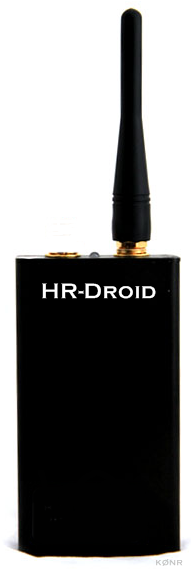 My article on the Android HT generated some interesting comments and ideas. Thanks so much! One of the main themes in the feedback is to have the radio be “faceless”, with the user interface done on a mobile device (i.e., smartphone or tablet). The mobile device would communicate to the transceiver via Bluetooth (or maybe WiFi). This approach has the advantage of separating the radio hardware (which probably doesn’t need to change very often) from the compute/display hardware (which is on a faster-paced technology path). I went ahead and hacked together a concept photo of such a device (click the photo to enlarge it). This device could interface with any mobile device that has a Bluetooth interface, so it would be independent of OS on the mobile device (yes, you could use your iPhone).
Such an approach opens up a variety of use models. Imagine sticking the transceiver in your backpack and using an app on your smartphone to enjoy QSOs when hiking. Alternatively, the radio could hang on your belt. At home, the radio could be left in some convenient location, connected to an external antenna on the roof and operated from the mobile device. (Low power Bluetooth is said to have a range of about 10 Meters.) These are just a few thoughts…I am sure you can think of others.
I would expect the original Android HT concept to be easier to use for casual operation, due to the All-In-One Design with dedicated hardware volume control, channel select and PTT switch. I am assuming those functions would be implemented in software in the faceless implementation, which would likely be less convenient. Most mobile devices have their own GPS system included, so that would mean one less thing that has to be in the radio.
The other idea that surfaced in the feedback is using Software Defined Radio (SDR) technology to implement the transceiver. This would provide a higher degree of flexibility in generating and decoding signals, enabling additional areas of innovation. That is a great idea and will require a whole ‘nuther line of thinking.
73, Bob K0NR
The Android HT
 I’ve been watching all of the innovative work going on in the smartphone and tablet arena and wondering how we could get more of that going in ham radio. To be sure, there are always radio amateurs developing creative technology. Some examples are adaptations of D-STAR, IRLP, improvements on APRS and sound card modulation modes. However, amateur radio is missing a standardized platform for handheld communications. Such a radio platform could open up lots of software innovation in this space.
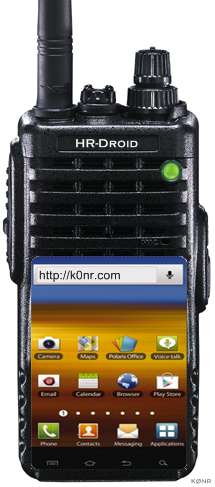
What I have in mind is a dualband (2M/70cm) handheld transceiver that is built on top of the Android operating system. (Sorry Apple Fan Boys, iOS is a non-starter based on Apple’s walled garden philosophy.) This radio would have some of the hardware features we now take for granted in smartphones: GPS, WiFi, USB, maybe even a camera. I’d also include APRS hardware built-in, similar to the Yaesu VX-8GR or the Kenwood TH-D72A. I’ve hacked together a concept photo shown on the left of this post (click to enlarge). We would probably want to maintain some of the most important direct hardware controls such as PTT, volume and channel select. The rest of the user interface would be done via a touchscreen display, where the power of the Android OS comes into play.
While this hardware configuration is exciting, the real power comes from having a software developers kit (SDK) with a stable Application Programming Interface (API). This would unleash the creativity of all those software-oriented hams out there and a plethora of apps would emerge. There are plenty of ham radio apps available on the Apple and Android platforms…it’s just they are missing the radio as part of the package. An obvious area for innovation would initially be in APRS or maybe D-STAR. We could actually have the equivalent of SMS text messaging on ham radio, backed up via the WiFi connection. (Yeah, this kind of exists already but it is really cumbersome to use due to the braindead menu-driven user interfaces of current radios.) Just think how easy programming the radio would be with a touchscreen approach.
This is the type of product development that requires significant investment, but the technology is readily available. I suppose a garage shop operation could get this done but one of the big radio manufacturers could easily pull this off. Maybe one of those upstarts from China might want to take this on. Whoever does it, just send me $5 per unit and I’ll be happy  .
.
That’s my best idea for this morning. What do you think?
73, Bob K0NR
Seventy Three
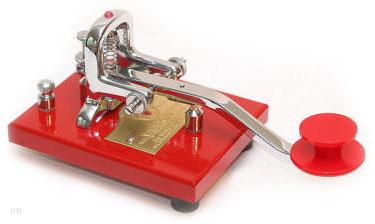 Like many technical activities, amateur radio has its own set of jargon and protocols used both on and off the airwaves. As part of our Technician license course, we cover basic jargon but also encourage the use of plain language. A new Technician recently asked about the use of the term “73″ on the local FM repeater, so I am posting this short piece.
Much of amateur radio history and practice is rooted in Morse Code, which traces back to the electrical telegraph. Two shorthand codes you’ll hear on both voice and Morse Code communications are:
73 means Best Regards
88 means Love and Kisses (sometimes Hugs and Kisses)
These codes originated with telegraph operating and are listed in the Western Union 92 Code, a set of numerical shorthand codes. On voice (phone) transmissions, you often hear something like this:
“Great to talk to you, Joe. Thanks and Seventy Three. This is K0NR, clear.”
Since 73 is often used at the end of a radio contact, it almost takes on the meaning of “best regards and goodbye.” “Eighty Eight” is used in a similar manner but is heard much less frequently on the ham bands.
Sometimes you’ll hear 73 expressed as “Seven Three”, which corresponds to how the Morse characters were sent. It is incorrect to say “Seventy-Three’s” since this would literally mean “Best Regards’s”. Of course, most of us have made this error from time to time, very similar to grammatical errors in the English language. (“Somes time we forget to talk good.”)
QRP operators often use 72 instead of 73 because low power operating is all about getting by with less. See W2LJ’s blog.
And I normally use 73 at the end of most ham radio related email messages.
73, Bob K0NR
This Spewed Out of the Internet #23
 Just catching up on a few things spewing forth from the internetz.
From the Great Minds Think Alike Department, Jeff KE9V suggests that the world needs a really good transceiver focused on 50 MHz and higher. I’ve always had this irrational attraction to VHF and higher and would love to have a solid radio in this category.
Don’t miss the Jamboree On The Air (JOTA) this weekend. Also, take a look at this ARRL article on Radio Scouting. Our local Scout troop will be on the air as KB0SA for JOTA.
Based on the blog posting by Jerry KD0BIK, I picked up a Kelty Redwing backpack, for SOTA and other hiking activities. The 20% off coupon for REI was a good incentive to pick up the pack.
I managed to miss the 2012 Pacificon hamfest. Early in the year, I figured out that I needed to be in the San Francisco area right around the Pacificon date, so it looked like a sure thing. Unfortunately, circumstances changed and I missed it again this year. I keep hearing great things about Pacificon so it may be the best hamfest in the USA, based on a quality venue and great programs. I will have to wait until next year to validate this theory.
The LA Times has a great time-lapse photography video of space shuttle Endeavor moving through the streets of LA. Check it out.
HamRadioSchool.com has a neat video of a flagpole vertical antenna getting installed. There’s some really good content on that website. But I might be biased, since I’ve been contributing a few articles under the Shack Talk banner.
My buddy Ken WA6TTY has written a review of the new ARRL RFI Book. Ken is an EMC expert and does an excellent job of reviewing the book.
- 73, Bob K0NR
Show Notes #092
Introduction:
- The earth moved in Texas, recently, which sends Richard down memory lane.
Announcements:
- Texoma Hamarama will held October 26-27, 2012 at the Ardmore Convention Center in Ardmore, Oklahoma. Pre-registration ends October 20th.
- The Augusta Hamfest will be Saturday, October 13, 2012 in Augusta, GA.
- Scott, N8VSI, was the LHS ambassador at the Ohio LinuxFest, September 28-30, 2012. We look forward to hearing a report from Scott in the near future.
Topics:
- Richard recounts his experience replacing a computer power supply. Moral? Don’t be afraid to try repairing a computer yourself. Swapping parts is easier than you might think. For power supplies, pay attention to the wattage required. (Ed. Note: When in doubt, it’s best to replace the bad supply with one that has the same or greater wattage rating.)
- Departing from our usual topics, Russ and Richard discuss a couple applications for producing slide shows and panoramic photographs:
- Imagination is a lightweight and simple DVD slide show maker for Linux and FreeBSD that’s very easy to use, offers a wide variety of transitions, supports background music, and much more. Available in the Debian and Fedora repositories, and probably many others.
- Hugin is a program that allows you to assemble a mosaic of photographs into a complete, immersive panorama, stitch together any series of overlapping pictures, and much more. It’s cross-platform and easy to use.
- Why Ham Radio? Richard talks about why you might wish to obtain an Amateur Radio License and how you can combine it with Linux, including:
- Getting your ham license for our non ham listeners.
- There are many modes of communication, including voice, Morse code, and many digital modes.
- The ease of getting your license.
- Why you should get your license.
- How to get your license.
- The Amateur Radio Relay League (ARRL) is a good source of information
- Free practice tests are available at qrz.com
- A list of certified Volunteer Examiner Coordinators is available at www.ncvec.org.
- Test sessions can be found through the ARRL and many local radio clubs.
- Russ describes Universal Plug ‘n’ Play devices (UPnP). Many new devices offer the ability to play media from UPnP servers. It makes sharing your media very convenient and easy, but can also be a security risk.
Feedback:
- Pete, VE2XPL, sends a long email in response to episode 88, and covers such things as the Toonie, Alexandre Graham Bell, Brad Sucks, the wAVEgUIDES PodCast, SouthCARS, email addresses for LHS, and the MintCast.
- Ted, WA0EIR, asked if there is a problem with the LHS mailing list as his attempts to post a message there “bounced”. Yes, the mailing lists have been broken, but they’re fixed now.
- Larry Bushey of the Going Linux podcast says thanks for the great show, and admits they stole the LHS “badger” sound effect for use on their show. Episode 185 contains an example of their use of the Badger.
- LHS was mentioned in a comment to a post at hak5.org.
Contact Info:
- Contact Richard at [email protected], Russ at [email protected], or both at the same time at [email protected].
- Listen to the live stream every other Tuesday at 8:00pm Central time. Check the LHS web site for dates.
- Leave us a voice mail at 1-909-LHS-SHOW (1-909-547-7469), or record an introduction to the podcast.
- Sign up for the LHS mailing list.
- Sign up for the MAGNetcon mailing list.
- LHS merchandise is available at the Merch link on Web site. Check out the Badgerwear or buy one of the other LHS-branded items at PrintFection.com/lhs or Cafe Press. Thanks!
- Thanks to Dave from Gamma Leonis for the theme music.
Music:
- “You Are You” by Fall Walk Run from the album Throwing It All Away, courtesy of Jamendo.
- “Flash Back” by MattMigma from the album Phoenix, courtesy of Jamendo.













