Archive for the ‘dx’ Category
 Strongest X-Ray Solar Flare in New Cycle 25! A Class M4.4 Flare on 29 Nov 2020
 November 30th, 2020 |
  Author:
Here’s a look at the strongest X-ray flare so far in Cycle 25, and the strongest in three years. The flare measured as an M4.4-class Solar Flare, and it peaked at 13:11 UTC on 29 NOV 2020.
Perfect Straight-Key Morse Code? Can It Be Made Without Machines?
Software-Defined Radio: Try Before You Buy? You Might Like It!
Sure! You don’t need to have a software-defined radio (SDR) before you start learning how to use the technology; there are a few different paths you can take, exploring and learning about SDR.
One way to gain some experience with SDR without spending a dime is to install a free software package for the very popular, non-Linux, operating system (that starts with ‘W’), and give SDR a test drive. If you like it, you might consider getting your own hardware (like the SDRplay RSPdx, for instance), and connecting it up to your computer and running this software, too.
Why I Dived Into SDR
I have always loved radio, ever since the early 1970s, when I discovered shortwave radio. In the last couple of years, I’ve had an increasing interest in the world of SDR. When I am working, but away from home (remember those days, before Covid?), I want to sample news and programming from around the world, but through shortwave. The way to do that, I found, is by using the various SDR options which allow a person to tune a remote receiver, and listen.
I also find working with the waterfall of a typical SDR-software user interface rewarding because, instead of blindly searching for signals in a subband, I can see all of the received signals on the scrolling time representation of a slice of frequency. Simply select that signal on the waterfall, and the radio tunes right to it.
I often connect to different SDR radios around the world, to catch all manner of shortwave signals, from maritime, military air, trans-oceanic air, or coast guard radio traffic, or other interesting HF communications including amateur radio CW and SSB signals. Occasionally, I also check out VHF and UHF signals from around the world. All of that, while instead an office building that is not suited for shortwave radio reception.
I’ve now decided to give back to the community; I’ve added my SDR receiver to the collection of receivers located around the world on the SDRSpace network of SDR radios.
My new SDRplay RSPdx software-defined radio receiver is live, via http://www.sdrspace.com/Version-3, using the SDR Console software (Version 3).
The receivers are online whenever I am not transmitting and when there are no local thunderstorms.
Antenna Port A is connected to a wire antenna (a horizontal 100-foot wire that runs out from my house’s chimney to a tall tree; about 10 feet of that wire is oriented vertically, where the wire passes through a pulley and then is weighted down so it can move with wind-driven tree movement), while Antenna Port B is connected up to a VHF/UHF discone.
Both antenna systems have an AM Broadcast band notch (reject) filter reducing local AM Broadcast-Band radio station signals by about 30 to 40 dB. I need to use these because the very close KLIN transmitting tower is just miles away and those signals overwhelm the receiver. When I use the signal filters, the local AM Broadcasting signals no longer overwhelm the receiver.
In the following video, I first explain my SDR setup, and in the second half of the video, I tune around the radio spectrum, using the software to control my SDR receiver.
[embedyt]https://www.youtube.com/watch?v=DHj917E1bKA[/embedyt]
A Couple of Questions
After watching this video, WO9B wrote an email to me. Michael asked of me two questions, summed up as:
1. Your SDR window has the IF screen on top. How is that accomplished?
2. Your AM Broadcast filters; more info, please. I live in the area of mucho broadcast stations and that looks like something I could use.
In the following video, I demonstrate how I changed my layout of the SDR Console software. And, I mention the AM Broadcast Filter for SDR Receivers (the hardware filter is found here: https://g.nw7us.us/3kU5SJN).
[embedyt]https://www.youtube.com/watch?v=YLBLHi441Zg[/embedyt]
To Use My Receiver
Download the latest version of SDR-Console from https://www.sdr-radio.com/download – there is a 32-bit and a 64-bit Windows installation package.
The 64-bit installation package may be downloaded from one of these three sources:
1. Google: https://g.nw7us.us/3auBq44
2. DropBox: https://g.nw7us.us/310ooIG
3. Microsoft: https://1drv.ms/u/s!AovWaZDu7Hrd3U-yqK1bs3wuaFw2?e=o4nKeh
The 32-bit installation package can be downloaded from one of these three sources:
1. Google: https://g.nw7us.us/3iLasrZ
2. DropBox: https://g.nw7us.us/3g4VcVc
3. Microsoft: https://1drv.ms/u/s!AovWaZDu7Hrd3U4mJiiRtI9lm70s?e=HDG4ZX
Install the SDR Console package according to the directions given. Once you have the software installed, you will want to add my server. It takes some work to get familiar with the software, but there are online FAQs on how to begin.
One guide on how to add a server to the list from which you can pick may be found, here:
https://www.sdrplay.com/wp-content/uploads/2018/02/SDRConsoleV3-ServerGuide1-1.pdf
I worked on getting all of the bugs worked out of my installation before making the video. It did take some work, and reading up on things. But, the software is solid and a good contender against SDRuno, and HDSDR, and, this way I can share it online with you.
My server is known as, ‘0 NW7US‘ — it will be online when I am not using my antenna systems for transmitting. It will be offline during thunderstorms, or during times when I must use the systems for transmitting.

Software-defined radio is a great way to hear all sorts of communications, from local AM broadcast stations, FM stations, VHF Air Traffic, to shortwave radio stations including amateur radio HF communications.
Thank you for watching, commenting, and most of all, for subscribing; please subscribe to my YouTube Channel: https://YouTube.com/NW7US Also, please click on the bell, to enable alerts so that when I post a new video, you will be notified. By subscribing, you will be kept in the loop for new videos and more.
73 de NW7US
.. (yes, this is an expansion of an earlier post… forgive the redundancy… thank you) ..
Check Out My New SDRplay RSPdx Software-Defined Radio Receiver – Live!
My new SDRplay RSPdx software-defined radio receiver is live, via http://www.sdrspace.com/Version-3, using the SDR Console software (Version 3).
The receivers are online whenever I am not transmitting and when there are no local thunderstorms.
Antenna Port A is a wire antenna (100′), while Antenna Port B is a VHF/UHF discone. Both have an AM Broadcast band reject filter, reducing local AM Broadcast signals by about 30 to 40 dB. I need to use these because the very close KLIN transmitting tower is just miles away and those signals overwhelm the receiver. When I use the signal filters, the local AM Broadcasting signals no longer overwhelm the receiver.
Let me know what you think. Enjoy!
To use my receiver:
Install the latest version of SDR-Console which can be downloaded from https://www.sdr-radio.com/download
Install SDR Console according to the directions given. Once you have the software installed, you will want to add my server.
It takes a little to get familiar with the software, but there are online FAQs on how to begin.
My server is known as, ‘0 NW7US‘ — it will be online when I am not using my antenna systems for transmitting. It will be offline during thunderstorms, or during times when I must use the systems for transmitting.
Software-defined radio is a great way to hear all sorts of communications, from local AM broadcast stations, FM stations, VHF Air Traffic, to shortwave radio stations including amateur radio HF communications.
Thank you for watching, commenting, and most of all, for subscribing; please subscribe to my YouTube Channel: https://YouTube.com/NW7US Also, please click on the bell, to enable alerts so that when I post a new video, you will be notified. By subscribing, you will be kept in the loop for new videos and more.
Video:
[embedyt] https://www.youtube.com/watch?v=DHj917E1bKA[/embedyt]
73!
Some 6m Summer Excitement

With three seasons of FT8 under its belt, there’s no doubt that it's taken over as the number-one mode for the 6m band ... there are very few traces of CW or SSB to be found.
What it hasn’t taken away, is the magic!
For the most part, this summer’s conditions from the west coast were pretty normal, except for when they weren’t ... and when they weren’t, they were pretty spectacular!
The spectacular parts were highlighted by one particularly unique contact that can only be attributed to some heads-up operating skills, a little help from FT8 ... and the unpredictability of Sporadic-E.
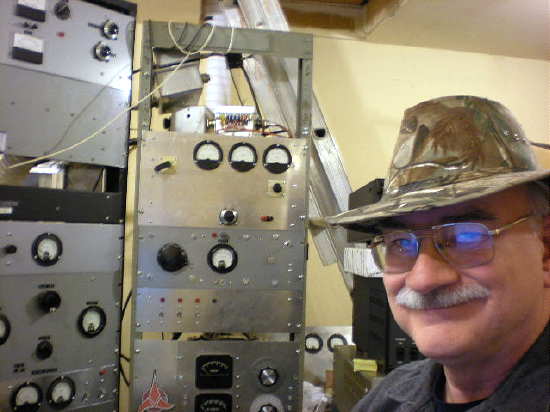
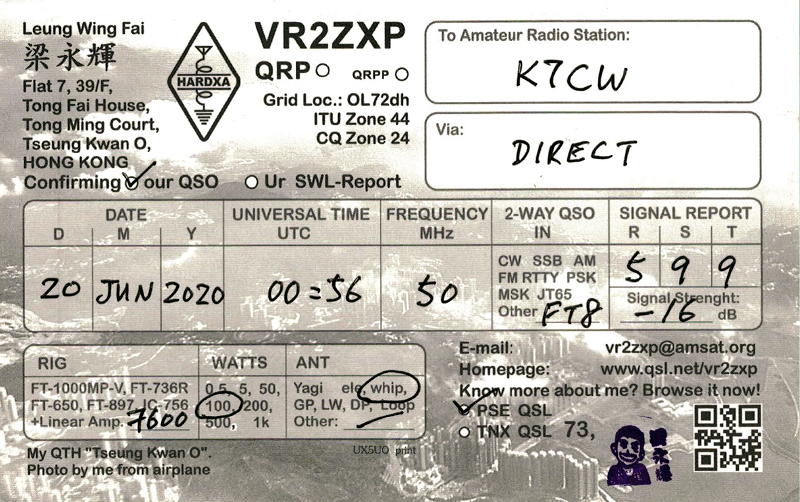
On June 20, at 0056Z, K7CW (Paul), south-west of Seattle, nudged his signal all the way to Hong Kong, more specifically, to VR2ZXP’s crowded apartment building. But that’s not the incredible part. That happened when Paul heard and exchanged signal reports with Alfred’s tiny station!
 |
| Paul, K7CW |
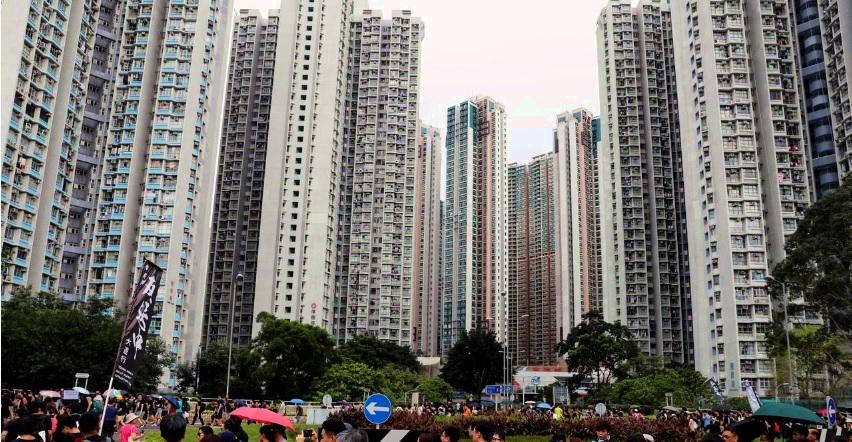 |
| Not the best location for weak signal 50MHz DX! |
"As I told to Paul, it’s a hard job to be a ham in VR2 Hong Kong especially for the DX. Hong Kong is a high density population city. 99% people are living in apartment only. The housing price here is crazy around US$1800 per sq. feet. Neighborhoods always complain why we setup antennas out of our windows and produce radiation to affect their health. So, what we just can do is to use a small whip with QRO for the QSO. Besides, interference is also serious. Thousands of air conditioner is surrounding me and a power station 132kV to 11kV is just faced to me in 1km away. Here the noise level on low HF band at night is S9."
As indicated above, Alfred’s station is located in a typical high-rise apartment, surrounded by numerous others, with no room for antennas. His solution is to clip a short (60”) whip antenna, horizontally mounted on his balcony railing, similar to this one from 20 years ago ... before being surrounded by noisy high-rise apartment buildings!
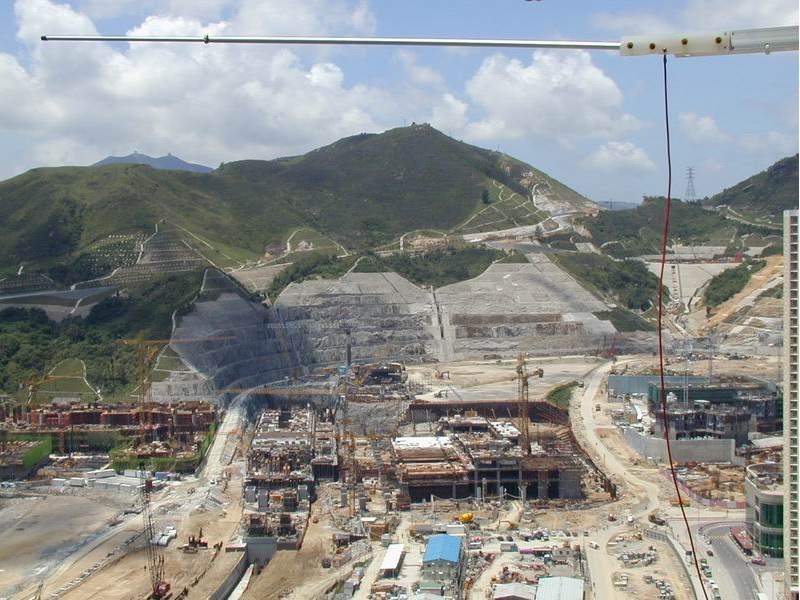
I’m not sure which is the most spectacular part of this contact ... that Alfred could detect Paul’s signal in such a noisy environment using such a small makeshift antenna or that Paul was able to copy the tiny signal coming from uptown Hong Kong.

 |
 |
| K7CW's 9el - 50' Yagi at 80' |
Long openings like this occur very rarely, making them even more thrilling and can cause even the most experienced 6m DXer’s mouse-hand to tremble with excitement!
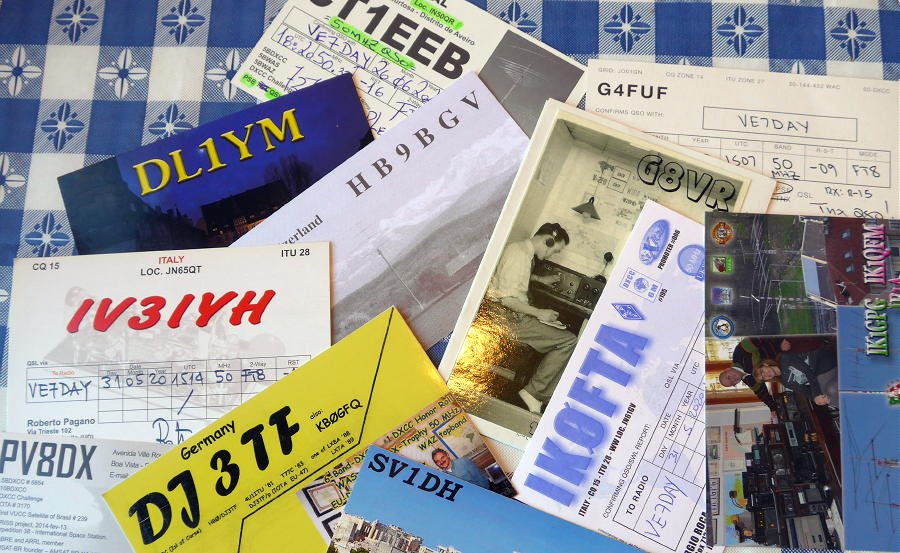 |
| Some of VE7DAY's wallpaper from the May 31st opening. |
Others up and down the west coast also filled their log pages with ‘new ones’ ... unfortunately my exciter was on the workbench while replacing the screen so I never knew what I had missed until some time later ... probably just as well. I guess I must have been pretty naughty at some point, as the 6m gods definitely singled me out for special punishment that morning.
Once the exciter was back together I was able to catch a few good openings myself, the best of which was early on the morning of June 23 when I was able to work SV9CVY (Crete), SV1DH (Greece) and IS0AWZ (Sardinia).

Crete and Sardinia gave me DXCC #89 and #90. Three days later, during a nice opening to the southern states, J68HZ in St. Lucia snuck through the QRM for #91. After a further three days, on June 29, another very early opening put 8 more Europeans in the log including HA8CE (Hungary) and YU7EF (Yugoslavia) for #92 and #93 respectively.
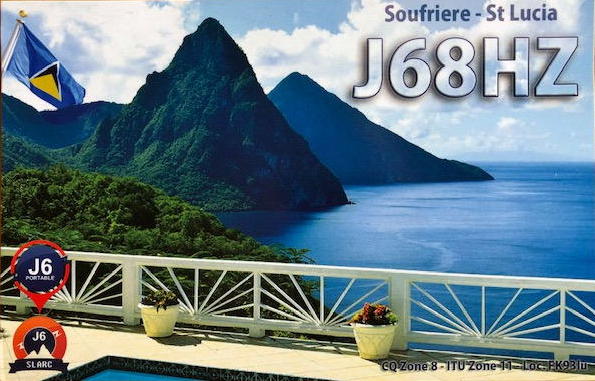
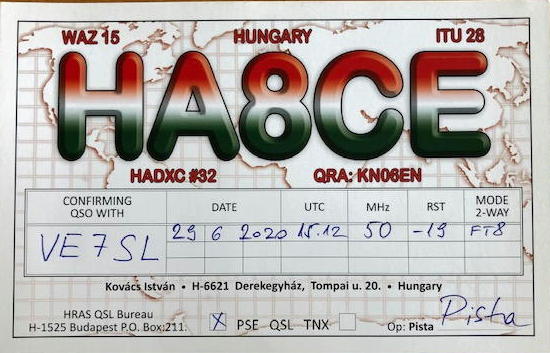
The band also produced several long openings to Asia, usually in the late afternoon hours. Several contacts were made with South Korean stations, China and dozens with Japan.
All told, the band produced some exciting activity this summer. Countries worked here were:
JA, JW, TG, V31, J68, LA, SM, SV9, SV, IS0, EA, HA, YU, F, 9A5, BG, HL, EA8. Certainly FT8 had much to do with a good portion of the action but it is difficult to say just how much. Many of the Europeans were very strong and could have easily been worked on CW in a matter of a few seconds, rather than the 60 - 75 seconds required for a valid FT8 exchange, assuming there are no repeats. But it's contacts like Paul and Alfred's that continue to validate the special name given to the band ... you just never know what might tricks will be next.
NEOPHYTE Adventures

I've just added a new page to my website, The VE7SL Radio Notebook, that describes my NEOPHYTE 1 regenerative receiver spring construction project. The new page can be found here.
Like most simple regens, its performance far exceeds its simple circuit expectations. My listening adventures with it continue during The Radio Board's annual Homebrew DX Contest which runs from July 11 - 24th. You may want to give it a try, after of course, you've checked-out my new web page!
One Aspect of Amateur Radio: Good Will Ambassadors to the World
This article is part two of the series taking a look at band plans and gentlemen agreements.
See part one, here: Land (er, FREQUENCY) Grab. See part three, here: In Response — Can’t We All Just Get Along?
Displaced and Marginalized
There are some unhappy amateur radio operators in the world of shortwave operations. Users of Morse code, and digital modes other than the highly-popular modes engineered by Joe Taylor, K1JT, feel displaced on the many amateur radio bands where Joe’s wildly-popular mode FT8 has erupted.
Joe (born March 29, 1941), is a friend of hams everywhere, and is an American astrophysicist and Nobel Prize in Physics laureate (https://g.nw7us.us/2Ptquv1) for his discovery with Russell Alan Hulse of a “new type of pulsar, a discovery that has opened up new possibilities for the study of gravitation.”
Many have asked questions like, “Did Joe Taylor K1JT Destroy Amateur Radio? Did Joe Taylor K1JT, Nobel Laureate and noted friend of hams everywhere, accidentally destroy amateur radio?” This question remains relevant, even as more and more FT8 operators take to the HF bands to chase wallpaper and awards.
FT8 Has Validity and Usefulness
Full disclosure: I administer a Facebook group for FT8 and FT8-related modes, because I believe that the mode has a valid place in our amateur radio technology portfolio. Here is the Facebook group URL, if you would like to join the fun: https://www.facebook.com/groups/FT8.FT4.HF.6m/. Understand, I have used and will continue to use FT8.
Because it has a place, it stands to reason that everyone should become more aware of the impact of using FT8 on the bands. It also stands to reason that it should be used ethically, and in the best spirit of amateur radio.
Many amateur operators use the FT8 digital mode as a novelty when there isn’t much else happening on amateur radio shortwave bands. One of the great things about it is that you can tell when a band is open–even though you don’t hear any other signals of other modes on the band in question, you very well may hear the roar of FT8 on the band where propagation actually exists to somewhere else than your QTH.
Others use it to finally get their DXCC, or WAS, or other award and wallpaper. This is especially popular during this season of the sunspot cycle where there are no sunspots–propagation is limited to lower-HF amateur bands because there’s just not enough solar activity to energize the ionosphere enough to open up the higher segment of shortwave.
FT8 Has Limitations
Can FT8 be used for two-way conversations? No. However, the JS8CALL digital mode is designed from the FT8 mode, by changing the protocol in a way that allows free text. It is designed for ragchewing and the new version 2.0 offers three modes of chat with 50 Hz and 16 wpm, 80 Hz and 24 wpm, and the turbo mode at 160hz and 40wpm with turbo only having a 6-second turn around time. The designated frequency is 7.078, which many find much nicer to use.
However, many find JS8CALL combersome, and non-intuitive. How fast and how reliably can it handle critical messages, say, during an emergency? I’m sure the software will improve, but how good is the protocol?
A mode such as Olivia has been field proven, and time tested. It can reliably handle traffic.
The Rant
During the early days of widespread FT8 operation that came with the first public non-Beta release of FT8-equipped WSJT-X software, I tried to reason with the FT8 development leadership team. I made a polite attempt at explaining how incredibly rude they were in purposefully programming into the software the default operating frequencies such as 7.075, 14.075, and so on.
One of the main leaders of that team slammed me and stated that “we only suggested those frequencies; the operator is free to change them.” Additionally, he stated that the team used a common QSO/Mode spotting website to see what digital modes or other operations (like CW) were sparser. They perceived that the frequencies they proposed where no longer active because they saw few if any spots. They thought that no one would care.
I explained that a single website-spotting strategy was illogical and very lazy. This is true for several reasons, at least.
I guess you have to have a Ph.D. to know better than any average ham who went by gentleman’s agreements. I have an extremely dim view of JT and his disciples. CW is not the only operating group he’s engineered out of traditional slices of spectrum. Olivia, and other modes, now have been pushed down into PSK subbands, and everyone is feeling the crowding. As far as my thinking of FT8, well, it is radio, but it doesn’t foster goodwill and building serious communications skill. IMHO.
Play Nice, Be Positive and Polite. Smile.
I’ve received wise counsel from a number of fellow amateur radio operators. They implore us to not promote hostility between “us and them.” That even though the WSJT team is playing the playground bully, we should not be vengeful, but polite and willing to negotiate in good faith.
If we don’t play nice with the bully then the bully won’t play with us. And, the general public will side with the bully because the bully has the nice toys…
Good negotiations, though, take a willingness by both sides, so that conversation evolves, resulting in positive, cooperative actions embraced by both parties. There are other amateur radio operators who have made attempts to open up talks with Joe and crew. What are the results, so far?
We can hope that Joe Taylor and his group of developers and leadership take a proactive role and join a conversation that is with a wider group of amateurs than just the WSJT enthusiasts. We hope that they will play fairly, and cooperatively, with the rest of the amateur radio community.

Tomas Hood, NW7US, is a regular contributor to AmateurRadio.com and writes from Nebraska, USA. Tomas is the Space Weather and Radio Propagation Contributing Editor to ‘CQ Amateur Radio Magazine’, and ‘The Spectrum Monitor’ magazine.













