Archive for the ‘dx’ Category
 Let’s Call CQ – QSO Today Episode 184 with NW7US
 February 13th, 2018 |
  Author:
 I got a Skype call a few weeks ago from Eric, 4Z1UG–the creator and host of the QSO Today Podcast–during which he asked me about how and why I got into amateur radio. Here’s the result.
Eric writes,
We talk a lot about the band conditions due to the Sunspot cycle. Most of it on Facebook and other places is about how “dead” the bands are at this point. We all can’t wait until the cycle starts to rise and we will be making contacts with little effort. I remember in my conversation with Chuck Adams, K7QO in Episode 58, that he really enjoys operating is “Pigrig”, one watt, CW transceiver on 20 meters. When I asked him, (I liberally paraphrase) “but Chuck, the bands are dead. How does that work for you?”. His reply was that while most hams are listening to the bands, he calls CQ until he gets a reply. Works every time.
My QSO this week is with Tomas Hood, NW7US, who has years of expertise in propagation and Solar activity. He is the propagation editor of more than a few radio magazines and websites. In our post-recording conversation we discussed this phenomenon of listening and not calling CQ. I even had this idea that maybe one of the reasons that the digital modes are so successful is because they “beacon”, as part of the whole digital experience, the same as calling CQ. This is why they make contacts. From what I see, looking at PSK Reporter, hams are making lots of contacts worldwide using the digital modes. While SSB may not be working so well, CW and the digital modes seem to work fine.
I like to work on my bench or make the podcast while listening to the bands. Jeff Damm, WA7MLH, in Episode 177, says that he will put his keyer in CQ mode while he is working on a new radio. Invariably, sometimes after many minutes, he gets a reply. Great idea Jeff!
73,
Eric, 4Z1UG
Episode 184 can be found here: https://www.qsotoday.com/podcasts/nw7us
Highlights of Episode 184:
Tomas Hood, NW7US is the propagation editor of a number of shortwave and amateur radio magazines, and has a wide variety of websites, that grew out of his love for all things radio, and for listening on the bands to far off DX and commercial broadcast stations. Tomas shares his understanding of propagation and the lessons we can learn from listening, really listening to the QSOs and exchanges during contest operation.
All of the QSO Today episodes are great. I enjoy hearing about many different hams. Do check out all of the episodes that Eric has published.
73 de NW7US dit dit
At The Dials
 |
| Courtesy |
A recent never-ending series of equipment breakdowns, repairs, computer software problems, along with everyday household duties, has kept me away from blogging longer than usual.
However, the recent arrival of a fresh 'off the press' 2018 World Radio Television Handbook (WRTH) has really augmented my rekindled interest in what initially hooked me on the magic of radio ... tuning around the international shortwave bands.
The last time I purchased a WRTH was more than 40 years ago, but other than the information between its covers, the book still looks much the same as it did back in the good old days. There is a lot to digest in this book and although it's likely that a lot of it could be found on the Internet, it would probably take weeks of sleuthing to find it ... there is just a ton of valuable information here to accommodate the varied interests of radio fanatics.
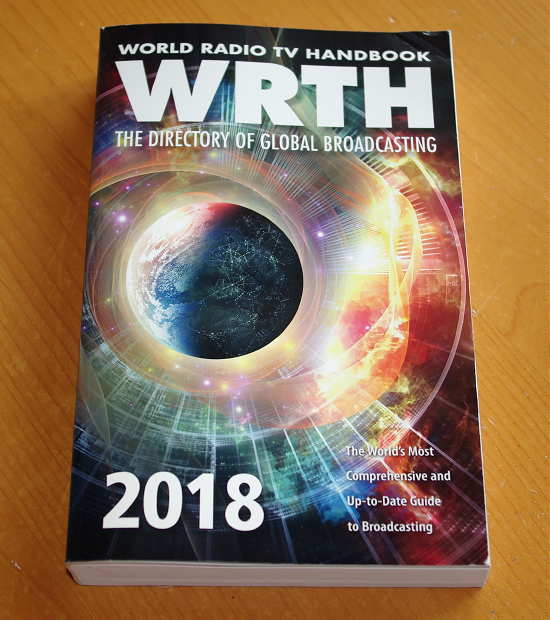 As always, the first section of the book is devoted to technical articles or equipment reviews with the remainder being a quick-find reference guide of maps, frequency lists, broadcast schedules and mailing / e-mail contact info for those that like to gather QSLs. At 672 pages, the WRTH is a valuable tool in your listening arsenal and well worth the cost.
I often read comments on various reflectors of just how few international shortwave stations there are and that tuning through the bands often reveals little to be heard. There is no question that the number of SW stations on the air today is much less than it was a few decades ago, but there are still a huge number of stations to target throughout the various SW bands and a lot of DX challenges yet to be found on the international bands.
For example, one such challenge comes to mind for west coast DXers ... and that is India. Signals on any band, from India to western Canada, have always been difficult. All India Radio (AIR) has 22 shortwave transmitters, operating from a half-dozen different sites ... hearing all sites from here on the various bands would keep one pretty busy for some time. To make it even more interesting, AIR still responds to listener reception reports with a QSL ... and who doesn't like a real 'paper' QSL!
Here is a quick tune through the 31m SW band this morning, at around 10:20 a.m. local time, on my FT-1000mp Mark V and 40m half-sloper. Although approaching the lowest part of a very poor solar cycle (Cycle 24, the weakest in the past 100 years), witness the activity on a day of very poor HF propagation ... there are still a good number of signals to seek out.
With the present low solar flux, it's usually the lower SW bands that really come to life, with the bands bursting with signals from shortly before sunset into the dawn.
In addition to the WRTH, there are several great reference sites on the internet as well as some wonderfully helpful blogs devoted to SW radio listening.
Here are the sites I find myself returning to quite often:
Yahoo Group's Primetimeshortwave
Worldwide DX Club News
Eibi Shortwave Time / Frequency Schedules
Shortwave Info
Hard-Core-DX Daily News
Blogs:
Mount Eveyln DX Report
The SWLing Post
Bulgarian DX Blog
South East Asia DXing
There are probably more but these ones are good. In addition, there are a lot of great Facebook sites that deal with SW radio and much interesting discussion is available there via a quick search.
Now it's back to the repair bench to hopefully finish everything off for some time, but maybe you can find a few spare hours to have a closer listen to the international SW bands and see what you can dig up.
SHORTWAVE BROADCAST BANDS
2300 - 2495 120m
3200 - 3400 90m
3900 - 4000 75m
4750 - 5060 60m
5850 - 6200 49m
7100 - 7350 41m
9400 - 9900 31m
11600 - 12050 25m
13570 - 13800 22m
15100 - 15800 19m
17480 - 17900 16m
18900 - 19020 15m
21450 - 21850 13m
25600 - 26100 11m
Rest in Peace, David Collingham, K3LP, SK

RIP David Collingham, SK – K3LP is now SK.
My condolences to the family and friends, and to our radio community, for the tragic loss of David Collingham, K3LP.
I am sad and sorry for his loved ones and friends who now grieve this loss.
May his memory echo through the ether like radio waves, reaching the receivers of our hearts.
Passing along a note from Paul, N6PSE:
Dear Friends of David Collingham-K3LP:
I have learned additional information concerning his death.
Last night, during a heavy winter storm, David let his dog outside. David later took his truck to search his 25-acre property when his dog did not return. David found that his dog had fallen into an icy pond that adjoins his property with another property.
David made the heroic decision to go into the pond to try and save his dog.
After some time had passed, David’s wife Rebecca went looking for him. She found his truck at the pond and called 911. Fire personal recovered David’s body as well as his dog. Efforts to resuscitate him were unsuccessful.
David lived his life bold, courageous and heroically and he died trying to save his beloved dog. He will always be a hero in our hearts.
RIP David R. Collingham, age 59.
Demonstration: Using FLDigi to Communicate with Olivia Digital Mode on Shortwave
Are you interested in starting out with the amateur-radio digital modes on the high frequencies? Have you heard of FLDigi? FLDigi is a software control and modem suite that interfaces with your transceiver, your computer sound card, and other input/output interfaces so that you can receive and transmit one of many digital modes. For example, FLDigi allows you to operate using the Olivia digital mode.
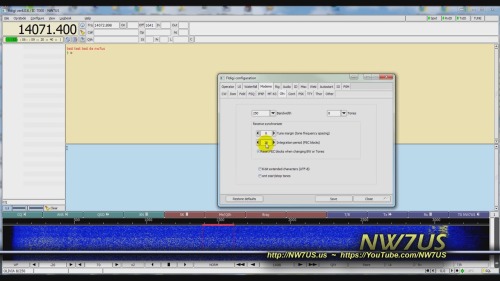
Demonstration: Using FLDigi to Communicate with Olivia Digital Mode on Shortwave
Unlike the JT/FT digital modes–modes that do an incredible job under marginal propagation conditions–there are other modes that offer keyboard-to-keyboard conversational QSO opportunities that can overcome rough shortwave radio propagation conditions. (The meaning of QSO on Wikipedia: An amateur radio contact, more commonly referred to as simply a “contact”, is an exchange of information between two amateur radio stations.)
While making quick work of getting DX stations into your logbook by exchanging callsigns, a signal report, and a grid square, the JT/FT modes (JT stands for Joe Taylor, the fellow that pioneered these modes) are limited. They cannot handle any additional communications beyond a callsign, a signal report, a grid square, and a very limited set of acknowledgments and sign-off messages.
When you desire to get to know people from other areas of the world, or if you need to establish networks around the world for passing information–perhaps an emergency net in support of the Red Cross–or if you are motivated by any other of a myriad reasons to establish a keyboard-to-keyboard conversation by way of the ionosphere, modes like Olivia are great candidates for your consideration.
In this video, contributing editor with CQ Amateur Radio Magazine, NW7US shares some starting points in the FLDigi software for Olivia keyboard-to-keyboard chat mode.
[embedyt] https://www.youtube.com/watch?v=ejSNfXiT8FE[/embedyt]
Current CENTER Frequencies With 8/250 in MHz:
1.8269, 3.5729, 7.0729, 10.1429, 14.0729, 18.1029, 21.0729, 24.9229, 28.1229, and so on. See the pattern?
By the way: The current suggested CENTER frequency With 16/1000 or 32/1000 on 20 meters is 14.1059.
(Why the …9 frequencies? Experts say that ending in a non-zero, odd number is easier to remember!)
Q: What’s a ‘CENTER’ Frequency? Is That Where I Set My Radio’s Dial?
For those new to waterfalls: the CENTER frequency is the CENTER of the cursor shown by common software. The cursor is what you use to set the transceiver’s frequency on the waterfall. If your software’s waterfall shows the frequency, then you simply place the cursor so that its center is right on the center frequency listed, above. If your software is set to show OFFSET, then you might, for example, set your radio’s dial frequency to 14.0714, and place the center of your waterfall cursor to 1500 (1500 Hz). That would translate to the 14.0729 CENTER frequency.
The FLDigi Manual of Operation is found here: http://www.w1hkj.com/FldigiHelp/
FLDigi can be downloaded here: https://sourceforge.net/projects/fldigi/
Join the Olivia movement:
1. Subscribe to the mailing list: https://Groups.io/g/Olivia
2. Join the Facebook group: https://www.facebook.com/groups/olivia.hf
For additional information on Olivia, check out:
http://blog.nw7us.us/post/168515010062/olivia-digital-mode-great-compromise
http://blog.nw7us.us/post/169114702522/are-you-an-amateur-ham-radio-operator-check-out
73 de NW7US
Update: More on Olivia, the Great Compromise Mode
Some HF digital modes were designed for long-distance (DX) radio-wave propagation via the ionosphere. One such keyboard-to-keyboard digital mode is Olivia.
Friday evening, 8 December 2017, at 0200 UTC {9-DEC}, Larry, N7ZDR, called an Olivia-mode 80-Meter digital roundtable net. The following video is a snapshot of about nine minutes of on-air net operations as received at my location in Omaha, Nebraska. My antenna is a wire run from an SEA marine autotuner mounted under the three-story-high roof’s eaves. I live in a high-RF environment within two miles of eight high-powered broadcast antenna facilities–TV, FM, AM–as well as business and public-service transmitters. All that RF desensitizes my receiver. The noise floor is also affected by industrial-level man-made RF noise.
No, Olivia is not lightening-fast keyboard-to-keyboard chatting, but it can get the job done. This following video shows some real-world operation in which the very weakest signals did not decode well. However, even with the 80-Meter band (center frequency is 3585 kHz) really difficult to work with, it did well in terms of what was available for the Ham Radio Deluxe DM780 software to decode.
Example QSO in Olivia Video:
[embedyt]https://www.youtube.com/watch?v=G7TlGEuStx4[/embedyt]
In 2005, SP9VRC, Pawel Jalocha, released to the world a mode that he developed starting in 2003 to overcome difficult radio signal propagation conditions on the shortwave (high-frequency, or HF) bands. By difficult, we are talking significant phase distortions and low signal-to-noise ratios (SNR) plus multipath propagation effects. The Olivia-modulated radio signals are decoded even when it is ten to fourteen dB below the noise floor. That means that Olivia is decoded when the amplitude of the noise is slightly over three times that of the digital signal!
Olivia decodes well under other conditions that are a complex mix of atmospheric noise, signal fading (QSB), interference (QRM), polar flutter caused by a radio signal traversing a polar path. Olivia is even capable when the signal is affected by auroral conditions (including the Sporadic-E Auroral Mode, where signals are refracted off of the highly-energized E-region in which the Aurora is active).
Currently, the only other digital modes that match or exceed Olivia in their sensitivity are some of the modes designed by Joe Taylor as implemented in the WSJT programs, including FT8, JT65A, and JT65-HF–each of which are certainly limited in usage and definitely not able to provide true conversation capabilities. Olivia is useful for emergency communications, unlike JT65A or the newly popular FT8. One other mode is better than Olivia for keyboard-to-keyboard comms under difficult conditions: MT63. Yet, Olivia is a good compromise that delivers a lot.
Join us — not just on the HF waterfall, but by joining our email-based group at:
or, on Facebook at:
–> https://www.facebook.com/groups/olivia.hf
Thanks for spreading the Olivia love! See you on the waterfall.
Addendum:
Current CENTER Frequencies With 8/250 (eight tones, 250-Hz bandwidth):
1.8269 MHz
3.5729 MHz
7.0729 MHz
10.1429 MHz
14.0729 MHz
18.1029 MHz
21.0729 MHz
24.9229 MHz
28.1229 MHz
See the pattern?
The current suggested CENTER frequency with 16/1000 or 32/1000 on 20 meters is 14.1059.
(Why the xxx…9 frequencies? Experts say that ending in a non-zero odd number is easier to remember!)
Q: What’s a ‘CENTER’ Frequency? Is That Where I Set My Radio’s Dial?
For those new to waterfalls: the CENTER frequency is the CENTER of the cursor shown by common software. The cursor is what you use to set the transceiver’s frequency on the waterfall. If your software’s waterfall shows the frequency, then you simply place the cursor so that its center is right on the center frequency listed, above. If your software is set to show OFFSET, then you might, for example, set your radio’s dial frequency to 14.0714, and place the center of your waterfall cursor to 1500 (1500 Hz). That would translate to the 14.0729 CENTER frequency.
The standard Olivia formats (shown as the number of tones/bandwidth in Hz) are 8/250, 8/500, 16/500, 8/1000, 16/1000, and 32/1000. Some even use 16/2000 for series emergency communication. The most commonly-used formats are 16/500, 8/500, and 8/250. However, the 32/1000 and 16/1000 configurations are popular in some areas of the world (Europe) and on certain bands.
These different choices in bandwidth and tone settings can cause some confusion and problems–so many formats and so many other digital modes can make it difficult to figure out which mode you are seeing and hearing. After getting used to the sound and look of Olivia in the waterfall, though, it becomes easier to identify the format when you encounter it. To aid in your detection of what mode is being used, there is a feature of many digital-mode software implementation suites: the RSID. The next video, below, is a demonstration on how to set the Reed-Solomon Identification (RSID) feature in Ham Radio Deluxe’s Digital Master 780 module (HRD DM780).
I encourage ALL operators, using any digital mode such as Olivia, to TURN ON the RSID feature as shown in this example. In Fldigi, the RSID is the TXID and RXID; make sure to Check (turn on) each, the TXID and RXID.
Please, make sure you are using the RSID (Reed Solomon Identification – RSID or TXID, RXID) option in your software. RSID transmits a short burst at the start of your transmission which identifies the mode you are using. When it does that, those amateur radio operators also using RSID while listening will be alerted by their software that you are transmitting in the specific mode (Olivia, hopefully), the settings (like 8/250), and where on the waterfall your transmission is located. This might be a popup window and/or text on the receive text panel. When the operator clicks on that, the software moves the waterfall cursor right on top of the signal and changes the mode in the software. This will help you make more contacts!
RSID Setting:
[embedyt]https://www.youtube.com/watch?v=lBIacwD9nNM[/embedyt]
+ NOTE 1: The MixW software doesn’t have RSID features. Request it!
+ NOTE 2: A problem exists in the current paid version of HRD’s DM780: the DM780 RSID popup box that lists the frequency, mode, and configuration with a link to click, does not work. HRD support is aware of the problem. You can still use the textual version that shows up in the DECODED TEXT window, a feature of RSID that you can select in the HRD DM780 program settings. This setting ensures that the detected RSID details appear in the receive text area. If you click the RSID link that comes across the text area, DM780 will tune to the reported signal, and change to the correct settings.
Voluntary Olivia Channelization
Since Olivia signals can be decoded even when received signals are extremely weak, (signal to noise ratio of -14db), signals strong enough to be decoded are sometimes below the noise floor and therefore impossible to search for manually. As a result, amateur radio operators have voluntarily decided upon channelization for this mode. This channelization allows even imperceptibly weak signals to be properly tuned for reception and decoding. By common convention amateur stations initiate contacts utilizing 8/250, 16/500, or 32/1000 configuration of the Olivia mode. After negotiating the initial exchange, sometimes one of the operators will suggest switching to other configurations to continue the conversation at more reliable settings, or faster when conditions allow. The following table lists the common center frequencies used in the amateur radio bands.
Olivia (CENTER) Frequencies (kHz) for Calling, Initiating QSOs
It is often best to get on standard calling frequencies with this mode because you can miss a lot of weak signals if you don’t. However, with Olivia activity on the rise AND all the other modes vying for space, a good deal of the time you can operate wherever you can find a clear spot–as close as you can to a standard calling frequency.
Note: some websites publish frequencies in this band, that are right on top of weak-signal JT65, JT9, and FT8 segments. DO NOT QRM weak-signal QSOs!
We (active Olivia community members) suggest 8/250 as the starting settings when calling CQ on the USB frequencies designated as ‘Calling Frequencies.’ A Calling Frequency is a center frequency on which you initially call, ‘CQ CQ CQ. . .’ and then, with the agreement of the answering operator, move to a new nearby frequency, changing the number of tones and bandwidth at your discretion. Even though 8/250 is slow, the CQ call is short. But, it is narrow, to allow room for other QSOs nearby. It is also one of the best possible Olivia configurations for weak-signal decoding.
– End of Addendum –
73
Come Join the Fun With Olivia on HF (Shortwave Digital Mode Olivia)
For those of you who have dived into the crowded but fun pool of FT8 operation or one of the other Joe Taylor modes (such as JT65 or JT9) and are excited now about digital modes, here’s something you might enjoy, too. Unlike those modes that allow you to make quick work of getting DX stations into your logbook, simply by exchanging callsigns, a signal report, and a grid square, there are other modes that offer keyboard-to-keyboard conversational QSO opportunities.
One such mode is known as Olivia and this mode offers keyboard-to-keyboard chatting for when you want to relax, and maybe make a friend. Ham radio is the oldest electronic social networking infrastructure.
In 2005, SP9VRC, Pawel Jalocha, released to the world a mode that he developed starting in 2003 to overcome difficult radio signal propagation conditions on the shortwave (high-frequency, or HF) bands. By difficult, we are talking significant phase distortions and low signal-to-noise ratios (SNR) plus multipath propagation effects. The Olivia-modulated radio signals are decoded even when it is ten to fourteen dB below the noise floor. That means that Olivia is decoded when the amplitude of the noise is slightly over three times that of the digital signal!
Olivia decodes well under other conditions that are a complex mix of atmospheric noise, signal fading (QSB), interference (QRM), polar flutter caused by a radio signal traversing a polar path. Olivia is even capable when the signal is affected by auroral conditions (including the Sporadic-E Auroral Mode, where signals are refracted off of the highly-energized E-region in which the Aurora is active).
Currently, the only other digital modes that match or exceed Olivia in their sensitivity are some of the modes designed by Joe Taylor as implemented in the WSJT programs, including FT8, JT65A, and JT65-HF–each of which are certainly limited in usage and definitely not able to provide true conversation capabilities. Olivia is useful for emergency communications, unlike JT65A or the newly popular FT8.
Here is a demonstration of a two-way transmission using the Olivia digital mode on shortwave. I am in QSO (conversation) with KA5TPJ. There are two other Olivia QSOs just below our frequency. Just above us is a lot of FT8 activity. Below the two other Olivia QSOs are PSK31 QSOs. The band is active. Olivia is not dead!
The standard Olivia formats (shown as the number of tones/bandwidth in Hz) are 8/250, 8/500, 16/500, 8/1000, 16/1000, and 32/1000. Some even use 16/2000 for series emergency communication. The most commonly-used formats are 16/500, 8/500, and 8/250. However, the 32/1000 and 16/1000 are popular in some areas of the world and on certain bands.
This can cause some confusion and problems with so many formats and so many other digital modes. After getting used to the sound and look of Olivia in the waterfall, though, it becomes easier to identify the format when you encounter it. To aid in your detection of what mode is being used, there is a feature of many digital-mode software implementation suites: the RSID. The video, below, is a demonstration on how to set the Reed-Solomon Identification (RSID) feature in Ham Radio Deluxe’s Digital Master 780 module (HRD DM780).
I encourage ALL operators in any digital mode such as Olivia, set the RSID feature on as shown in this example. In Fldigi, the RSID is the TXID and RXID (I believe).
Please make sure you are using the RSID (Reed Solomon Identification – RSID or TXID, RXID) option in your software. RSID transmits a short burst at the start of your transmission which identifies the mode you are using. When it does that, those amateur radio operators also using RSID while listening will be alerted by their software that you are transmitting in the specific mode (Olivia, hopefully), the settings (like 8/250), and where on the waterfall your transmission is located. This might be a popup window and/or text on the receive text panel. When the operator clicks on that, the software moves the waterfall cursor right on top of the signal and changes the mode in the software. This will help you make more contacts!
+ NOTE 1: MixW doesn’t have RSID features. Request it!
+ NOTE 2: A problem exists in the current paid version of HRD’s DM780: the DM780 RSID popup box to click does not work. HRD support is aware of the problem. You can still use the textual version that you can select in the settings so that it appears in the receive text areas. If you click the RSID link that comes across the text area, DM780 will tune to the reported signal, and change to the correct settings.
+ NOTE 3: some websites publish frequencies that are right on top of weak-signal FT8, JT65 and JT9 segments. Even if that is a matter of contention, follow the regulations and be kind: DO NOT QRM weak-signal QSOs! AGAIN: make sure that your signal does not cross into other sub-bands where weak-signal modes are active. For instance, do not have any part of your signal at x.074 or higher, as this is the sub-band for FT8, JT65A, and JT9.
Quick Reference: we in the active Olivia group suggest 8/250 as the starting settings when calling CQ on the USB dial frequency of 14.072 MHz with an offset of 700 Hz, on 20m–that translates to a CENTER frequency of 14.0729 MHz. On 40m, 7.072 MHz on the dial with an offset of 700 Hz (and again 8/250) which translates to a center frequency of 7.0729 MHz.

An example of the calling frequency on 20 meters with a center frequency of 14.0729 MHz, 8 tones, and a bandwidth of 250 Hz.
Also, do not quickly switch to other modes without calling CQ for at least a five-minute window. It is really horrid when people call CQ and change settings, modes, bandwidths, tones, every time they call CQ during the same session!
There are several key resources that we in the Olivia community are developing, to make it easier for you to enter into the great world of Olivia. One is an active support e-mail group to which you can subscribe at https://groups.io/g/Olivia — a group containing topical areas of interest which can be filtered so that you are not flooded by email containing topics of which you are not interested. It has a files section, as well, in which we will add helpful how-to instructions and so on.
Another resource is our Facebook group, at https://www.Facebook.com/groups/olivia.hf — also with a files area containing help files. This group is a great resource for getting help from like-minded Olivia digital mode enthusiasts.
Some more eavesdropping on an Olivia QSO:
And, two more:
One last note: Olivia is NOT a weak-signal mode. There are no points won by barely making a contact. In the USA FCC regulations, you are directed to use only the power necessary to make the QSO. Typically, with poor propagation, using Olivia with an output power of 100w is the minimum to establish a reliable circuit. You just cannot go beyond your rig’s duty cycle (don’t burn out the finals in your radio!). You also must be sure that you do not overdrive the audio chain into your radio. Be sure that you do not have RF coming back into your audio chain. Yes, 100 watts is acceptable. Don’t let anyone convince you otherwise. After all, think about RTTY.
Welcome to Olivia! See you on the waterfall.
73 de NW7US
A 630m Maritime Adventure
 |
| HAKUNA MATATA |
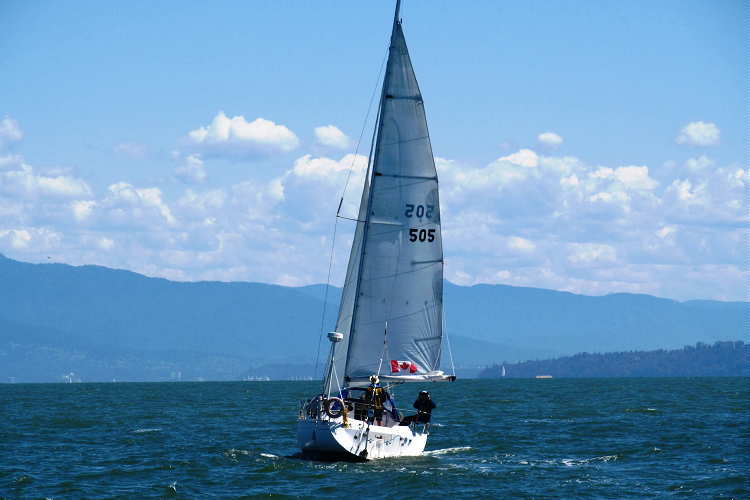
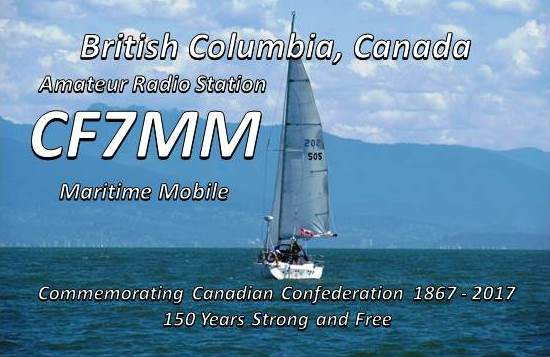
Crewed by Mark (VA7MM) and YL May (VE7MAY), Toby (VE7CNF) and XYL Nancy, the 31' Benateu recently completed a 14-day circumnavigation of Georgia Strait's Gulf Islands. This is a yearly adventure that has been successfully completed for the past few summers and looks as though it may now be an annual tradition.
Normally, the crew kept up regular radio contact on HF as well as on VHF when possible but this year saw a major departure.
In previous summers, near the end of the voyage, the crew has always visited us here on Mayne Island for an afternoon of vittles and libation before heading for home. There is always a good amount of time spent recalling the past-year's radio activities, winter projects and reminiscence of the 'good old days'. Last year, just as the party was ending, I jokingly suggested that 'next year', it would be cool to work them from the boat on 630m.
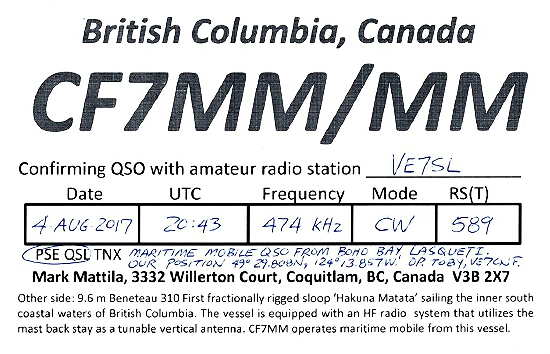
Although there was no immediate commitment, I knew that the seed had been planted, and with three of the four crew being engineers, I suspected it might be hard for them to resist, and ... just before departure, the local bunch of 630m ops were put on alert to be watching for CF7MM/mm on 475 kHz CW as they would be attempting to work us from three different overnight anchorages during their summer voyage!
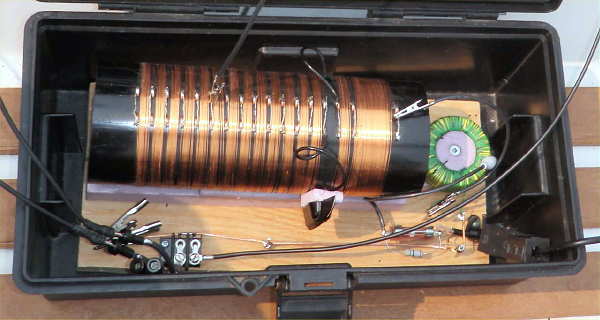
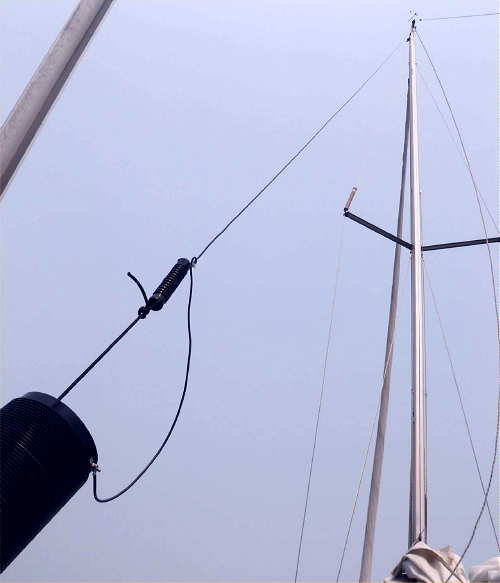
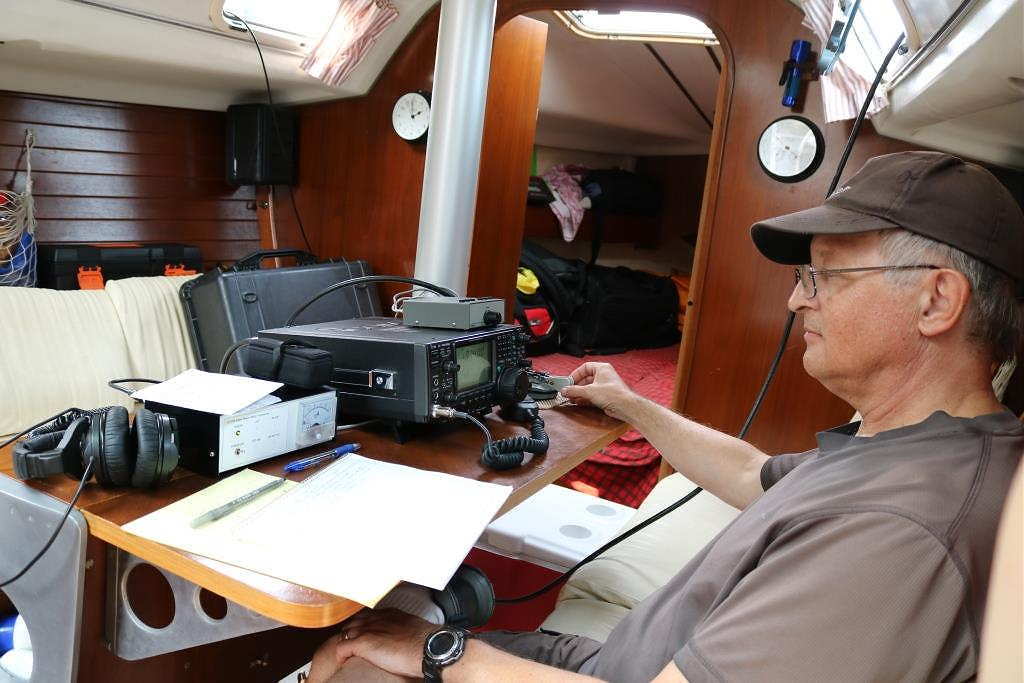
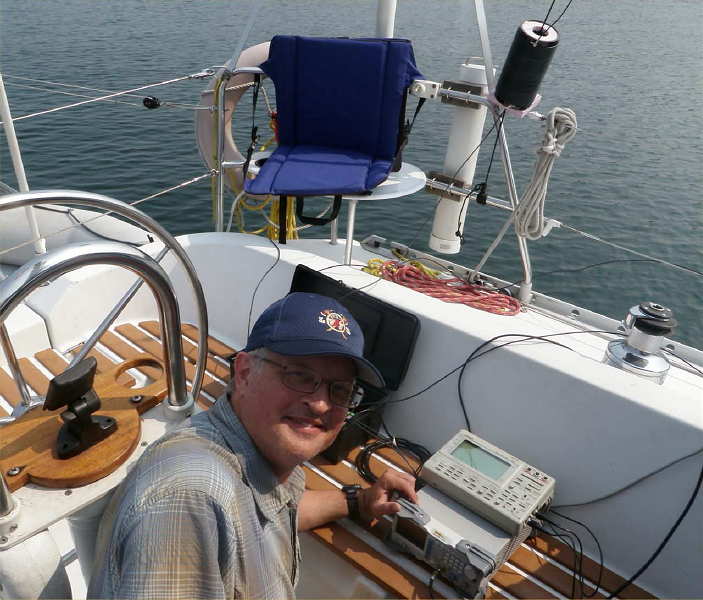
Evidently Toby had been working quietly during the winter to make this become a reality. Here are some pictures of the system along with Toby's (the system's builder) comments.
 |
| Variometer and matching transformer |
 |
| Wire vertical and loading coil |
 |
| Toby (VE7CNF) working the pileups! |
 |
| Tuneup |
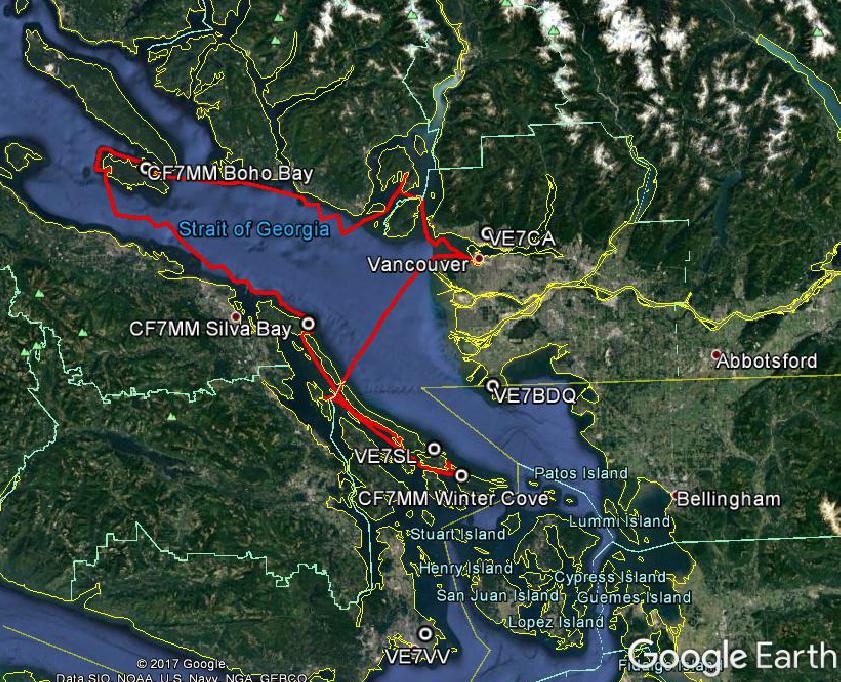 |
| The route, heading north from Vancouver |
Some of the contacts are shown below. Note the transceiver is not really on 160m ... it's just the i.f. for my 630m transverter!
I was impressed with the strength of ground wave signals given the low transmitter powers and EIRP's well below 5W. Received signals ranged from S1 to S9+10dB and copy was easy for all QSOs. QSO distances ranged from 10 to 142 km. We had low receive noise levels in all locations, with Silva Bay being a little noisier than the others due to many nearby boats and some shore power lines.
We tried disconnecting the gunnel ground wires and leaving only the keel, and found that the antenna capacitance and resistance did not change. When we disconnected the keel and left only the gunnel wires, the antenna capacitance dropped to about 87pF and antenna resistance dropped by a few ohms. It appears that the keel provided most of our ground coupling to sea water and it would have been a sufficient ground on its own.
More details of Toby's 630m transverter as well as a practical 630m antenna tune-up procedure can be found on his website here.
All-in-all, I think the 630m operation was a great success and very likely the first-ever 630m marine mobile operation on that band, as I don't recall this happening anywhere else over the years. It was also a great way to pay homage to the band's original maritime heritage where its quality groundwave and skywave capabilities were used to advantage for so many decades safeguarding mariners worldwide.
Maritime mobile operation on the amateur bands has some great history behind it, including the yacht YASME. In the mid-50's, Danny Weil was the first ever amateur to undertake DX'pedition style operations via sailboat, as he visited numerous rare islands in the Caribbean and South Pacific.
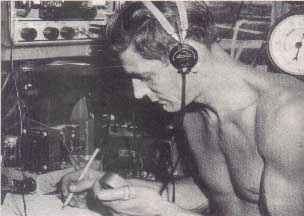 |
| Danny on the YASME - courtesy: www.gm3itn.co.uk |
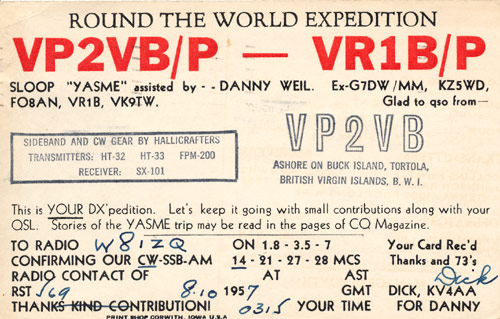 |
| Original YASME QSL - courtesy: http://hamgallery.com/ |
His exploits were regularly published in CQ magazine at the time and always made for exciting reading as Danny would eventually wreck three YASMES over the years! His adventures laid the groundwork for future island-hopping DX operations such as those undertaken by Gus Browning (W4BPD), Don Miller (W9WNV) and all that followed ... I'm sure they would all have enjoyed working the HAKUNA MATATA as well!













