Archive for the ‘antennas’ Category
 A New ‘VE’ on 630m!
 January 11th, 2015 |
  Author:
  Interest in Canada's newest ham band, 630m, continues to slowly grow. Toby (VE7CNF) in Burnaby, BC, has made his first and second CW contacts on the new band!
 Both myself and John (VE7BDQ) had the pleasure of working Toby on 473.000 CW on Thursday afternoon. Here is Toby's description of his station at present:
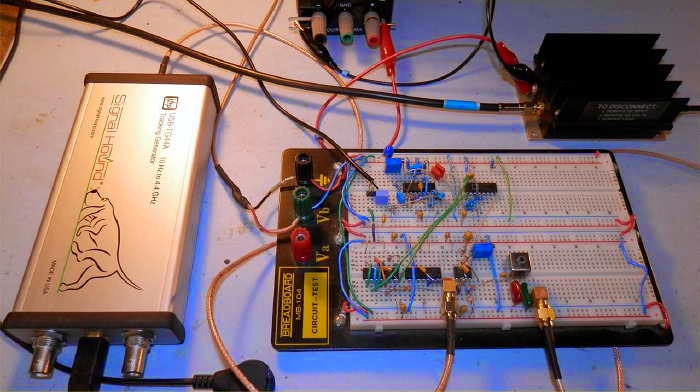
"I have put together a low-power 630m WSPR transmitter here. I have a USB-TG44A signal generator clocking a phasing-type SSB modulator with WSPR audio coming from a laptop. The modulator gives 45db suppression of the carrier and lower sideband. This drives a ZHL-32A 1-watt linear amplifier. I have a matching transformer and loading coil at the base of my 80-meter inverted-L antenna. Wire height is 10m.
John VE7BDQ has weakly received my WSPR signal. Are you able to receive WSPR?
The antenna series resistance is much higher than I expected, probably due to 10 year old antenna wire and only 4 ground radials. Right now the antenna match is poor and efficiency is very low. I may rewind the matching transformer tomorrow and gain a few dB. Maybe soon I’ll have enough signal to complete a 2-way CW QSO with you.
I have attached pictures of the hardware. After I determine the proper configuration I’ll make a more efficient loading coil."
 |
| Courtesy: VE7CNF |
 |
| Courtesy: VE7CNF |
Being grateful
A conversation has started on the QFOX reflector amongst the Hounds and Foxes. We're sharing with each other what our antenna situations are.
Myself, I am using a Butternut HF9V which is ground mounted and had about 55+ radials running from underneath it. I also have an 88' EDZ which is up in the trees somewhere between 25-30 feet (8-9 Meters) up. My W3EDP is still up there, but I need to change the coax. Still haven't done that, but will, someday.
If you look at the standings in the Fox hunts, come the end of the seasons, you will find W2LJ firmly ensconced in the middle or just below the middle of the pack. I suppose if I had more wire up, higher - that could possibly change. But what I have is what I have, and for that, I am grateful.
There are a lot of Hams out there who would consider what I have to be the "best antenna farm - ever". These guys live in places where their antenna possibilities are either severely limited, or perhaps not allowed at all. Some may even be restricted to operating portable 100% of the time, from their cars or local parks, perhaps.
So I am always mindful to be appreciative of what I do have - particularly when I find myself falling into that "wish I had more" rut. It may not be as good as what a lot of others have, but it's also a lot more than what a lot of others are forced to live with.
72 de Larry W2LJ
QRP - When you care to send the very least!
BTW - To all my Orthodox friends out there - Merry Christmas!
Myself, I am using a Butternut HF9V which is ground mounted and had about 55+ radials running from underneath it. I also have an 88' EDZ which is up in the trees somewhere between 25-30 feet (8-9 Meters) up. My W3EDP is still up there, but I need to change the coax. Still haven't done that, but will, someday.
If you look at the standings in the Fox hunts, come the end of the seasons, you will find W2LJ firmly ensconced in the middle or just below the middle of the pack. I suppose if I had more wire up, higher - that could possibly change. But what I have is what I have, and for that, I am grateful.
There are a lot of Hams out there who would consider what I have to be the "best antenna farm - ever". These guys live in places where their antenna possibilities are either severely limited, or perhaps not allowed at all. Some may even be restricted to operating portable 100% of the time, from their cars or local parks, perhaps.
So I am always mindful to be appreciative of what I do have - particularly when I find myself falling into that "wish I had more" rut. It may not be as good as what a lot of others have, but it's also a lot more than what a lot of others are forced to live with.
72 de Larry W2LJ
QRP - When you care to send the very least!
BTW - To all my Orthodox friends out there - Merry Christmas!
New Year’s Eve Magic
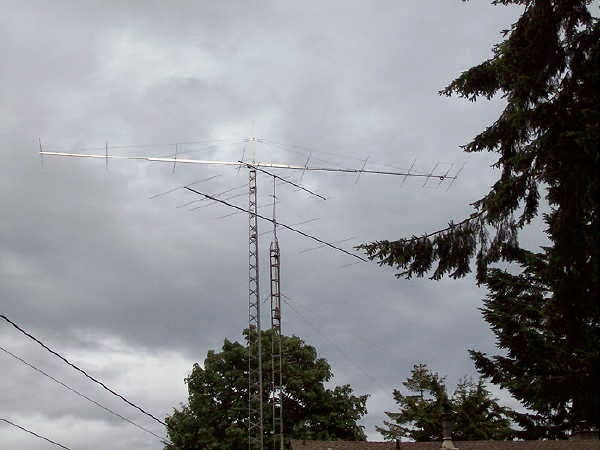 |
| 9el LFA at VE7DAY |
During the last solar rotation, flux values rose to near-Cycle highs and quickly plummeted, along with any hope of finding that six-meter Holy Grail...long-haul F2 propagation. Many six meter ops quickly found other things to do.
One person that didn't stop watching, and never does, was John - VE7DAY, in Campbell River, B.C., on Vancouver Island. John is VE7's iron man of 6m and spends almost 100% of his radio time seeking the magic.
For the past few winters, John has pointed his beam towards the south Pacific at around sunset, and called CQ from the VE7 black hole....on Tuesday evening he was justly rewarded.
At 00:50 UTC on the 31st, John's CQ was answered by Roger, ZL3RC in Christchurch, on New Zealand's South Island...12,021km from Campbell River.
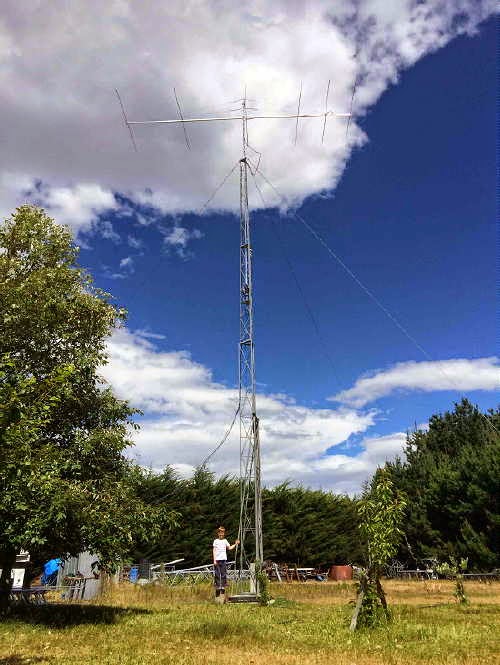 |
| 6el Yagi at ZL3RC |
One minute later, John worked Chris, ZL2DX, in Martinborough, on the North Island.
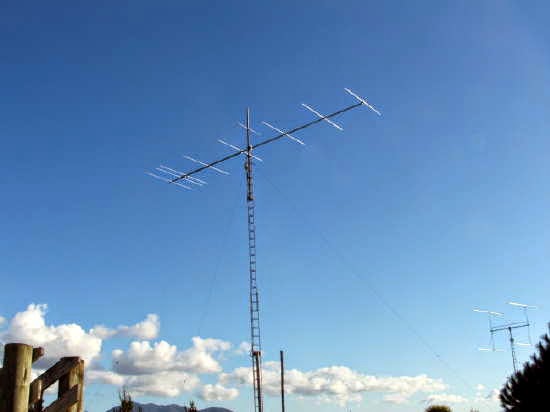 |
| 8el Yagi at ZL2DX |
At 0111 UTC, John completed the hat-trick by working Paul, ZL4PW, in Oamaru, back on the South Island.
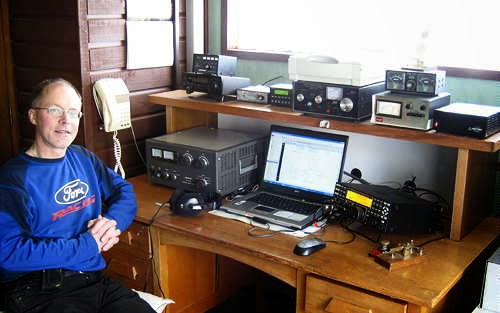 |
| Paul, ZL4PW / 7el at 7m |
"Decades ago, many DXers believed that Argentina was the world DX hot spot. DXers and contesters seemed to do the best down there. When I was in Brazil, one of the places I lived in was the state of Mato Grosso do Sul, PT9-land. It was only about an hour-and-a-half's drive to the Paraguay border, so conditions there were pretty near like those in Argentina, which was also nearby. I ran 100 watts to a vertical wire taped to a bamboo rod... and thought my QTH must have been included in the hot spot area.
I think now we are becoming aware of another hot spot, this one being in North America on Vancouver Island. I'm speaking, of course, of the your QTH, John! You seem to be doing quite well from that location. Keep it up!!
I see you worked clear down to ZL4. I'm envious. I've been looking for a ZL4 contact for a long time. Today when the band was open to ZL, I was on the road returning from Tacoma. Well, I'm glad you were able to work that great DX.
I will change the Distance Scoreboard to indicate the new records you established today. Congrats!
73, Paul K7CW"
With the present dismal solar flux and low solar activity, it is not likely that these contacts were via the F2 mode, but you wouldn't know it from the size of John's signal, recorded by ZL3RC. Being in the middle of our secondary sporadic-E season, north of the equator and at the peak of the major Es season down-under, I think a better candidate is an Es-link from both sides into the Trans Equatorial afternoon 'bubble'....certainly Es from both ends into whatever is happening in the ionospheric cauldron at the equator!
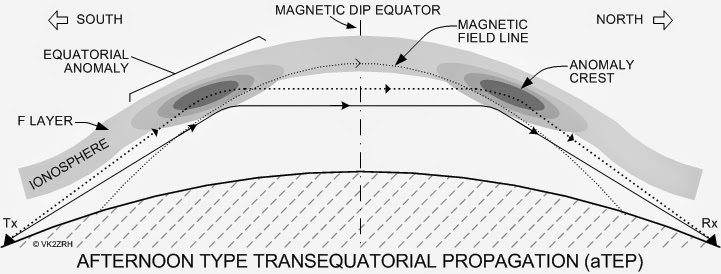
All four stations were running high power and big antennas, and with a little help from the seasonal E, it all seems to have come together nicely.

Congrats to all involved, and especially John, as all of the other 6m ops in this part of the country, including myself, were asleep at the switch it seems!
630m Resources – Part 3

Probably the most-often discussed ham radio topic is that of 'antennas' and with LFers it is no different.
When it comes to antennas used for receiving,
you might be surprised to learn that even small, simple antennas, can be very effective on 630m. Small loops are easy to build and work well as they are often quieter than wire antennas and with preampflication, will usually yield a better signal-to-noise ratio.
The shielded Burhan's loop described here, is a good performer on 630m and below, while a tuned wire loop can be just as effective if resonated to 630m.
Easily built active antennas are also popular and once situated in a quiet spot in your backyard, can work extremely well, considering their size and simplicity. The PAØRDT active antenna is popular worldwide and offers good performance, if properly placed, as shown in this LF bandscan from Japan.
Several of the stations that I recently worked on crossband, from 630m to HF, were using their normal HF dipoles to listen on 630m. Often times a non-resonant antenna, such as an 80m dipole, can give reasonably quiet performance and is worth trying should you just want to listen. Others have used HF dipoles with the feedline shorted and fed as a top-loaded vertical (T), and resonated to 630m against a small radial ground. Try what you presently have and you may be surprised at what you can hear.
Transmitting antennas need not be large to enjoy 630m propagation. For most backyards, an inverted 'L' antenna would probably be the easiest to configure.
If you have a tower, the vertical portion of the 'L' could be hung from a support arm off of the tower, with the horizontal portion as long and as high as possible. If you have some trees to hang wires from, a center-fed 'T' antenna would also be effective.
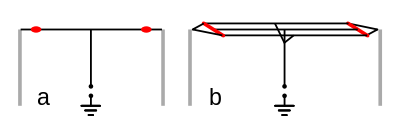 |
| Top-loaded 'T' Antennas. Courtesy: http://en.wikipedia.org/wiki/T-Antenna |
In both of these examples, try and get as much 'vertical' as possible and then work on the top-hat portion. Top-hats with multiple wires will also increase antenna efficiency. An interesting paper by VK2DX, explains the process that he used to build and match a simple inverted 'L'.
 | |
| Courtesy: VK2DX |
As well, JUMA publishes an informative application note on building an 'L' for 630m.
If you don't have room for one of these types of antennas, effective results can also be had with short top-loaded radiators as used at many NDB installations. Try to go as high as you can and make the top-hat as large as possible.
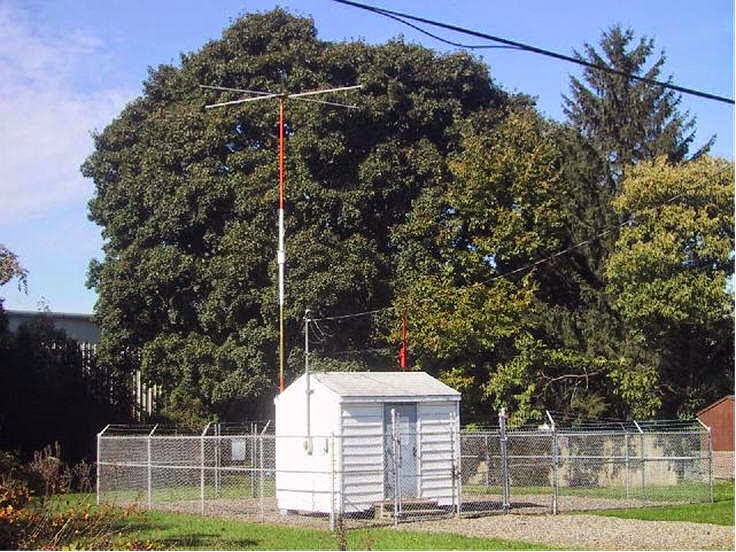
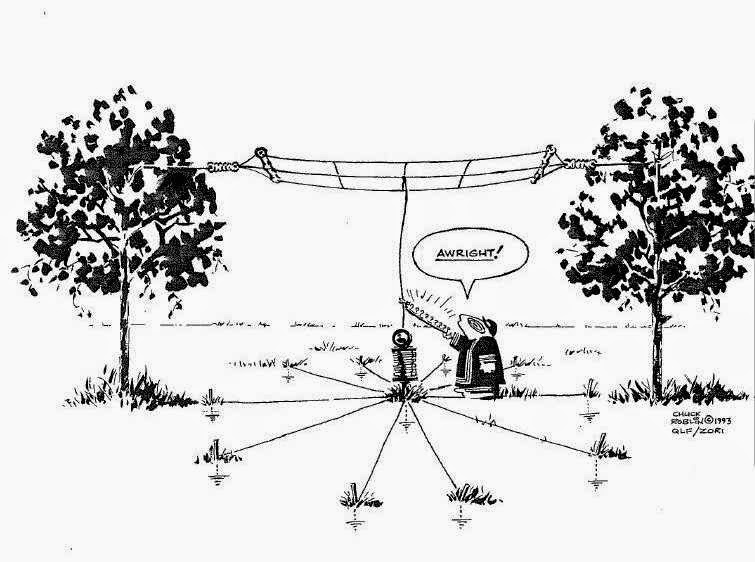
Any of the transmitting antennas described above will require sufficient series inductance (base loading usually) to bring them to resonance as well as some form of variometer to fine-tune exactly. As well, they all require some form of ground system to radiate.
Since most backyards will never be large enough for an efficient ground system on 160m, let alone on 630m, just do the best that you can. You might be surprised at the results achieved with just a simple system of a few buried radials but the more you can lay down, the better. Radials can be effectively hidden beneath the grass with a few days of effort. Some have noted an increase in antenna current when ground rods were driven in at the far end of the radials.
 |
| Courtesy: http://www.auroralchorus.com/ |
This well-written series of articles describing simple antenna systems for the 1750m band is chalk-full of neat ideas and practical information...all applicable to the 630m band.
For an even more in-depth look at practical LF and MF antennas, the ON7YD site is hard to beat...again, all applicable to 630m.
Canada's new 630m band is a wonderful opportunity to build and experiment with all aspects of your station and it's crying out for activity!
It's still not too late to be the first station on 630m from most parts of Canada and the VE7's are waiting to work you!
I’m dreaming of a white …….
Thanksgiving.
What?!?
Yes, Virginia, it looks like the east coast is going to receive a rare white Thanksgiving. Even though it approached 70F (21C) here yesterday, a change is in the offing. By 8:00 AM tomorrow morning, the busiest travel day of the entire year, a classic Nor'easter will be making its way up the coast, bringing much colder air and snow with it. By Buffalo, NY and Great Lakes region standards, we're talking a mere dusting of snow - maybe only 3-8 inches (7-20 cm), but enough to make traveling to Grandma's house a trickier proposition than normal. By the way, the last time it snowed in these parts for Thanksgiving was 1989 - some 25 years ago.
On a Ham Radio note, it appears my W3EDP antenna has gone the way of the DoDo Bird, that is - extinct. I plugged it into the KX3 the other day and I noticed that it is considerably deaf. Stations that I can hear plainly and loudly with the EDZ and the Butternut are but a mere whisper on the W3EDP.
I suspect I know where the trouble is. There are only three parts to this antenna - the actual wire, the balun, the coax. I'm placing my money on the coax. I suppose water could have gotten into the balun and could be wreaking havoc, but it is a commercial brand, popular make balun. I think it's way more likely that water probably got into the coax. I probably didn't weather-proof the connection as well as I thought I had.
Unfortunately, I don't have a piece of coax long enough to replace it right now. Guess I'll be ordering some over the long Holiday weekend. I don't suppose there are any coax stores holding day-after-Thanksgiving Black Friday sales, eh?
72 de Larry W2LJ
QRP - When you care to send the very least!
What?!?
Yes, Virginia, it looks like the east coast is going to receive a rare white Thanksgiving. Even though it approached 70F (21C) here yesterday, a change is in the offing. By 8:00 AM tomorrow morning, the busiest travel day of the entire year, a classic Nor'easter will be making its way up the coast, bringing much colder air and snow with it. By Buffalo, NY and Great Lakes region standards, we're talking a mere dusting of snow - maybe only 3-8 inches (7-20 cm), but enough to make traveling to Grandma's house a trickier proposition than normal. By the way, the last time it snowed in these parts for Thanksgiving was 1989 - some 25 years ago.
On a Ham Radio note, it appears my W3EDP antenna has gone the way of the DoDo Bird, that is - extinct. I plugged it into the KX3 the other day and I noticed that it is considerably deaf. Stations that I can hear plainly and loudly with the EDZ and the Butternut are but a mere whisper on the W3EDP.
I suspect I know where the trouble is. There are only three parts to this antenna - the actual wire, the balun, the coax. I'm placing my money on the coax. I suppose water could have gotten into the balun and could be wreaking havoc, but it is a commercial brand, popular make balun. I think it's way more likely that water probably got into the coax. I probably didn't weather-proof the connection as well as I thought I had.
Unfortunately, I don't have a piece of coax long enough to replace it right now. Guess I'll be ordering some over the long Holiday weekend. I don't suppose there are any coax stores holding day-after-Thanksgiving Black Friday sales, eh?
72 de Larry W2LJ
QRP - When you care to send the very least!
BK Building…
 |
| March 1926 QST. Courtesy: ARRL |
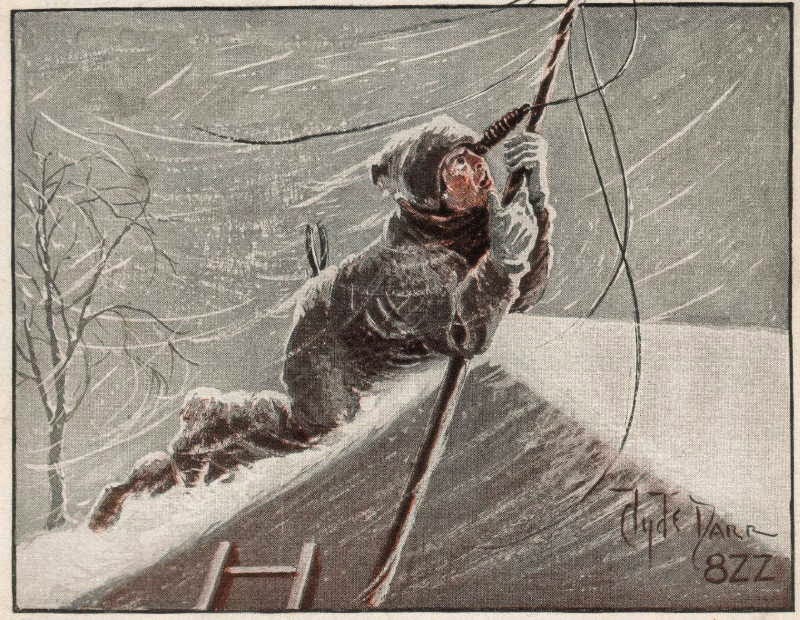
Every year as contest time approaches, I anxiously follow our local weather patterns in hope that the winds remain quiet for the event. For the past few years, the wind has been non-existent...right until zero-hour, when, almost as if a switch were thrown, the wind ramps up to gale-like conditions. Now if you've never heard a self-excited oscillator directly connected to a wind-blown antenna, then be sure to take a listen to this year's BK. These '29 rigs are often not very pretty-sounding, even into a dummy load, but couple them to the wind and things get very 'nostalgic-sounding' quickly. Frequency shifts in the order of several hundred Hertz between letters are not uncommon, making copying a weak signal difficult and almost impossible if listening with a narrow filter. The amplifier will effectively isolate the effects of a shifting antenna impedance from the oscillator stage, making life very much less stressful, come BK time.
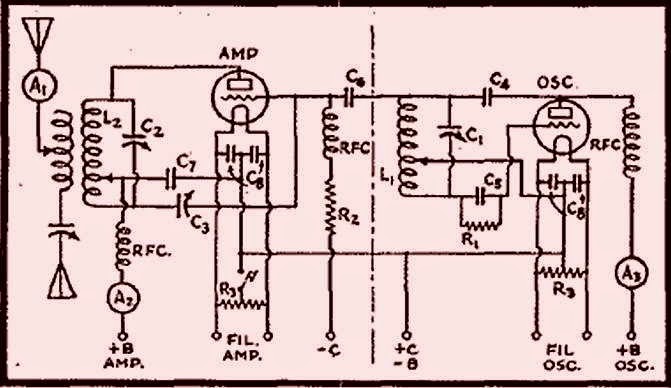
My plan is to follow the wisdom of the '29ers themselves, carefully explained in "More Power With Better Frequency Stability" by George Grammer and published in the February 1931 edition of QST. I'm always impressed at how quickly those folks back in the 20's figured out so many of the important "basics of radio" that have withstood the test of time. It must have been an exciting time to be a ham! A glance through any of the numerous radio magazines from the late 20's and early 30's reveals a vibrant market for the homebrewer, with every type of component available. Whether the average ham could afford to buy them in the hungry-thirties is another question.
I've chosen to use another type '10' power triode as my amplifier, as shown below.
 |
| Courtesy: ARRL |
I see the main challenges being coupling conveniently from the oscillator as well as neutralizing the triode amplifier...I wonder, will neutralizing it on 40m (for example) also make it stable on 80m?
As well, since the type '10' uses a directly-heated cathode, if I wish to let the oscillator run while I key the amplifier, a separate filament supply will be required for each tube. With this in mind, I've got the ball rolling this week with the construction of a dedicated '29 rig filament supply. The supply uses two center-tapped 5V transformers with their secondaries in series and brought out to the back panel. This will allow me to use tubes with 2.5V, 5V, 7.5V and 10V filaments...up to 3A.
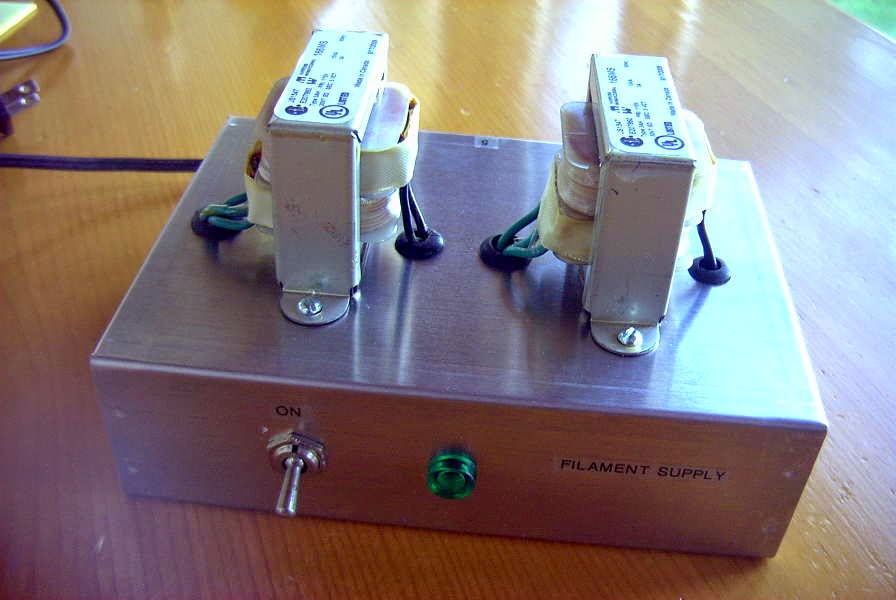 |
| New filament supply |
Are you building or planning anything for this year's BK Party?
Launching Antennas With Right Guard
 Dedicated LFer, K2ORS (Warren), posted a short video yesterday of his friend's attempted 'pre-antenna launch' test flight: "Attempted to use an 8 rotor U.A.V, to lift a string over the trees with
which an antenna wire could be pulled up. However, there were some
control issues..."
Dedicated LFer, K2ORS (Warren), posted a short video yesterday of his friend's attempted 'pre-antenna launch' test flight: "Attempted to use an 8 rotor U.A.V, to lift a string over the trees with
which an antenna wire could be pulled up. However, there were some
control issues..." I'm not sure exactly what went wrong but I hope that beautiful machine was not damaged too heavily.
I've seen a few others using inexpensive quadcopters to get light strings up and over trees and it seems that they would be ideal for such tasks. As these devices flood the hobby-market, their prices seem to be dropping quickly and more and more amateurs are looking at these with antennas in mind.
Over the years I have tried numerous methods of getting a string up and over...slingshots, fishing rods... but nothing seemed to get me past the 35'- 40' mark, if that high. Maybe it was just poor technique on my part as others claim to have good success with these methods. Eventually I decided to try a homebrew 'spud gun' as I needed to get wires up to the top of my 70' Balsam.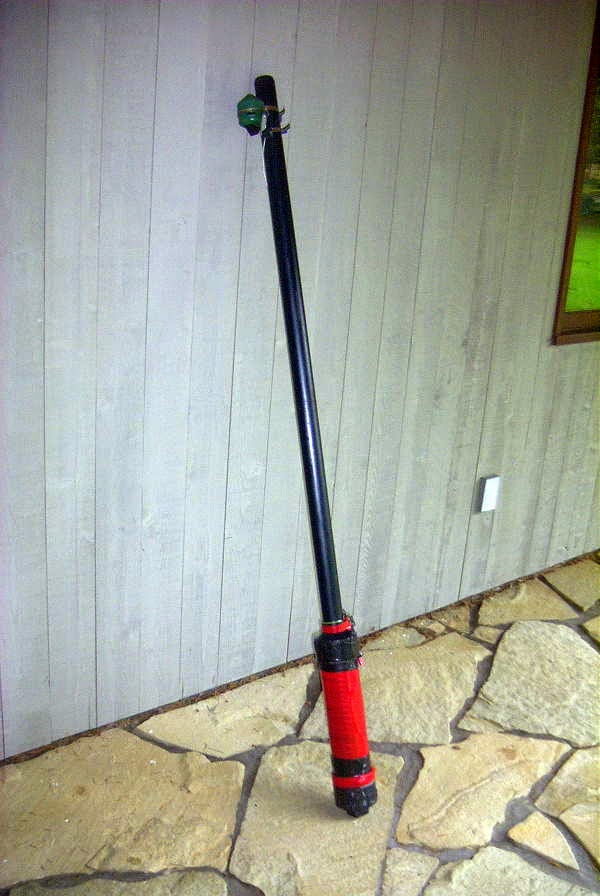
I used Schedule 40 ABS pipe, the thick-walled stuff. This is becoming harder to find in the typical hardware outlets as most of it seems to be the lighter foam-core material which should not be used for this.
When I first fired it, I wrapped the breech in several layers of towelling, just in case it blew apart but felt confident enough to remove it after a few test shots.
There are several websites describing spud gun construction and a quick Google-search will bring up some interesting plans. My system pretty much follows this design, found here at spudgunner.com.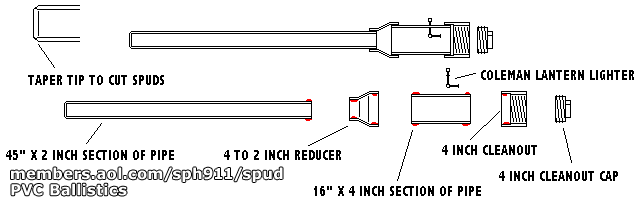
When I first fired it, I wrapped the breech in several layers of towelling, just in case it blew apart but felt confident enough to remove it after a few test shots.
There are several websites describing spud gun construction and a quick Google-search will bring up some interesting plans. My system pretty much follows this design, found here at spudgunner.com.
The first propellant that I used was hair spray but found that it quickly built-up a layer of sticky-goo on the inside of the cleanout cap and threads, making it very hard to unscrew the cap. I cleaned it thoroughly and changed to Right Guard spray deodorant which worked extremely well, was very clean burning and left no residue.
The first few times I fired the gun I was shocked to hear how loud it was, with a loud 'BOOM' reverberating around the neighbourhood. After a few shots, I fully expected to see the local RCMP arriving but when enquiring a few doors away, I was told that they had not heard anything! Perhaps it is because the thing is right beside you at the time that makes it sound so loud but I have never had any enquiries about it.
I have mounted an inexpensive (Walmart) spinning reel at the very top which has been loaded with a light (10lb) mono filament fishing line. This is attached to a homebrew lathe-turned wooden bullet, about 8" long, as shown below.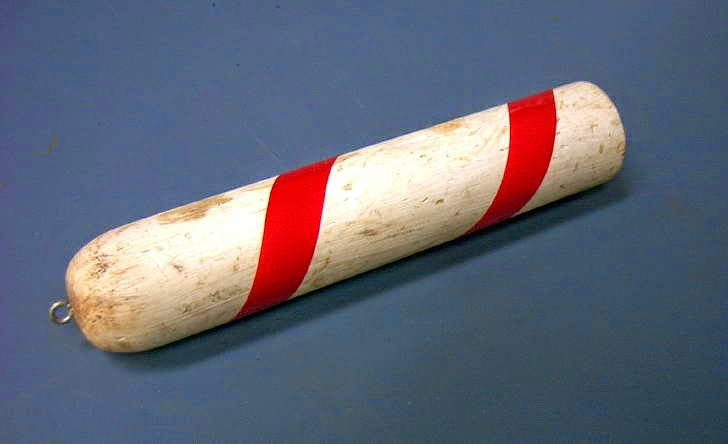
The first few times I fired the gun I was shocked to hear how loud it was, with a loud 'BOOM' reverberating around the neighbourhood. After a few shots, I fully expected to see the local RCMP arriving but when enquiring a few doors away, I was told that they had not heard anything! Perhaps it is because the thing is right beside you at the time that makes it sound so loud but I have never had any enquiries about it.
I have mounted an inexpensive (Walmart) spinning reel at the very top which has been loaded with a light (10lb) mono filament fishing line. This is attached to a homebrew lathe-turned wooden bullet, about 8" long, as shown below.
The bullet is lowered down the barrel to a peg mounted just above the firing-chamber. Once fired, it pulls line off of the spinning reel, hopefully to land on the ground on the other side of the tree. The initial attempt at launching the line over my 70' Balsam resulted in a perfect shot, but about 100' above the tree! The bullet pulled all of the line from the reel and snapped off. I eventually found it on the beach in a small bay about four properties to my south...oops.
I then backed-off on the amount of propellant and found that just a short one-second squirt was enough for a more controlled launch. It took me a few shots to get the feel of the launcher and compensating for the light wind. It is best to do this when there is no wind at all is it doesn't take much to blow the line and bullet slightly off course.
I have since used the gun many times, both here and at other ham's locations, to fire lines very high. It has always worked very well.
Should you choose to build something similar, be sure to build with caution and follow any safety instructions noted on the various websites. Most importantly, be sure to use the proper material.
Editor's Note: Using a combustion gun is inherently dangerous and can result in serious injury or death. Using the wrong materials, especially, can put the operator at risk. We cannot be responsible for personal injury or property damage resulting from use (or misuse).
I have since used the gun many times, both here and at other ham's locations, to fire lines very high. It has always worked very well.
Should you choose to build something similar, be sure to build with caution and follow any safety instructions noted on the various websites. Most importantly, be sure to use the proper material.
Editor's Note: Using a combustion gun is inherently dangerous and can result in serious injury or death. Using the wrong materials, especially, can put the operator at risk. We cannot be responsible for personal injury or property damage resulting from use (or misuse).













