Archive for the ‘antennas’ Category
 How I Worked VY0M From a Tent
 August 10th, 2015 |
  Author:
 I experimented with multiple antennas as I didn't know what I would be allowed to do at the camp. Would I be allowed to put up an antenna in camp? Would I have to find a remote location somewhere else? How long would my batteries last? So my plan was to try a Buddipole vertical first. It was relatively low profile and wouldn't attract a lot of attention. So I set up the station, in my tent, for a dry run.
As luck would have it, there was a 110v plug in my tent, the power intended to power a light and possibly a fan, so exit the batteries and in with the power supply. I set up the vertical and the antenna worked fine. I was using a Yaesu FT-857, which is a very capable radio, especially for portable use. With 70 watts I worked into Europe with good reports, so I was thinking that I might just get by with this set-up. However, the first day that VY0M came up, he was on SSB. I never heard a peep from him and decided it was time for plan B.
After erecting the vertical, a few around camp inquired about it and everyone thought the radio set-up was cool, so the next afternoon I decided to put up the bright orange Jacktite, 30 ft. collapsible pole with an end-fed long wire through a 9 to 1 balun. After I got everything connected, I turned on the radio and tuned the antenna with an LDG tuner. Everything looked good, so I checked the spots on my iPhone and Cezar had just moved to CW. I went to 14.040 and there he was with the fluttery signal common to stations in the far northern latitudes. After two or three calls I had him in the log, Victory dance. All the planning had paid off and I had another IOTA in the log.
What a blast ham radio is. Below is video of the set-up, right after I made the QSO. I didn't have the narrow CW filter on the FT-857, so the stations you hear are actually 1 KC up, but you can still hear Cezar's fluttery signal if you listen closely.
Our Amazing Sun and HF Radio Signal Propagation
Space Weather. The Sun-Earth Connection. Ionospheric radio propagation. Solar storms. Coronal Mass Ejections (CMEs). Solar flares and radio blackouts. All of these topics are interrelated for the amateur radio operator, especially when the activity involves the shortwave, or high-frequency, radiowave spectrum.
Learning about space weather and radio signal propagation via the ionosphere aids you in gaining a competitive edge in radio DX contests. Want to forecast the radio propagation for the next weekend so you know whether or not you should attend to the Honey-do list, or declare a radio day?
In the last ten years, amazing technological advances have been made in heliophysics research and solar observation. These advances have catapulted the amateur radio hobbyist into a new era in which computer power and easy access to huge amounts of data assist in learning about, observing, and forecasting space weather and to gain an understanding of how space weather impacts shortwave radio propagation, aurora propagation, and so on.
I hope to start “blogging” here about space weather and the propagation of radio waves, as time allows. I hope this finds a place in your journey of exploring the Sun-Earth connection and the science of radio communication.
With that in mind, I’d like to share some pretty cool science. Even though the video material in this article are from 2010, they provide a view of our Sun with the stunning solar tsunami event:
On August 1, 2010, the entire Earth-facing side of the sun erupted in a tumult of activity. There was a C3-class solar flare, a solar tsunami, multiple plasma-filled filaments of magnetism lifting off the stellar surface, large-scale shaking of the solar corona, radio bursts, a coronal mass ejection and more!
At approximately 0855 UTC on August 1, 2010, a C3.2 magnitude soft X-ray flare erupted from NOAA Active Sunspot Region 11092 (we typically shorten this by dropping the first digit: NOAA AR 1092).
At nearly the same time, a massive filament eruption occurred. Prior to the filament’s eruption, NASA’s Solar Dynamics Observatory (SDO) AIA instruments revealed an enormous plasma filament stretching across the sun’s northern hemisphere. When the solar shock wave triggered by the C3.2-class X-ray explosion plowed through this filament, it caused the filament to erupt, sending out a huge plasma cloud.
In this movie, taken by SDO AIA at several different Extreme Ultra Violet (EUV) wavelengths such as the 304- and 171-Angstrom wavelengths, a cooler shock wave can be seen emerging from the origin of the X-ray flare and sweeping across the Sun’s northern hemisphere into the filament field. The impact of this shock wave may propelled the filament into space.
This movie seems to support this analysis: Despite the approximately 400,000 kilometer distance between the flare and the filament eruption, they appear to erupt together. How can this be? Most likely they’re connected by long-range magnetic fields (remember: we cannot see these magnetic field lines unless there is plasma riding these fields).
In the following video clip, taken by SDO AIA at the 304-Angstrom wavelength, a cooler shock wave can be seen emerging from the origin of the X-ray flare and sweeping across the sun’s northern hemisphere into the filament field. The impact of this shock wave propelled the filament into space. This is in black and white because we’re capturing the EUV at the 304-Angstrom wavelength, which we cannot see. SDO does add artificial color to these images, but the raw footage is in this non-colorized view.
The followling video shows this event in the 171-Angstrom wavelength, and highlights more of the flare event:
The following related video shows the “resulting” shock wave several days later. Note that this did NOT result in anything more than a bit of aurora seen by folks living in high-latitude areas (like Norway, for instance).
This fourth video sequence (of the five in the first video shown in this article) shows a simulation model of real-time passage of the solar wind. In this segment, the plasma cloud that was ejected from this solar tsunami event is seen in the data and simulation, passing by Earth and impacting the magnetosphere. This results in the disturbance of the geomagnetic field, triggering aurora and ionospheric depressions that degrade shortwave radio wave propagation.
At about 2/3rd of the way through, UTC time stamp 1651 UTC, the shock wave hits the magnetosphere.
This is a simulation derived from satellite data of the interaction between the solar wind, the earth’s magnetosphere, and earth’s ionosphere. This triggered aurora on August 4, 2010, as the geomagnetic field became stormy (Kp was at or above 5).
While this is an amazing event, a complex series of eruptions involving most of the visible surface of the sun occurred, ejecting plasma toward the Earth, the energy that was transferred by the plasma mass that was ejected by the two eruptions (first, the slower-moving coronal mass ejection originating in the C-class X-ray flare at sunspot region 1092, and, second, the faster-moving plasma ejection originating in the filament eruption) was “moderate.” This event, especially in relationship with the Earth through the Sun-Earth connection, was rather low in energy. It did not result in any news-worthy events on Earth–no laptops were fried, no power grids failed, and the geomagnetic activity level was only moderate, with limited degradation observed on the shortwave radio spectrum.
This “Solar Tsunami” is actually categorized as a “Moreton wave”, the chromospheric signature of a large-scale solar coronal shock wave. As can be seen in this video, they are generated by solar flares. They are named for American astronomer, Gail Moreton, an observer at the Lockheed Solar Observatory in Burbank who spotted them in 1959. He discovered them in time-lapse photography of the chromosphere in the light of the Balmer alpha transition.
Moreton waves propagate at a speed of 250 to 1500 km/s (kilometers per second). A solar scientist, Yutaka Uchida, has interpreted Moreton waves as MHD fast-mode shock waves propagating in the corona. He links them to type II radio bursts, which are radio-wave discharges created when coronal mass ejections accelerate shocks.
I will be posting more of these kinds of posts, some of them explaining the interaction between space weather and the propagation of radio signals.
For live space weather and radio propagation, visit http://SunSpotWatch.com/. Be sure to subscribe to my YouTube channel: https://YouTube.com/NW7US.
The fourth video segment is used by written permission, granted to NW7US by NICT. The movie is copyright@NICT, Japan. The rest of the video is courtesy of SDO/AIA and NASA. Music is courtesy of YouTube, from their free-to-use music library. Video copyright, 2015, by Tomas Hood / NW7US. All rights reserved.
A Solar flare, A CME, A Proton Storm: Magnitude M2.5 X-ray Flare
Watch this amazing explosion on the Sun. From sunspot complex 1226-1227 comes an X-ray Flare peaking at a magnitude of M2.5 at 0640 UTC on 7 June, 2011.
Source: https://www.youtube.com/watch?v=KQMrRu8BWDo
This X-ray flare hurled a massive coronal mass ejection (CME) toward the Earth. This not-squarely Earth-directed CME is moving at 1400 km/s according to NASA models. The CME did not deliver even a noticeable glancing blow to Earth’s magnetic field late June 8th or June 9th.
What can be seen clearly in this movie is one of the most spectacular prominence eruptions ever observed. In fact, one could call it a “prominence explosion”. The prominence material expanded to a volume some 75 times as big across as the earth!
This X-ray flare also triggered an S1-level solar radiation storm, causing a long-lasting polar cap absorption (PCA) event. A polar cap absorption (PCA) event affects the propagation of a shortwave radio signal as it makes its way over the polar regions. In short, radio communications on lower shortwave radio frequencies become more difficult, as those radio signals are absorbed by the ionosphere (in the D-region) over the polar regions.
What does this mean in real-world communications? Trans-polar airline pilots may find it more difficult to communicate with regional air traffic control, shortwave radio listeners who want to hear a broadcast from a country by receiving a transmission from a country by way of a transmission beamed over the pole (like, from Europe into the USA via the North Pole), or other such communications, will find those signals all but gone. The stronger the PCA event, the higher the frequencies absorbed over the polar regions, with the greatest absorption occurring at the lower frequencies.
This movie spans the period of time from 0300 UTC through 1556 UTC, and is composed of the 171-Angstrom, 304-Angstrom, and 335-Angstrom wavelength views as captured by the filters of the Solar Dynamics Observatory (SDO) Atmospheric Imaging Assembly (AIA). In this movie, the AIA instruments capture the Sun’s extreme ultraviolet light and reveal a very large eruption of cool gas. It is somewhat unique because at many places in the eruption there seems to be even cooler material–at temperatures less than 80,000 K.
The following is a linked video that is part of this event: http://www.youtube.com/watch?v=L4CsjcUGoaw
Watch as we zoom out to see a total view of the June 7, 2011 moderately-powerful X-ray Flare and Prominence Eruption. This movie will give you a full perspective of the immense size of this prominence eruption as it spews out away from the Sun.
The X-ray Flare peaked at a moderate magnitude of M2.5 at 0640 UTC, but unleashed a huge prominence eruption. The massive cloud of plasma was ejected out into interplanetary space, but missed the Earth. This movie stars with a “close-up” view by the Solar Dynamics Observatory at a combined wavelength view at 94 and 304 Angstroms. Then, the movie views the event further back through the eyes of the COR1 spacecraft (with the SDO AIA 304 image superimposed in the middle). Next, we zoom out to the COR2 spacecraft and superimpose the COR1 and SDO views. Then, we zoom further back to the H1 view… and finally look again at the event close-up.
More info: http://sunspotwatch.com/
Google Plus:
http://g.nw7us.us/gplus_spacewx
Facebook:
http://www.facebook.com/spacewx.hfradio
http://www.facebook.com/NW7US
Twitter:
@hfradiospacewx
@NW7US
Source: SDO AIA NASA SOHO
Working VK2SSI From My Backyard
This past weekend I was testing portable configurations for a trip I will be taking to Philmont Scout Ranch in Cimarron, New Mexico next week. I am the President of the Alamo Area Council of the Boy Scouts and will be going through some training there. So, this trip I will not operating from a summit, but rather I need to work an IOTA Island that I need that will QRV the week I am there.
I use EFHW's from summits all the time, but at QRP power levels, this time I will be running ~100 watts from a battery, so I thought an on air test would be a good idea. I conduct such tests in my backyard "Outdoor Radio Laboratory". I test portable configurations in an outdoor environment to simulate the conditions I will be operating in. I was running ~100 watts from an old Yaesu FT-100D to the EFHW on a 30' pole tied off in a tree. I was tuning on 17m and I found and was able to work VK2SSI on OC-194, Solitary Island. So a portable to portable QSO would bode well for the capability of the set up.
Below is a video of the set up.
I think I have more fun in my backyard than in my regular shack.
Working VK2SSI From My Backyard
This past weekend I was testing portable configurations for a trip I will be taking to Philmont Scout Ranch in Cimarron, New Mexico next week. I am the President of the Alamo Area Council of the Boy Scouts and will be going through some training there. So, this trip I will not operating from a summit, but rather I need to work an IOTA Island that I need that will QRV the week I am there.
I use EFHW's from summits all the time, but at QRP power levels, this time I will be running ~100 watts from a battery, so I thought an on air test would be a good idea. I conduct such tests in my backyard "Outdoor Radio Laboratory". I test portable configurations in an outdoor environment to simulate the conditions I will be operating in. I was running ~100 watts from an old Yaesu FT-100D to the EFHW on a 30' pole tied off in a tree. I was tuning on 17m and I found and was able to work VK2SSI on OC-194, Solitary Island. So a portable to portable QSO would bode well for the capability of the set up.
Below is a video of the set up.
I think I have more fun in my backyard than in my regular shack.
Field Day 2015 – Comprehensive Report
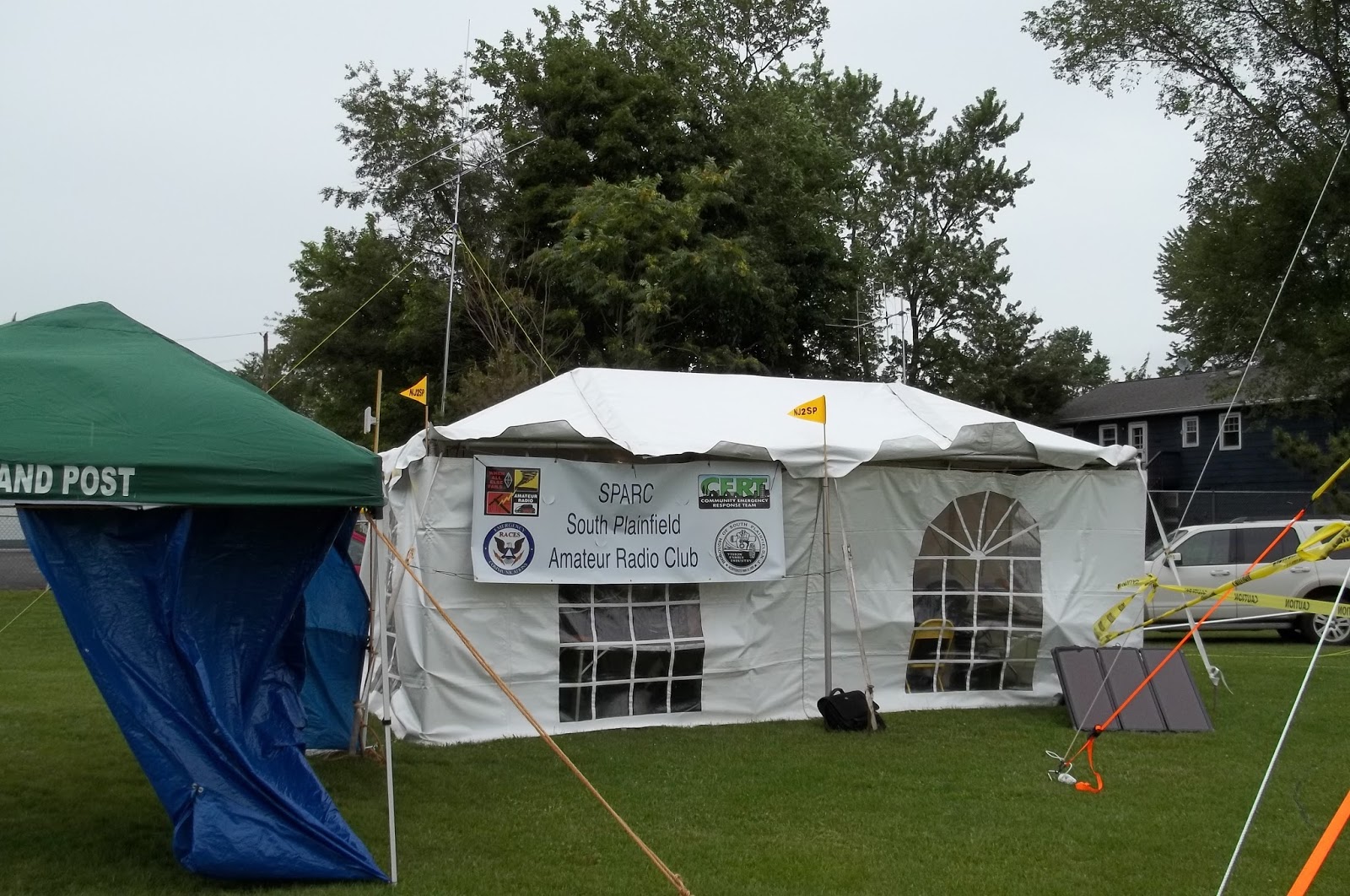
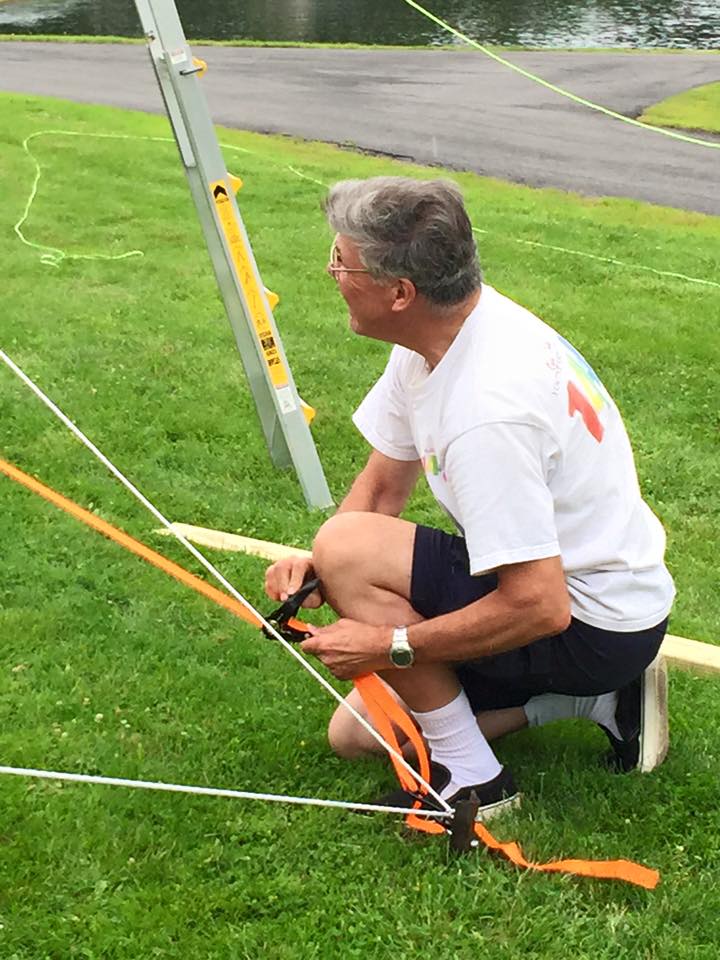
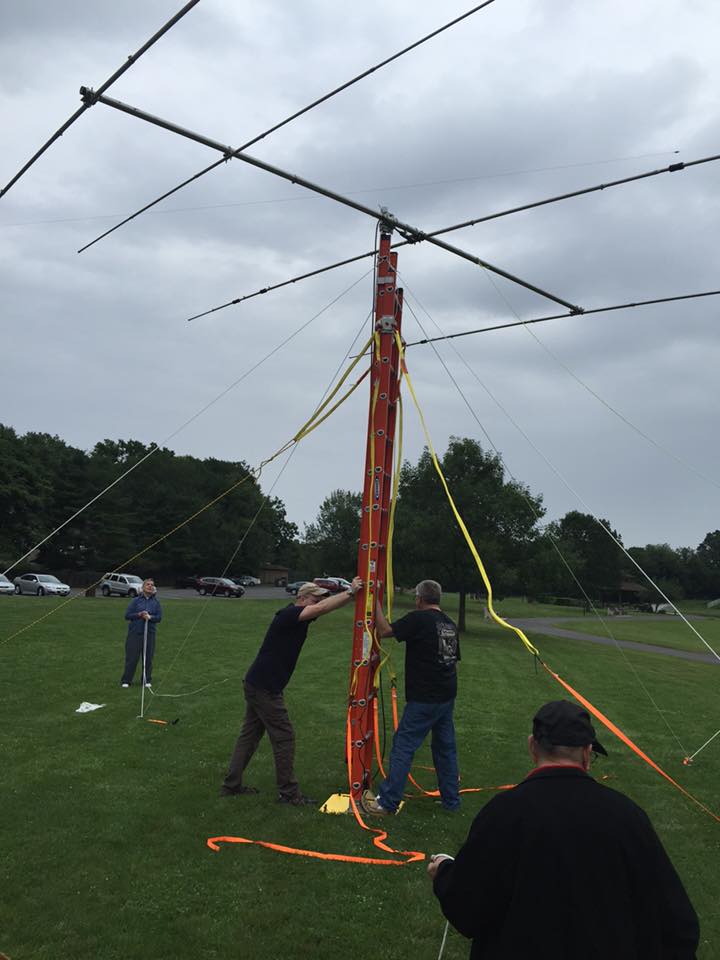
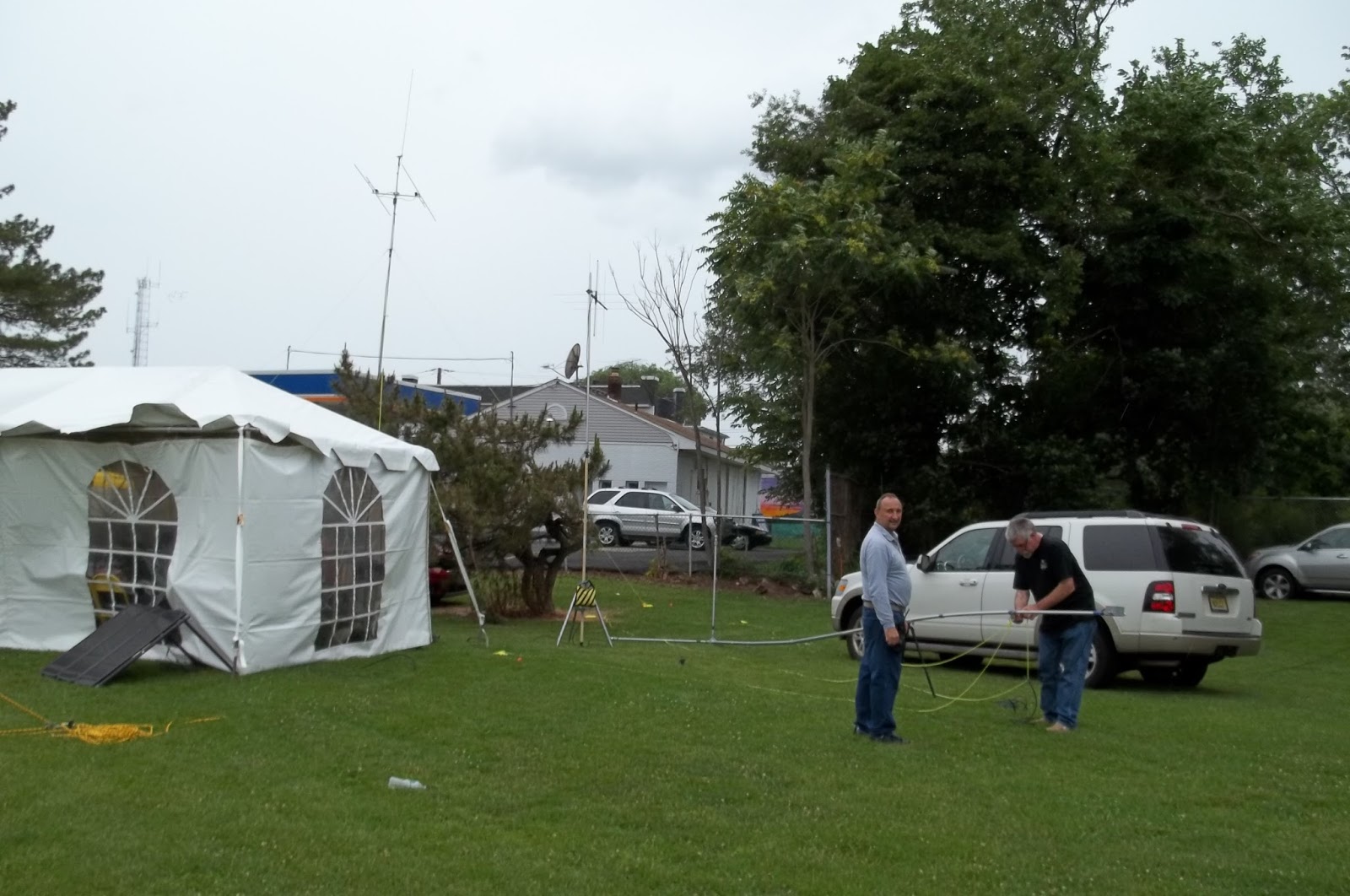
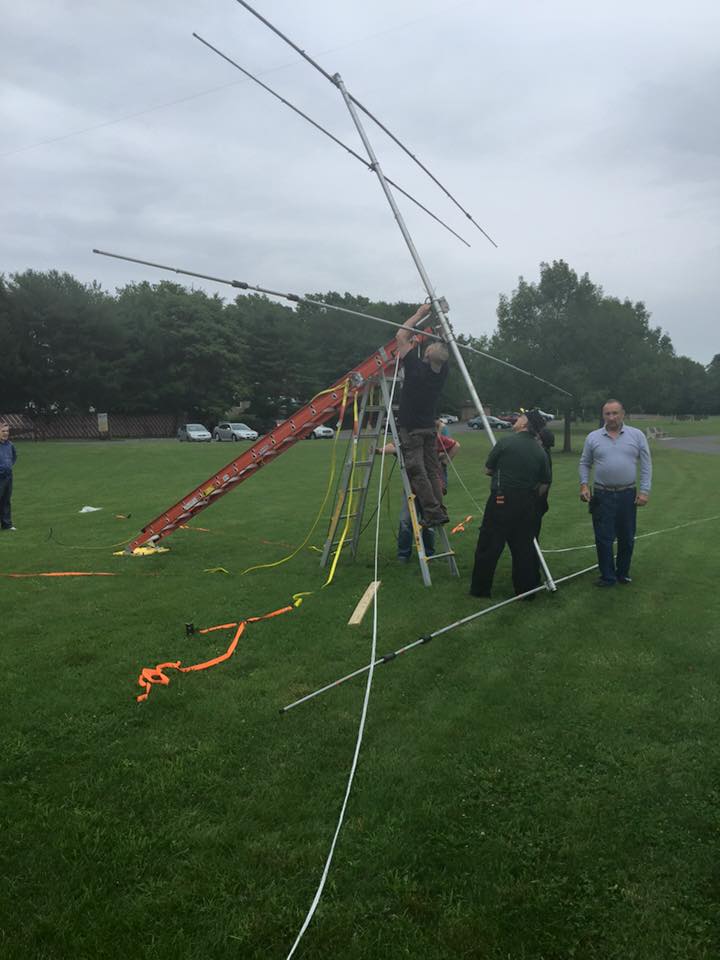
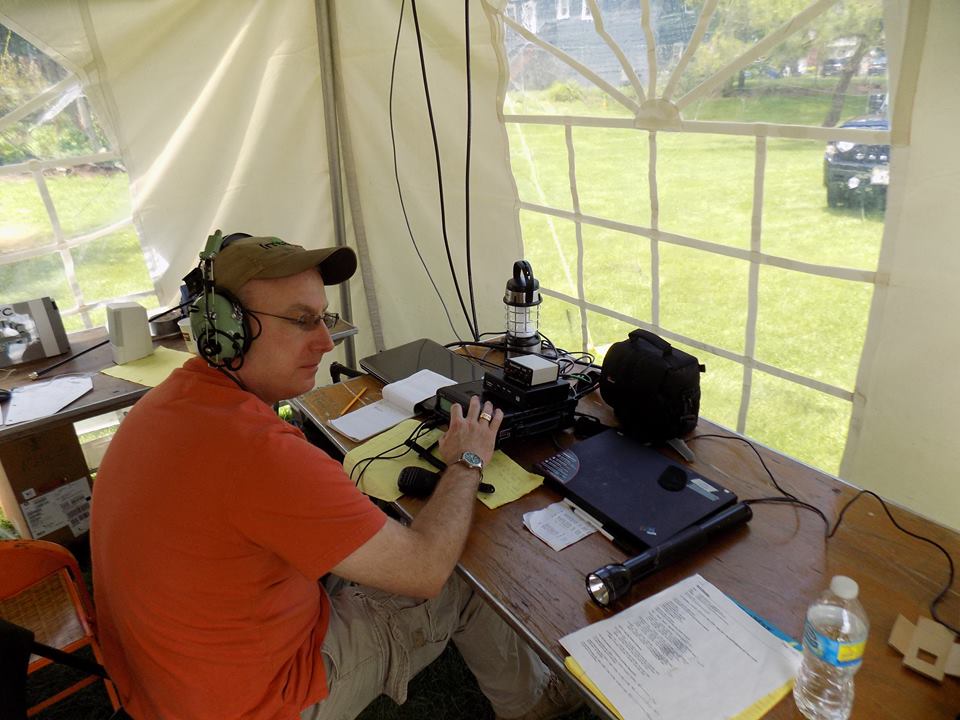
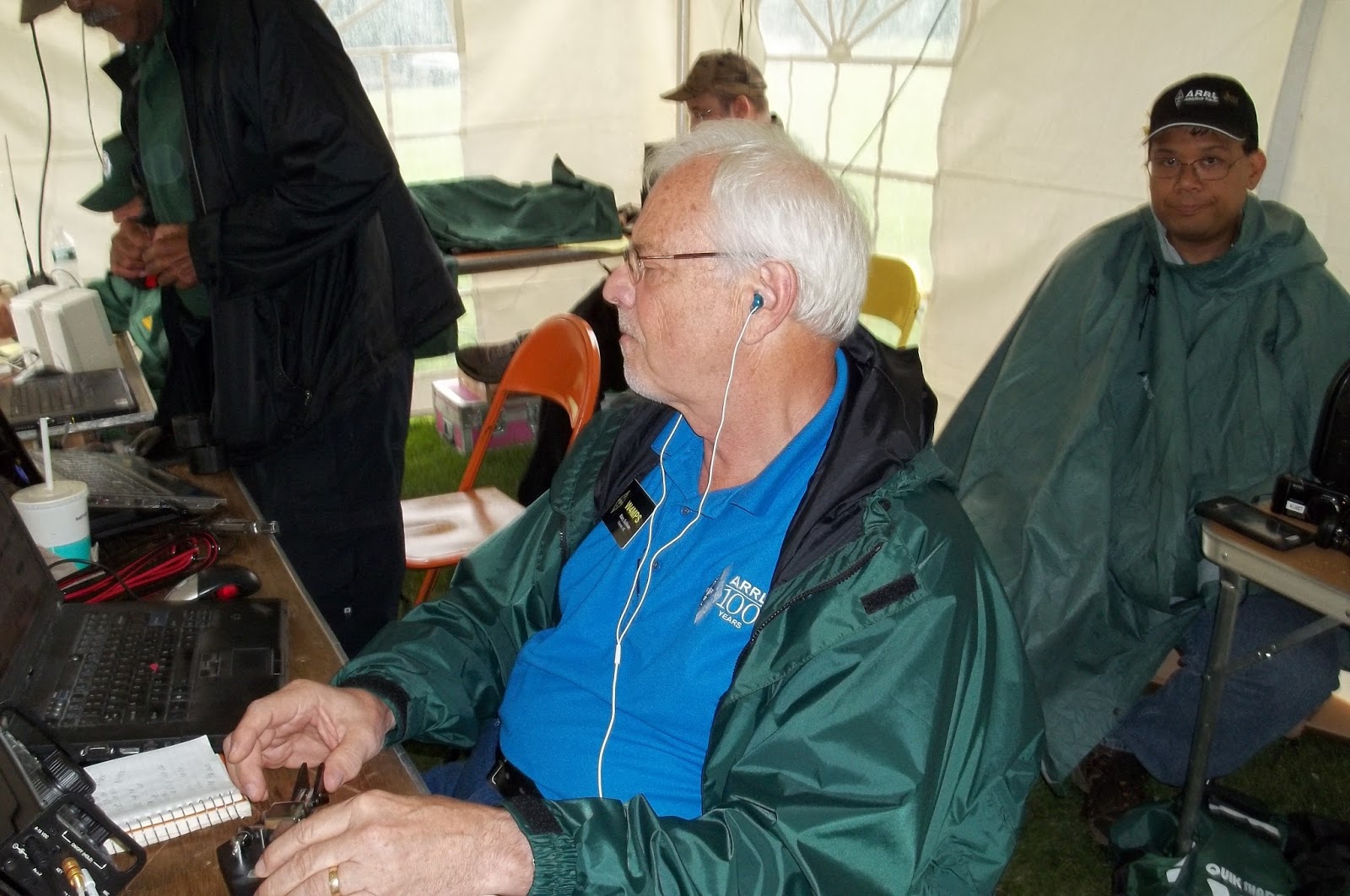
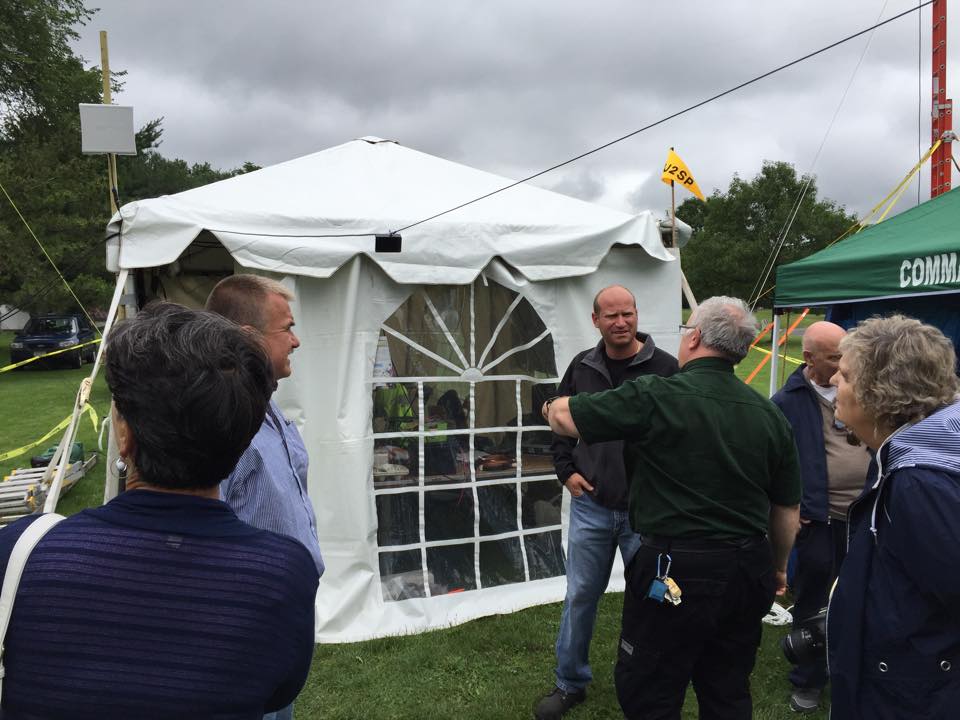
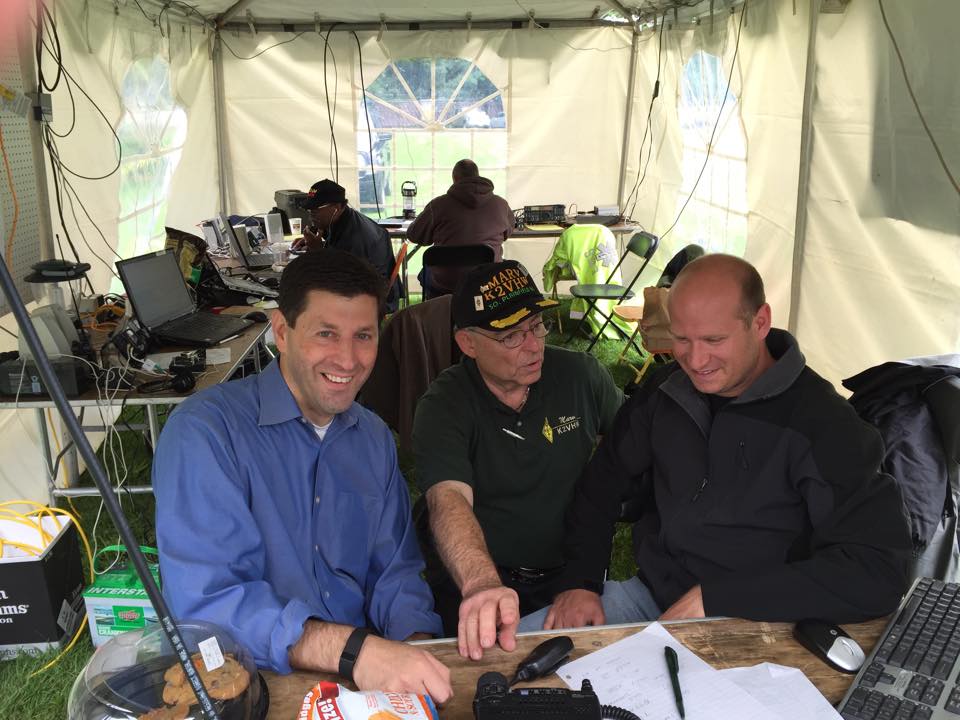
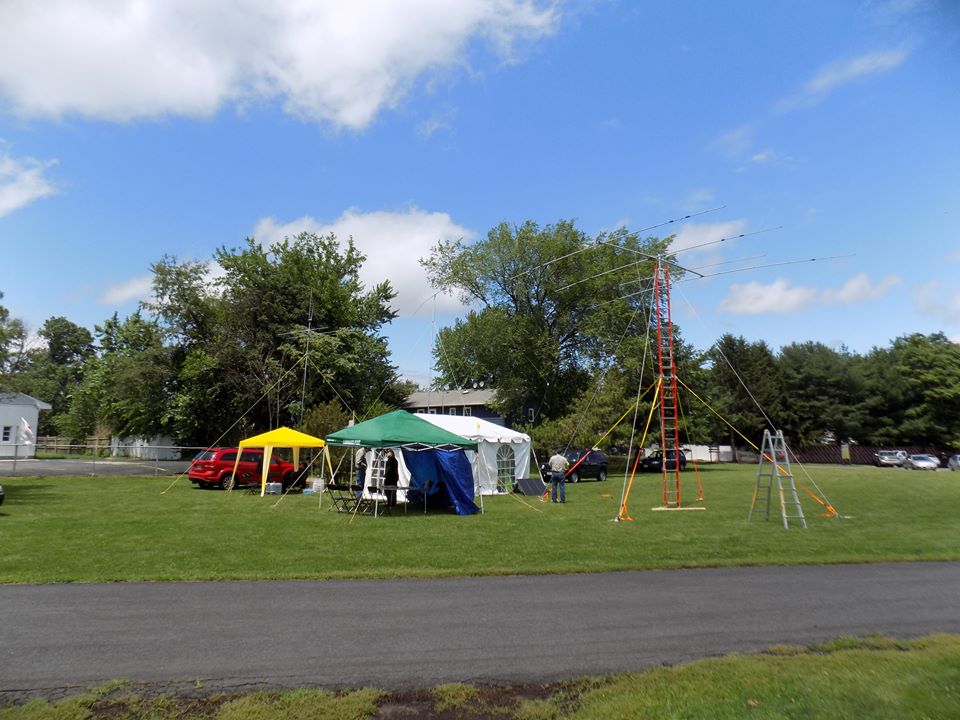
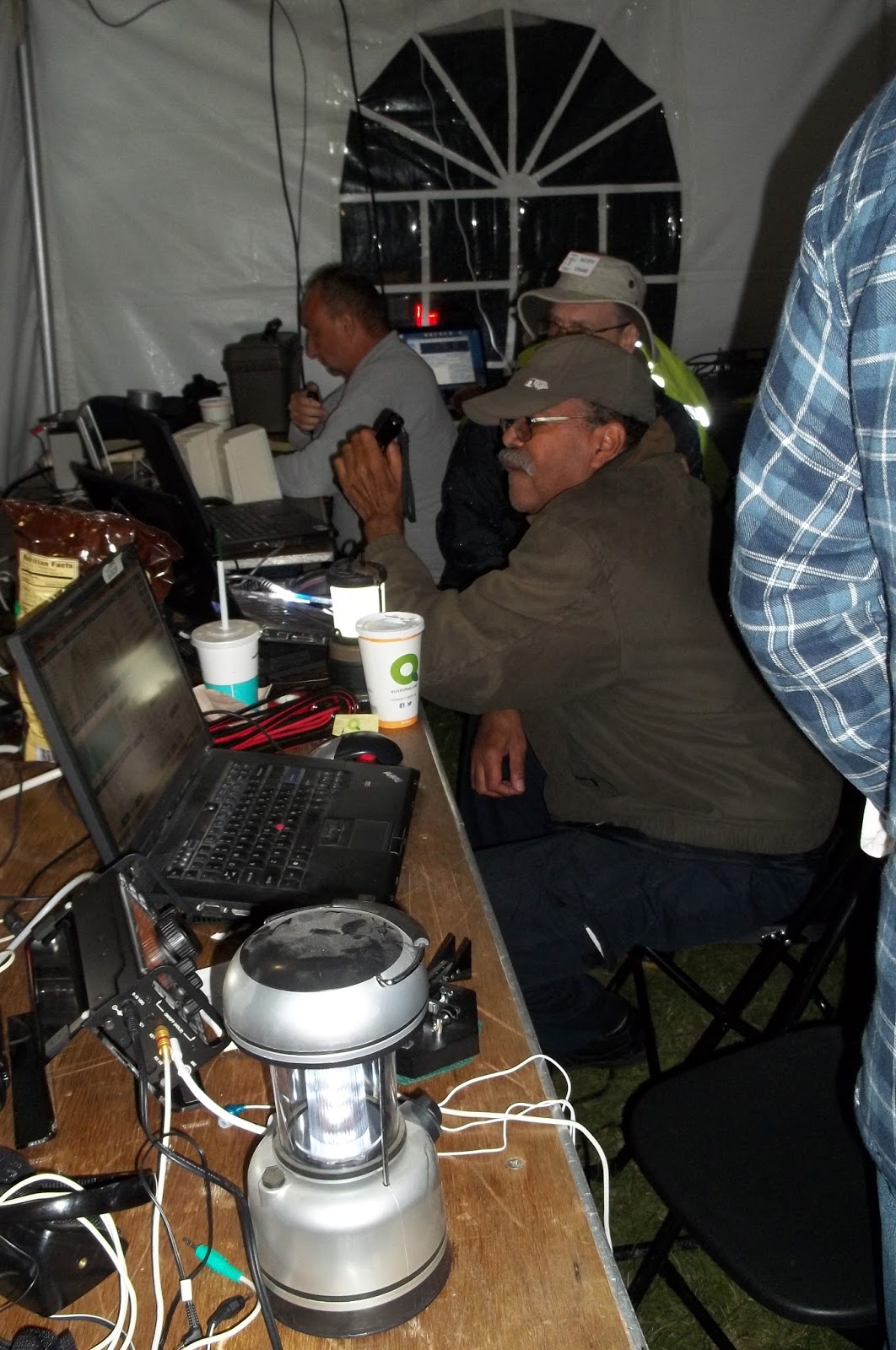
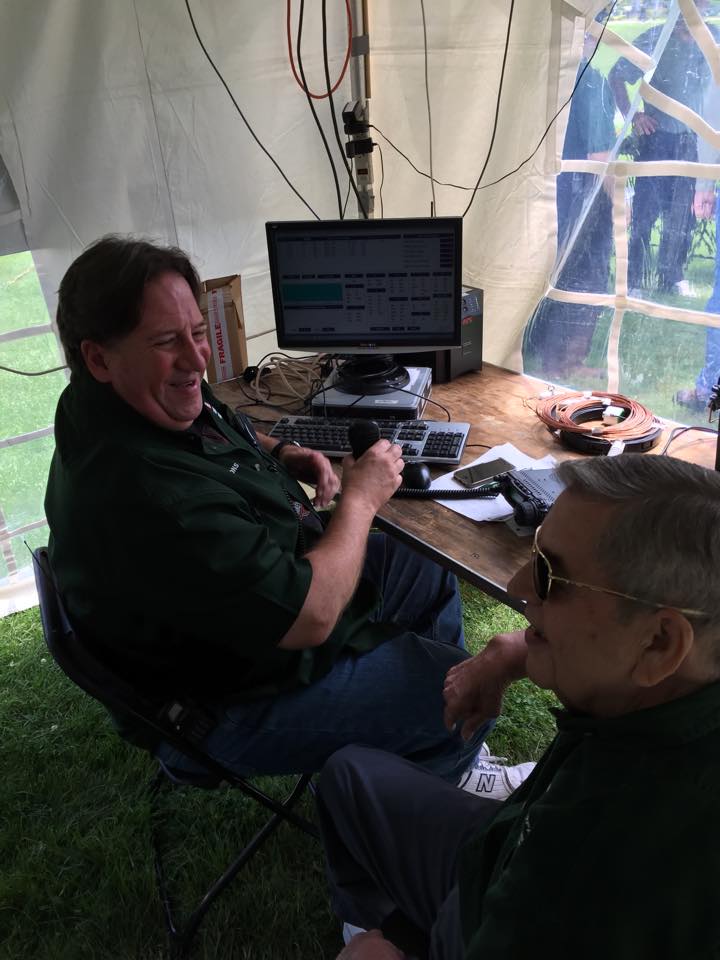
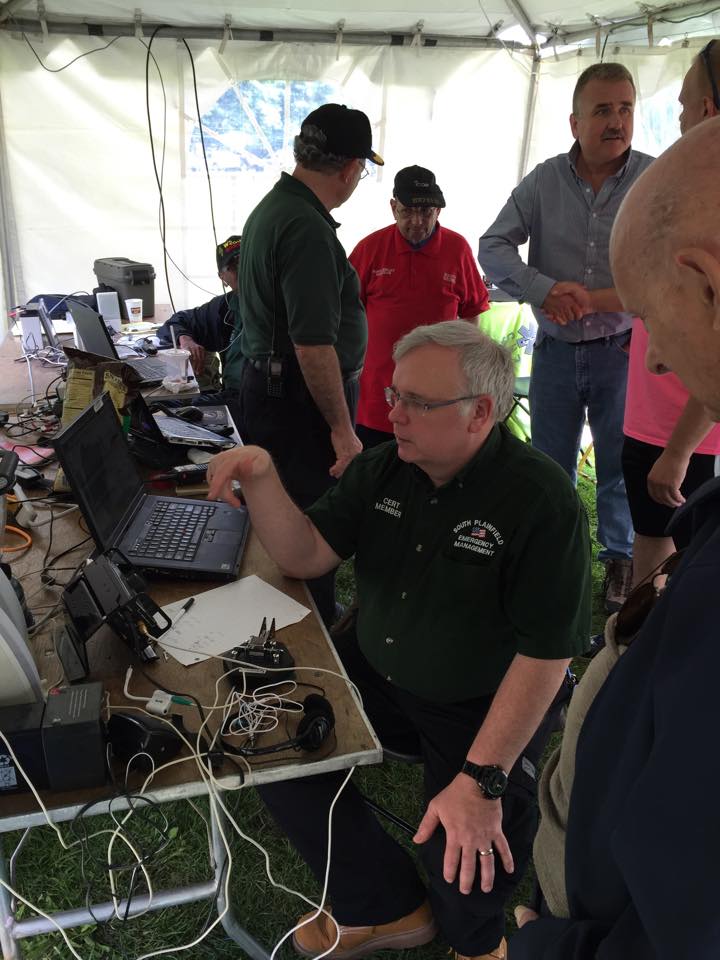
First - set up the antennas, and organize the tent - our "home" for the next 24+ hours.

CKZU – 6160 Close-Up
 |
| courtesy: googlemaps.ca |
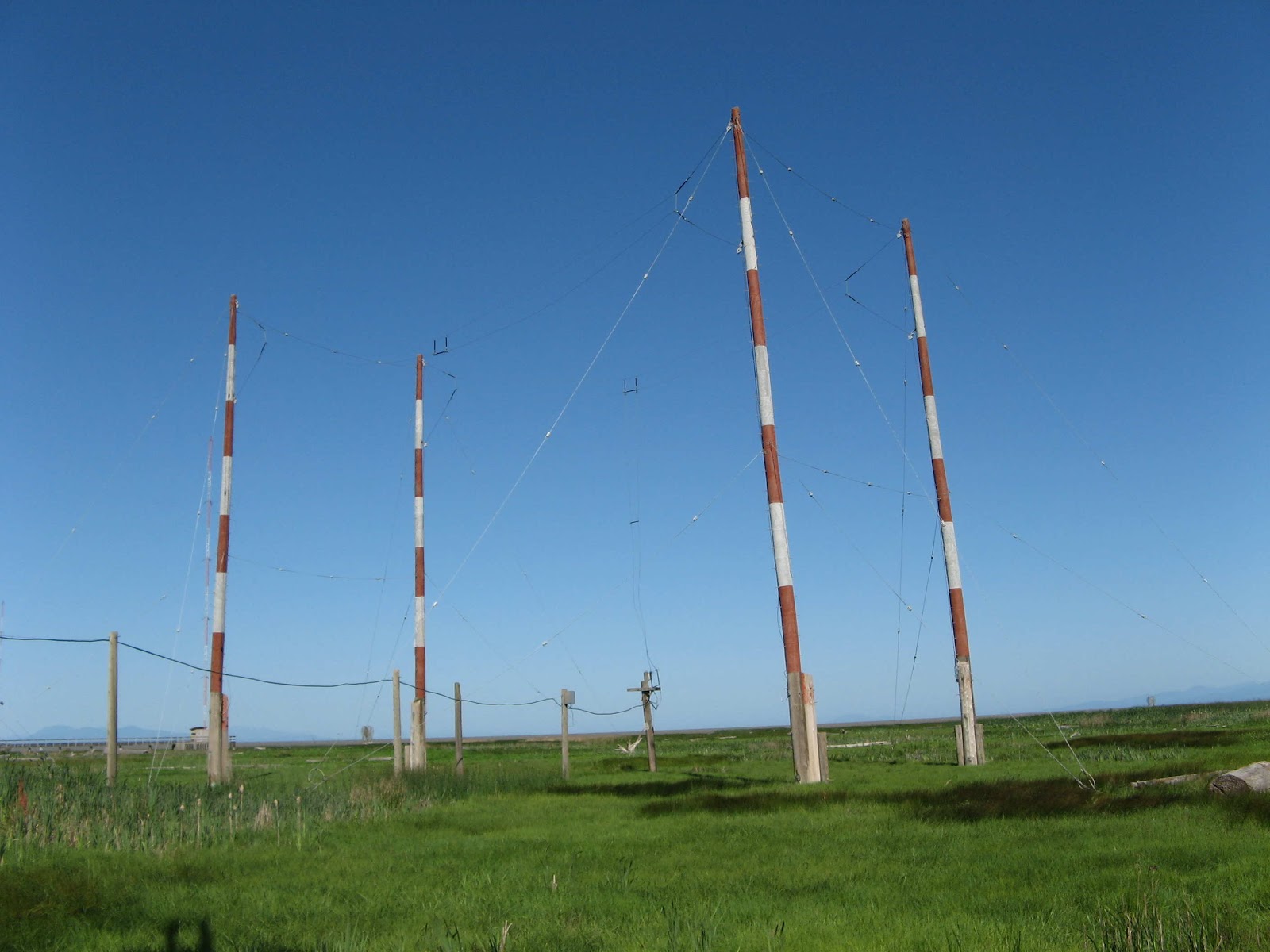
On a weekend bike ride along the West Richmond dyke, Mark (VA7MM) snapped this wonderful close-up view of the system:
 | ||||
| courtesy: VA7MM |
So the next time you are tuning around 40m, drop down a bit and see how their signal sounds at your location ... you may be pleasantly surprised.













