Archive for the ‘antenna’ Category
 LHS Episode #067: The Left Hand of ARES
 October 1st, 2011 |
  Author:
  And we are back. In this installment, Richard tells us all about his renewed interest in emergency communications and his dealings with ARES in the Texas county where he now lives. On the Linux side of things, Russ talks about some security issues: the hacking of kernel.org, emacs violates the GPL and how to get cheap certificates for your Web sites. Throw in a dash of humor, some general screwing around and you have the formula for pretty much every episode of Linux in the Ham Shack. Thanks for sticking it out with us, everyone. We love each and every one of you.
73 de The LHS Guys
AmateurLogic.TV 33: One Jam Packed Show
George visits the Twit.tv studios and interviews Randy Hall, K7AGE. Tommy visits the Huntsville Hamfest. Jim builds an Audio Isolation Interface. Peter shows us the DATV QSO Party.
QRP at Bamarang
Last weekend I had a great time playing radio. Along with half a dozen other families and all our kids we went to spend the Easter weekend at the “mud brick mansion” at Bamarang on the Shoalhaven River, a few km west of Nowra on the south coast of New South Wales. Courtesy of the pod on my car I was able to take quite a few radio bits and pieces along.
We enjoyed perfect autumn weather while it rained back home in Sydney!
I even managed to build the neat little EFHW (End Fed Half Wave) Tuner designed by Stu, KI6J on a shady verandah. The kit had arrived a few days earlier and I made sure I had everything I needed to build it away from my attic/shack/workshop. In fact the weekend became a sort of trial for field day and a great way to identify the essentials. If there’s a lot of gear on hand an awful amount of time can be wasted deciding which bits to use and how.
I was inspired by reports about the EFHW tuner and the appeal of not having to worry about ground radials. What clinched it for me was a photo I saw on one of the (far too many) qrp email groups I try to follow showing a ham on a mountain side beneath his arching squid pole with the little tuner matching the hi-Z of the half-wave antenna to the 50 ohms expectations of the tiny transceiver which was probably an ATS3b.
So that was my mission for the weekend.
The tuner kit went together in a very short time. Before accepting my order Stu, KI6J sent me a powerpoint of the assembly instructions so I was sure I could handle the construction. The fiddliest bit was the tiny binocular ferrite core transformer for the bridge. Fortunately he provided enough wire in the kit for me to botch it the first time round and do it perfectly the second!
After a couple of leisurely hours mostly taken up with drilling holes in a tiny plastic box it was working on the test lash-up. The polyvaricon is delightfully sharp. You tune by dimming the LED – and then switch out the bridge to transmit.

The KI6J EFHW Tuner kit almost complete with the 5k ohms test load in place. The builder provides the enclosure and connectors. (Photo sourced from instructions)
I had a 10m (almost 33 feet) squid pole (aka Jackite or crappie pole) with a tiny pulley from a boating store attached to the top with cable ties. I used the guy ropes from my Buddipole setup to hold the pole up straight. It stayed up all weekend.
The half wavelength formula in feet is 477/freq in MHz, or just on 68 feet (20.7m) for the code end of 40m. The far end of this was held up – via a plastic button insulator – by a fishing line launched up into a tree using a half-filled plastic drink bottle. All too easy! The near end of the antenna simply terminates in a banana plug that connects to the little tuner. I also connected a short 5-6 foot counterpoise, which was essential.
I had a great time playing with the tuner and my new SDR-Cube pumping out a whole watt of RF, as well as the trusty little FT-817.
Now I have a clear idea of what’s required for an effective little kit of gear to take up a hill for relatively speedy SOTA style deployment. And maybe I’ll fill the water bottle for those trips.
If you’re interested in getting hold of one of these nifty little EFHW Tuner kits you should contact Stu KI6J at [email protected]. US$27 included shipping across the Pacific Ocean! Fast and very fair!

My blissed-out second operator in the field at Bamarang, near Nowra NSW. He helped me retain my QRP calm.
During a trip into the township to replenish supplies I found a fishing tackle shop with an Easter sale on, and bought a couple of handy Plano tackle boxes and some inexpensive 10m lengths of nylon coated stainless steel ‘leader line’ wire which I’m sure can be used for a handy weatherproof dipole. As long I don’t have to solder the stuff.
Small loop antenna for HF listening
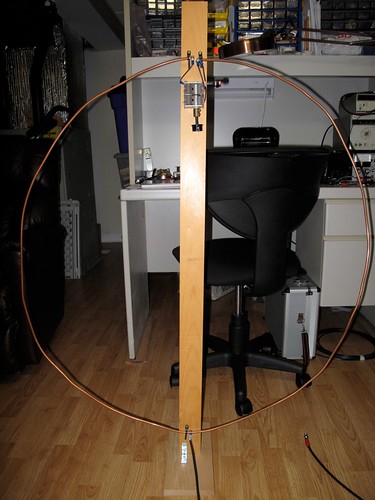
I built this antenna a few years ago and it is about time I posted details about it on this blog.
This is a small loop, that is the length is ≤0.1 of a wavelength, and designed for receive only, not transmitting. The loop is a little more oval than round with the narrower diameter being 36″ and the wider diameter being 40″. A transformer is used to collect the signal and pass it via coax to the receiver. The antenna shown and described here tunes from around 3 MHz to 18 MHz. So it covers 80m through to 20m and of course the broadcast bands in between those frequencies too.
The schematic of the loop is shown below.

Schematic of the small loop antenna
The main loop is composed of ¼” copper tubing (available from hardware and plumbing stores). The advantage of this type of tubing is that is easy to bend into a set shape and it maintains that shape with just a few fixing points. If a wire loop was to be made it would require some sort of frame to retain the loop shape.
The capacitor is a variable capacitor from a receiver. I have not measured the capacitance but I suspect both sections together give a maximum of 300 to 400pF. To increase the range of the tuning of the loop I included a switch to allow either one or both of the dual stage capacitor to be included in the loop. The picture below shows the top mounting of the loop, the variable capacitor and the switch. To make easy connection to the capacitor, the copper was squeezed closed at the ends and holes were drilled for bolts. Ring or spade-end connectors can be used to connect wires from the capacitor to the copper tube, and held in place with nuts and bolts.
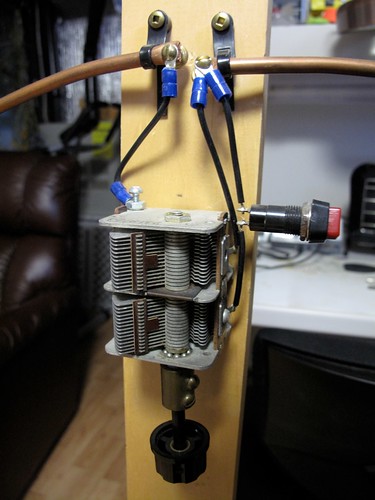
Note that the copper ends of the loop should not contact each other. They are close in my loop, because of the cable tie mountings on the pine wood, but they do not touch. Electrical connectivity is through the capacitor. To prevent any ‘hand capacitance’ effects when tuning (and hence tuning issues) I added a non-conducting shaft on the capacitor (you can see the brass shaft connector). In my loop the two capacitor sections are joined in parallel to increase the capacitance. The switch can switch out one section, so decreasing the minimum capacitance and increasing the upper frequency that can be tuned. A single stage capacitor, without a switch, will do fine, but the higher the capacitance the better.
At the opposite end of the loop a T50-43 toroid has been threaded onto the copper tube. The toroid has five turns of enameled wire wound on it and it slides easily over the copper. The copper loop now makes one turn on the loop and the five turns of wire on the ferrite toroid makes the transformer (as shown on the schematic). This arrangement can be seen below.
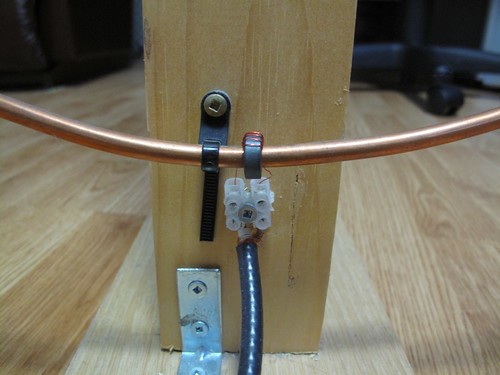
The enameled wire ends have had the enamel removed (only the ends) and have been tinned with solder before inserted into the electric wire block, which allows connection to the RG-58 cable. At the end of the cable add whatever connector you need for your receiver. The photograph also shows the simple L bracket arrangement for holding the pine plank upright on a simple plinth (a small piece of off-cut maple) large enough to stop the loop from toppling over..
The use of the electric connector block is not ideal I find (the enameled wire is too thin) and in future I will probably make something suitable out of some unetched copper circuit board and solder the wire and coax directly to the board.
I am sure there is room for experimentation with the type of mix of the toroid, as well as the number of turns of the enameled wire. My loop worked satisfactorily so I left it as it is.
How does it perform? Well I find it always surprises me how well it works for about 10ft of copper tube in a loop, a capacitor and a transformer. I use this in my basement and can easily tune in stronger stations on the bands. The high Q of small loop antennas rejects strong out of band stations that can bleed-through in more conventional random wire or even dipole antennas, so improving reception performance. When using the antenna you must tune to the frequency or band of interest and then adjust the loop’s capacitor to tune the loop to the same frequency. You will hear either a rise in signal strength of a station or background noise if there is no station on frequency. It is simple to use and it is surprising how it can increase the received signal.
Below are a few recordings made using the loop antenna. The receiver was the old but excellent Yaesu FRG-7, which for the purpose of this demonstration serves well as a general good receiver, although as you will hear the filtering is wide (‘barn-door’ wide springs to mind). For each of the recordings I tuned the receiver to the required frequency and adjusted its pre-selector for maximum signal. What you will hear in each case is the signal and then I will detune the loop one way, then tune it back through the peak to the other side and then returning to the peak of the signal. Recordings were made with an MP3 recorder place in-front of the receiver’s speaker, so you hear what the listener would hear. You should remember this is a 10ft circumference loop in my basement, NOT 100+ft of wire 50ft off the ground.
Small loops are directional to the signal source so if you use one you should experiment by turning it. It may be the HF frequency, or the fact that my antenna is below ground level, but I have noticed not too much of a difference when the loop is turned in orientation. That said, other small loops I have built for the AM broadcast frequencies, or medium wave, do show a stronger directional nature.
If you want to learn more about small loop antennas I recommend Joe Carr’s Loop Antenna Handbook, published by Universal Radio. That book describes many loops, both large and small and is well worth the read if you enjoy antenna design. This loop design is not from the book, but I used concepts and theory from it. The idea of using the copper tubing and the toroid transformer slid onto the copper was my own, although it may not be a novel idea and could have been reported before.
Let me know with a comment if you build and experiment with such an antenna. Share your findings with other readers.


LHS Show Notes #057
Introduction:
- Hacker Public Radio promo.
Announcements:
- Check out the Mid-America GNU/Linux Networkers Conference (MAGNet Con) website for the latest news and registration information. (Note: the event has been postponed until 2012.)
- Take a look at the LHS website for some new screencasts.
Topics:
- Richard and Russ talk about the origins of the LHS podcast name. See Linux on the Desktop podcast.
- Richard talks about how to build a Delta loop antenna, and using a piece of 75 ohm coax to act as a matching transformer between the antenna and the 50 ohm feed line. He also describes velocity factor for coaxial cable. Here’s an illustration of a 20m Delta loop similar to what Richard describes.
- Just for fun: Fab’s Crap Alert
- linSmith, in the Debian repositories, is a program for plotting Smith Charts, and more.
- Richard then talks about Henry Allen W5TYD, formerly K5BUG, of Texas BugCatcher antenna fame, and the inductors he wound around Plexiglas forms. (Henry ceased production of his antennas in 2009 and has retired. -Ed.)
- Russ uses an Alpha Delta DX-CC multiband dipole, in preference to a G5RV dipole.
- Other antennas mentioned:
- Barker Williamson
- Resonant dipole antennas
- 135′ doublet (I use a 4:1 balun and an LDG autotuner. -Bill)
- Impedance of transmission lines: 50 ohms for communications coaxial cable, 75 ohms for cable TV coaxial cable, 300 ohms for the old TV twinlead, 450 ohms for window line, and typically 600 ohms for ladder line.
- Richard explains Standing Wave Ratio (SWR).
- Richard relates an Field Day story from several years ago… Commodore-64 running packet radio on the tailgate of a truck in 100-degree heat, and burning up the C-64.
Feedback:
- Audio feedback from Frasier K. thanking our hosts for the podcast. He’s currently studying for his ham license via HamTestOnline, and learned about Linux from the podcast. He’s now running Ubuntu 10.10 on his laptop and rockbox on his iPod. He’d like some sort of automatic calendar reminder service to alert him when a new episode will be recorded. Thanks, Frasier, and we’ll look into that.
- Mitch, KC2MBN, says that he enjoys the podcast. He’s now an Extra class licensee, but is new to Linux. He recently tried dual-booting Windows 7 with Pinguy OS and reports some troubles, and asks for some recommendations for a distro. Thanks, Mitch. If you have a spare machine, it would be better to run Linux on that rather than going to the trouble and risk of dual-booting. You might try actual Ubuntu, Debian or Linux Mint. Crunchbang Linux is also easy to install, as is PCLinuxOS.
Contact Info:
- Contact Richard at [email protected], Russ at [email protected], or both at the same time at [email protected].
- Listen to the live stream every other Tuesday at 8:00pm Central time. Check the LHS web site for dates.
- Leave us a voice mail at 417-200-4811, or record an introduction to the podcast.
- Sign up for the LHS mailing list.
- Sign up for the MAGNetcon mailing list.
- LHS merchandise is available at the SHOP! link on Web site. Check out the Badgerwear or buy one of the other LHS-branded items at PrintFection.com/lhs or Cafe Press. Thanks!
- Thanks to Dave from Gamma Leonis for the theme music.
Music:
Arctic DXpedition
Over the weekend sunspot 1112 erupted and produced a strong solar flare. Now according to Space weather sites there’s a 25-35% chance of high latitude auroras on 19-20 October.
And right now a group of four Norwegian friends are enjoying their annual DXpedition to Kongsfjord – well and truly in the high latitudes – at 70°43′N 29°21′E at the top of Norway.

Kongsfjord, Norway - a nice place to set up your 500 metre Beverage antenna
Four of the main participants are Arnstein Bue, from Trondheim, Bjarne Mjelde (host), from Berlevåg, Odd-Jørgen Sagdahl, from Trondheim and Tore Johnny Bråtveit, from Trondheim. As you’ll see if you visit their pages these men are serious medium wave and short wave DXers, with impressive equipment racks and listening achievements to match.
Arnstein Bue’s blog DX Paradise gives a sense of some of the QSL trophies. DXpedition host, Bjarne Mjelde’s blog Arctic DX has an entry logging their first day last Friday anticipating the weather awaiting them:
“+2 Celsius, 15-20 m/s (35-45 mph) northerly winds, rain and sleet showers…”
As I write this it’s early afternoon there and according to their website it’s warmed up to +4 Celsius!
They also appear to operate remotely from this spot. Their antennas include a new 500 metre long Beverage aimed at the North Island of New Zealand which is clearly working very well. Two shorter Beverages (225m & 330m) and a Quad Delta Flag Array complete this dream DXing antenna farm.
And if you visit the site you’ll see ample evidence that they clearly know how to enjoy themselves at the dining table as well. Local King crabs are accompanied by the finest New Zealand wines. Their dining notes are as tempting as their DX!
Main course was pork sirloin marinated in garlic and chili, served with tagliatelle, basil, leeks and cherry tomatoes. With the pork we tried Kim Crawford’s Pinot Noir. Maybe a bit light for the quite tasty meat, but absolutely a super wine!
For dessert we had local blueberries with grappa – another Kongsfjord signature dish! And now we are off to listen to more recordings and prepare for another – hopefully eventful night. The solar indexes are going down and the K-index for Tromsø is now 0, and we hope that it will remain like this!
The main website is also the repository of a number of documents on DXing issues by Dallas Lankford. There are also data sheets for a large number of receivers (including AOR, Racal, Rohde & Schwarz, R L Drake Company, Siemens, Harris, TenTec, Icom etc) and information about antennas. Bjarne Mjelde has distilled his experience into a definitive article about the best antenna wire. The conclusion? A thumbs up for galvanised steel and aluminium. A number of his reviews are also aggregated on the site, including reviews of the IC-703 and the Perseus SDR.
Their sites demonstrate how much a part SDR plays in modern DXing and monitoring. There are some huge SDR recordings and mp3 files available as well. Retrospective analysis of these files enables them to find rare stations as well as – presumably – traditional live listening.
It’s been a delight checking in on their site each day to catch up with the activities of such a convivial group of friends. Truly inspiring to this reader on the other side of the globe.
2m Moxon antenna by VA3OMP

VA3OMP's 2m Moxon antenna
Back in August I was doing some simplex D-Star and D-RATs testing with Greg, VA3OMP on 145.67MHz. He lives in the West part of Ottawa in Kanata and I live in the South in Greely so to improve the link between us Greg constructed a 2m Moxon. The antenna is built out of solid aluminium rod and as you can see he put some craftsmanship into building it. Greg kindly agreed that I could post the pictures and details here.
To determine the measurements Greg used the design program at the Moxon antenna project website. Here are the dimensions.

Moxon antenna design for 145_67 MHz
Greg reported the built antenna had an SWR of 1.6 :1 at the design frequency.
Here are set of pictures showing the construction.

Moxon ends secured with Plexiglas

Moxon ends secured (bolt side)

Feedpoint before sealing

Feedpoint sealed

Complete Moxon
Thanks to Greg, VA3OMP, for supplying and sharing his photographs and construction details. All photographs are copyright to Greg Speakman, VA3OMP.















