Author Archive
 The Importance of 1929 – Part 1
 December 8th, 2014 |
  Author:
When it comes to the Bruce Kelley QSO Party and the rules involving the use of circuitry and tubes popular in 1929 or earlier, some have enquired..."Why 1929...what was special about that year in particular?"
Over the past few nights I've spent some enjoyable hours reading QSTs from the late '20's. It seems that 1929 was really the beginning of much that we have come to recognize, for all of our lives, as 'Amateur Radio'....but to answer the question, we really need to go back a few more years.
Prior to that time, and especially in the very early years, amateur radio seemed to have much in common with the 'wild-west'. Rules, if any, were difficult to enforce, as was licensing. May hams operated without a licence, choosing their own call letters. There was a lot of crazy stuff happening...bootleggers, broadcasting music and a general 'every man for himself' approach.
 |
| Headquarters - Courtesy: http://qsl-history.webs.com/ |
With the appearance of QST, in 1915, membership grew quickly and it soon became a sign of notability to be a League member. By the late 20's radio was thriving and growing at unprecedented rates. The U.S. amateur population grew from 16,000 in 1926, to 30,000 in 1932 alone. By 1938 there were 50,000 licenced hams in the U.S.
However, a federal judgement, in 1926, ruled the Radio Act of 1912, to be largely unenforceable, creating even more chaos amongst broadcasters. Things were getting somewhat chaotic in the amateur radio world as well as in the commercial field. The time was ripe for some serious changes.
In order to gain some control over this new technology and the chaos surrounding its usage, more so in the commercial field (ships, aircraft, broadcasting, telegraph), the U.S. Congress passed the Radio Act of 1927 thus giving more tools to the recently-established Federal Radio Commission, the forerunner of today's FCC.
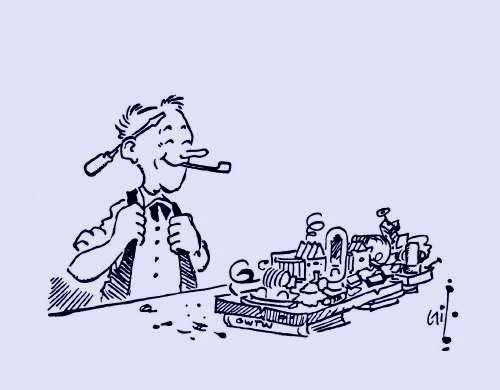
Although the Radio Act of 1927 gave the FRC the power to enforce regulations, it came down to the international agreements hammered out in the winter of 1937 to make things happen. The International Radiotelegraph Conference, attended by representatives from 72 countries, met in Washington, DC to grind out some international 'rules' since the growing popularity and surprising success of the 'shortwaves' was now of worldwide concern.
Much as we see today, the fight for radio spectrum had begun. The 172-page Washington document makes fascinating reading and in it we see the basis for many of amateur radio's beloved fundamentals.
 |
| Courtesy: http://www.arrl.org/ |
The amateur's of 1927 didn't know it yet, but they would soon be deep in rebuilding their stations to meet the 'new requirements' of 1929!
BK Bustle
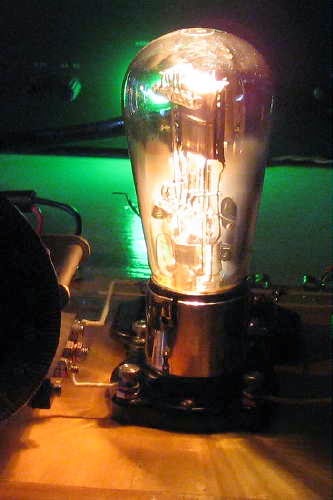
You may hear plenty of activity in the nights leading up to the Party as various stations burn the cobwebs out of their handmade creations around 3550-3570 in the next few nights...you might give them a call if you hear them as most will be delighted to know that they're getting out of their backyard.
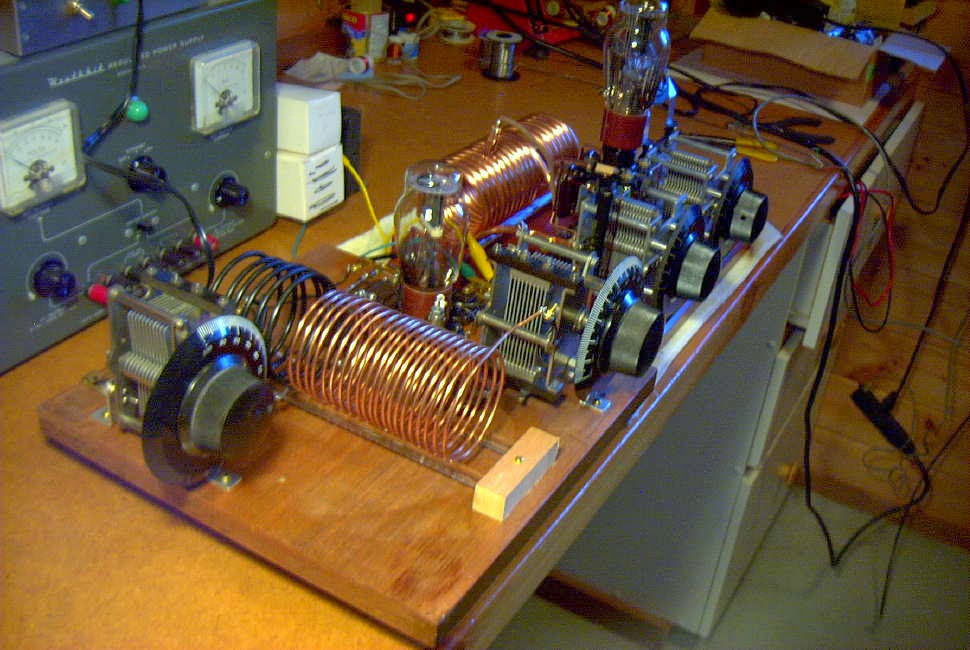
A few weeks ago, in the same spirit of preparation, I began work on a small amplifier for my Hull Hartley transmitter. Ever since entering the BK Party, I have been held hostage by the monster winds which always seem to show up here during early December. Self-excited oscillators connected to blowing antennas create an unusual-sounding signal...somewhat musical....up to about 30km, but after that, somewhat dreadful, as shifts in frequency between keying elements can be measured in tens of Hertz or more and make it difficult to copy a weak signal.
I put the amp together in the original 'ugly construction' style of the 20's, which I'll call 'ugly breadboard'. For the most part, period-appropriate components were used, as it was to be a 'proof-of-concept' project....to see if and how it would work and what changes might need to be implemented in a 'finished' version.
 t t |
| Amplifier stage followed by Hull Hartley exciter on far end. |
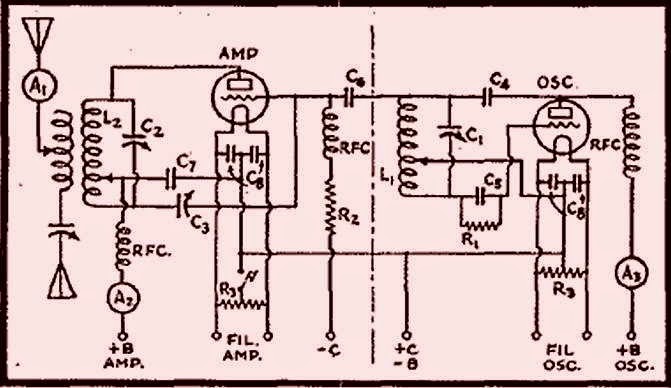
The original circuit, shown below, was published in the February 1931 QST and penned by George Grammer (W1DF), the ARRL's Assistant Technical Editor. Since I already had the oscillator section, I built the amplifier only, making a few modifications.
 |
| Courtesy: http://www.arrl.org/ |
My changes involved removing the B+ from the exposed plate tank coil by putting C7 between the plate and the tank circuit, grounding the coil tap point and shunt-feeding the B+ directly to the plate. As well, the operating bias was changed from the original combination of grid-leak and external fixed-bias (always a pain) to grid-leak bias only. Since I planned to let the oscillator run and key only the amplifier stage, no external (extra) bias was needed. The original system of feeding drive via capacitive coupling from the oscillator tank circuit was maintained as was the 'plate neutralizing' system. With the plate tank no longer carrying B+, a wide-spaced variable capacitor was no longer required for C3. These changes are illustrated below:
 |
| Courtesy: http://www.arrl.org/ |
Testing went smoothly and with the help of a tuned RF-sniffing wavemeter (the actual one I built when I was a brand new15 years old ham!), the amplifier neutralized beautifully. It was unconditionally stable, in spite of the numerous clip leads surrounding the board connecting to the separate Hartley oscillator in a somewhat haywire fashion....it really was a mess. As one other '29 builder (KK7UV) so perfectly described his latest workbench project, it "looked like the transmitter was on life-support!"
Surprisingly little drive was required from the Hartley and it was run at just 200VDC. The amplifier efficiency was around 50% which could probably be improved upon with careful attention to biasing values, shorter leads and more efficient antenna coupling. On 80m, the only band that I wound a coil for, keying was clean and very nice (an advantage of being able to run the oscillator at low level). Without too much effort, 15 watts out was easily obtained...far too much for the BK Party.
Tapping down on the tank coil for 40m operation proved to be a different story as the note sounded like a buzz saw...very raspy and nasty. To really undertake a fair test, a dedicated 40m tank coil would have to be used as well as a much 'cleaner build'.
The rat's nest of unwanted coupling of both RF and AC ripple was showing through on this higher frequency.
For multiband operating events, such as the BK, things have to be efficient enough to make band changing and tune-up procedures quick and simple and in its present haywire form, the amplifier would just not be 'contest-friendly'.
All in all it was a very valuable building exercise as a LOT was learned. I am now convinced that for a true MOPA (Master Oscillator Power Amplifier) combination to do what is needed will require an all-in-one style of construction....both oscillator and amplifier on the same board, with short leads and little chance for unwanted parasitic-coupling between stages. With separate coils for all bands and calibrated dials, tuning and changing bands would be very much easier than trying to couple two separate units together. I can see why the struggle to get the original '29ers away from their simple Hartley's and TNT's and over to MOPAS went on for several years.

So once again I am at the mercy of the wind-gods and hoping for two back-to-back Saturdays of quiet BK-friendly air...in early December...on the west coast...by the ocean...yeh, right!
Cycle 24….Still Teasing
 |
| Courtesy: http://www.noaa.gov/ |
With the solar flux index remaining relatively high over the past week, the F2 MUF has been spending most of the day in the mid 40MHz region. For 6m operators, it's always a good sign to see the MUF climb this high as it only takes a nudge to keep it climbing, hopefully to reach that magical 50MHz level.
The region between 10m and 6m is chalk-full of commercial two-way FM activity, particularly from 39MHz on up. With the skip zone running east-west, oftentimes the distinctive Boston accent or the unmistakable Bronx chatter can be heard...police, taxis, fire departments...sometimes even with sirens blazing away in the background. Other times, things will be further south, with accents favoring easily-recognized southern drawls.
Early this morning at 0641Z, a small M1.8 flare added some extra fuel to the F2 fire, resulting in an unusually early-morning rise in the MUF.
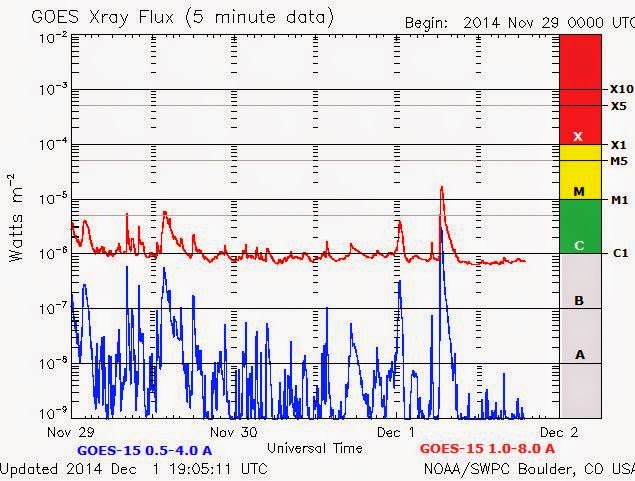 |
| Courtesy: http://www.solarham.net/xray2.htm |
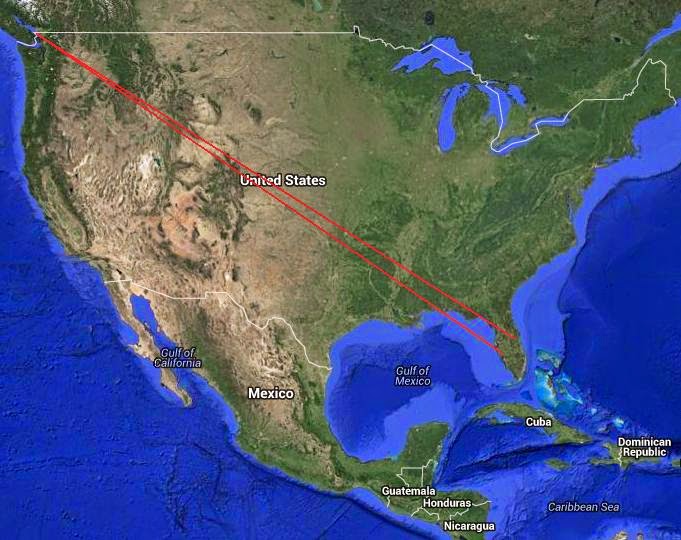
By 0900 local time, it was hovering around 46-47MHz when I started to hear the 22-watt W4CLM beacon near Atlanta, Georgia. Warming-up the transmitter and calling a few CQ's on 50.098, I was soon answered by Bob, N3LL, in EL86 on the west coast of Florida ....a nice single-hop (2600mile) F2 QSO. Another CQ brought KJ4E in EL98, to the northeast of Bob.
 |
| Courtesy: https://maps.google.com/ |
From here, things went south fast and for some reason, the normally slow climb halted as the MUF quickly retreated to the low 40MHz regions...it was all over.
The end of the opening can be clearly seen in the geomagnetic activity recorded at the Kiruna Magnetometer (Sweden). The circled area indicates the period of high MUF:
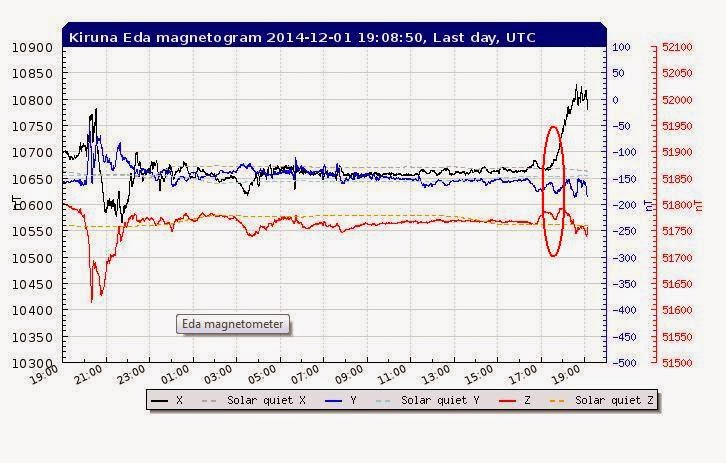
...but what started the sudden spike in the MUF today...was it the earlier flare or the suddenly south-going 'Bz' component of the Interplanetary Magnetic Field as seen about an hour earlier?
 |
| Courtesy: http://www.solarham.net/solarwind.htm |
I wonder what surprises tomorrow will bring?
630m Resources – Part 3

Probably the most-often discussed ham radio topic is that of 'antennas' and with LFers it is no different.
When it comes to antennas used for receiving,
you might be surprised to learn that even small, simple antennas, can be very effective on 630m. Small loops are easy to build and work well as they are often quieter than wire antennas and with preampflication, will usually yield a better signal-to-noise ratio.
The shielded Burhan's loop described here, is a good performer on 630m and below, while a tuned wire loop can be just as effective if resonated to 630m.
Easily built active antennas are also popular and once situated in a quiet spot in your backyard, can work extremely well, considering their size and simplicity. The PAØRDT active antenna is popular worldwide and offers good performance, if properly placed, as shown in this LF bandscan from Japan.
Several of the stations that I recently worked on crossband, from 630m to HF, were using their normal HF dipoles to listen on 630m. Often times a non-resonant antenna, such as an 80m dipole, can give reasonably quiet performance and is worth trying should you just want to listen. Others have used HF dipoles with the feedline shorted and fed as a top-loaded vertical (T), and resonated to 630m against a small radial ground. Try what you presently have and you may be surprised at what you can hear.
Transmitting antennas need not be large to enjoy 630m propagation. For most backyards, an inverted 'L' antenna would probably be the easiest to configure.
If you have a tower, the vertical portion of the 'L' could be hung from a support arm off of the tower, with the horizontal portion as long and as high as possible. If you have some trees to hang wires from, a center-fed 'T' antenna would also be effective.
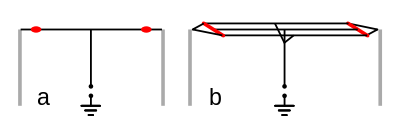 |
| Top-loaded 'T' Antennas. Courtesy: http://en.wikipedia.org/wiki/T-Antenna |
In both of these examples, try and get as much 'vertical' as possible and then work on the top-hat portion. Top-hats with multiple wires will also increase antenna efficiency. An interesting paper by VK2DX, explains the process that he used to build and match a simple inverted 'L'.
 | |
| Courtesy: VK2DX |
As well, JUMA publishes an informative application note on building an 'L' for 630m.
If you don't have room for one of these types of antennas, effective results can also be had with short top-loaded radiators as used at many NDB installations. Try to go as high as you can and make the top-hat as large as possible.
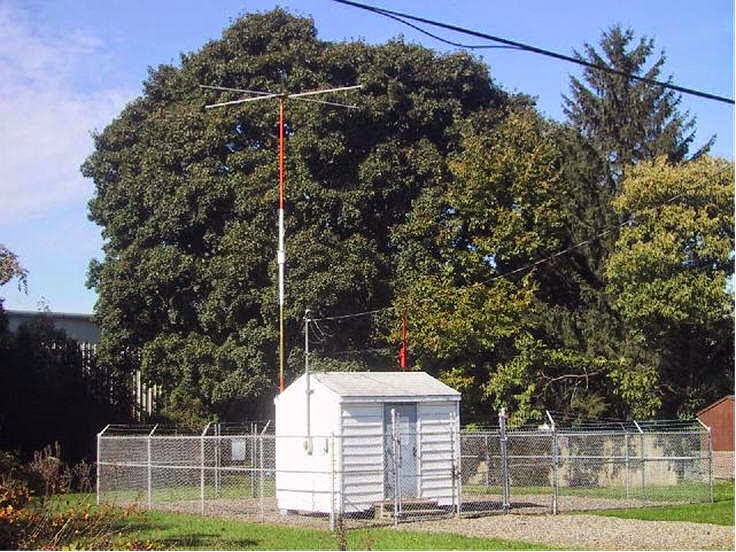
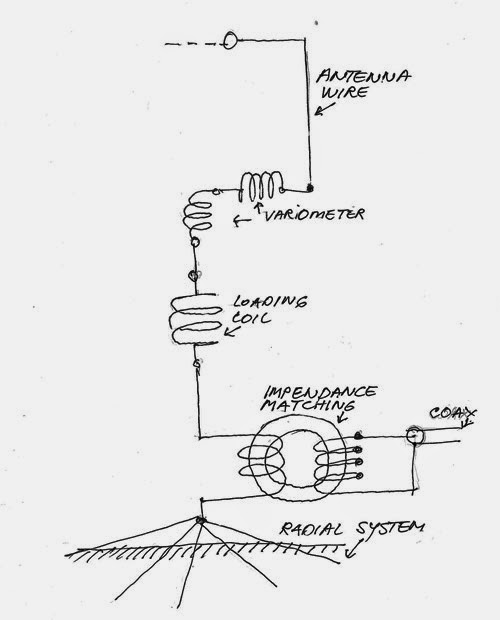
Any of the transmitting antennas described above will require sufficient series inductance (base loading usually) to bring them to resonance as well as some form of variometer to fine-tune exactly. As well, they all require some form of ground system to radiate.
Since most backyards will never be large enough for an efficient ground system on 160m, let alone on 630m, just do the best that you can. You might be surprised at the results achieved with just a simple system of a few buried radials but the more you can lay down, the better. Radials can be effectively hidden beneath the grass with a few days of effort. Some have noted an increase in antenna current when ground rods were driven in at the far end of the radials.
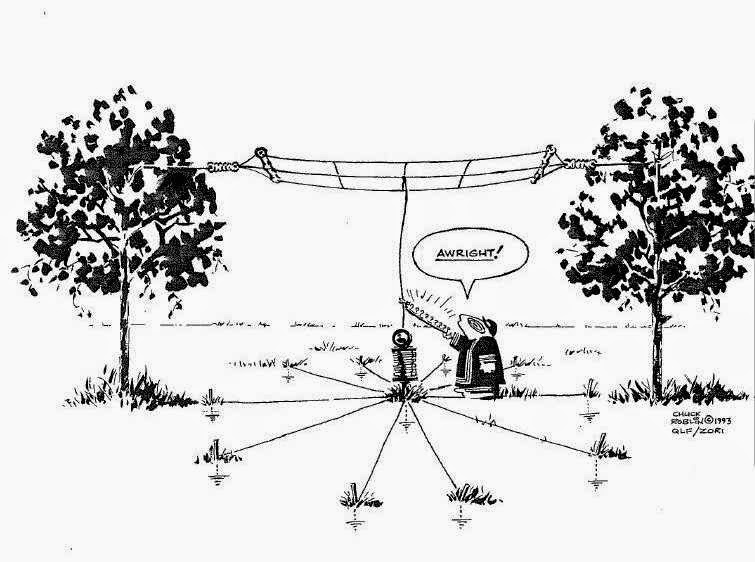 |
| Courtesy: http://www.auroralchorus.com/ |
This well-written series of articles describing simple antenna systems for the 1750m band is chalk-full of neat ideas and practical information...all applicable to the 630m band.
For an even more in-depth look at practical LF and MF antennas, the ON7YD site is hard to beat...again, all applicable to 630m.
Canada's new 630m band is a wonderful opportunity to build and experiment with all aspects of your station and it's crying out for activity!
It's still not too late to be the first station on 630m from most parts of Canada and the VE7's are waiting to work you!
Loop..Perseus..and CLE188
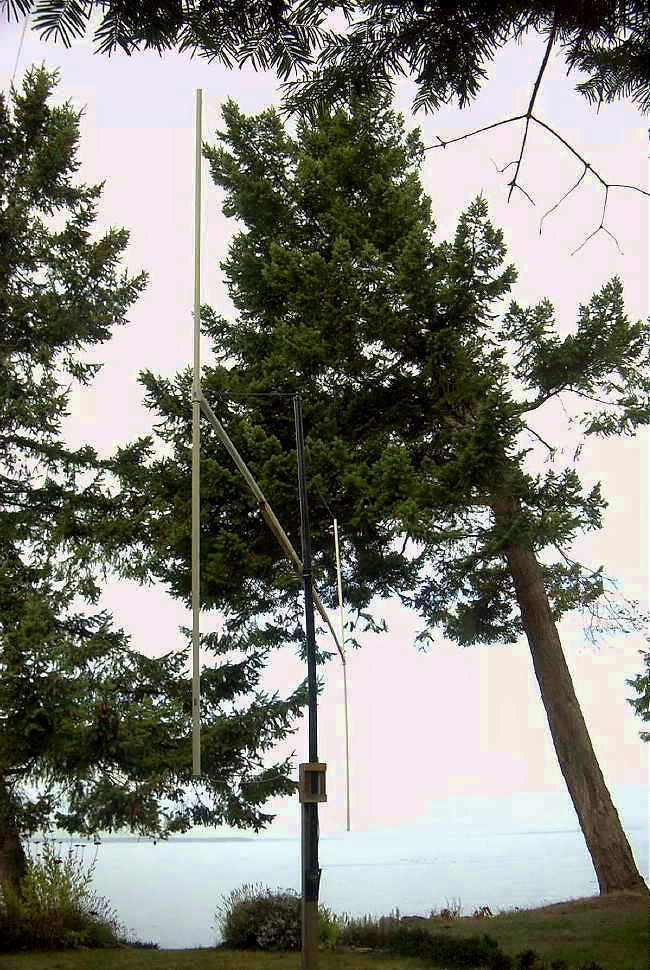 |
| 10' x 20' LF Loop |
As is usually the case, conditions deteriorated rapidly as the CLE weekend approached. Conditions varied throughout North America as those listening from the south-eastern regions of the U.S. reported much better propagation than those further to the northwest. Friday night appeared to be the best of the lot but all three nights were very much less than stellar.
The three-night event produced a total of 39 NDBs, with a couple of surprises.
DD UTC kHz Call mi Location
----------------------------------------------------------
22 05:00 370 YBV 1169 Berens River Apt, MB, CAN
22 06:59 370 OUN 1611 UoOk Westheimer Apt, OK, USA
22 05:00 371 YK 211 Yakima, WA, USA
23 09:00 371 PUR 1629 Marshall, MO, USA
22 05:00 371 ITU 558 Great Falls, MT, USA
22 05:00 371 GW 1946 Kuujjuarapik, QC, CAN
22 05:00 372 ZPA 824 Prince Albert, SK, CAN
22 05:00 372 YCO 1340 Coppermine, NU, CAN
22 05:12 372 FPN 675 Petersburg, ALS
22 07:00 373 TF 1191 Pueblo Mem Apt, CO, USA
22 05:00 373 MF 444 Table Rock, OR, USA
22 05:00 374 LV 776 Livermore, CA, USA
22 05:00 374 EX 190 Kelowna, BC, CAN
23 09:00 374 EE 1319 Forada, MN, USA
22 05:00 374 BOD 942 Bowman, ND, USA
24 09:59 375 PSN 1854 Palestine, TX, USA
22 05:00 375 FS 896 Fort Simpson, NT, CAN
22 10:59 375 DW 1629 Owasso, OK, USA
22 07:00 375 CP 900 Casper, WY, USA
22 05:00 375 BD 803 Moose Jaw, SK, CAN
22 07:00 376 ZIN 3326 Matthew Town, BAH
22 07:00 376 YAG 1345 Fort Frances, ON, CAN
22 13:59 376 PVQ 1690 Deadhorse, ALS
22 06:59 377 EHA 1350 Elkhart, KS, USA
23 06:59 378 ZFA 1000 Faro Municipal Apt, YT, CAN
22 05:00 378 OT 381 North Bend, OR, USA
22 10:59 379 ZEG 526 Edmonton Intl, AB, CAN
22 05:00 379 YBE 945 Uranium City, SK, CAN
23 12:59 379 IWW 1360 Kenai, ALS
22 09:00 380 OEL 1297 Oakley, KS, USA
22 05:00 380 GC 899 Gillette, WY, USA
22 05:00 382 YPW 86 Powell River, BC, CAN
22 05:00 382 YE 686 Fort Nelson, BC, CAN
22 12:59 382 JNR 1731 Unalakleet, ALS
22 12:00 382 GRN 1522 Guerro Negro, MEX
22 05:00 382 AW 75 Marysville, WA, USA
22 06:59 383 PI 658 Pocatello, ID, USA
22 05:20 383 CNP 1146 Chappell, NE, USA
22 05:00 384 3F 792 Ile-a-la-crosse, SK, CAN
-----------------------------------------------------------------
This particular frequency range (370-384.9kHz) is a tough one for me, since my local pest signal, 'AP' is on 378kHz, smack in the middle of the listening range. 'AP's antenna is just .4 miles (2100') from my antenna and its signal is about 60db over S9.... Very loud!
 |
| AP to me...Courtesy: https://www.google.ca/maps/ |
Using this 'deep null' position, I was (somewhat surprisingly) able to log another Canadian NDB (ZFA Mayo Airprt, Yukon Territory) on the same frequency as AP. The ident-tone modulation frequencies are separated by 10Hz (408Hz vs 418Hz) which was enough to allow the very narrow ~3Hz Perseus filtering, combined with two notch filters, to reveal the 'ZFA' identifier between the 'AP' identifier. Listen for the weak 'ZFA' ident after the loud keying artifacts of 'AP', when they are transmitting just a steady tone.
The other surprise was the logging of 'PVQ' in Deadhorse, Alaska, way up on the extreme northern slope oil fields.
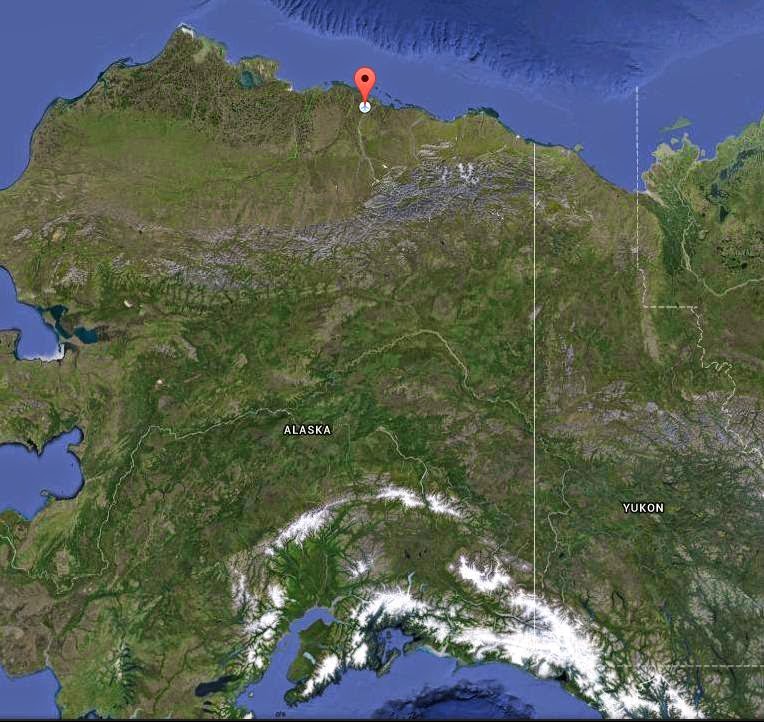 |
| Courtesy: https://www.google.ca/maps/ |
CLE organizer, Brian Keyte (G3SIA), reports 51 participants worldwide and over 2100 reception reports. All reports have been added to the RNA/REU beacon database.
As well, Brian will be publishing all results on the NDB Information page shortly.
All-in-all CLE188 was another enjoyable event....hopefully conditions will be better by this time next month and if you did not participate, maybe you will give it a try next time!
630m Resources – Part 2
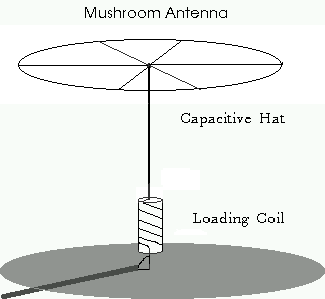
Using the transverter approach offers the advantage of providing a higher-stability signal generated by the main station's transceiver oscillator system. Most of the digital modes require a higher stability than would be needed for straight CW.
If your main interest is normal speed CW, then a digital VFO, such as the one devised by GW3UEP, would do the job.
If you are content operating on 475.0 kHz, then an inexpensive 7.6MHz crystal, in a divided-down oscillator will work well, and with good enough stability for some QRSS work as my earlier "GW3UEP Transmitter In QRSS Mode" report indicated.
The other option for frequency generation is a DDS.
 |
| N3ZI DDS |
For those wanting something a bit more robust, W1VD describes a very nice high-power transmitter. His website is packed with useful circuits and ideas for both 2200m and 630m.
 |
| W1VD Dual-Band Kilowatt : http://www.w1vd.com/ |
W7IUV also describes, in great detail, his method of generating high-power on 630m. There is much to be learned from his document describing the design and operation of his unique 'linear-mode' transmitter.
 |
| W7IUV 630m TX: http://www.w7iuv.com |
Another practical way of generating moderate power, certainly enough to meet the Canadian 5W EIRP limit, is to combine two or more 100W transmitters, such as the GW3UEP transmitter. It is reasonably simple and inexpensive to combine several modules with the use of a homebrew power combiner, as previously described.
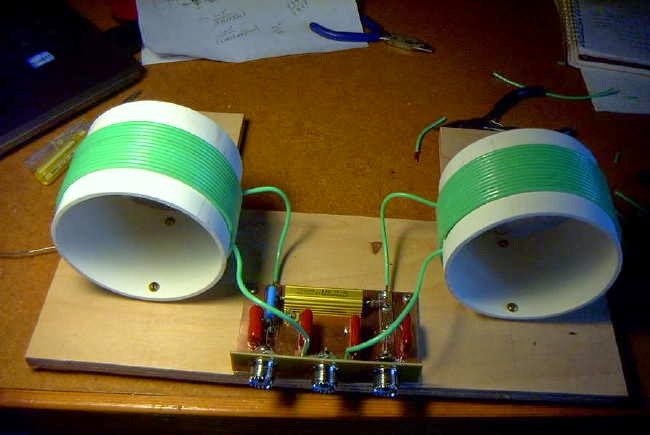 |
| Homebrew 630m two-Port Power Combiner / VE7SL |
630m Resources – Part 1

If you're thinking about getting something going for our new 630m band, the following web resources may be of help to you.
There are a couple of 630m transmitters available on the commercial market that I know of.
JUMA , in Finland, offers the TX500, an extremely well engineered 60W Class D CW transmitter in kit form.
 |
| JUMA TX500 Transmitter: http://www.jumaradio.com/juma-tx500/ |
 |
| VK3XDK Linear Transverter: http://www.vk3xdk.net46.net/ |
From the U.S.A., WA3ETD offers a Class D transverter (non-linear) in either prebuilt or kit form.
At 13.2VDC, an output of 19-22W is claimed from the single FET final amplifier. Full details can be viewed here.
 |
| MF Solutions Transverter: http://njdtechnologies.net/ |
Roger's (G3XBM) has been widely reproduced in the UK and makes a nice way to get on the band on CW or with WSPR. Although the final amplifier is non-linear, with a little experimentation, it could be put into a linear mode for PSK or the JT modes. Perhaps that is what M1GEO did, as his video shows the transverter being used on SSB.
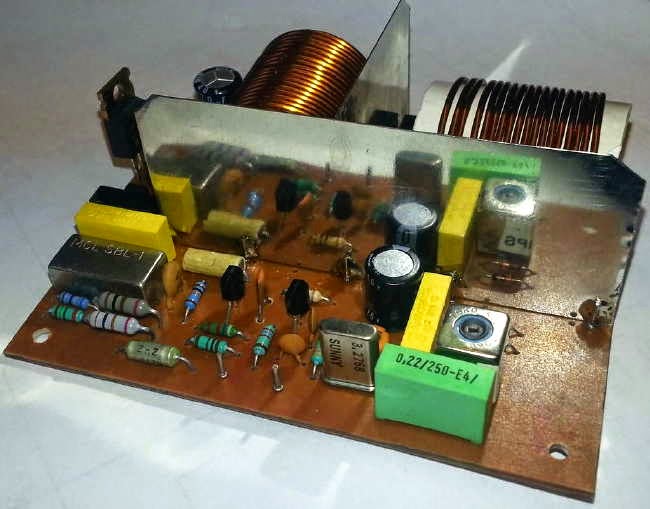 |
| M1GEO's Homebrew Version of the G3XBM Xvrtr |
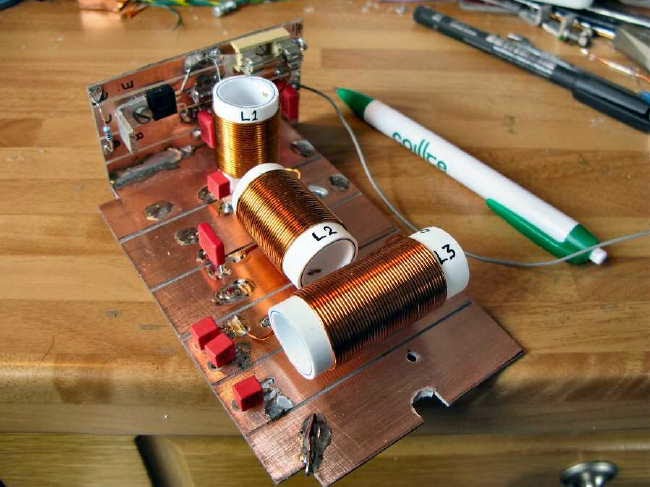 | ||
| Source: http://www.gw3uep.ukfsn.org/25W_QTX/QTX.htm |