Author Archive
 Another New VE on 630m!
 January 8th, 2016 |
  Author:
 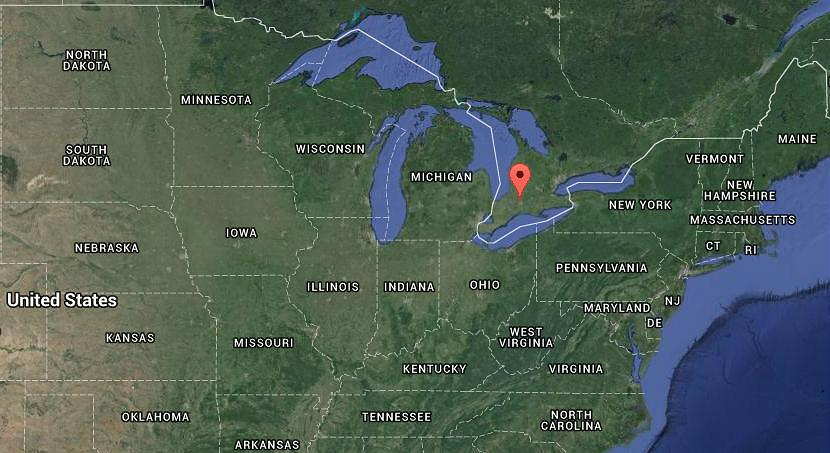 |
| courtesy: https://www.google.ca/maps |
Another new Canadian station has been activated on 630m ... VE3OT, Mitch, in London, Ontario.
For many years, Mitch has been running his QRSS 'MP' beacon on 2200m, using a large E-W wire loop and about 200 watts.
The move to 630m uses the same transmitter with a retuned loop and new output LPF. Although the antenna tuner still needs a capacitor swap and a new toroid to perfectly resonate the loop, Mitch has been getting many good 'audible' reports from eastern stations as well as from the central states and as far south as Texas.
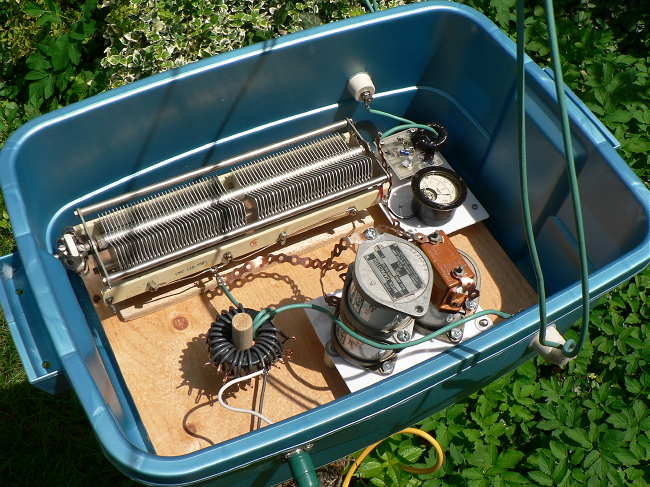
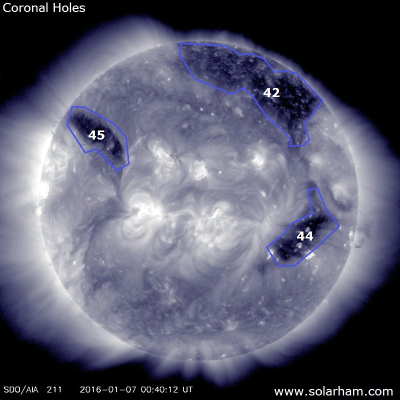
Present testing is in the QRSS6 CW mode on 475.0 kHz. Unfortunately, since moving up to 630m, E-W propagation has been hit and miss and although I can copy his QRSS6 CW signal, I have not had aural copy as of yet ... maybe tonight.
 |
| courtesy: http://www.solarham.net/ |
***************************************************
Another 630m CW crossband activity has been planned for early February and I will have more details shortly. If you missed the last event, here is another chance to get in on the two-way crossband fun ... please stay tuned!
***************************************************
LED Lights In The Shack
 |
| Utilitech Pro Soft White LED Bulb |
A recent posting by Phil, KO6BB, to Yahoo Group's ndblist, described his recent search for some LED lamps to replace the CFL's in his shack / radio workbench area. If you have been wondering how much RFI that LED lamps might be producing, you may find Phil's findings of some value.
"Recap
I had a 60W equivalent CFL in the floor lamp directly over my operating position. I'd tried a 100W equiv one but it was extremely noisy! Also a couple CFLs in the ceiling lamp.
This is a floor lamp with a crookneck at the top and a triangular metal
shade reminiscent of the old style desk lamps, bulb is horiz to the
floor. I've used it for years and like it because it places the light
directly over the operating position work area (keyboard, radios etc).
The actual bulb was about 4.5 inches from the front of the Softrock SDR
receiver (in a plastic case), with the base of the lamp (where the
electronics are) about 7.5 inches (somebody asked about the distances).
This coupled a LOT of RFI directly into the SDR, visible on the
waterfall. For best results when recording and having the light on I'd
slip a 60W incandescent lamp in place of the CFL. The lamp is also
about 16 inches above the operating table, and when listening to ANY
portable radio on the table, if it was in the AM or Longwave band and
using the built in loopstick antenna, got a LOT of RFI from the lamp
(unless the lamp was off ;-)
So today I went down to Lowes (we have a Costco, but I don't have a
card) and looked at their LED lamp offerings. As I expected they had a
large variety of them, from a low cost 3 pack for ~$9.00 for 60W units
to about $18.00 or so each (Sylvania). From what I read here I wanted
to avoid the REALLY cheap ones as some reported them to be 'noisy'.
Also, I wanted to put a 75W equivalent unit in the one over the
operating position, and a pair of 100W equivalent units in the ceiling
lamp. All three had CFLs, and if I walked around the radio room with a
portable radio and the ceiling lamp on I could hear it's 'hash' anywhere
in the room. . .
The ones I settled on were a brand I'd never heard of, "UtiliTech Pro"
soft white, 75W for the bench and 2 100W ones for the ceiling. They
were what I'd call "mid-priced", $8.98 for the 75W and $9.98 for the
100W ones.
Specs:
75 W one draws 12W and gives 1100 Lumens.
100W one draws 16.5W and gives 1600 Lumens (the pair in the ceiling
should then be 3200 Lumens if I calculated right).
How low is the RFI to my Radios?
75W one over the bench:
NO trace from the lamp electronics visible in the SDR waterfall at
all. With a portable radio on the bench-top, NO audible RFI. Put a
portable radio up to the "bulb" part (light area) and with no station
tuned in can't hear ANY RFI. Move the portable to the base area of the
lamps there is SOME RFI, but I won't be putting the radio that close to
the lamp, move it a couple inches away and the noise disappears.
100W ones in the ceiling lamp, NO audible RFI in the portable when
walking around the room, RFI just barely perceptible right next to the
light wall switch that turns the lamp on, again, audible IF I put the
radio right up to the base of the lamps, not a likely real-world scenario!
Upshot?
Based on the sample of three that I bought and the almost
non-existent RFI from them I'd consider the UtiliTech Pro lamps to be a
good product and suitable for use in the radio room. I consider them
good value for the ~$30.00 I spent for three."
I don't see these being sold here in Canada but I may be mistaken. If you have tested anything similar (other brands / models), please let me know and I will add it to Phil's helpful information.
KO6BB's website can be found here, along with some of his homebrew equipment.
GW3UEP 630m Transmitter Tweaks
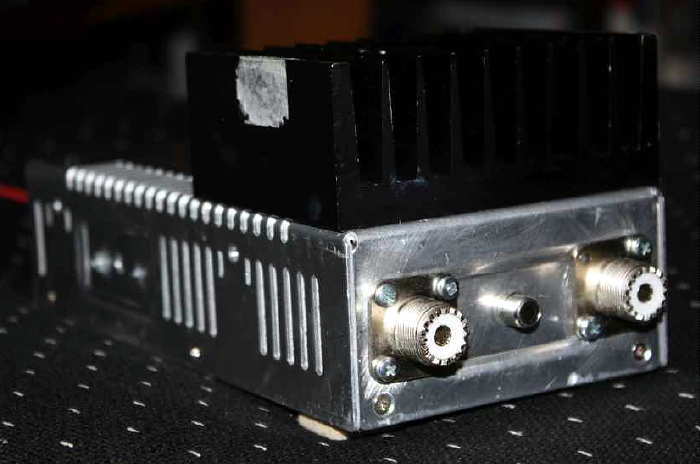 |
| DF8UO's GW3UEP 630m Tx |
Hi Steve,
I have seen on your Website, that you are also a MF/LF fan and builder of GW3UEP QTX. I build the version with 2 IRF540 as you proposed and the same version with 2 IRF630. As I bought some time ago a PSU with can be regulated from 1V to 60V and max 10A (it is a Manson HCS 3404) I made some measurements on both version. Find attached an Excel with the measurements I made, if you are interested in.
If you use the IRF540 version you can see that if the power exceeds 100 W, the efficiency goes down, as the IRF540 is only specified for 100V.
Currently I am using the IRF630 version running at 300W without problems.
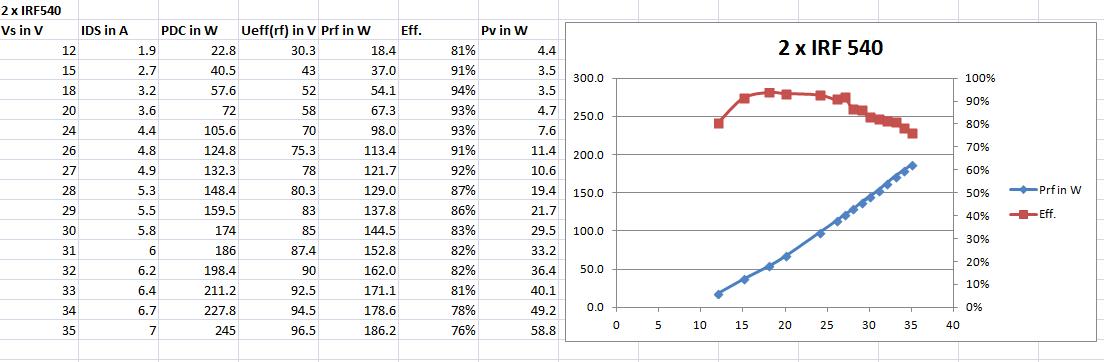
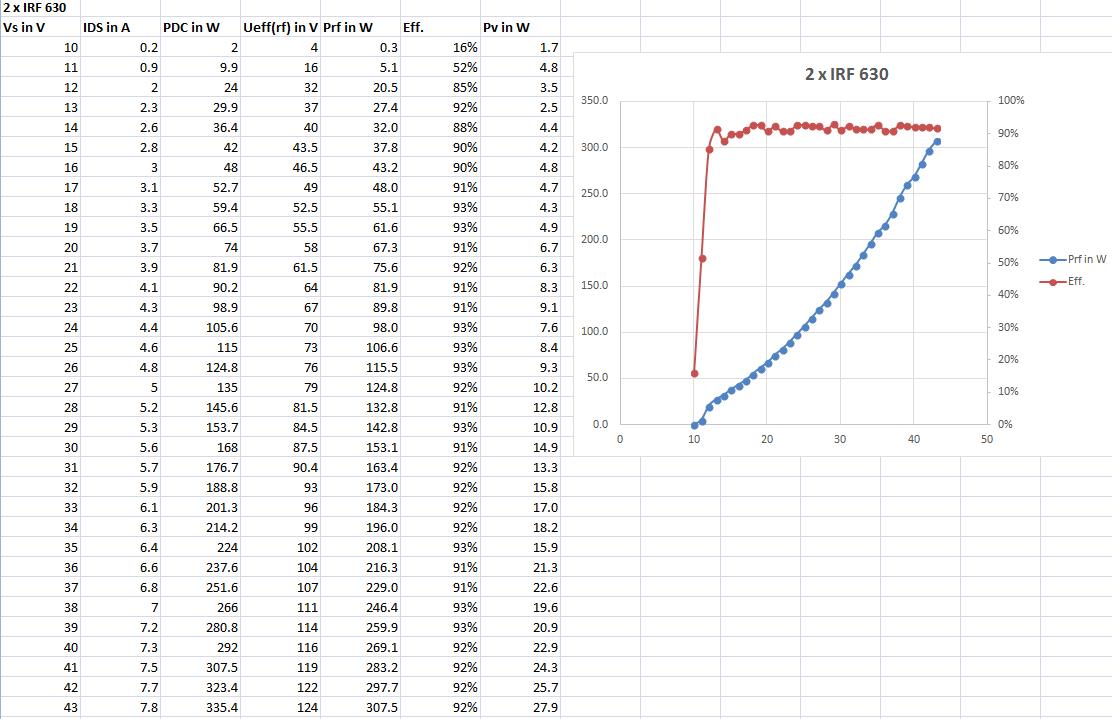
From Daniel's test data, it looks as though the IRF540's are quite happy as long as you keep the transmitter at 100W or less ... anything higher would certainly benefit from the switch to IRF630's as the high efficiency is maintained at least to the 300W level. Something at this level would no doubt benefit from higher-voltage capacitors and heavier inductors as well as a little more heatsinking, enough to shed at least 25 watts of heat between the two FETs.
Daniel drives his amplifier with an Ultimate3, followed by a 10db attenuator, a squarer and into the totem pole driver stage. His own version uses toroidal inductors rather than the original air wound coils.
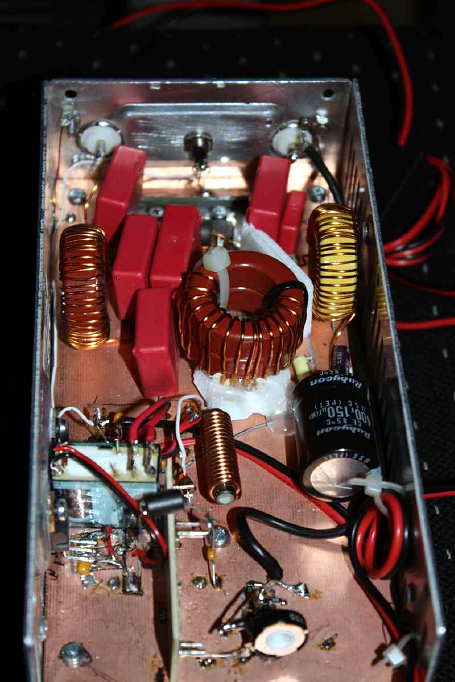
A pair of GW3UEP amplifiers using IRF630's at ~40V into a small power combiner, should provide ~550W of useful output at >90% efficiency ... more than enough power to do some serious work on 630m.
Hunting For NDBs In CLE 202 – Using Remote SDRs
 |
| courtesy: http://websdr.ewi.utwente.nl:8901/ |
If you've ever enjoyed listening to remote SDRs on the internet, then you might find this particular CLE of interest.
There really are some excellent receivers, with very quiet LF reception capabilities, being made available on the web ... all with just the click of a mouse!
If you have avoided previous CLE activities because of local noise issues, perhaps using one or more of these remotes will inspire you to give it a try ... but be careful ... hunting for NDB's can easily become addictive.
From CLE co-ordinator, Brian Keyte (G3SIA), comes the following (detailed) announcement of this weekend's interesting event:
It is quite easy to listen to NDBs in different parts of the World using remote receivers via the Internet. If you are a fan of 'Live Listening' without use of recordings - this is for you!
I have chosen ten receivers to use, located in eight different radio countries.
Most of them should give quite good coverage of NDBs by day and by night.
A brief description of how to log in to the receivers is given at the end of
this email.
Start: Friday 1 January at 12:00 UTC
End: Monday 4 January at 12:00 UTC
(note the UTC start/end times, NOT your local midday)
Frequencies: 190 kHz - 1470 kHz
Remote Receivers - all of the TEN receivers listed below.
Target: A maximum of TEN normal NDBs logged from EACH receiver.
Try to include as many different radio countries in your log
as you can.
Eight Global Tuners ( www.globaltuners.com ) located at:
Sydney, New South Wales, Australia *428 GLF
Grenoble, Rhone-Alpes, France 291 WS
Mojave Desert, Ridgecrest, California, USA 344 FCH
Odenwald, Hessen, Germany 292 NKR
Crema, Northern Italy 400.5 COD
Rimini, Italy 374.5 ANC
Rovigo, Italy 332 PDA
Vilhena, Rondonia, Brazil 395 VLH
Two WebSDRs located at:
University of Twente, Enschede, Holland *406.5 BOT
http://websdr.ewi.utwente.nl:8901
University of Southampton, Farnham, England 328 BLK
http://websdr.suws.org.uk
*As a starter for you, the kHz and Ident of a local NDB are given on each line.
LOGS (Please read CAREFULLY):
Please show your loggings in a SEPARATE GROUP for each receiver with
a line showing the LOCATION NAME OF THE RECEIVER before each group.
Please include on EVERY LINE of your log:
# the UTC date ( e.g. '2016-01-02' or just '02' )
# UTC time (the day changes at 00:00 UTC).
# kHz - the nominal, published, frequency.
# Call Ident.
Show those main log items FIRST. Any other, optional, details such as the
NDB's location, etc. must go LATER on the same line. You could include
any UNIDs - e.g. separately if you already have ten loggings for that receiver.
It would be OK to include the same NDB more than once if it was heard with
different receivers.
As this is a special kind of CLE, any extra comments in your log on your
listening experience will be of interest.
REMINDERS: Only use the ten SPECIFIED receivers. Not more than 10 loggings
from any receiver - so 100 is the (impossible?) maximum loggings for the CLE!
Only LIVE LISTENING for this event. Start/End at 12:00 UTC, not your midday.
Remember that reception conditions will depend on the local time of day/night
at the receiver.
We hope to send the owner of each of the ten receivers a list of all the
loggings that we manage to make using it - several of the owners may
not know much about NDBs, so it could help to advertise our hobby.
Whether you are taking part in this event or not - A HAPPY NEW YEAR
Brian
----------------------------------------------------------
From: Brian Keyte G3SIA ndbcle'at'gmail.com
Location: Surrey, SE England (CLE Co-ordinator)
----------------------------------------------------------
HOW TO USE THE RECEIVERS
GLOBAL TUNERS
Go to www.globaltuners.com and sign up for a free account.
You'll only need to choose a user name of 3 or more characters (almost
anything such as your call sign - I used NDBbk) and give your email address
for a password to be sent to you.
Choose one of the eight specified receivers when it is shown as 'Free'.
If available, one of the Italian receivers would be a good starter.
Read the brief information about it and then 'Open this receiver!'.
To start with, set a low volume (usually at the left hand side) and try these
settings: AM, Medium or Narrow, ATT, AGC and NB all UNselected.
The frequency selection is usually in MHz, so for 332 kHz you would enter .332
When you change any of the settings, including the frequency, there is a delay
of a few seconds for the change to take effect. Try CW settings as well as AM.
Please always look out for any messages in the 'chat' lines and give way
( 'Log out' ) if asked to do so (maybe by a Full User or by the owner of that
receiver). We have permission to use the receivers for our CLE as 'guests'.
Please try not to stay logged on to a particular Tuner for a long period.
WebSDRs
Go to http://websdr.ewi.utwente.nl:8901 or http://websdr.suws.org.uk
and read the advice (It would probably be easier to start with Twente).
Just as for the Global Tuners, you are invited to enter an Ident - name or
Callsign, etc. - in a box above the Waterfall.
You can begin listening right away.
To start with, set a fairly low volume (right hand side), type the desired
frequency in kHz, select AM-nrw and MAX in.
That should allow you to hear the suggested NDB for that receiver and you
can then enjoy improving reception with the big range of settings available.
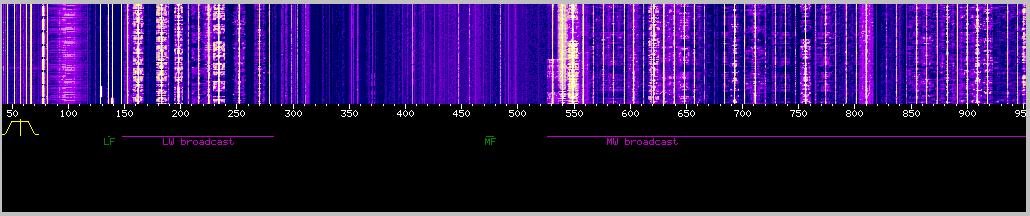
In the big black area on the screen above, you can see the frequencies being
used and the Idents of maybe hundreds (for the Twente receiver) of the other
simultaneous users. You will probably recognise your own Ident there too
at the LF end - i.e down the far left hand side.
ENJOY!
These listening events serve several purposes. They:
- determine, worldwide, which beacons are actually in service and on-the-air so the online database can be kept up-to-date
- determine, worldwide, which beacons are out-of-service or have gone silent since the last CLE covering this range
- will indicate the state of propagation conditions at the various participant locations
- will give you an indication of how well your LF/MF receiving system is working
- give participants a fun yet challenging activity to keep their listening skills honed
Final details can be found at the NDB List website, and worldwide results, for every participant, will be posted there a few days after the event. If you are a member of the ndblist Group, results will also be e-mailed and posted there.
The very active Yahoo ndblist Group is a great place to learn more about the 'Art of NDB DXing' or to meet other listeners in your region. There is a lot of good information available there and new members are always very welcome.
You need not be an ndblist member to participate in the CLEs and all reports, no matter how small, are of much value to the organizers. 'First-time' logs are always VERY welcome!
Reports may be sent to the ndblist or e-mailed to either myself or CLE co- ordinator, Brian Keyte (G3SIA), whose address appears above.
Please ... do give the CLE a try ... then let us know what NDB's can be heard from your location! Your report can then be added to the worldwide database to help keep it up-to-date.
__._,_.___
Great Circle Map Generator
A recent 'year end review' posting in the Amateur Radio Weekly blog, reminded me of great little piece of online software that might interest a lot of hams. It is a very nice Great Circle Map Generator, centered on your specific location.
The map generator is the brainchild of Tom, NS6T, and can be found on his 'HAM STUFF' website along with some other interesting bits. The actual map generator can be found here.The user interface is simple and map generation times are fast. Anyone with a beam will likely be interested in this, should they not already have a great circle map for their present QTH.
I used my six-letter grid square identifier for centering the map. Depending on the 'distance' value used, one can tailor the map for local / regional work or for a worldwide setting.
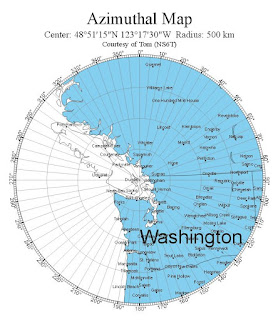
This is the map generated for a distance unit of 500km and would be helpful for local VHF'ing:
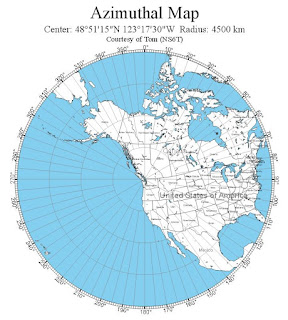
This map was produced when a distance unit of 4500km was used ... nice for the 6m grid square hunter:
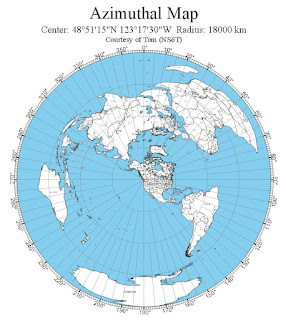
This worldwide map was produced with an input of 18000km:
Hopefully you might find the map generator of some value in your own shack.
The map generator is the brainchild of Tom, NS6T, and can be found on his 'HAM STUFF' website along with some other interesting bits. The actual map generator can be found here.The user interface is simple and map generation times are fast. Anyone with a beam will likely be interested in this, should they not already have a great circle map for their present QTH.
I used my six-letter grid square identifier for centering the map. Depending on the 'distance' value used, one can tailor the map for local / regional work or for a worldwide setting.
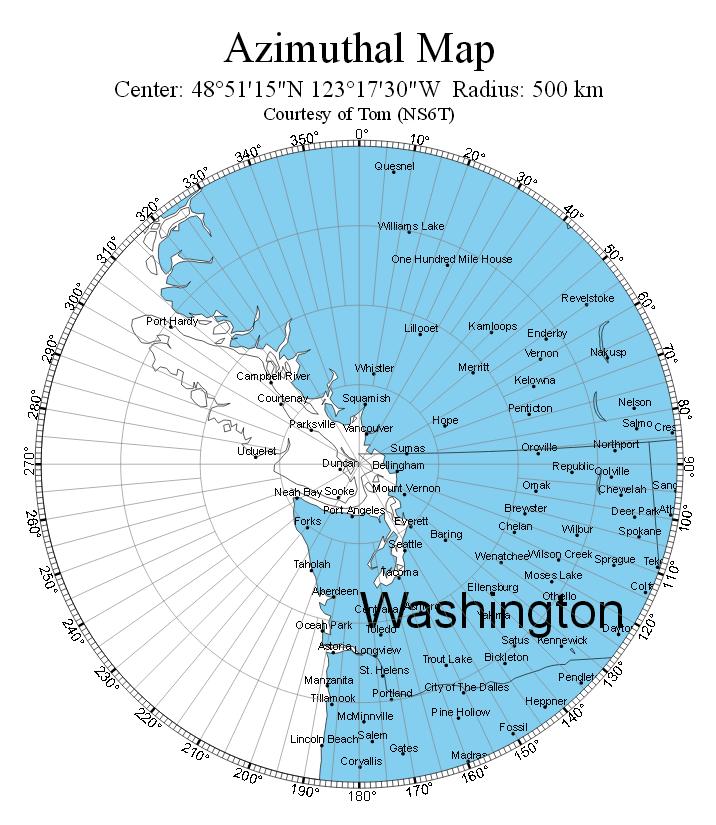
This is the map generated for a distance unit of 500km and would be helpful for local VHF'ing:
This map was produced when a distance unit of 4500km was used ... nice for the 6m grid square hunter:

This worldwide map was produced with an input of 18000km:

Hopefully you might find the map generator of some value in your own shack.
Stew Perry Topband Challenge
Last night saw another running of the winter Stew Perry Topband Challenge.
This contest is unique in that the usual density of activity on the eastern side of the continent does not necessarily provide an advantage ... contest scores are determined by the distances worked and each QSO will have a different point score, depending on its distance. The exchange is a simple one ... grid locators only ... and from these, the point score for each contact is calculated. From my way of thinking, and many others that I have discussed this with, the 'SP' is one of the fairest contests there is, putting everyone, no matter where they are located, on an even footing.
 |
| Today's Sun (courtesy: http://sdo.gsfc.nasa.gov/) |
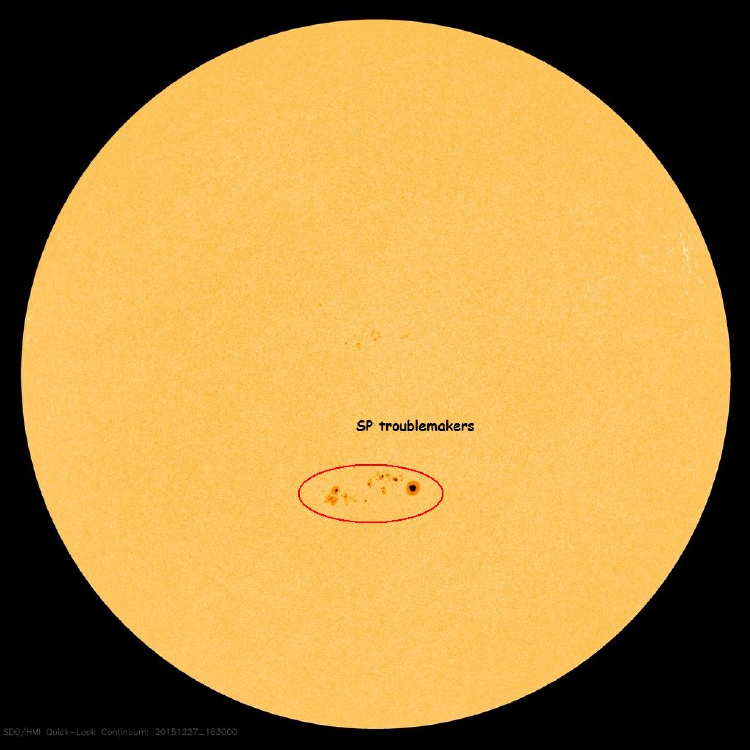
From here, operating in the 100-watt category, it was a struggle to work the normally easy single-hop stations, with no signs of the central states for several hours after sunset. Several east coast stations were worked towards midnight for the nice 12-point per QSO scores, but truth be told, almost all contacts were a struggle with many stations needing several repeats just to get the call or grid.
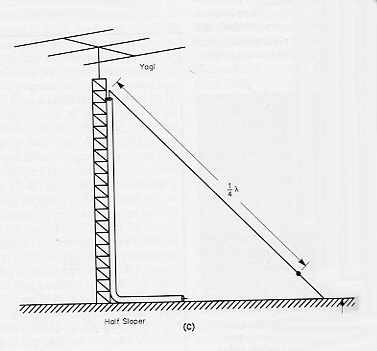
My half-sloper antenna and radial system is located right on the edge of the ocean, looking to the east, and its already low takeoff angle is enhanced with ~ 6db of sea (horizon) gain, making it a poor antenna for anything within the first-hop region ... after that it really seems to comes to life.
At 12:15 a.m., I pulled the plug, ending up with just 97 QSO's and 555 claimed points, way down from normal. Other claimed scores can be viewed on the 3830Scores.com website.
My best DX is usually JA but this time was KH6. The SP is always fun, but better conditions would have really made it a blast ... hopefully next year!
Tri-Tet Fun
 |
| courtesy: VK5TR http://www.users.on.net/~endsodds/ |
I spent a few hours yesterday, operating in the 'RAC Winter Contest'.
Originally, this contest began back in 1932, when QST excitedly announced a 'Canada-U.S.A. Contact Contest' to run in mid-January of that year.

The contest turned out to be extremely popular and has been run, in one form or another, ever since ... gradually becoming known as the 'VE-W Contest', sponsored by the Montreal Amateur Radio Club, and eventually by its modern name, with one version in July and a second in December.
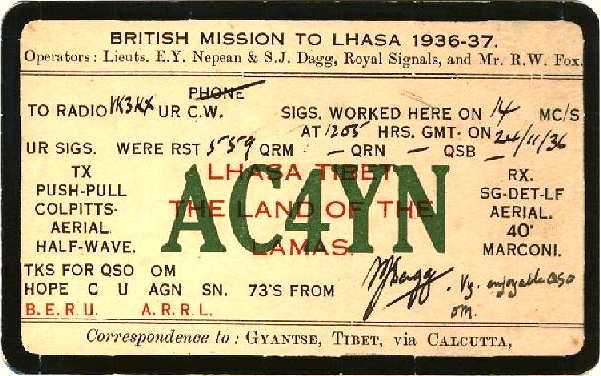
As a teen-aged ham, the 'VE-W Contest' was always the highlight of the year as the contest format, much as it is today, made anyone with a 'VE' call as sought-after as AC4YN ... not the one in North Carolina!
Old-timers and DXers will remember the call, as it represented the rarest of all possible contacts at the time and only a very lucky few made contact with the low-powered station, high in the Himalayan mountains at the British mission encampment in Lhasa, Tibet, in the late 30's. Having an 'AC4' QSL on the wall anointed you bragging rights for life.
Another great aspect about the contest back then, as in most, was that stations exchanged real RST's and not the meaningless '599' of today's contest operation. It was always interesting to learn how my little station, nestled in the upstairs attic, was really sounding at the other end.
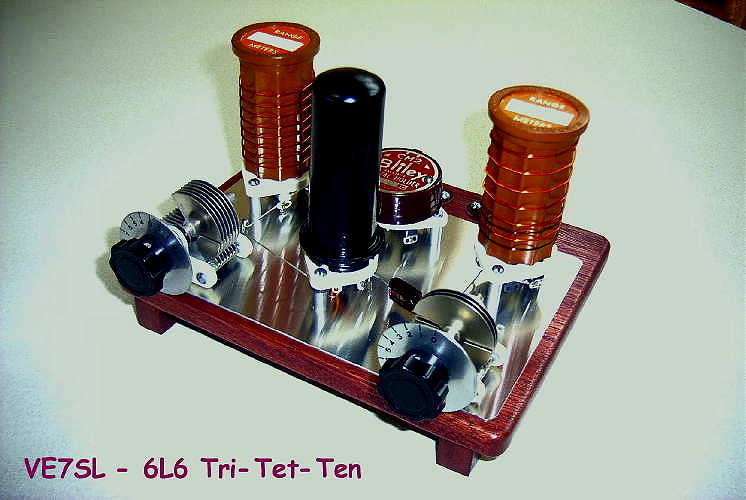
I decided to set up my homebrew 'Tri-Tet-Ten', 6L6 crystal oscillator, and give the contest a short try. Being unable to conveniently move around the band meant that I would be reliant on stations answering my CQs ... not something that normally happens with the little transmitter in typical contest QRM ... but the magical 'VE' factor would change all of that, I hoped.
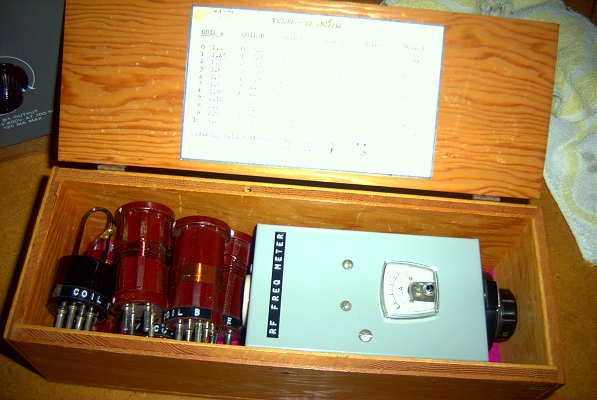
I plugged-in the 15/20m plate coil and got out my old homebrew RF-sniffer / wavemeter. It was the first piece of gear that I built, as a new 15 year-old ham, and the poor man's spectrum analyzer has been in constant use ever since. Using the 40m crystal's third harmonic, I have found the wavemeter is the easiest way to avoid mistuning and quickly found myself with just over 5 watts of RF ready to go. A tune-up for 20m later, found the second harmonic producing about 10 watts of pile-up generating madness.
Nowadays, the rules have changed a bit, and 'VE-to-VE' contacts are worth more than 'VE-to-W' QSO's but for 'W's, the goal is still to work as many 'VE's as possible ... and call they did.
Over the period of a few hours, the Tri-tet did not disappoint, generating 206 callers, including PY, PJ and HP ... frequently generating pileups 4 and 5 deep. I didn't try 10m as by the time I got started, it was falling off and the 6L6's 4 1/2 watts of fourth harmonic output on 10m requires really good conditions to be heard very well.
Due to conflicts with other activities, this was the first RAC VE-W Party that I have operated in many years ... it's nice to see that apparently not much has changed since 1932!













